Counterbalancing Can newborns recognize sounds they heard in the - - PowerPoint PPT Presentation

counterbalancing
SMART_READER_LITE
LIVE PREVIEW

Counterbalancing Can newborns recognize sounds they heard in the - - PowerPoint PPT Presentation

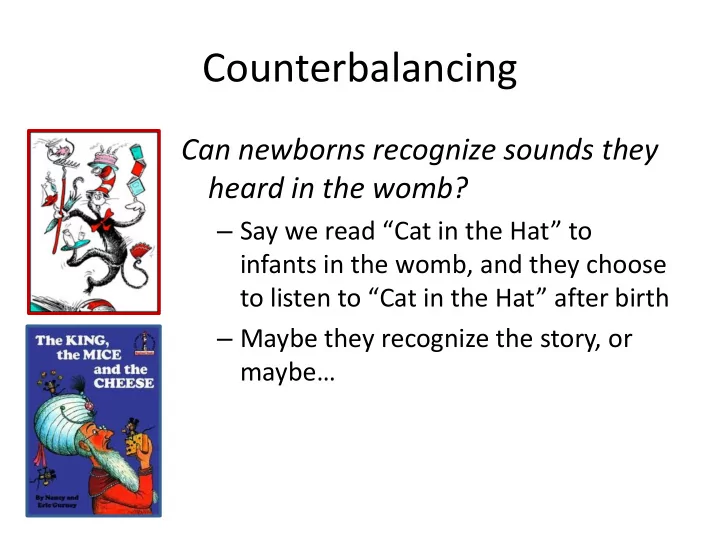
Counterbalancing Can newborns recognize sounds they heard in the womb? Say we read Cat in the Hat to infants in the womb, and they choose to listen to Cat in the Hat after birth Maybe they recognize the story, or maybe


slide-1
SLIDE 1

Counterbalancing

Can newborns recognize sounds they heard in the womb?

– Say we read “Cat in the Hat” to infants in the womb, and they choose to listen to “Cat in the Hat” after birth – Maybe they recognize the story, or maybe…

slide-2
SLIDE 2

Counterbalancing

Can newborns recognize sounds they heard in the womb? One solution: a baseline measure. No training Training

slide-3
SLIDE 3

Counterbalancing

Can newborns recognize sounds they heard in the womb? Counterbalancing

slide-4
SLIDE 4

Counterbalancing

Can newborns recognize sounds they heard in the womb? Counterbalancing

  • Unfam. Fam.
slide-5
SLIDE 5

Counterbalancing

  • Goal: Logically rule out dumb, low-level

effects as potential explanations for a positive result

  • “Best practices”: minimize these effects
  • Cat in the Hat vs. The Lorax or vs.

Wuthering Heights?

  • Makes it more likely you’ll be able to see

a positive result (that your experiment will “work”)

  • Baseline condition: measure these effects
slide-6
SLIDE 6

It’s a modi! It’s a dax! Dumbo is very good at naming objects Simba is not very good at naming objects

slide-7
SLIDE 7

It’s a modi! It’s a dax! Dumbo is very good at naming objects Simba is not very good at naming objects

  • Kids make use of past

reliability to decide which new name to trust

  • Kids trust elephants more

than lions

  • Kids like the word “modi”

more than “dax”, or think the object looks more like a modi, or hear “modi” better

  • Kids trust whoever named

the object first

  • Kids trust whoever’s on

their left

  • Kids trust animals with deeper voices
  • Kids trust characters named “Dumbo” more than characters named “Simba”
  • Kids trust the experimenter to summarize the correct answer first (“Dumbo

said it’s called a modi, and Simba said it’s called a dax.” … Sometimes there are a lot of uninteresting explanations.

slide-8
SLIDE 8

It’s a modi! It’s a dax! Dumbo is very good at naming objects Simba is not very good at naming objects

Sometimes there are a lot of uninteresting explanations. Fortunately, we don’t care how much each one matters. Q1: Two factors or

  • ne? (Hedging

your bets) Q2: What should we do about the

  • bject name?

“Folding factors together”

Factor A: Lion L/R Factor B: Whom to trust On the left… Elephant… Speak first Has a deep voice Summarized first Is named Dumbo

slide-9
SLIDE 9

Three separate techniques

  • Counterbalancing: Logically rule out dumb,

low-level effects as potential explanations for a positive result

  • Position
  • Specific stimuli (sounds, appearances)
  • Order of trials
  • “Best practices”: minimize these effects
  • Cat in the Hat vs. The Lorax or vs.

Wuthering Heights?

  • Makes it more likely you’ll be able to see

a positive result (that your experiment will “work”)

  • Baseline condition: measure these effects