COUNCIL OF PRESIDENTS OF MEDICAL COLLEGES 1 CPMC is the unifying - - PowerPoint PPT Presentation

council of presidents of medical colleges
SMART_READER_LITE
LIVE PREVIEW

COUNCIL OF PRESIDENTS OF MEDICAL COLLEGES 1 CPMC is the unifying - - PowerPoint PPT Presentation

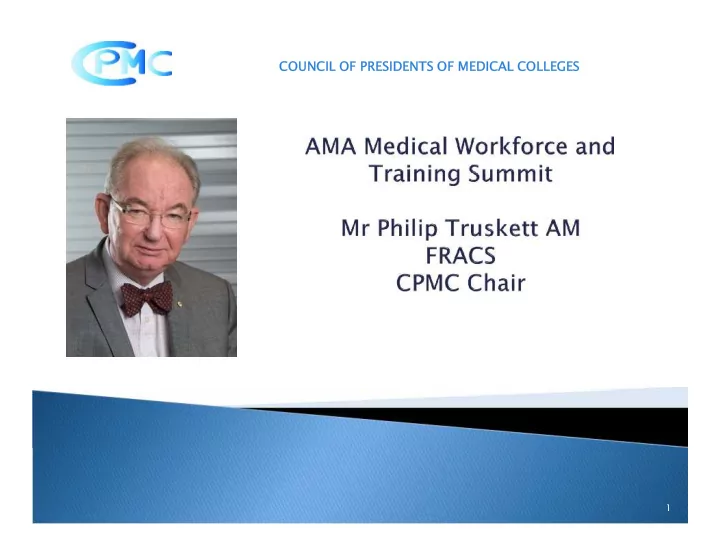
COUNCIL OF PRESIDENTS OF MEDICAL COLLEGES 1 CPMC is the unifying organisation for all fifteen specialist medical colleges, half of which are located also in NZ. Overview of current environment Recommend breaking down barriers


slide-1
SLIDE 1

1

COUNCIL OF PRESIDENTS OF MEDICAL COLLEGES

slide-2
SLIDE 2

 CPMC is the unifying organisation for all

fifteen specialist medical colleges, half of which are located also in NZ.

 Overview of current environment

 Recommend breaking down barriers

  • Discuss benefits of generalists v sub-

specialisation

  • Incentivise for better geographic

distribution

2

slide-3
SLIDE 3
  • We recognise over supply medical graduates
  • Demand for internships – is there capacity?
  • Competitive entry to vocational training
  • Large cohort of non hospital specialists wanting access
  • Complex workforce environment, problems at

every part of the pipeline

  • Recommend breaking down barriers
  • Incentivise for better geographic distribution
  • Specialty versus sub-specialty- discuss
  • Be innovative and flexible

3

slide-4
SLIDE 4

4 Source: Australia’s Future Health Workforce p9

  • Standard training pipeline if smooth access.
  • Non vocational trainees are growing – CMOs/NHS
  • Retirement age extending – no incentive to retire
  • Post Fellowship trainees remain in posts
  • Lack of consultant positions apparent
slide-5
SLIDE 5

5

Source: Dept Health with permission

slide-6
SLIDE 6

Aggregate over supply projected to 2030 We know:

  • Shortages persist in regions, in disciplines of increasing need:

geriatrics, psychiatry, urology, ENT, dermatology, palliative care

  • Changing patterns of disease, chronicity and ageing
  • Population disease profile not matched with workforce, but

evidence is available

  • Oversupply in ED, ICU, cardiology
  • Emerging in anaesthetics, obstetrics

We Need to lessen the rigidity of training process

  • Targeted WF planning to include disease profile in region.
  • New & innovative methods of training- complex

6

slide-7
SLIDE 7

0.9 1.1 1.6 2.3 2.5 3.2 5.7 7 14 22 30 43 64 10 20 30 40 50 60 70 Timor Leste Myanmar Samoa PNG Solomon Islands Vanuatu Fiji Micronesia Tonga Cook Islands Nauru New Zealand Australia

slide-8
SLIDE 8

 Rural/regional Australians lack access to

adequate medical care

 Early exposure to rural practice benefits UG, PG &

consultants

  • Radiologists /pathologists benefit from M&Ms

 Funding required for rural placements  Better utilisation of the private sector

  • Positive impact on patient outcomes

8

slide-9
SLIDE 9

9

Maldistribution

Employed medical practitioners: FTE per 100,000 population: principal area of practice, remoteness area, 2015

Source AIHW 2015

slide-10
SLIDE 10

 Develop the IRTP hubs + match with available

infrastructure & increase it, ensure adequate supervision, provide pastoral care/support

 Integrated training & networking – obstetric

diploma GP

 Rotational training to conditions have proven

to be labour intensive + costly

10

slide-11
SLIDE 11

 Are we training for the main game?

  • Generalism v sub-specialisation
  • Too much focus on sub-specialty training
  • Are we producing too many medical graduates –

diluting training experience

  • Can we be innovative?
  • Training hubs – graduates
  • Post fellowship experience
  • Incentives – infrastructure support.

11

slide-12
SLIDE 12

12

Thankyou from Australia’s College Presidents