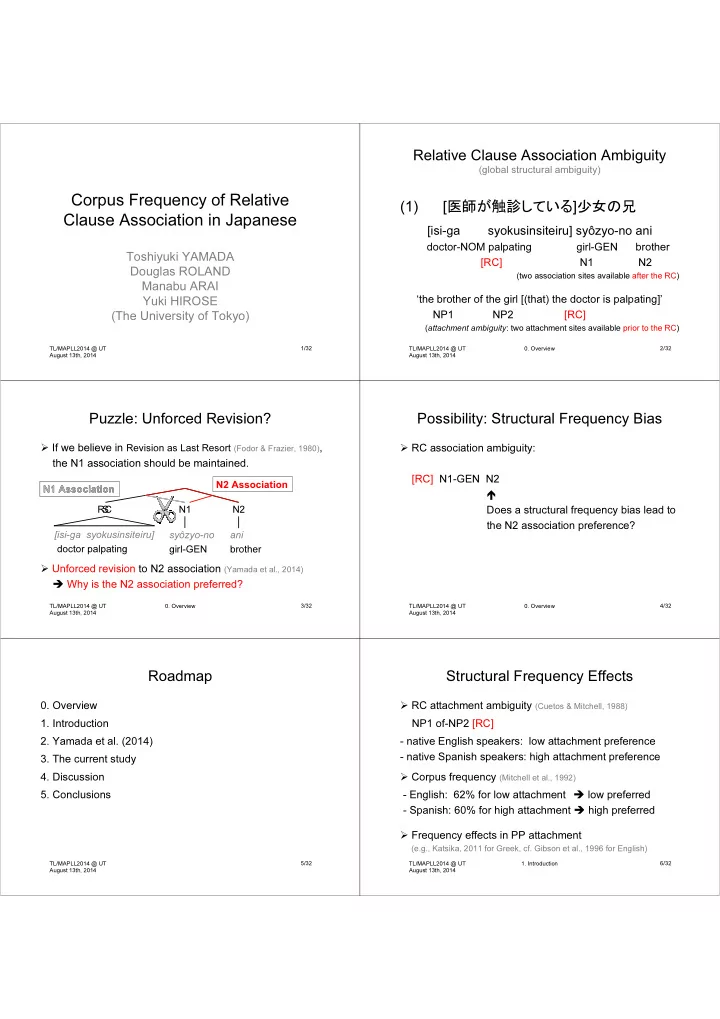

SLIDE 1
TL/MAPLL2014 @ UT August 13th, 2014 1/32
Corpus Frequency of Relative Clause Association in Japanese
Toshiyuki YAMADA Douglas ROLAND Manabu ARAI Yuki HIROSE (The University of Tokyo)
TL/MAPLL2014 @ UT August 13th, 2014
- 0. Overview
2/32
Relative Clause Association Ambiguity
(global structural ambiguity)
(1) [医師が触診している]少女の兄
[isi-ga syokusinsiteiru] syôzyo-no ani
doctor-NOM palpating girl-GEN brother [RC] N1 N2
(two association sites available after the RC)
‘the brother of the girl [(that) the doctor is palpating]’ NP1 NP2 [RC]
(attachment ambiguity: two attachment sites available prior to the RC)
TL/MAPLL2014 @ UT August 13th, 2014
- 0. Overview
3/32
Puzzle: Unforced Revision?
If we believe in Revision as Last Resort (Fodor & Frazier, 1980), the N1 association should be maintained.
[isi-ga syokusinsiteiru] doctor palpating
Unforced revision to N2 association (Yamada et al., 2014) Why is the N2 association preferred?
RC S N1 N2 syôzyo-no girl-GEN ani brother N1 Association N2 Association N1 Association
TL/MAPLL2014 @ UT August 13th, 2014
- 0. Overview
4/32
Possibility: Structural Frequency Bias
RC association ambiguity: [RC] N1-GEN N2
- Does a structural frequency bias lead to
the N2 association preference?
TL/MAPLL2014 @ UT August 13th, 2014 5/32
Roadmap
- 0. Overview
- 1. Introduction
- 2. Yamada et al. (2014)
- 3. The current study
- 4. Discussion
- 5. Conclusions
TL/MAPLL2014 @ UT August 13th, 2014
- 1. Introduction
6/32
Structural Frequency Effects
RC attachment ambiguity (Cuetos & Mitchell, 1988) NP1 of-NP2 [RC]
- native English speakers: low attachment preference
- native Spanish speakers: high attachment preference
Corpus frequency (Mitchell et al., 1992)
- English: 62% for low attachment low preferred
- Spanish: 60% for high attachment high preferred