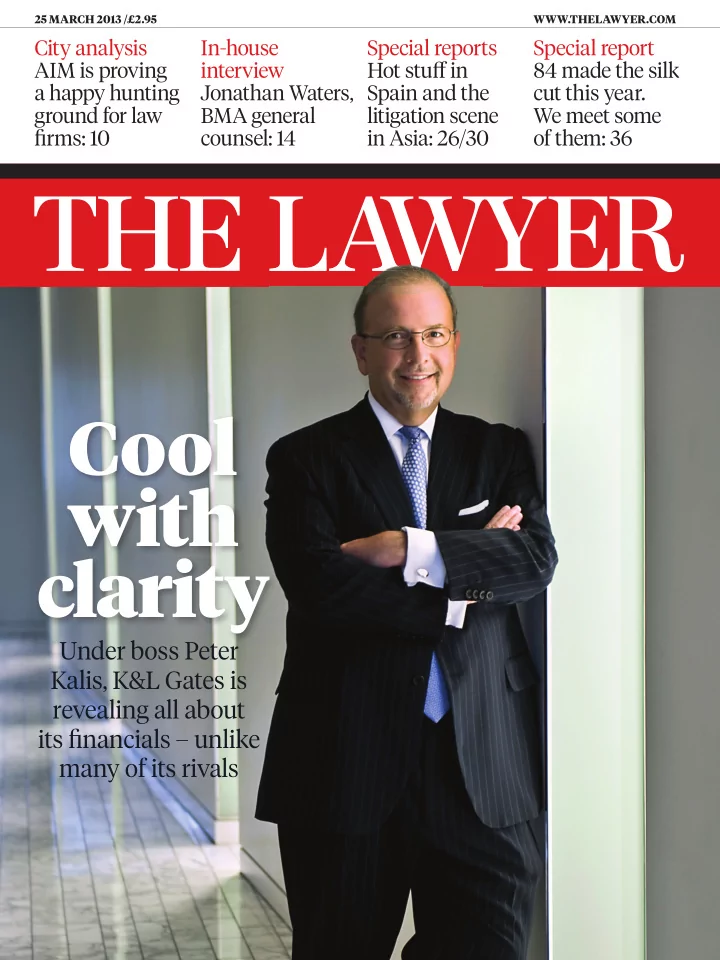
Cool with clarity Under boss Peter Kalis, K&L Gates is - - PDF document

cool with clarity
SMART_READER_LITE
LIVE PREVIEW

Cool with clarity Under boss Peter Kalis, K&L Gates is - - PDF document

25 MARCH 2013 /2.95 WWW.THELAWYER.COM City analysis In-house Special reports Special report AIM is proving interview Hot stuff in 84 made the silk a happy hunting Jonathan Waters, Spain and the cut this year. ground for law BMA


slide-1
SLIDE 1 25 MARCH 2013 /£2.95 WWW.THELAWYER.COM City analysis AIM is proving a happy hunting ground for law fi rms: 10 In-house interview Jonathan Waters, BMA general counsel: 14 Special reports Hot stuff in Spain and the litigation scene in Asia: 26/30 Special report 84 made the silk cut this year. We meet some
  • f them: 36

Cool with clarity

Under boss Peter Kalis, K&L Gates is revealing all about its fi nancials – unlike many of its rivals TL_250313 1 22/03/2013 16:23
slide-2
SLIDE 2 The Lawyer | 25 March 2013 18 Feature

All c

Clarity is K&L Gates boss Peter Kalis’s not-so- between his fi rm and others’ opaque fi nancial

Matt Byrne When K&L Gates posted its fi nan- cial results this February it laid it- self bare. For the fi rst time ever a US law fi rm had published a level of detail in its end of year fi nancial report that was similar to a UK fi rm’s LLP fi ling. K&L Gates’ move came less than a year after the collapse of Dewey & LeBoeuf, a fi rm that had overstated its fi nal year’s turnover by around 16 per cent, or some $150m (£99m). At the time of Dewey’s collapse, Peter Kalis, the chairman and glob- al managing partner of K&L Gates, was reported as commenting, “I was embarrassed to be part of the same profession and industry as Dewey & LeBoeuf”. This year Kalis and his partners decided to put as much distance as possible between their fi rm and the soiled image created by a fi rm that had been found out. Typically, the majority of US fi rms either report no fi nancial re- sults at all to magazines such as American Lawyer or, indeed, The Lawyer, or primarily release basic headline information such as total revenue, average profi t and head-
  • count. In contrast, in February K&L
Gates went the whole hog. Its 2012 fi nancial results state- ment, prepared to Securities & Ex- change Commission reporting standards, revealed all the usual data as well as its level of bank debt (zero), lines
  • f
credit ($75m), investments in IT and other over- heads ($109.6m) and partner capital ($173.7m). And that just scratches the surface – overall there was an unprecedented level of detail that immediately had the market asking ‘why?’. Bare comparison Culturally, this level of disclosure is not an easy sell. As Pannone fi nance director An- thony Clare puts it: “In any organi- sation there’s a degree of reluctance to increasing the level of transpar- ency if you don’t have to. There’s a feeling you’re giving away state secrets, even when 99 per cent of the time you’re not. The feeling is: if I don’t have to, why would I?” US law fi rm fi nancial reporting is signifi cantly less transparent than the UK’s. Over here most fi rms have TL_250313 18 22/03/2013 17:13 19 The Lawyer | 25 March 2013

clear

secret weapon in putting clear blue water l reporting

Times described it as “ground- breaking”, while industry commen- tator Bruce MacEwen of Adam- SmithEsq.com called the disclosure “genius”. Video link Kalis has long been one of the glob- al legal market’s most outspoken fi rm leaders. In February, prior to the publication of his fi rm’s results and the resulting media storm, The Lawyer met him in London for a prearranged video interview. The primary focus of the ques- tions back then, for a man who has probably negotiated more law fi rm mergers than anyone else, was K&L Gates’ continuing international ex- pansion, a trend highlighted by the fi rm’s January merger with Austral- converted to LLP status and, conse- quently, most fi le their annual fi nancial statements at Companies House within months of the year-
  • end. At that point the accounts are
pored over (and yes, to answer a fre- quently asked question, the legal press does go back and retrospec- tively check results). Any anoma- lies, if they exist, should thus be quickly uncovered. No such regime exists in the US. Bluntly, US fi rms’ fi nancial results are largely taken on trust. Legal market reporters, the primary inter- ested parties outside the fi rms, quiz current and former partners, re- cruitment and other consultants and whatever ‘informed sources’ they can fi nd to make a judgement call on the fi nancial position of fi rms that choose not to provide data. Reporters can, of course, also fall back on the results of previous years as a guide, although these will also be guesstimates. The result is a sys- tem that makes it relatively easy for fi rms to fudge their fi gures if they don’t wish to divulge them (and, of course, Dewey proves that even providing fi gures is no reliable guide to honesty). This is not to say fi rms do fudge their fi gures, simply that the condi- tions exist to allow it. K&L Gates’ decision to lay bare its books may just be the start of the end of all that. The Wall Street Jour- nal said it “could well be the most complete picture of a US fi rm’s fi n- ancial performance”, the New York TL_250313 19 22/03/2013 17:13
slide-3
SLIDE 3 The Lawyer | 25 March 2013 20 Feature ian fi rm Middletons. Kalis also dis- cussed, in his usual forthright man- ner: collaborative vs carnivorous behaviour in law fi rms; the develop- ment of his fi rm’s London offi ce from legacy Nicholson Graham & Jones to a key plank in a billion- dollar practice; and why Swiss Ver- eins are a bet – and why logic sug- gests they might be a bad bet. (See video on TheLawyer.com.) Just days later, however, K&L Gates published its results, shaking up the US legal market in the pro- cess. The Lawyer immediately called Kalis to ask if he had had a specifi c reason for going on the front foot. “I was born with two front feet,” he says. “More fundamentally, cur- rent surveys of US law fi rms present incomplete, misleading and at times false information. In the UK surveys can at least be read in tan- dem with LLP fi
  • lings. We don’t have
that luxury in the US. “For years, I’ve privately encour- Kalis is genuinely
  • utraged by what
happened at Dewey and some
  • f the practices
he believes go on at other fi rms in the US A snapshot of how K&L Gates announced its 2012 fi nancial results Pittsburgh – K&L Gates LLP today reported results for the year ended 31 December 2012 as refl ected in the following table comparing 2012 and 2011 performance data. The results are stated
  • n the modifi
ed cash basis of accounting used for US federal income tax purposes 2012 2011 Operating Results Revenues 1,060,294 1,061,658 Net income available for: Fully participating equity partners 227,330 235,146 All equity partners 320,498 329,345 Net income as a % of revenues: Fully participating equity partners 21.4% 30.2% All equity partners 22.1% 31.0% Statistics Revenue per lawyer 616,486 593,536* Net income per partner: Fully participating equity partners 899,960 636,920 All equity partners 890,367 626,608 Compensation compression ratio** 7.9:1 5.8:1 *Restated to reflect the recategorisation in 2012 of certain government afg airs professionals from other legal professionals to lawyers; 2011 headcount has been reclassified to conform to the 2012 presentation **Ratio of the compensation of the highest paid equity partner to the average of first-year equity partners’ compensation Years ended 31 December (US$ in thousands except per lawyer and per partner amounts) At 31 December (US$ in thousands) 2012 2011 Cash and cash equivalents 220,722 260,765 Investments in leasehold 109,629 102,580 Improvements, information technology, furnishings and offi ce equipment (net of accumulated depreciation) Bank debt – year end
  • 0-
  • 0-
Low for year
  • 0-
  • 0-
High for year
  • 0-
  • 0-
Partner capital: Required 173,784 169,460 Discretionary balances subject to withdrawal 187,883 200,539 Annual retirement obligation Expense as a % of revenues*** 0.3% 0.3% ***Reflects payments under frozen legacy retirement programmes For the full report go to: http://www.klgates.com/files/upload/2012_Firm_Financials.htm The Question: Why do you not report your year-end fi nancial results? Arnold & Porter No response Cleary A fi rm spokesperson says: “Cleary Gottlieb is a private limited liability partnership and has no obligation to disclose fi nancial data outside the
  • partnership. All fi
nancial data is available to all partners.” Cravath No response Davis Polk No response Jones Day No response Kirkland & Ellis No response Milbank No response Skadden No response Sullivan & Cromwell No response Wachtell No response aged the leading surveyor of the US legal market to change its ways and have had no impact whatsoever. Fair enough – it’s their magazine. But at the same time, it’s my part- ners’ law fi
  • rm. We’re not a leaf on a
  • stream. We’ll control our own fate.”
Alpha mail It’s worth recounting here verbatim what Kalis said in an internal email to his partners and associates about these surveys when the fi rm was announcing the increased fi nancial disclosure (and it is equally only fair to point out that, by implica- tion, The Lawyer does not escape criticism): “The massive overstatement of revenues and other metrics by Dew- ey & LeBoeuf remained undetected and unchecked over multiple years by publications in the US and the
  • UK. In a world capable of producing
Bernie Madoff , this may seem insig- nifi
  • cant. But there has been no indi-
cation that major publications are taking steps to detect any other mis-statements or to prevent future distortions of their rankings. “Published fi nances of US law fi rms are based on data secretly supplied by law fi rms or other sources with little or no public ac-
  • countability. We don’t know which
law fi rms co-operated by dutifully TL_250313 20 22/03/2013 17:13
slide-4
SLIDE 4 The Lawyer | 25 March 2013 22 Feature Questions of transparency fi lling out surveys, which ones did not co-operate but whose results are nonetheless presented as equal- ly authoritative, or what the meth-
  • ds and sources are for determining
fi nancial results when fi rms do not co-operate. “The various rankings of law fi rms based on gross revenues might now be referred to as the ‘Faux Firm 100’ because of the in- clusion of mere referral societies in which separate law fi rms share common brands. As recently as two weeks ago, the chairman of one such agglomeration described his group as composed of ‘member fi rms’. Precisely. Yet, while those re- ferral societies don’t regard them- selves as one fi rm, industry publica- tions do. Just because it’s easy doesn’t make it right. “Publications make no eff
  • rt to
adjust metrics to account for diff er- ent business models of diff erent law fi rms and seek instead to exploit these apples-to-oranges compari- sons in order to create storylines for their magazines. Metrics expressed as averages, for example, have been rendered increasingly irrelevant in an era of radically diff erent law fi rm business models and geographic footprints as well as equally diver- gent approaches to sharing equity
  • wnership.
“Yet such problematic metrics re- main central to the magazines’ ap- proach to fi nancial coverage of the legal industry and thus drive unfor- tunate and destructive behaviours within law fi rms. “In their surveys, publications consistently ignore fi nancial as- it per equity partner (PEP) of $899,960, is it anywhere near the most profi table of US fi rms, so this was not a chequebook-waving re- cruitment play either. The fi rm is a defi nitively mid-market player, al- beit one that has grown in the past decade into a billion-dollar-plus global fi rm with one of the most ex- tensive networks on the planet. So why do it? Was the move driv- en by internal or external pres- sures? Is Kalis purely altruistic in seeing the value of sharing this in- formation? Or did he simply want his fi rm to be the fi rst? Clearly, if transparency is of value to everyone in the market, what better way of making headlines and capital than to be the fi rst? Or was he just stick- ing two fi ngers up to the legal press? In Kalis’s case there was probably

Q Q Q

The Lawyer: Why did you feel the need to publish this level of detail? Kalis: Brobeck, Heller, Thelen, Howrey, Coudert, Dewey and
  • thers – the bodies are piling up.
Behind each major law fi rm implosion the lives of thousands
  • f people – clients, partners,
employees, vendors, charitable causes – are dislocated. How many of these people are we going to sacrifi ce on the altar of
  • pacity before we come to our
senses? LLP fi lings in the UK have shown that well-run, honest fi rms need not fear transparency. Transparency makes an
  • rganisation better because it
informs and empowers our clients and stakeholders, requires
  • rganisations to run themselves
responsibly in real time, and discourages fi rms from tossing the dice into an uncertain future. Law is a public profession. We
  • we duties to clients, courts and
  • ther regulatory authorities as
well as to our stakeholders and various third parties. We need, in short, to begin acting as if our public responsibilities are a public trust. How did you convince your partners to do it? Was there a vote or did the K&L Gates members’ agreement not require it? Under our partnership agreement the global management committee is empowered to make this decision. Sixty-nine partners – 13 per cent of our equity partners representing our worldwide venues and major practices – sit on our management committee and they voted unanimously in favour of our fi nancial disclosure in the form in which it was published. The matter was fully discussed within the committee for over a month – including distributions
  • f drafts of the disclosure –
culminating in the formal motion
  • f adoption at our in-person
meeting the fi rst week of February. Was the decision to publish infl uenced by the negative press last year? I’ve been around too long to allow tempests in tea kettles to dictate
  • strategy. On the other hand, we
understand that the disclosure has strategic signifi cance. Consider this – McKinsey says that we’re trending towards a $500bn global legal marketplace with 60 per cent or so in the US. In that gigantic US market, as the bodies of failed AmLaw 100 fi rms continue to pile up, we stand alone for full transparency – not
  • nly revenues and profi
ts, but also bank debt, retirement obligations, client concentration, liquidity, capitalisation and so on. We think this transparency will pects of law fi rms that could have predicted law fi rm failures – debt loads, unfunded retirement obliga- tions, undercapitalisation, illiquid- ity and the like. These indicia go right to the heart of institutional stability.” Debt heat Although it is true that K&L Gates choosing to reveal it has no debt is probably an easier decision to make than coming clean over a borrowing mountain, the fi rm has for years made a virtue – and no secret – of its no-debt approach. Equally, it did not choose to re- veal this unprecedented level of fi
  • nancial detail in a record year. In-
deed, the fi rm’s total revenue was broadly fl at last year, at $1.06bn. Nor, with an annual average prof- TL_250313 22 22/03/2013 17:13 23 The Lawyer | 25 March 2013 something of all of these elements. The collapse of Dewey last year looms large in his detailed answers however, as does Kalis’s obvious ir- ritation at the traditional method of reporting US law fi rms’ fi nancial re- sults (see box). Equally, Kalis knows as well as anyone the impact a stream of neg- ative stories about a fi rm can have. As Howard KennedyFsi’s CEO Mark Dembovsky says: “The negative im- pact bad press can have – the mo- mentum it can generate – can be serious, or fatal.” The sword of truth K&L Gates has not suff ered any- thing like the stream of partner exits of other fi rms, which subse- quently went to the wall; but was the decision to go all-out infl uenced Picture caption: ?????? Picture caption: ?????? Q

Q Q Q Q Q Q

by the negative publicity surround- ing some partner departures? It seems unlikely. Kalis is genu- inely outraged by what happened at Dewey and some of the practices that he believes go on at other fi rms in the US. Equally, although he is by some way the single person most associated with K&L Gates, this move is not really about personal
  • glory. (Kalis makes a point of fl
ag- ging up Mac Ewen’s ‘genius’ com- ment, saying: “In case you’re won- dering, the ‘genius’ is the product of a collaboration among a senior se- curities partner, our CFO and our immediate past CFO, who now serves as a senior adviser to the management committee.”) MacEwen himself is a big fan of the fi rm’s move, telling The Lawyer that it is widely recognised that nu- merous US fi rms “play around with the numbers”. “I used to think it was just with PEP, but since Dewey I’m not so sure,” MacEwen adds. “Dewey was an extreme case, unquestionably, but a lot of the spin surrounding that fi rm was that ‘everybody does it to some extent’. Call me an old- fashioned Scottish Presbyterian, but I take exception to that.” There are few cannier operators in the US than the head of K&L Gates and it is unlikely he will have
  • verlooked any of the pros and cons
  • f being the fi
rst to break ranks. On balance, however, Kalis’s gamble – if such it is – has paid off . But, as he himself says, this is a one-way street: “Annual fi nancial disclosure is now a part of our business.” productivity was generally consistent across practice disciplines year over year, with the exception of intellectual property, where productivity increased by close to 10 per cent.’ Did this year’s disclosure require you to change any accounting standards in the way you report? We changed nothing. We employ a modifi ed cash-basis accounting system, as do most US fi rms, and as the disclosure states we also conform our accounting to US federal income tax standards. We doubt that all US fi rms conform their accounting to US federal income tax standards. For example, we run everything through our P&L in the year of expenditure unless the tax standards require that such expenditures be amortised. My impression is that some
  • ther fi
rms are more liberal with the amortisation option which, of course, makes the current fi scal year look better by spreading the accounting impact of expenditures into future years. I should also note that we have
  • ur fi
nancials certifi ed each year by our outside auditor, a Big Four fi rm [PwC]. The audit cycle concludes with a certifi cation in the second quarter of the year following the year under audit. Thus the 2011 numbers in the disclosure are drawn from and are consistent with our audited 2011 be a favourable diff erentiator in both the market for talent and the market for clients. The early feedback on both fronts – clients and talent – has been
  • verwhelmingly positive. Terms
like ‘confi dence-inspiring’ come up
  • repeatedly. Perhaps this will be an
example of ‘doing well by doing good’. How did you decide what to include and exclude? There’s nothing about revenue breakdown by practice area. Is there any reason for that? We tried to be as inclusive as possible, to achieve clarity and to avoid confusion. Our seven principal practice areas are defi ned in disciplinary terms (for example, corporate and transactional) and by certain industries (for example, fi nancial services). This works well for us from a management standpoint. But how, as but one example of many, do you then count M&A work in the fi nancial services industry for year-over-year public comparison purposes? Corporate
  • r fi
nancial services? I suppose you could make arbitrary choices or you could double-count this work – once in the practice discipline and once in the industry area. But those options would be inherently misleading to the
  • public. We resolved this
conundrum by stating accurately in the disclosure: ‘Lawyer fi nancials, and the 2012 numbers are currently subject to an audit that will conclude in Q2 of 2013. What information is in there that doesn’t get covered by the legal press when it reports on law fi rm fi nancials? Start with the indicia of fi nancial stability: cash balances ($220m), partner capital ($173m), bank debt (zero), available lines of credit ($75m), unfunded retirement
  • bligations (0.3 per cent of annual
revenues), clients accounting for
  • ver 5 per cent of fi
rm revenues (none). The focus on the balance sheet is another. The year-over-year geographic analysis of our headcount and revenues is
  • another. The putative profi
t margin if we were to choose to pay income partners out of profi ts instead of expensing them (41.8 per cent) is another. The percentage of
  • ur work that is sourced in one
  • ffi
ce and performed in one or more other offi ces (27.5 per cent) is another. There’s more, but that gives you a sense of why the mainstream business press has been so positive. What do you think the decision to publish results in this much detail says about K&L Gates? I’m proud of our decision to take this step, especially in light of the extraordinarily positive responses from our stakeholders (including our partners) and our clients. What it says about K&L Gates is that those two audiences – our clients and our stakeholders – are why we’re in business and that we try never to forget that. Have you had any negative feedback from the market? No negative feedback
  • whatsoever. The client market
and the market for talent – both inside and outside the fi rm – have responded enthusiastically. The business press and the accounting profession have been
  • positive. The blogs have been
  • positive. We haven’t heard much
  • f anything from traditional US
legal publications, bankers and
  • ther managing partners. Nor did
we expect to. Have you had any feedback from peers saying they’ll be doing it next year? No, but then why would they tell me? Their fi rms are their businesses and they should run them as they see fi t, and make decisions within their own private deliberations. Is this a one-way street – will you be reporting to this level of detail every year? It’s a one-way street. Annual fi nancial disclosure is now part of
  • ur business.
TL_250313 23 22/03/2013 17:13