Control flow Conditionals and Control Flow l A conditional - - PowerPoint PPT Presentation

control flow conditionals and control flow
SMART_READER_LITE
LIVE PREVIEW

Control flow Conditionals and Control Flow l A conditional - - PowerPoint PPT Presentation

10/2/15 Control flow Conditionals and Control Flow l A conditional branch is sufficient to implement most control Condition codes flow constructs offered in higher


slide-1
SLIDE 1

10/2/15 1

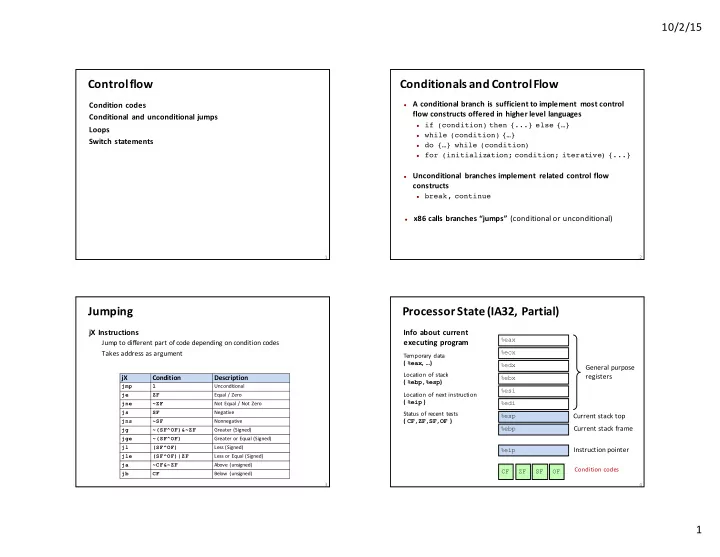
Control ¡flow

Condition ¡codes Conditional ¡ and ¡unconditional ¡jumps Loops Switch ¡statements

1

Conditionals ¡and ¡Control ¡Flow

l A ¡conditional ¡branch ¡is ¡sufficient ¡to ¡implement ¡ most ¡control ¡

flow ¡constructs ¡offered ¡in ¡higher ¡level ¡languages

l if (condition)

then {...} else {…}

l while

(condition) {…}

l do {…} while

(condition)

l for (initialization;

condition; iterative) {...}

l Unconditional ¡ branches ¡implement ¡ related ¡control ¡flow ¡

constructs

l break,

continue

l x86 ¡calls ¡branches ¡“jumps” (conditional ¡or ¡unconditional)

2

Jumping

jX Instructions

Jump ¡to ¡different ¡part ¡of ¡code ¡depending ¡on ¡condition ¡codes Takes ¡address ¡as ¡argument

3

jX Condition Description

jmp 1 Unconditional je ZF Equal ¡/ ¡Zero jne ~ZF Not ¡Equal ¡/ ¡Not ¡Zero js SF Negative jns ~SF Nonnegative jg ~(SF^OF)&~ZF Greater ¡(Signed) jge ~(SF^OF) Greater ¡or ¡Equal ¡(Signed) jl (SF^OF) Less ¡(Signed) jle (SF^OF)|ZF Less ¡or ¡Equal ¡(Signed) ja ~CF&~ZF Above ¡(unsigned) jb CF Below ¡ (unsigned)

Processor ¡State ¡(IA32, ¡Partial)

Info ¡about ¡current ¡ executing ¡program

Temporary ¡ data ( ¡%eax, ¡…) Location ¡of ¡stack ( ¡%ebp,%esp) Location ¡of ¡next ¡instruction ( ¡%eip ) Status ¡of ¡recent ¡ tests ( ¡CF,ZF,SF,OF )

4

%eip

General ¡purpose registers Current ¡stack ¡top Current ¡stack ¡frame Instruction ¡pointer

CF ZF SF OF Condition ¡codes %eax %ecx %edx %ebx %esi %edi %esp %ebp

slide-2
SLIDE 2

10/2/15 2

Condition ¡Codes (flags)

Single-­‑bit ¡ registers

CF Carry ¡Flag ¡(for ¡unsigned) SF Sign ¡Flag ¡(for ¡signed) ZF Zero ¡Flag OF Overflow ¡Flag ¡(for ¡signed)

Arithmetic ¡ instructions ¡set ¡flags ¡implicitly

Example: addl/addq Src,Dest ↔ t = a+b CF ¡set if ¡carry ¡out ¡from ¡most ¡significant ¡bit ¡(unsigned ¡overflow) ZF ¡set ¡if ¡t == 0 SF ¡set ¡if ¡t < 0 (as ¡signed) OF ¡set ¡if ¡two’s ¡complement ¡(signed) ¡overflow sign(a) == sign(b) && sign(b) != sign(t) LEA ¡does ¡not ¡set ¡flags. Full ¡documentation (IA32): ¡http://www.jegerlehner.ch/intel/IntelCodeTable.pdf

5

cmp: compare ¡values ¡with ¡subtraction

Single-­‑bit ¡ registers

CF Carry ¡Flag ¡(for ¡unsigned) SF Sign ¡Flag ¡(for ¡signed) ZF Zero ¡Flag OF Overflow ¡Flag ¡(for ¡signed)

Compare ¡instructions ¡set ¡flags

cmpl/cmpq Src2,Src1 cmpl b,a computes a-b, discards ¡result CF ¡set ¡if ¡carry ¡out ¡from ¡most ¡significant ¡bit ¡(used ¡for ¡unsigned ¡comparisons) ZF ¡set ¡if ¡a == b SF ¡set ¡if ¡(a-b) < 0 (as ¡signed) OF ¡set ¡if ¡two’s ¡complement ¡(signed) ¡overflow sign(a) == sign(b) && sign(b) != sign(t)

6

test: compare ¡values ¡with ¡&

Single-­‑bit ¡ registers

CF Carry ¡Flag ¡(for ¡unsigned) SF Sign ¡Flag ¡(for ¡signed) ZF Zero ¡Flag OF Overflow ¡Flag ¡(for ¡signed)

Test ¡instructions ¡set ¡flags

testl/testq Src2,Src1 testl b,a computes a & b, ¡discards ¡result ¡ Sets ¡condition ¡codes ¡based ¡on ¡value ¡of ¡Src1 & Src2 Useful ¡to ¡have ¡one ¡of ¡the ¡operands ¡be ¡a ¡mask ZF ¡set if ¡a&b == SF ¡set if ¡a&b < testl %eax, %eax Sets ¡SF ¡and ¡ZF, ¡check ¡if ¡%eax is ¡+,0,-­‑

7

Inspecting ¡Condition ¡Codes

SetX Instructions

Set a ¡single ¡byte ¡to ¡0 ¡or ¡1 ¡based ¡on ¡combinations ¡of ¡condition ¡codes

8

SetX Condition Description sete ZF Equal ¡/ ¡Zero setne ~ZF Not ¡Equal ¡/ ¡Not ¡Zero sets SF Negative setns ~SF Nonnegative setg ~(SF^OF)&~ZF Greater ¡ (Signed) setge ~(SF^OF) Greater ¡ or ¡Equal ¡(Signed) setl (SF^OF) Less ¡(Signed) setle (SF^OF)|ZF Less ¡or ¡Equal ¡(Signed) seta ~CF&~ZF Above ¡(unsigned) setb CF Below ¡(unsigned)

slide-3
SLIDE 3

10/2/15 3

Inspecting ¡Condition ¡Codes

SetX Instructions: ¡

Set ¡single ¡byte ¡to ¡0 ¡or ¡1 ¡based ¡on ¡combination ¡of ¡ condition ¡codes

One ¡of ¡8 ¡addressable ¡byte ¡registers

Does ¡not ¡alter ¡remaining ¡3 ¡bytes Typically ¡use ¡movzbl to ¡finish ¡job

zero-­‑extend ¡ from ¡byte ¡(8 ¡bits) ¡to ¡longword (32 ¡bits)

9

int gt (int x, int y) { return x > y; } movl 12(%ebp),%eax # eax = y cmpl %eax,8(%ebp) # compare: x - y setg %al # al = x > y movzbl %al,%eax # zero rest of %eax %eax %ecx %edx %ebx %esi %edi %esp %ebp %al %ah %cl %ch %dl %dh %bl %bh Body: ¡y ¡at ¡12(%ebp), ¡x ¡at ¡8(%ebp)

Jump!

jX Instructions

Jump ¡to ¡different ¡part ¡of ¡code ¡depending ¡on ¡condition ¡codes Takes ¡address ¡as ¡argument

10

jX Condition Description

jmp 1 Unconditional je ZF Equal ¡/ ¡Zero jne ~ZF Not ¡Equal ¡/ ¡Not ¡Zero js SF Negative jns ~SF Nonnegative jg ~(SF^OF)&~ZF Greater ¡(Signed) jge ~(SF^OF) Greater ¡or ¡Equal ¡(Signed) jl (SF^OF) Less ¡(Signed) jle (SF^OF)|ZF Less ¡or ¡Equal ¡(Signed) ja ~CF&~ZF Above ¡(unsigned) jb CF Below ¡ (unsigned)

Conditional ¡Branch ¡Example

11

int absdiff(int x, int y) { int result; if (x > y) { result = x-y; } else { result = y-x; } return result; } absdiff: pushl %ebp movl %esp, %ebp movl 8(%ebp), %edx movl 12(%ebp), %eax cmpl %eax, %edx jle .L7 subl %eax, %edx movl %edx, %eax .L8: leave ret .L7: subl %edx, %eax jmp .L8 Body1 Setup Finish Body2

Conditional ¡Branch ¡Example

12

int goto_ad(int x, int y) { int result; if (x <= y) goto Else; result = x-y; Exit: return result; Else: result = y-x; goto Exit; }

¢

C ¡allows ¡“goto” ¡as ¡means ¡of ¡ transferring ¡ control

§ Closer ¡to ¡machine-­‑level ¡

programming ¡style

¢

Bad ¡style int absdiff(int x, int y) { int result; if (x > y) { result = x-y; } else { result = y-x; } return result; }

slide-4
SLIDE 4

10/2/15 4

13 http://xkcd.com/292/

Conditional ¡Branch ¡Example

14

int goto_ad(int x, int y) { int result; if (x <= y) goto Else; result = x-y; Exit: return result; Else: result = y-x; goto Exit; } absdiff: pushl %ebp movl %esp, %ebp movl 8(%ebp), %edx movl 12(%ebp), %eax cmpl %eax, %edx jle .L7 subl %eax, %edx movl %edx, %eax .L8: leave ret .L7: subl %edx, %eax jmp .L8 int x %edx int y %eax

C ¡Code

val = Test ? Then-­‑Expr : Else-­‑Expr;

Goto Version

nt = !T est; if (nt) goto Else; val = Then-­‑Expr; Done: . . . Else: val = Else-­‑Expr; goto Done;

General ¡Conditional ¡Expression ¡Translation

19

Test is ¡expression ¡returning ¡integer

= ¡0 ¡interpreted ¡ as ¡false ≠ 0 ¡interpreted ¡as ¡true

Create ¡separate ¡code ¡regions ¡for ¡then ¡an d ¡ else expressions Execute ¡appropriate ¡one

result = x>y ? x-y : y-x;

if (Test) val = Then-­‑Expr; else val = Else-­‑Expr;

Typical ¡control ¡flow ¡code ¡in ¡assembly

21

cmpl %eax,%ebx je label … … … … label:

slide-5
SLIDE 5

10/2/15 5

PC ¡Relative ¡Addressing

22

l Jump ¡instruction ¡encodes ¡offset from ¡next ¡instruction ¡to ¡

destination ¡PC.

l

(Not ¡the ¡absolute ¡address ¡of ¡the ¡destination.)

l

PC ¡relative ¡branches ¡are ¡relocatable

l

Absolute ¡branches ¡are ¡not ¡(or ¡they ¡take ¡a ¡lot ¡work ¡to ¡relocate)

0x100 cmp r2, r3 0x1000 0x102 je 0x70 0x1002 0x104 … 0x1004 … … … 0x174 add r3, r4 0x1074

Compiling ¡Loops

How ¡to ¡compile ¡other ¡loops ¡should ¡be ¡straightforward

The ¡only ¡slightly ¡tricky ¡part ¡is ¡to ¡be ¡sure ¡where ¡the ¡conditional ¡branch ¡

  • ccurs: ¡top ¡or ¡bottom ¡of ¡the ¡loop

23

while ( sum != 0 ) { <loop body> } loopTop: cmpl $0, %eax je loopDone <loop body code> jmp loopTop loopDone:

Machine ¡code: C/Java ¡code:

C ¡Code int fact_do(int x) { int result = 1; do { result *= x; x = x-1; } while (x > 1); return result; } Goto Version int fact_goto(int x) { int result = 1; loop: result *= x; x = x-1; if (x > 1) goto loop; return result; }

“Do-­‑While” ¡Loop ¡Example

24

Use ¡backward ¡ branch ¡to ¡continue ¡looping Only ¡take ¡branch ¡when ¡“while” ¡condition ¡holds Goto Version

int fact_goto(int x) { int result = 1; loop: result *= x; x = x-1; if (x > 1) goto loop; return result; }

“Do-­‑While” ¡Loop ¡Compilation

25

Register Variable %edx x %eax result fact_goto: pushl %ebp # Setup movl %esp,%ebp # Setup movl $1,%eax # eax = 1 movl 8(%ebp),%edx # edx = x .L11: imull %edx,%eax # result *= x decl %edx # x-- cmpl $1,%edx # Compare x : 1 jg .L11 # if > goto loop movl %ebp,%esp # Finish popl %ebp # Finish ret # Finish

Assembly

Translation? Why ¡put ¡the ¡loop ¡condition ¡at ¡the ¡end?

slide-6
SLIDE 6

10/2/15 6

C ¡Code

do Body while (T est);

Goto Version

loop: Body if (T est) goto loop

General ¡“Do-­‑While” ¡Translation

Body: Test returns ¡integer = ¡0 ¡interpreted ¡as ¡false ≠ 0 ¡interpreted ¡as ¡true { Statement1; Statement2; … Statementn; }

26

C ¡Code

int fact_while(int x) { int result = 1; while (x > 1) { result *= x; x = x-1; } return result; }

Goto Version

int fact_while_goto(int x) { int result = 1; goto middle; loop: result *= x; x = x-1; middle: if (x > 1) goto loop; return result; }

“While” ¡Loop ¡Translation

Used ¡by ¡GCC ¡for ¡both ¡IA32 ¡and ¡x86-­‑64 Test ¡at ¡end, ¡first ¡iteration ¡jumps ¡over ¡body ¡to ¡test.

27

int fact_while(int x) { int result = 1; while (x > 1) { result *= x; x--; }; return result; } # x in %edx, result in %eax jmp .L34 # goto Middle .L35: # Loop: imull %edx, %eax # result *= x decl %edx # x-- .L34: # Middle: cmpl $1, %edx # x:1 jg .L35 # if >, goto # Loop

“While” ¡Loop ¡Example

28

“For” ¡Loop ¡Example: ¡Square-­‑and-­‑Multiply

Algorithm

Exploit ¡bit ¡representation: ¡p = p0 + 2p1 + 22p2 + … 2n–1pn–1 Gives: ¡xp = z0 · z1 2 · (z2 2) 2 · … · (…((zn–12) 2 )…)2 zi = 1 when ¡pi = 0 zi = x when ¡pi = 1 Complexity ¡O(log p) = O(sizeof(p))

/* Compute x raised to nonnegative power p */ int ipwr_for(int x, unsigned int p) { int result; for (result = 1; p != 0; p = p>>1) { if (p & 0x1) { result *= x; } x = x*x; } return result; } n–1 ¡ ¡times Example 310 = 32 * ¡38 = ¡32 * ¡((32)2)2

29

xm * ¡xn = ¡xm+n ... ¡ ¡ ¡ ¡0 1 ¡ ¡ ¡ ¡ ¡1 1 = ¡13 12^31 * ¡... ¡* ¡116 * ¡x8 * x4 * ¡12 * ¡x1 = ¡x13 1 ¡= ¡x0 x ¡= ¡x1 [optional]

slide-7
SLIDE 7

10/2/15 7

ipwr Computation

/* Compute x raised to nonnegative power p */ int ipwr_for(int x, unsigned int p) { int result; for (result = 1; p != 0; p = p>>1) { if (p & 0x1) { result *= x; } x = x*x; } return result; }

before ¡iteratio n result x=3 p=10

1 1 3 10=10102 2 1 9 5= 1012 3 9 81 2= 102 4 9 6561 1= 12 5 59049 43046721 02

30

[optional]

“For” ¡Loop ¡Example

for (Initialize; T est; Update) Body int result; for (result = 1; p != 0; p = p>>1) { if (p & 0x1) { result *= x; } x = x*x; } General ¡ Form Init result = 1 T est p != 0 Update p = p >> 1 Body { if (p & 0x1) { result *= x; } x = x*x; }

31

“For”→ “While”

for (Initialize; T est; Update ) Body Initialize; while (T est ) { Body Update ; } Initialize; goto middle; loop: Body Update ; middle: if (T est) goto loop; done: While ¡Version For ¡Version Goto Version

32

For-­‑Loop: ¡Compilation

for (result = 1; p != 0; p = p>>1) { if (p & 0x1) { result *= x; } x = x*x; } result = 1; goto middle; loop: if (p & 0x1) result *= x; x = x*x; p = p >> 1; middle: if (p != 0) goto loop; done: 33

for (Initialize; T est; Update ) Body For ¡Version Initialize; goto middle; loop: Body Update ; middle: if (T est) goto loop; done: Goto Version

slide-8
SLIDE 8

10/2/15 8

Switch ¡Statements

Multiple ¡case ¡labels

Here: ¡5, ¡6

Fall ¡ through ¡cases

Here: ¡2

Missing ¡cases

Here: ¡4

Lots ¡to ¡manage, we ¡need ¡a ¡jump ¡table

long switch_eg (unsigned long x, long y, long z) { long w = 1; switch(x) { case 1: w = y*z; break; case 2: w = y/z; /* Fall Through */ case 3: w += z; break; case 5: case 6: w -= z; break; default: w = 2; } return w; }

34

Jump ¡Table ¡Structure

Code ¡Block Targ0: Code ¡Block 1 Targ1: Code ¡Block 2 Targ2: Code ¡Block n–1 Targn-1:

  • Targ0

Targ1 Targ2 Targn-1

  • JTab:

target = JTab[x]; goto target; switch(x) { case val_0: Block 0 case val_1: Block 1

  • • •

case val_n-1: Block n–1 } Switch ¡Form Approximate ¡Translation Jump ¡T able Jump ¡T argets

35

Jump ¡Table ¡Structure

switch(x) { case 1: <some code> break; case 2: <some code> case 3: <some code> break; case 5: case 6: <some code> break; default: <some code> }

36

6 5 4 3 2

Jump T able Code Blocks Memory We ¡can ¡use ¡the ¡jump ¡table ¡when ¡x <= ¡6: if (x <= 6) target = JTab[x]; goto target; else goto default; C ¡code:

1

Jump ¡Table ¡(IA32)

.section .rodata .align 4 .L62: .long .L61 # x = 0 .long .L56 # x = 1 .long .L57 # x = 2 .long .L58 # x = 3 .long .L61 # x = 4 .long .L60 # x = 5 .long .L60 # x = 6 Jump ¡table switch(x) { case 1: // .L56 w = y*z; break; case 2: // .L57 w = y/z; /* Fall Through */ case 3: // .L58 w += z; break; case 5: case 6: // .L60 w -= z; break; default: // .L61 w = 2; }

37

“long” ¡as ¡in ¡movl: ¡4 ¡bytes declaring ¡data, ¡not ¡instructions 4-­‑byte ¡memory ¡alignment

slide-9
SLIDE 9

10/2/15 9

Switch ¡Statement ¡Example ¡(IA32)

Setup: switch_eg: pushl %ebp # Setup movl %esp, %ebp # Setup pushl %ebx # Setup movl $1, %ebx # w = 1 movl 8(%ebp), %edx # edx = x movl 16(%ebp), %ecx # ecx = z cmpl $6, %edx # x:6 ja .L61 # if > goto default jmp *.L62(,%edx,4) # goto JTab[x] long switch_eg(unsigned long x, long y, long z) { long w = 1; switch(x) { . . . } return w; } Translation?

38

Jump ¡table

.sect ion .rod ata .a lign 4 .L62: .long . L61 # x = 0 .long . L56 # x = 1 .long . L57 # x = 2 .long . L58 # x = 3 .long . L61 # x = 4 .long . L60 # x = 5 .long . L60 # x = 6

Switch ¡Statement ¡Example ¡(IA32)

Setup: switch_eg: pushl %ebp # Setup movl %esp, %ebp # Setup pushl %ebx # Setup movl $1, %ebx # w = 1 movl 8(%ebp), %edx # edx = x movl 16(%ebp), %ecx # ecx = z cmpl $6, %edx # x:6 ja .L61 # if > 6 goto default jmp *.L62(,%edx,4) # goto JTab[x] Indirect ¡ jump Jump ¡table

.sect ion .rod ata .a lign 4 .L62: .long . L61 # x = 0 .long . L56 # x = 1 .long . L57 # x = 2 .long . L58 # x = 3 .long . L61 # x = 4 .long . L60 # x = 5 .long . L60 # x = 6

39

long switch_eg(unsigned long x, long y, long z) { long w = 1; switch(x) { . . . } return w; }

jump ¡above (like ¡jg, ¡but unsigned)

Assembly ¡Setup ¡Explanation ¡(IA32)

Table ¡Structure

Each ¡target ¡requires ¡4 ¡bytes Base ¡address ¡at ¡.L62

Jump ¡target ¡address ¡modes

Direct: jmp .L61 Jump ¡target ¡is ¡denoted ¡by ¡label ¡.L61 Indirect: jmp *.L62(,%edx,4) Start ¡of ¡jump ¡table: ¡.L62 Must ¡scale ¡by ¡factor ¡of ¡4 ¡(labels ¡are ¡32-­‑bits ¡= ¡4 ¡bytes ¡on ¡IA32) Fetch ¡target ¡from ¡effective ¡address ¡.L62 + edx*4 target = JTab[x]; goto target; (only ¡for ¡ ¡0 ¡≤ x ≤ 6)

.section .rodata .align 4 .L62: .long .L61 # x = 0 .long .L56 # x = 1 .long .L57 # x = 2 .long .L58 # x = 3 .long .L61 # x = 4 .long .L60 # x = 5 .long .L60 # x = 6 Jump ¡table

40

Code ¡Blocks ¡(Partial)

.L61: // Default case movl $2, %ebx # w = 2 jmp .L63 .L57: // Case 2: movl 12(%ebp), %eax # y cltd # Div prep idivl %ecx # y/z movl %eax, %ebx # w = y/z # Fall through – no jmp .L58: // Case 3: addl %ecx, %ebx # w+= z jmp .L63 ... .L63 movl %ebx, %eax # return w popl %ebx leave ret switch(x) { . . . case 2: // .L57 w = y/z; /* Fall Through */ case 3: // .L58 w += z; break; . . . default: // .L61 w = 2; } return w;

41

slide-10
SLIDE 10

10/2/15 10

Code ¡Blocks ¡(Rest)

.L60: // Cases 5&6: subl %ecx, %ebx # w –= z jmp .L63 .L56: // Case 1: movl 12(%ebp), %ebx # w = y imull %ecx, %ebx # w*= z jmp .L63 ... .L63 movl %ebx, %eax # return w popl %ebx leave ret switch(x) { case 1: // .L56 w = y*z; break; . . . case 5: case 6: // .L60 w -= z; break; . . . } return w;

42

Code ¡Blocks ¡(Partial, ¡return ¡inlined)

.L61: // Default case movl $2, %ebx # w = 2 movl %ebx, %eax # Return w popl %ebx leave ret .L57: // Case 2: movl 12(%ebp), %eax # y cltd # Div prep idivl %ecx # y/z movl %eax, %ebx # w = y/z # Fall through – no jmp .L58: // Case 3: addl %ecx, %ebx # w+= z movl %ebx, %eax # Return w popl %ebx leave ret switch(x) { . . . case 2: // .L57 w = y/z; /* Fall Through */ case 3: // .L58 w += z; break; . . . default: // .L61 w = 2; }

43

The ¡compiler ¡might ¡choose ¡to ¡pull ¡the ¡ return ¡ statement ¡in ¡to ¡each ¡relevant ¡case ¡ rather ¡ than ¡jumping ¡out ¡to ¡it.

Code ¡Blocks ¡(Rest, ¡return ¡inlined)

.L60: // Cases 5&6: subl %ecx, %ebx # w –= z movl %ebx, %eax # Return w popl %ebx leave ret .L56: // Case 1: movl 12(%ebp), %ebx # w = y imull %ecx, %ebx # w*= z movl %ebx, %eax # Return w popl %ebx leave ret switch(x) { case 1: // .L56 w = y*z; break; . . . case 5: case 6: // .L60 w -= z; break; . . . }

44

The ¡compiler ¡might ¡choose ¡to ¡pull ¡the ¡ return ¡ statement ¡in ¡to ¡each ¡relevant ¡case ¡ rather ¡ than ¡jumping ¡out ¡to ¡it.

Switch ¡machine ¡code

Setup

Label ¡.L61 will ¡mean ¡address ¡0x08048630 Label ¡.L62 will ¡mean ¡address ¡0x080488dc

08048610 <switch_eg>: . . . 08048622: 77 0c ja 8048630 08048624: ff 24 95 dc 88 04 08 jmp *0x80488dc(,%edx,4) switch_eg: . . . ja .L61 # if > goto default jmp *.L62(,%edx,4) # goto JTab[x]

Assembly ¡Code Disassembled ¡Object ¡Code

45

slide-11
SLIDE 11

10/2/15 11

Switch ¡machine ¡code

Jump ¡Table

Doesn’t ¡show ¡up ¡in ¡disassembled ¡code Can ¡inspect ¡using ¡GDB ¡if ¡we ¡know ¡its ¡address. (gdb) x/7xw 0x080488dc Examine ¡7 hexadecimal ¡format ¡“words” ¡(4 ¡bytes ¡each) Use ¡command ¡“help x” ¡to ¡get ¡format ¡documentation 0x080488dc: 0x08048630 0x08048650 0x0804863a 0x08048642 0x08048630 0x08048649 0x08048649

46

Matching ¡Disassembled ¡Targets

8048 630: b b 02 00 00 0 0 mov 8048 635: 8 9 d8 mov 8048 637: 5 b pop 8048 638: c 9 leav e 8048 639: c 3 ret 8048 63a: 8 b 45 0c mov 8048 63d: 9 9 cltd 8048 63e: f 7 f9 idiv 8048 640: 8 9 c3 mov 8048 642: 0 1 cb add 8048 644: 8 9 d8 mov 8048 646: 5 b pop 8048 647: c 9 leav e 8048 648: c 3 ret 8048 649: 2 9 cb sub 8048 64b: 8 9 d8 mov 8048 64d: 5 b pop 8048 64e: c 9 leav e 8048 64f: c 3 ret 8048 650: 8 b 5d 0c mov 8048 653: 0 f af d9 imul 8048 656: 8 9 d8 mov 8048 658: 5 b pop 8048 659: c 9 leav e 8048 65a: c 3 ret

0x08048630 0x08048650 0x0804863a 0x08048642 0x08048630 0x08048649 0x08048649

47

0x080488dc:

¢ Would ¡you ¡implement ¡ this ¡with ¡a ¡jump ¡table? ¢ Probably ¡ not:

§ Don’t ¡want ¡a jump ¡table ¡with ¡52001 ¡entries ¡for ¡only ¡4 ¡cases ¡(too ¡big) § about ¡200KB ¡= ¡200,000 ¡bytes § text ¡of ¡this ¡switch ¡statement ¡= ¡about ¡200 ¡bytes

Question

switch(x) { case 0: <some code> break; case 10: <some code> break; case 52000: <some code> break; default: <some code> break; }

48

Quick ¡Review

Processor ¡State Memory ¡addressing ¡modes

(%eax) 17(%eax) 12(%edx, %eax) 2(%ebx, %ecx, 8)

Immediate ¡ (constant), ¡Register, ¡ and ¡Memory ¡ Operands

subl %eax, %ecx # ecx = ecx + eax sall $4,%edx # edx = edx << 4 addl 16(%ebp),%ecx # ecx = ecx + Mem[16+ebp] imull %ecx,%eax # eax = eax * ecx

49

%eip

Current ¡ stack ¡top Current ¡ stack ¡frame Instruction ¡ pointer

CF ZF SF OF Condition ¡codes %eax %ecx %edx %ebx %esi %edi %esp %ebp

General ¡purpose registers

slide-12
SLIDE 12

10/2/15 12

Quick ¡Review

Control

1-­‑bit ¡condition ¡code/flag ¡registers Set ¡by ¡arithmetic ¡instructions ¡(addl, ¡shll, ¡etc.), ¡ ¡cmp, test Access ¡flags ¡with ¡setg, setle, ¡… ¡instructions ¡ Conditional ¡jumps use ¡flags ¡for ¡decisions ¡(jle .L4, je .L10, …) Unconditional ¡jumps always ¡jump: ¡jmp Direct ¡or ¡indirect ¡jumps Standard ¡Techniques

Loops ¡converted ¡to ¡do-­‑while ¡form Large ¡ switch ¡statements ¡use ¡jump ¡tables

50

CF ZF SF OF

carry sign zero

  • verflow

Quick ¡Review

Do-­‑While ¡loop While-­‑Do ¡loop

C ¡Code

do Body while (Test);

Goto Version

loop: Body if (Test) g oto loop

While ¡version

while (Test) Bod y

Do-­‑While ¡Version

if (!Test) g oto done ; do Body while(Test); done:

Goto Version

if (!Test) g oto done ; loop: Body if (Test) g oto loop ; done: goto midd le; loop: Body middl e: if (Test) g oto loop ;

  • r

51