Continuous Optimization in Buildings Partnership with BC Hydro and - - PowerPoint PPT Presentation

continuous optimization in buildings
SMART_READER_LITE
LIVE PREVIEW

Continuous Optimization in Buildings Partnership with BC Hydro and - - PowerPoint PPT Presentation

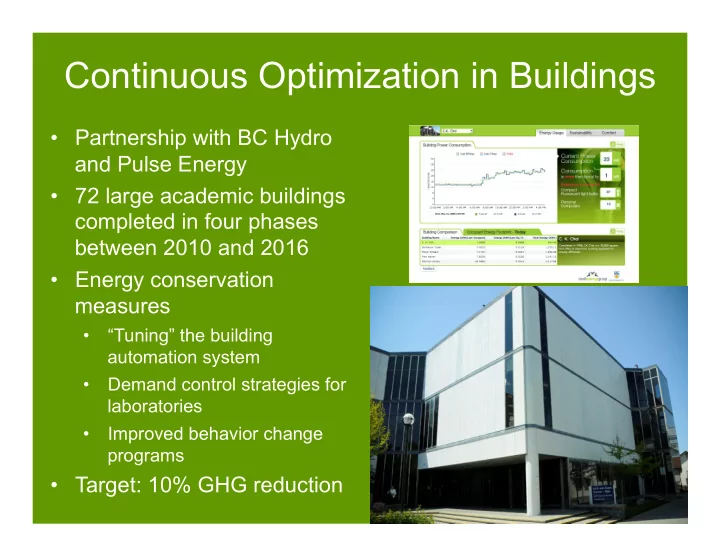
Continuous Optimization in Buildings Partnership with BC Hydro and Pulse Energy 72 large academic buildings completed in four phases between 2010 and 2016 Energy conservation measures Tuning the building automation system


slide-1
SLIDE 1
  • Partnership with BC Hydro

and Pulse Energy

  • 72 large academic buildings

completed in four phases between 2010 and 2016

  • Energy conservation

measures

  • “Tuning” the building

automation system

  • Demand control strategies for

laboratories

  • Improved behavior change

programs

  • Target: 10% GHG reduction

Continuous Optimization in Buildings

slide-2
SLIDE 2

UBC Bioenergy Research & Demonstration Facility

Four story CLT building Heating mode: 6 MW Cogen mode : 2 MW(elec) + 3 MW(heat) CO2 Reduc’n: 4,000 tpy of GHG

slide-3
SLIDE 3

Steam to Hot Water Conversion

  • One of largest Hot Water

conversion in North America - $80-90M

  • 24% Energy and 22% GHG

savings

  • Replaces aging infrastructure

with high operational and deferred maintenance costs

  • Increases fuel source flexibility
  • 14 km of pre-insulated EN 253

hot water distribution piping

  • 131 Energy transfer stations in

building mechanical rooms

slide-4
SLIDE 4

Integrated Campus Systems –Energy, Water, Waste

slide-5
SLIDE 5

Project A

Regenerative Sustainability Gradient

CIRS

Time UBC Academic and Community Projects

Steam to Hot Water Continuous Optimization Distributed Peaking Waste Heat Recovery (Sinks and Sources) Smart Energy Systems Integration (Energy Demand and Energy Use Reductions; PEDM; Renewables) BR&DP

UBC “Foundational” Projects Sustainability Rating

Space use efficiency Project B Project C Project D Project E Project F Project G

LEED Gold

slide-6
SLIDE 6

UTown@UBC

  • From ¡commuter ¡

campus ¡to ¡sustainable ¡ community ¡

  • More ¡affordable ¡

housing ¡for ¡students ¡& ¡ families ¡to ¡live ¡on ¡ campus ¡

  • Enhance ¡academic ¡

engagement, ¡campus ¡ life ¡and ¡the ¡ environment ¡

slide-7
SLIDE 7

Sustainable Community Indicators

0.0 0.5 1.0 1.5 2.0 2.5 3.0 3.5 4.0 4.5

1997 2011

Transit trips Vehicle trips Parking spaces Residents Daytime population

slide-8
SLIDE 8

Utown Build-out

2001 Population: ~10,000

  • 7,000 Students
  • 700 Faculty/ Staff Rental
  • 1,700 Family

2010 Population: ~16,500

  • 8,500 Students
  • 1,900 Faculty/ Staff Rental
  • 6,000 Family/ Co-Development (2,100 are affiliated)

2025 Population: ~30,000

  • 14,000 Students
  • 3,300 Faculty/Staff Rental
  • 12,800 Family Housing/Co-Development (4,750 are affiliated)
slide-9
SLIDE 9
  • About ¡10% ¡of ¡our ¡full-­‑

Bme ¡faculty ¡and ¡staff ¡ now ¡live ¡on ¡campus, ¡

  • ccupying ¡half ¡of ¡the ¡

2,200 ¡apartments ¡and ¡ townhouses ¡that ¡were ¡ built ¡as ¡of ¡2008 ¡ ¡ ¡

  • 50% ¡of ¡all ¡new ¡family ¡

homes ¡in ¡UTown@UBC ¡ will ¡have ¡at ¡least ¡one ¡ member ¡of ¡the ¡ household ¡who ¡works ¡or ¡ studies ¡on ¡campus ¡

Social Sustainability | Family Housing

slide-10
SLIDE 10
  • 20% ¡of ¡all ¡new ¡apartments ¡

and ¡townhouses ¡on ¡campus ¡ are ¡rental, ¡and ¡half ¡of ¡these ¡ units ¡are ¡available ¡at ¡below-­‑ market ¡rates ¡

  • About ¡20% ¡off ¡

comparable ¡rentals ¡in ¡ adjacent ¡Vancouver ¡areas ¡

  • Co-­‑development ¡opportuniBes ¡

save ¡UBC ¡faculty ¡and ¡staff ¡up ¡ to ¡20% ¡off ¡market ¡prices ¡by ¡ reducing ¡typical ¡project ¡ management ¡and ¡promoBonal ¡ costs ¡

Social Sustainability | Family Housing

slide-11
SLIDE 11

UBC Farm

Mission

To be a global leader in the creation of new patterns for sustainable and healthy communities integrated with their surrounding ecology

slide-12
SLIDE 12

2011 User Engagement and Trends:


55,000+ Site Visits

Partners

  • 8 Faculties
  • 37 UBC Departments
  • 100+ Partners
  • Projects
  • 150+ Projects


50 UBC Courses
 2,400+ UBC Students

  • $8,000%%

$10,000%% $30,000%% $30,000%% $55,000%% $65,000%% $78,000%% $85,000%% $114,000%% $125,000%% $160,000%% $0%% $20,000%% $40,000%% $60,000%% $80,000%% $100,000%% $120,000%% $140,000%% $160,000%% $180,000%% 2001% 2002% 2003% 2004% 2005% 2006% 2007% 2008% 2009% 2010% 2011%

UBC$Farm$Gross$Farm$Product$Sales$

200# 240# 350# 800# 1150# 2100# 2250# 2400# 2552# 2211# 2904# 4# 7# 14# 30# 36# 30# 41# 43# 51# 66# 82# 0# 10# 20# 30# 40# 50# 60# 70# 80# 90# 0# 500# 1000# 1500# 2000# 2500# 3000# 3500# 2001# 2002# 2003# 2004# 2005# 2006# 2007# 2008# 2009# 2010# 2011# #"of"credit"courses" #"of"students"

Student"and"Credit"Course"Involvement"at"UBC"Farm"

Students# Credit#Courses#

slide-13
SLIDE 13

Agent of Change

slide-14
SLIDE 14

The Role of the University as Agent of Change

“New forms of partnership between the private, public and NGO sectors should be a critical component of the sustainability agenda . . . identify and flesh out new, more integrated models of interaction . . . transform the institutional rules and processes that govern the universities’ relationships with the

  • utside world.”

(Stephen Toope, Submission to Secretary-General’s Global Colloquium of University Presidents, New York University, Nov 28-29, 2007)

slide-15
SLIDE 15

Strategic Alliance Partnerships

Smart energy system Utown@UBC as living lab Clean energy Energy systems, decision support Residential sustainability Energy, engagement, mobility

slide-16
SLIDE 16

Year 1 Year 2 Year 3 Year 4

Beyond the classroom Discipline- based Theme- based

SUST 101: Introduction to sustainability ideas and principals, models and contemporary

  • issues. The

course could contain a component mentored or led by a senior students.

Courses within an existing program leading to an understanding of ones discipline through a sustainability lens. Sustainability-oriented student immersive experience outside the university, locally or globally

Leadership course: Students explore & reflect

  • n attainment of

sustainability attributes during their learning pathway. Opportunity for mentoring undergraduates.

Courses ¡based ¡on ¡a ¡theme ¡such ¡as ¡“water” ¡ ¡ taken ¡inside ¡or ¡outside ¡the ¡student’s ¡program ¡of ¡

  • study. ¡Ideally ¡would ¡include ¡some ¡case ¡study ¡

analysis ¡of ¡the ¡themaBc ¡issue. ¡

1 2 3 4 1 2 3 2 3 4 2 3 4 2 1

Holistic Systems Thinking

2 3 4

Sustainability Knowledge Awareness & Integration

Acting for Positive Change

1

Sustainability Pathways