Continuous measurement of solid-state qubits Alexander Korotkov - - PowerPoint PPT Presentation

continuous measurement of solid state qubits
SMART_READER_LITE
LIVE PREVIEW

Continuous measurement of solid-state qubits Alexander Korotkov - - PowerPoint PPT Presentation

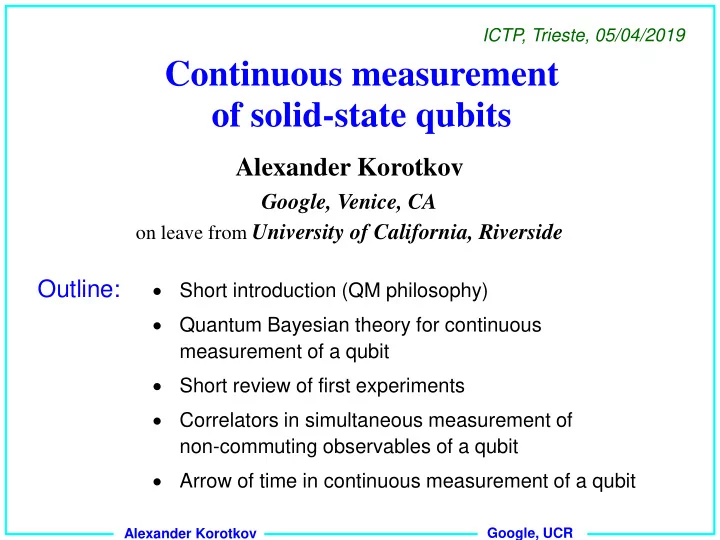
ICTP, Trieste, 05/04/2019 Continuous measurement of solid-state qubits Alexander Korotkov Google, Venice, CA on leave from University of California, Riverside Outline: Short introduction (QM philosophy) Quantum Bayesian theory for


slide-1
SLIDE 1

Google, UCR Alexander Korotkov

ICTP, Trieste, 05/04/2019

Alexander Korotkov

Google, Venice, CA

  • n leave from University of California, Riverside

Continuous measurement

  • f solid-state qubits

Outline:

 Short introduction (QM philosophy)  Quantum Bayesian theory for continuous measurement of a qubit  Short review of first experiments  Correlators in simultaneous measurement of non-commuting observables of a qubit  Arrow of time in continuous measurement of a qubit

slide-2
SLIDE 2

Google, UCR Alexander Korotkov

“Orthodox” (Copenhagen) quantum mechanics

Schrödinger equation + collapse postulate

1) Fundamentally random measurement result 𝑠

(out of allowed set of eigenvalues). Probability:

2) State after measurement corresponds to result:  Instantaneous, single quantum system (not ensemble)

 Contradicts Schröd. Eq., but comes from common sense  Needs “observer”, reality follows observer’s knowledge

Why so strange (unobjective)?

  • “Shut up and calculate”
  • May be QM founders were stupid?
  • Use proper philosophy?

|𝜔𝑠〉 𝑞𝑠 = 𝜔 𝜔𝑠

2

slide-3
SLIDE 3

Google, UCR Alexander Korotkov

Werner Heisenberg

Physics and Philosophy: The Revolution in Modern Science

Books:

Philosophical Problems of Quantum Physics The Physicist's Conception of Nature Across the Frontiers

Immanuel Kant (1724-1804), German philosopher

Critique of pure reason (materialism, but not naive materialism)

Nature - “Thing-in-itself” (noumenon, not phenomenon)

Humans use “concepts (categories) of understanding”; make sense of phenomena, but never know noumena directly

A priori: space, time, causality

A naïve philosophy should not be a roadblock for good physics, quantum mechanics requires a non-naïve philosophy

Niels Bohr

Wavefunction is not a reality, it is only our description of reality

slide-4
SLIDE 4

Google, UCR Alexander Korotkov

Causality principle in quantum mechanics

space time

a b

A B C

  • bjects a and b
  • bservers A and B (and C)

light cones

  • bservers have “free will”;

they can choose an action

A choice made by observer A can affect evolution of object b “back in time”

However, this retroactive control cannot pass “useful” information to B (no signaling)

Ensemble-averaged evolution of object b cannot depend on actions of observer A Randomness saves causality (even C cannot predict result of A measurement)

Our focus: continuous collapse

|0 |1

  

slide-5
SLIDE 5

Google, UCR Alexander Korotkov

Various approaches to non-projective (weak, continuous, partial, generalized, etc.) quantum measurements Key words: POVM, restricted path integral, quantum trajectories, quantum

filtering, quantum jumps, stochastic master equation, etc.

Names: Davies, Kraus, Holevo, Mensky, Caves, Diosi,

Carmichael, Milburn, Wiseman, Aharonov, Vaidman, Molmer, Gisin, Percival, Belavkin, … (very incomplete list)

solid-state qubit detector classical output

We consider:

What is “inside” collapse? What if collapse is stopped half-way?

Quantum Bayesian approach

slide-6
SLIDE 6

Google, UCR Alexander Korotkov

Quantum Bayesian formalism for qubit meas.

(A.K., 1998)

Qubit evolution due to measurement (informational back-action)

So simple because: 1) no entanglement at large QPC voltage 2) QPC is ideal detector 3) no other evolution of qubit (𝐼qb = 0)

1) 𝛽 𝑢

2 and 𝛾 𝑢 2 evolve as probabilities,

i.e. according to the Bayes rule (same for 𝜍𝑗𝑗)

2) phases of 𝛽 𝑢 and 𝛾 𝑢 do not change

(no dephasing!),

Τ 𝜍𝑗𝑘 𝜍𝑗𝑗𝜍𝑘𝑘 = const

V

I(t)

|𝟐〉 |𝟏〉 qubit

(double Qdot)

detector

(quantum point contact)

𝜔 𝑢 = 𝛽 𝑢 0 + 𝛾 𝑢 1

  • r 𝜍𝑗𝑘(𝑢)

Bayes rule (1763, Laplace-1812):

likelihood posterior probability prior probab.

𝑄 𝐵𝑗 res = 𝑄 𝐵𝑗 𝑄(res|𝐵𝑗) norm

𝐽0 𝐽1

measured

ҧ 𝐽m = ׬

𝑢 𝐽 𝑢′ 𝑒𝑢′

𝑢

ҧ 𝐽m 𝑄( ҧ 𝐽|0) 𝑄( ҧ 𝐽|1) 𝑄 ҧ 𝐽 = 𝜍00 0 𝑄 ҧ 𝐽 0 + 𝜍11 0 𝑄( ҧ 𝐽|1)

slide-7
SLIDE 7

Google, UCR Alexander Korotkov

Further steps in quantum Bayesian formalism

  • 1. Informational back-action (“spooky”, no mechanism), ×

likelihood I(t)

|1〉 |0〉

𝛽 𝑢 0 + 𝛾 𝑢 1

𝐽0 𝐽1

measured

ҧ 𝐽m = ׬

𝑢 𝐽 𝑢′ 𝑒𝑢′

𝑢

ҧ 𝐽m 𝑄( ҧ 𝐽|0) 𝑄( ҧ 𝐽|1) 𝜔 𝑢 = 𝑄 ҧ 𝐽m 0 𝛽 0 0 + 𝑄 ҧ 𝐽m 1 𝛾 0 1 norm

  • 2. Add unitary (phase) back-action, physical mechanisms for QPC and cQED

𝜔 𝑢 = 𝑄 ҧ 𝐽m 0 exp 𝑗𝐿 ҧ 𝐽m − 𝐽0 + 𝐽1 2 𝛽 0 0 + 𝑄 ҧ 𝐽m 1 𝛾(0) 1 norm

  • 3. Add detector non-ideality (equivalent to dephasing)

𝜍𝑗𝑗 𝑢 = 𝑄 ҧ 𝐽m 𝑗 𝜍𝑗𝑗 0 norm ,

𝜍𝑗𝑘 𝑢

𝜍01 𝑢 𝜍00 𝑢 𝜍11 𝑢 = 𝑓𝑗𝐿( ҧ

𝐽m− 𝐽0+𝐽1 2 )𝜍01 0

𝜍00 0 𝜍11 0 exp(−𝛿𝑢) 𝛿 = Γ − Δ𝐽 2 4𝑇𝐽 − 𝐿2𝑇𝐽 4

slide-8
SLIDE 8

Google, UCR Alexander Korotkov

Further steps in quantum Bayesian formalism

  • 4. Take derivative over time (if differential equation is desired)

𝑒𝑔 𝑢 𝑒𝑢 = 𝑔 𝑢 + Τ 𝑒𝑢 2 − 𝑔(𝑢 − 𝑒𝑢/2) 𝑒𝑢

Simple, but be careful about definition of derivative Stratonovich form preserves usual calculus

𝑒𝑔 𝑢 𝑒𝑢 = 𝑔 𝑢 + 𝑒𝑢 − 𝑔(𝑢) 𝑒𝑢

Ito form requires special calculus, but keeps averages

  • 5. Add Hamiltonian evolution (if any) and additional decoherence (if any)

Standard terms

Steps 1–5 form the quantum Bayesian approach to qubit measurement

(A.K., 1998—2001)

slide-9
SLIDE 9

Google, UCR Alexander Korotkov

Generalization: measurement of operator 𝑩

“Informational” quantum Bayesian evolution in differential (Ito) form:

𝐽 𝑢 = Tr 𝐵𝜍 + Τ 𝑇 2 𝜊(𝑢)

noisy detector output

𝜊 𝑢 𝜊 𝑢′ = 𝜀(𝑢 − 𝑢′)

normalized white noise

𝑇: spectral density of the output noise

ሶ 𝜍 = 𝐵𝜍𝐵 − Τ (𝐵2𝜍 + 𝜍𝐵2) 2 2𝜃𝑇 + 𝐵𝜍 + 𝜍𝐵 − 2𝜍Tr (𝐵𝜍) 2𝑇 𝜊(𝑢)

With additional unitary (Hamiltonian) back-action 𝐶 and additional evolution

ሶ 𝜍 = ℒ 𝜍 + 𝐵𝜍 + 𝜍𝐵 − 2𝜍Tr (𝐵𝜍) 2𝑇 𝜊 𝑢 − 𝑗 𝐶, 𝜍 1 2𝑇 𝜊 𝑢

ℒ[𝜍]: ensemble-averaged (Lindblad) evolution 𝜃: quantum efficiency The same as in the Quantum Trajectory theory (Wiseman, Milburn, …)

Nowadays “quantum trajectory“ often means Q.Bayesian real-time monitoring

 

 

   

 

   

 

   

𝐽1 𝐽2 𝐽𝑙 ҧ 𝐽m 𝐽3

slide-10
SLIDE 10

Google, UCR Alexander Korotkov

Quantum trajectory theory

  • H. J. Carmichael, 1993

H.-S. Goan and G. J. Milburn, 2001 H.-S. Goan, G. J. Milburn, H. M. Wiseman, and H. B. Sun, 2001

  • ptics

Essentially the same thing, but look different

  • H. M. Wiseman and G. J. Milburn, 1993

solid-state, quantum point contact

  • J. Gambetta, A. Blais, M. Boissonneault, A. A. Houck,
  • D. I. Schuster, and S. M. Girvin, 2008

circuit QED Relation between Quantum Trajectory and Quantum Bayesian formalisms Quantum trajectory theory uses mathematical language (superoperators), quantum Bayesian theory uses simple physical approach (undergraduate-level) Another meaning of “quantum trajectories“: real-time monitoring of evolution (often done by quantum Bayesian theory) Computationally, Bayesian theory is usually better (more than first-order)

slide-11
SLIDE 11

Google, UCR Alexander Korotkov

𝑄

𝑠 =

𝑁𝑠𝜔 2

Measurement (Kraus) operator

𝑁𝑠 (any linear operator in H.S.) :

Quantum measurement in POVM formalism

Completeness : Probability :

  • r
  • r

(People often prefer linear evolution and non-normalized states)

Relation between POVM and quantum Bayesian formalism polar decomposition: Bayes unitary

Davies, Kraus, Holevo, etc.

system ancilla

𝜔 → 𝑁𝑠𝜔 | 𝑁𝑠𝜔 | 𝜍 → 𝑁𝑠𝜍𝑁𝑠

Tr(𝑁𝑠

†𝑁𝑠𝜍)

σ𝑠 𝑁𝑠

†𝑁𝑠 = 1

𝑄

𝑠 = Tr(𝑁𝑠 † 𝑁𝑠𝜍)

𝑁𝑠 = 𝑉𝑠 𝑁𝑠

† 𝑁𝑠 (steps 1 and 2 above)

slide-12
SLIDE 12

Google, UCR Alexander Korotkov

𝜍11(𝜐) 𝜍00(𝜐) = 𝜍11 0 exp[− Τ ҧ 𝐽m − 𝐽1

2 2𝐸]

𝜍00 0 exp[− Τ ҧ 𝐽m − 𝐽0

2 2𝐸]

𝜍01 𝜐 = 𝜍01 0 𝜍00 𝜐 𝜍11 𝜐 𝜍00 0 𝜍11 0 exp 𝑗𝐿 ҧ 𝐽m𝜐

Quantum Bayesian theory for circuit QED setup

  • A. Blais et al., PRA 2004
  • A. Wallraff et al., Nature 2004
  • J. Gambetta et al., PRA 2008

|0 |1

Two quadratures:

1) information on qubit state  informational back-action 2) information on fluct. photon number  unitary (phase) back-action

unitary Bayes ҧ 𝐽m = 𝜐−1 ׬

𝜐 𝐽 𝑢 𝑒𝑢

𝐸 = 𝑇𝐽/2𝜐 𝐽0 − 𝐽1 = Δ𝐽 cos 𝜒 𝐿 = Τ Δ𝐽 sin 𝜒 𝑇𝐽 Γ = Δ𝐽 cos 𝜒 2 4𝑇𝐽 + 𝐿2 𝑇𝐽 4 = Δ𝐽2 4𝑇𝐽 = 8𝜓2 ത 𝑜 𝜆

𝐽0 𝐽1

𝑄( ҧ 𝐽m|0) 𝑄( ҧ 𝐽m|1) 𝑄 ҧ 𝐽m = 𝜍00 0 𝑄 ҧ 𝐽m 0 + 𝜍11 0 𝑄 ҧ 𝐽m 1

A.K., arXiv:1111.4016

Amplified phase  controls trade-off between informational and phase back-actions (we choose if photon number fluctuates or not) qubit

(transmon) resonator amplifier microwave generator mixer

  • utput (two

quadratures)

d

r

homodyne meas.

𝜆

phase-sensitive

slide-13
SLIDE 13

Google, UCR Alexander Korotkov

Causality in quantum mechanics

Ensemble-averaged evolution cannot be affected back in time (single realization can be affected)

qubit resonator paramp wave gen. mixer

d r

|0 |1

  

We can choose direction of qubit evolution to be either along parallel or along meridian

  • r in between (delayed choice)
  • Expt. confirmation: K. Murch et al., Nature 2013

A.K., arXiv:1111.4016

slide-14
SLIDE 14

Google, UCR Alexander Korotkov

Beyond the “bad-cavity” limit

|. . (𝑢 − 3Δ𝑢)〉 qubit resonator

amp wave gen. mixer

r

|𝛽0(𝑢)〉 |. . (𝑢 − Δ𝑢)〉 |. . (𝑢 − 2Δ𝑢)〉 |. . (𝑢 − 3Δ𝑢)〉

A.K., PRA 2016

|. . (𝑢 − Δ𝑢)〉 |. . (𝑢 − 2Δ𝑢)〉 |𝛽1(𝑢)〉 “history tail” measure

𝜍11 𝑢 + Δ𝑢 𝜍00 𝑢 + Δ𝑢 = 𝜍11 𝑢 𝜍00 𝑢 exp 𝐽𝑛 cos 𝜚𝑒 Τ Δ𝐽max 𝐸

Imax: max response

D: noise variance

d: angle from optimal quadrature

ො 𝜍 𝑢 = σ𝑘,𝑙=0,1 𝜍𝑘𝑙 𝑢 𝑘 𝑙 ⨂|𝛽𝑘 𝑢 〉〈𝛽𝑙(𝑢)|

𝜍10 𝑢 + Δ𝑢 𝜍10 𝑢 = 𝜍11 𝑢 + Δ𝑢 𝜍00 𝑢 + Δ𝑢 𝜍11 𝑢 𝜍00 𝑢 exp(−𝛿Δ𝑢) × exp −𝑗𝜀𝜕ac StarkΔ𝑢 exp −𝑗𝐽𝑛 sin 𝜚𝑒 Τ Δ𝐽max 2𝐸 𝛿 = Γ − Τ Δ𝐽max

2

8𝐸Δ𝑢 𝜃 = Τ (Γ − 𝛿) Γ 𝜀𝜕ac Stark = 𝜆 Im 𝛽1

∗𝛽0 + Re 𝜁∗ 𝛽1 − 𝛽0

= 2𝜓Re(𝛽1

∗𝛽0) − 𝑒 𝑒𝑢 Im(𝛽1 ∗𝛽0)

Γ = Τ 𝜆 2 𝛽1 − 𝛽0 2

The same quantum Bayesian approach, now applied to entangled qubit-resonator system (arbitrary 𝜆, classical equations for 𝛽𝑘(𝑢)) Equivalent to “polaron” approach in quantum trajectories, but undergraduate-level derivation and possibly faster computationally

slide-15
SLIDE 15

Google, UCR Alexander Korotkov

Why not just use Schrödinger equation for the whole system?

qubit detector information

Technical reason: Leaking information makes it an open system

Impossible in principle!

Logical reason: Random measurement result, but deterministic Schrödinger equation Heisenberg: unavoidable quantum-classical boundary Einstein: God does not play dice (actually plays!)

slide-16
SLIDE 16

Google, UCR Alexander Korotkov

First experiments (superconducting qubits)

Partial collapse of phase qubit: the state remains pure, but evolves in accordance with acquired information

  • 1. N. Katz, M. Ansmann, R. Bialczak, E. Lucero, R. McDermott, M. Neeley,
  • M. Steffen, E. Weig, A. Cleland, J. Martinis, and A. Korotkov, Science 2006
  • 2. N. Katz, M. Neeley, M. Ansmann, R. Bialzak, E. Lucero, A. O’Connell, H. Wang,
  • A. Cleland, J. Martinis, and A. Korotkov, PRL 2008

Uncollapse: qubit state is restored if classical information is erased (two POVMs cancel each other). Phase qubit

  • 3. A.Palacios-Laloy, F. Mallet, F. Nguyen, P. Bertet, D. Vion, D. Esteve,

and A. Korotkov, Nature Phys. 2010

Continuous monitoring of Rabi oscillations (Rabi oscillations do not decay in time). Transmon, circuit QED

  • 4. R. Vijay, C. Macklin, D. Slichter, S. Weber, K. Murch, R. Naik, A. Korotkov,

and I. Siddiqi, Nature 2012

Quantum feedback of Rabi oscillations: maintaining desired phase forever. Transmon, phase-sensitive amp.

slide-17
SLIDE 17

Google, UCR Alexander Korotkov

First experiments (cont.)

Direct check of quantum back-action for measurement

  • f a qubit. Phase-preserving amplifier.
  • 5. M. Hatridge, S. Shankar, M. Mirrahimi, F. Schackert, K. Geerlings, T. Brecht,
  • K. Sliwa, B. Abdo, L. Frunzio, S. Girvin, R. Schoelkopf, M. Devoret, Science 2013
  • 6. K. Murch, S. Weber, C. Macklin, and I. Siddiqi, Nature 2013

Direct check of individual quantum trajectories against quantum Bayesian theory. Phase-sensitive amplifier. Many more experiments since then, including 2-qubit entanglement by continuous measurement (in one resonator and in remote resonators), qubit lifetime increase by uncollapse, phase feedback, and simultaneous measurement of non-commuting observables Practicaly all our proposals have been realized

Still no experiments with semiconductors. Who will be the first?

slide-18
SLIDE 18

Google, UCR Alexander Korotkov

Possible applications of continuous quantum measurement

  • Quantum feedback
  • Continuous quantum error correction
  • Better readout fidelity (continuous cQED measurement)
  • Understanding of actual measurement (neighbors, etc.)
  • Entanglement (even remote) by measurement
  • Parameter monitoring
  • Less disturbance from strong on/off controls
slide-19
SLIDE 19

Google, UCR Alexander Korotkov

Simultaneous measurement of non-commuting observables of a qubit

Ruskov, A.K., Molmer, PRL 2010

state purification simple monitoring

1 2 0.0 0.2 0.4 0.6 0.8 1.0

 = 1  = 0.5  = 0.1

purity time (t /meas )

1 2 0.0 0.2 0.4 0.6 0.8 1.0

 = 0.5  = 1

monitoring fidelity

blue: rectangular red: exponential  = 0.1

averaging time (/meas)

window

meas

1/ 1 2    

Measurement of three complementary observables for a qubit

Evolution:

Nothing forbids simultaneous continuous measurement of non-commuting observables

Very simple quantum Bayesian description: just add terms for evolution Until recently it was unclear how to realize experimentally

diffusion over Bloch sphere

𝑒 Ԧ 𝑠 𝑒𝑢 = −2𝛿Ԧ

𝑠 + 𝑏{𝑣 𝑢 1 − 𝑠2 − Ԧ 𝑠 × Ԧ 𝑠 × 𝑣 𝑢 }
slide-20
SLIDE 20

Google, UCR Alexander Korotkov

Simultaneous measurement of 𝝉𝒚 and 𝝉𝒜

  • S. Hacohen-Gourgy, L. Martin, E. Flurin,
  • V. Ramasesh, B. Whaley, and I. Siddiqi,

Nature 2016

 Measurement in rotating frame of fast Rabi oscillations (40 MHz)  Double-sideband rf wave modulation with the same frequency  Two resonator modes for two channels ΩRabi = ΩSB = 2𝜌 × 40 MHz Τ 𝜆 2𝜌 = 4.3 and 7.2 MHz Γ

1 −1 = Γ2 −1 = 1.3 μs

Actually, any 𝜏𝑨 cos 𝜒 + 𝜏𝑦 sin 𝜒

quantum trajectory theory for simulations

𝚫 ≪ 𝝀 ≪ 𝛁𝐒𝐛𝐜𝐣

slide-21
SLIDE 21

Google, UCR Alexander Korotkov

Simple physical picture

Physical qubit (Rabi Ω𝑆)

𝑨ph 𝑢 = 𝑠0 cos(Ω𝑆𝑢 + 𝜚0)

This modulates resonator frequency

𝜕𝑠 𝑢 = 𝜕𝑠

𝑐 + 𝜓𝑠 0 cos(Ω𝑆𝑢 + 𝜚0)

Drive with modulated amplitude

𝐵 𝑢 = 𝜁 sin(Ω𝑆𝑢 + 𝜒)

Then evolution of field 𝛽(𝑢) is ሶ 𝛽 = −𝑗𝜓𝑠

0 cos Ω𝑆𝑢 + 𝜚0 𝛽

−𝑗𝜁 sin Ω𝑆𝑢 + 𝜒 − 𝜆 2 𝛽 Now solve this differential equation Fast oscillations (neglect 𝜆)

Δ𝛽 𝑢 = 𝑗 𝜁 Ω𝑆 cos Ω𝑆𝑢 + 𝜒

𝜕𝑠

qubit

𝜕𝑠 ± Ω𝑆

𝛽 𝑢

𝜆

Rabi Ω𝑆

𝜆 ≪ Ω𝑆

  • rel. phase 𝜒

Insert, then slow evolution is ሶ 𝛽𝑡 = 𝜓𝜁 2Ω𝑆 𝑠

0 cos 𝜚0 − 𝜒 − 𝜆

2 𝛽𝑡 Thus, slow evolution is determined by effective qubit (in rotating frame),

𝑨 = 𝑠0 cos 𝜚0 , 𝑦 = 𝑠0 sin 𝜚0 , 𝑧 = 𝑧0,

measured along axis 𝜒 (basis |1𝜒〉, |0𝜒〉)

𝑠0cos 𝜚0 − 𝜒 = Tr[𝜏𝜒𝜍] 𝜏𝜒 = 𝜏𝑨 cos 𝜒 + 𝜏𝑦 sin 𝜒

  • J. Atalaya, S. Hacohen-Gourgy, L. Martin,
  • I. Siddiqi, and A.K., npj Quant.Info.-2018

𝑦ph 𝑢 = 𝑠0 sin(Ω𝑆𝑢 + 𝜚0) 𝑧ph 𝑢 = 𝑧0

Stationary state

𝛽st,1 = −𝛽st,0 = 𝜓𝜁 Ω𝑆𝜆

From this point, usual Bayesian theory More accurately, 𝜒 → 𝜒 + 𝜆/2Ω𝑆

slide-22
SLIDE 22

Google, UCR Alexander Korotkov

Correlators in simultaneous measurement

  • f non-commuting qubit observables

𝐿𝑗𝑘 𝜐 = 〈𝐽

𝑘 𝑢 + 𝜐 𝐽𝑗 𝑢 〉

𝐽𝜒 𝑢 = Tr 𝜏𝜒𝜍 𝑢 + 𝜐𝜒 𝜊𝜒 𝑢 𝐽𝑨 𝑢 = Tr 𝜏𝑨𝜍 𝑢 + 𝜐𝑨 𝜊𝑨 𝑢 𝜏𝜒 = 𝜏𝑨 cos 𝜒 + 𝜏𝑦 sin 𝜒 𝜐𝑨,𝜒: “measurement time” (SNR=1) “Collapse recipe” (no phase back-action): replace continuous meas. with projective

  • meas. at time moments 𝑢 and 𝑢 + 𝜐, use ensemble-averaged evolution in between

(proof via Bayesian equations)

𝐿𝑨𝑨 𝜐 = 1 2 1 + Γ𝑨 + cos 2𝜒 Γ𝜒 Γ+ − Γ− 𝑓−Γ−𝜐 + 1 2 1 − Γ𝑨 + cos 2𝜒 Γ𝜒 Γ+ − Γ− 𝑓−Γ+𝜐 𝐿𝑨𝜒 𝜐 = Γ𝑨 + Γ𝜒 cos 𝜒 + 2෩ Ω𝑆 sin 𝜒 Γ+ − Γ− 𝑓−Γ−𝜐 − 𝑓−Γ+𝜐 + cos 𝜒 2 𝑓−Γ−𝜐 + 𝑓−Γ+𝜐

Γ± = 1

2 Γ𝑨 + Γ𝜒 ± Γ𝑨 2 + Γ𝜒 2 + 2Γ𝑨Γ𝜒cos(2𝜒) − 4෩

Ω𝑆

2 1/2 + Τ

1 2𝑈

1 + Τ

1 2𝑈2 self-correlator cross-correlator

no dependence on initial state

  • J. Atalaya, S. Hacohen-Gourgy, L. Martin,
  • I. Siddiqi, and A.K., npj Quant.Info.-2018
slide-23
SLIDE 23

Google, UCR Alexander Korotkov

Comparison with experiment

Cross-correlators for 11 values of 𝜒 between 0 and 𝜌

Self-correlators

Good agreement

Maximally non-commuting:

𝜒 = Τ 𝜌 2 𝜀𝜒 = 𝜆𝜒 − 𝜆𝑨 2Ω𝑆

Correction to angle: 200,000 experimental traces

slide-24
SLIDE 24

Google, UCR Alexander Korotkov

Parameter estimation via correlators

Rabi frequency mismatch: ෩

Ω𝑆 = Ω𝑆 − Ωsideband

Fitting: ෩ ΩR = Ω𝑆 − Ωsideband ≈ 2𝜌 × 12 kHz Very sensitive technique

(Ω𝑆/2𝜌 = 40 MHz)

𝐿𝑨𝜒 𝜐 − 𝐿𝜒𝑨(𝜐) = ෩ Ω𝑆 sin 𝜒 Γ+ − Γ− 𝑓−Γ+𝜐 − 𝑓−Γ−𝜐

  • J. Atalaya, S. Hacohen-Gourgy, L. Martin,
  • I. Siddiqi, and A.K., npj Quant.Info.-2018
slide-25
SLIDE 25

Google, UCR Alexander Korotkov

Generalization to N-time correlators

  • J. Atalaya, S. Hacohen-Gourgy, L. Martin,
  • I. Siddiqi, and A.K., PRA-2018

𝐿𝑚1…𝑚𝑂 𝑢1, … 𝑢𝑂 = 〈𝐽𝑚𝑂 𝑢𝑂 … 𝐽𝑚2 𝑢2 𝐽𝑚1 𝑢1 〉

Many detectors, 𝑂 time moments

Surprising factorization:

𝑂 = 3 𝑂 = 4

good agreement with experiment

𝐽𝑚3 𝑢3 𝐽𝑚2 𝑢2 𝐽𝑚1 𝑢1 = 𝐽𝑚3 𝑢3 𝐽𝑚2 𝑢2 〉 × 〈𝐽𝑚1 𝑢1 , 𝐽𝑚4 𝑢4 𝐽𝑚3 𝑢3 𝐽𝑚2 𝑢2 𝐽 𝑢1 = 𝐽𝑚4 𝑢4 𝐽𝑚3 𝑢3 〉 × 〈𝐽𝑚2 𝑢2 𝐽𝑚1 𝑢1 ,

etc.

The same collapse recipe works OK

(unital case)

non-commuting

  • bservables
slide-26
SLIDE 26

Google, UCR Alexander Korotkov

Correlators with phase backaction

  • J. Atalaya, S. Hacohen-Gourgy, I. Siddiqi, and A.K., arXiv:1809.04222

With phase backaction (𝜒 ≠ 0) Only informational backaction (𝜒 = 0)

𝐿𝑨𝑨 < 1

Bloch sphere

evolution due to Rabi and dephasing trajectory starts at 𝑨 = 1 for any initial state

𝑨

effective trajectory is always inside Bloch sphere

phase-backaction kick:

Ƹ 𝑨 × 𝒔in tan 𝜒 𝑨

trajectory starts

  • utside Bloch sphere

𝐿𝑨𝑨 > 1

effective trajectory can be outside Bloch sphere

Bloch sphere

𝐿𝑨𝑨 𝜐 = 〈𝐽𝑨 𝜐 𝐽𝑨 0 〉

With phase backaction and Rabi oscillations, correlators may exceed 1

𝐿𝑨𝑨(𝜐) 𝝌 = 𝟏

𝑔

Rabi = 1 MHz, Γm = 1/1.6𝜈s

solid: expt, dashed: thy

blue: 𝑦in = 1, red: 𝑦in = −1

(initial state)

𝜐[𝜈s] 𝜐[𝜈s]

𝐿𝑨𝑨(𝜐) 𝝌 = 𝟖𝟏

lines: theory symbols: expt.

usual bound

𝐽 𝑢 = Tr[𝜏𝑨𝜍 𝑢 ] + 𝜊 𝑢

Similar to weak values, but no post-selection

slide-27
SLIDE 27

Google, UCR Alexander Korotkov

Arrow of time for continuous measurement

  • J. Dressel. A. Chantasri, A. Jordan,

and A. Korotkov, PRL 2017

Is continuous quantum measurement time-reversible? If yes, can we distinguish forward and backward evolutions?

Classical mechanics

Dynamics is time-reversible. However, for more than a few degrees of freedom, one time direction is much more probable than the other.

Posing of quantum problem: a game

We are given a “movie”, showing quantum evolution |𝜔 𝑢 〉 of a qubit due to continuous measurement and Hamiltonian, together with “soundtrack”, representing noisy measurement record. We need to tell if the movie is played forward of backward.

Unitary evolution is time-reversible.

slide-28
SLIDE 28

Google, UCR Alexander Korotkov

Reversing qubit evolution

Quantum Bayesian equations (Stratonovich form, quantum-limited detector) ሶ 𝑦 = −Ω𝑨 − Τ 𝑦𝑨𝑠 𝜐, ሶ 𝑧 = −𝑧𝑨 Τ 𝑠 𝜐, ሶ 𝑨 = Ω𝑦 + (1 − 𝑨2) Τ 𝑠 𝜐 Hamiltonian: 𝐼 = ℏΩ𝜏𝑧/2 Measurement output: 𝑠 𝑢 = 𝑨 𝑢 + 𝜐 𝜊(𝑢),

“measurement” (collapse) time 𝜐, white noise 𝜊 𝑢 𝜊 0

= 𝜀 𝑢 Time-reversal symmetry:

(so, need to flip Rabi direction and measurement record)

𝑢 → −𝑢, Ω → −Ω, 𝑠 → −𝑠 This quantum movie, played backwards, is fully legitimate (soundtrack is flipped) Is there a way to distinguish forward from backward?

slide-29
SLIDE 29

Google, UCR Alexander Korotkov

Emergence of an arrow of time

Use classical Bayes rule to distinguish forward from backward movie

𝑆 = 𝑄Forward[𝑠(𝑢)] 𝑄Backward[𝑠(𝑢)]

Since the measurement record (“soundtrack” ) is flipped, the particular noise realization becomes less probable (usually)

𝑠 𝑢 = 𝑨 𝑢 + 𝜐 𝜊(𝑢) −𝑠 𝑢 = 𝑨 𝑢 + 𝜐 𝜊𝐶(𝑢) 𝜊𝐶 𝑢 = −𝜊 𝑢 − 2𝑨(𝑢) 𝜐

𝜊𝐶(𝑢) is less probable than 𝜊 𝑢 ln 𝑆 = 2 𝜐 න

𝑈

𝑠 𝑢 𝑨 𝑢 𝑒𝑢

Relative log-likelihood, distinguishing time running forward or backward For a long movie time 𝑈, almost certainly ln 𝑆 > 0, so we will know the direction of time. For a short 𝑈, we will often make a mistake in guessing the time direction.

slide-30
SLIDE 30

Google, UCR Alexander Korotkov

Numerical results

𝑆 = 𝑄𝐺[𝑠(𝑢)] 𝑄𝐶[𝑠(𝑢)]

ln 𝑆 = 2 𝜐 න

𝑈

𝑠 𝑢 𝑨 𝑢 𝑒𝑢

Τ 2𝜌 Ω = 0.5𝜐 𝑦 𝑢 = 0 = 1

Asymptotic behavior (long T) Probability of guessing the direction of time incorrectly:

𝑄

err ≈ 2

3 𝜐 𝜌𝑈 exp − 9 𝑈 16 𝜐 Probability distribution for ln 𝑆 (decreases exponentially with the ratio Τ 𝑈 𝜐) Statistical arrow of time emerges at timescale of “measurement time” 𝜐 𝑆 ≈ 3𝑈 2𝜐 ± 2𝑈 𝜐 Similar to classical entropy increase, but

  • pposite direction: from more to less random
  • J. Dressel. A. Chantasri, A. Jordan,

and A. Korotkov, PRL 2017

slide-31
SLIDE 31

Google, UCR Alexander Korotkov

Conclusions

 Quantum Bayesian approach is based on common sense and simple (undergraduate-level) physics; it is similar to Quantum Trajectory theory, though looks different  Measurement back-action necessarily has “spooky” part (informational, without physical mechanism); it may also have unitary part (with physical mechanism)  Many experiments demonstrated evolution “inside” collapse (most of our proposals already realized)  Simultaneous measurement of non-commuting

  • bservables has become possible experimentally

 Continuous measurement of a qubit is time-reversible (with flipped record), but the arrow of time emerges statistically

slide-32
SLIDE 32

Google, UCR Alexander Korotkov

Thank you!