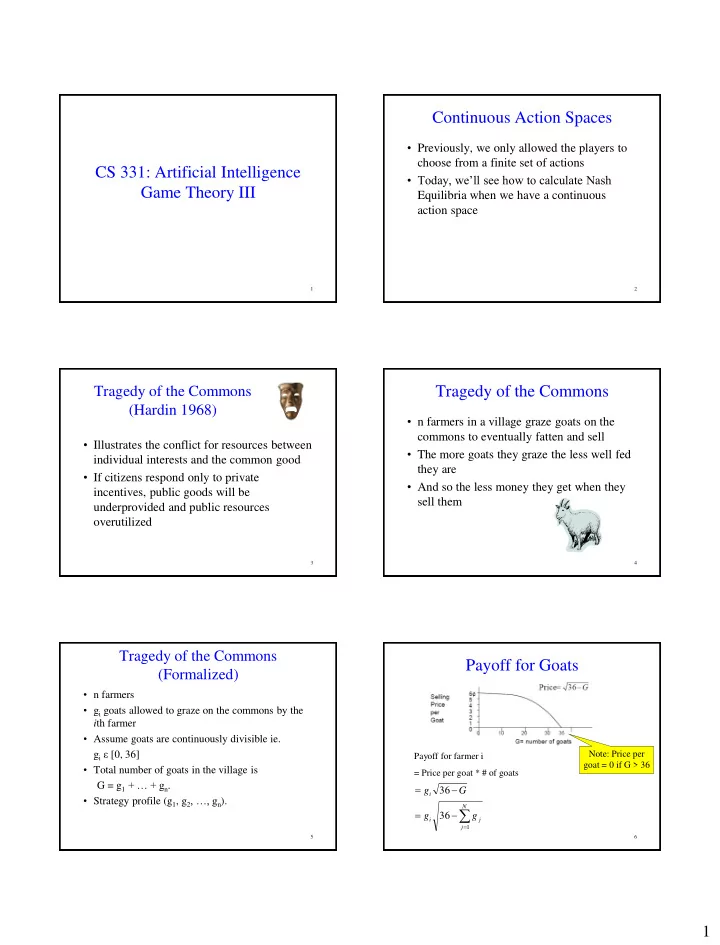
Continuous Action Spaces Previously, we only allowed the players to - - PDF document

continuous action spaces
SMART_READER_LITE
LIVE PREVIEW

Continuous Action Spaces Previously, we only allowed the players to - - PDF document

Continuous Action Spaces Previously, we only allowed the players to choose from a finite set of actions CS 331: Artificial Intelligence Today, well see how to calculate Nash Game Theory III Equilibria when we have a continuous


slide-1
SLIDE 1

1

1

CS 331: Artificial Intelligence Game Theory III

2

Continuous Action Spaces

  • Previously, we only allowed the players to

choose from a finite set of actions

  • Today, we’ll see how to calculate Nash

Equilibria when we have a continuous action space

3

Tragedy of the Commons (Hardin 1968)

  • Illustrates the conflict for resources between

individual interests and the common good

  • If citizens respond only to private

incentives, public goods will be underprovided and public resources

  • verutilized

4

Tragedy of the Commons

  • n farmers in a village graze goats on the

commons to eventually fatten and sell

  • The more goats they graze the less well fed

they are

  • And so the less money they get when they

sell them

5

Tragedy of the Commons (Formalized)

  • n farmers
  • gi goats allowed to graze on the commons by the

ith farmer

  • Assume goats are continuously divisible ie.

gi ε [0, 36]

  • Total number of goats in the village is

G = g1 + … + gn.

  • Strategy profile (g1, g2, …, gn).

6

Payoff for Goats

Payoff for farmer i = Price per goat * # of goats

   

N j j i i

g g G g

1

36 36

Note: Price per goat = 0 if G > 36

slide-2
SLIDE 2

2

7

Calculating the Nash Equilibrium

  • Suppose a Nash Equilibrium exists using the

strategy profile (g1

*, g2 *, …, gn *)

  • This means that

           ) , , , ( play players

  • ther

the assuming i farmer to Payoff max arg

* * 2 1 * n * g i

g g g g

i

  • Define
  • Therefore
  • Use calculus to compute gi

*!

   i j j i

g G

* *

 

* *

36 max arg

i i i g i

G g g g

i

  

Calculating the Nash Equilibrium

* * * * * * * * * * * * * * * * * * * * * * * * * * * * * * * *

3 2 24 3 2 72 2 2 72 ) 36 ( 2 36 2 36 36 2 36 36 36 36

i i i i i i i i i i i i i i i i i i i i i i i i i i i i i i i i

G g g G g G g g G g G g g G g G g g G g G g g g G g g g G g g g

          

                                                          

9

Calculating the Nash Equilibrium

) ( 3 2 24 ) ( 3 2 24 ) ( 3 2 24 ) ( 3 2 24

* 1 * 3 * 2 * 1 * * * 4 * 2 * 1 * 3 * * 4 * 3 * 1 * 2 * * 4 * 3 * 2 * 1 

                       

n n n n n

g g g g g g g g g g g g g g g g g g g g     

Could use Linear Programming but notice the symmetry in these equations. It turns out that: g1* = g2* = … = gn* If you don’t believe me, try solving the 2 farmer case:

* 1 * 2 * 2 * 1

3 2 24 3 2 24 g g g g    

10

Calculating the Nash Equilibrium

) ( 3 2 24 ) ( 3 2 24 ) ( 3 2 24 ) ( 3 2 24

* 1 * 3 * 2 * 1 * * * 4 * 2 * 1 * 3 * * 4 * 3 * 1 * 2 * * 4 * 3 * 2 * 1 

                       

n n n n n

g g g g g g g g g g g g g g g g g g g g     

Write g* = g1* = g2* = … = gn*

1 2 72 72 ) 2 2 3 ( 72 ) 1 ( 2 3 ) 1 ( 2 72 3 ) 1 ( 3 2 24

* * * * * * * *

                  n g n g g n g g n g g n g

11

Calculating the Nash Equilibrium

  • At the Nash Equilibrium, a rational farmer grazes

72/(2n+1) goats

  • How many goats in total will be grazed?

1 2 36 36 1 2 72     n n n

  • Note that as n →∞, 36 goats will be grazed

(remember that we allow goats to be continuously divisible)

12

The Tragedy

  • How much profit per farmer?

1 2 72 36 1 2 72 farmer a to Payoff     n n n

Suppose there are 24 farmers, then the payoff would be about 1.26 cents If they all got together and agreed on 1 goat each, then the payoff would have been about 3.46 cents

46 . 3 12 24 36 farmer a to Payoff    

slide-3
SLIDE 3

3

13

What Went Wrong?

  • Rational behavior lead to sub-optimal solutions
  • Maximizing one’s utility is not the same as

maximizing social welfare

  • To solve this problem, we can define the rules of

the game to ensure that social welfare is not disregarded

  • This is why mechanism design is important since

it involves defining the rules of the game

14

Conclusions on Game Theory

  • Sylvia Nasar's (author of the biography “A

Beautiful Mind”) synopsis of John Nash’s remarks

  • n winning the Nobel prize:

“…he [Nash] felt that game theory was like string theory, a subject of great intrinsic intellectual interest that the world wishes to imagine can be of some utility. He said it with enough skepticism in his voice to make it funny.”

15

Conclusions on Game Theory

  • Game theory is mathematically elegant but there are

problems in applying it to real world problems:

– Assumes opponents will play the equilibrium strategy – What to do with multiple Nash equilibria? – Computing Nash equilibria for complex games is nasty (perhaps even intractable) – Players have non-stationary policies – Lots of other assumptions that don’t hold…

  • Game theory used mainly to analyze environments at

equilibrium rather than to control agents within an environment

  • Also good for designing environments (mechanism design)

16

What you should know

  • How to calculate Nash Equilibria for a

continuous action space game like the Tragedy of the Commons

  • Why the Tragedy of the Commons is tragic
  • Why game theory has difficulties being

applied to real world problems