Continuation of injectable contraceptives DMPA-SC and DMPA-IM when - - PowerPoint PPT Presentation

continuation of injectable contraceptives dmpa sc and
SMART_READER_LITE
LIVE PREVIEW

Continuation of injectable contraceptives DMPA-SC and DMPA-IM when - - PowerPoint PPT Presentation

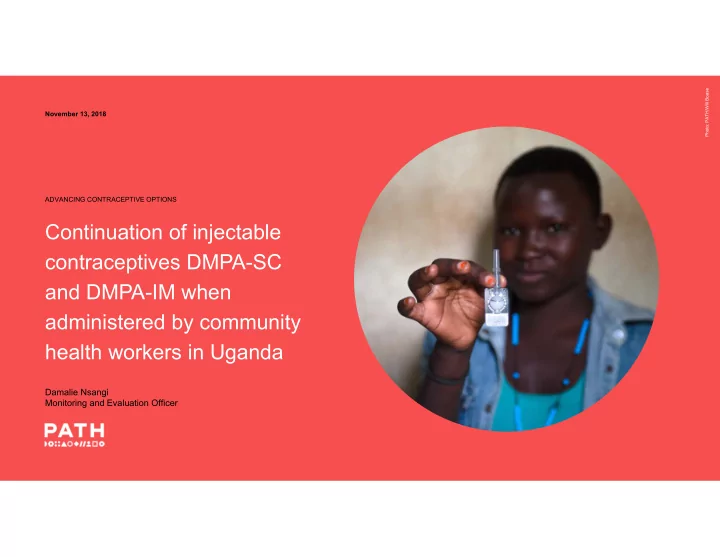
Photo: PATH/Will Boase November 13, 2018 ADVANCING CONTRACEPTIVE OPTIONS Continuation of injectable contraceptives DMPA-SC and DMPA-IM when administered by community health workers in Uganda Damalie Nsangi Monitoring and Evaluation Officer


slide-1
SLIDE 1

November 13, 2018

Continuation of injectable contraceptives DMPA-SC and DMPA-IM when administered by community health workers in Uganda

Damalie Nsangi Monitoring and Evaluation Officer

ADVANCING CONTRACEPTIVE OPTIONS

Photo: PATH/Will Boase

slide-2
SLIDE 2

2 Continuation of injectable contraceptives DMPA-SC and DMPA-IM when administered by community health workers in Uganda

Task sharing and injectable contraceptives in Uganda

  • Offering contraception through a wide range of service-delivery points enables access and availability.
  • Proven High Impact Practice (HIP): Equipping community health workers to provide a wide range of family planning (FP)

methods.

  • Community-based health volunteers (Village Health Teams, VHTs) were authorized to provide FP products, including the

injectable products DMPA-IM* and DMPA-SC in 2013/2014.

  • We assessed women’s experiences and continuation with both products, which were administered by VHTs over 12 months.

*DMPA: depot medroxyprogesterone acetate

slide-3
SLIDE 3

3

Results

  • No difference was found in 12-month

continuation between the two methods. Both rates were relatively high at 77%.

  • A similar study in Burkina Faso found much lower

continuation rates (47-50%) when both products were administered via facility-based providers.

  • Primary reasons for discontinuation were

also similar between the two methods:

  • Being late for an injection.
  • Receiving the injection from a non-VHT.
  • Side effects.
  • Women aged 18 to 24 years were much less

likely to continue the injectable as compared to women aged 25 to 49 years.

Continuation of injectable contraceptives DMPA-SC and DMPA-IM when administered by community health workers in Uganda

0.50 0.75 1.00 Probability of Continuation (%) 100 200 300 400 Time in Number of Days Aged 25-49 Aged 18-24

Log-rank test of equality across strata, P=0.04
slide-4
SLIDE 4

4

Implications:

  • The high injectable-continuation rates suggest that provision of FP

services through the community-based channel can be an effective distribution method for injectable contraception.

  • To reduce discontinuation of injectables, health workers must

counsel women on side effects and reinjection timing.

  • Offering a wide range of contraceptive options and adequate

counseling at multiple service-delivery points can enable women to switch to a new option when a particular method or provider no longer meets their needs.

  • Sub-groups, such as younger women, may need additional

support to continue using contraception.

4 Continuation of injectable contraceptives DMPA-SC and DMPA-IM when administered by community health workers in Uganda

slide-5
SLIDE 5

5

For more information:

Contact Damalie Nsangi: dnsangi@path.org Visit: www.path.org/dmpa-sc

Advancing Contraceptive Options