Context-sensitive User-centered Scalability: An Introduction - - PowerPoint PPT Presentation
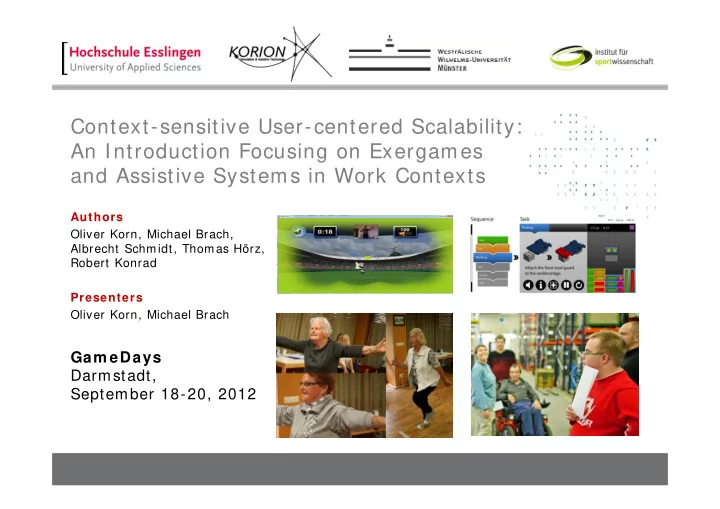
Context-sensitive User-centered Scalability: An Introduction Focusing on Exergames and Assistive Systems in Work Contexts Authors Oliver Korn, Michael Brach, Albrecht Schmidt, Thomas Hrz, Robert Konrad Presenters Oliver Korn, Michael Brach
2
University of Applied Sciences Esslingen
Overview
- we introduce an approach for implementing
context-sensitive user-centered scalability (CSUCS) into interactive applications using motion recognition
- we discuss two prototypical implementations:
- an “exergame” enriching
sports exercises for the elderly
- an assistive system using
gamification elements to enrich the working experience
- f impaired and elderly persons
AS LM
3
University of Applied Sciences Esslingen
Motivation
- percentage of elderly persons in society and disabled employees grows
- these persons suffer from
- general reduction of physical health, especially the loss of muscle,
power balance and cardio-respiratory abilities [ 1]
- reduction of short term memory [ 2]
- decrease of learning abilities [ 3]
assistive systems at the workplace and exergames at the residences are an efficient way to meet this demographic challenge assistive systems and exergames empower elderly persons and persons with disabilities and impairments to sustain an active lifestyle
[ 1] Nelson, M.E.; Rejeski, W.J.; Blair, S.N.; Duncan, P.W.; Judge, J.O.; King, A.C.; Macera, C.A. & Castanda-Sceppa, C.: Physical Activity and Public Health in Older Adults. Recommendation from the American College of Sports Medicine and the American Heart As-sociation. Circulation, 116, 1094-1105, 2007 [ 2] Anders, T. R.; Fozard, J. L. and Lillyquist, T. D. 1972. “Effects of age upon retrieval from short-term memory”. In: Developmental Psychology, vol. 6, iss. 2, 214-217 [ 3] Satre, D.; Knight, B. G.; David, S. 2006: Cognitive behavioral interventions with older adults: Integrating clinical and Gerontological research. In Professional Psychology: Research and Practice, (37): 489-498
4
University of Applied Sciences Esslingen
Users
5
University of Applied Sciences Esslingen
Adapted HAAT-model
HAAT: The Human Activity Assistive Technology Model as presented in: Cook, A. M. & Hussey, S. M.: Assistive Technologies: Principles and Practice, St. Louis, USA: Mosby, 1995 Mapping of our approach: The assistive technology of the work contexts and the training contexts share several sub-components.
Focus
6
University of Applied Sciences Esslingen
Two Prototypical Solutions
In both solutions…
- …
the input side is realized by motion recognition
- …
the user interface allows implicit interaction [ 1]
- …
natural interaction is supported
The continuous interpretation
- f motion data
allows real-time feedback and gamification
[ 1] Schmidt, A., Implicit Human Computer Interaction Through Context. Personal Technologies, vol. 4, no. 2&3, pp. 191-199, 2000
Exergame enriching sports exercises for the elderly Assistive system using gamification elements
7
Focus
University of Applied Sciences Esslingen
Gamification, Flow and the Need for Scaling
- We consider gamification as a means to achieve
"flow" [ 1] , a mental state in which a person:
- feels fully immersed in an activity
- experiencing energized focus
- and believing in the success of
the activity
- Four conditions are necessary for flow:
- clear set of goals
- good balance between perceived
challenges and perceived skills
- clear and immediate feedback
- activity is intrinsically rewarding,
perceived effortlessness of action
[ 1] Csikszentmihalyi, M.; Abuhamdeh, S.; Nakamura, J. 2005: Flow. In Elliot, A. (ed.): Handbook of Competence and Motivation, New York, USA, 598-69
8
University of Applied Sciences Esslingen
Prototype 1: Flow & Scaling in Exergames
- Realization of seven mini-games for seniors
mapping different sports exercises, linked by a virtual journey to foreign cities
- When a user starts the exergame,
the difficulty is always set to the lowest level to prevent early frustration
- During the exergame the user receives points
for successful activities (like catching a ball or grabbing a coin) and sometimes lose points (e.g. by failing to catch a ball)
- These points are the product of the user’s
level and a constant. Obvious and motivating visual feedback guides the seniors
- This consistent visualization keeps the scaling
process transparent and motivates the user
9
University of Applied Sciences Esslingen
Prototype 1: Flow & Scaling in Exergames
- Apart from the dynamic visualization
there is a results screen after each exercise
- Substantial improvements or degradations
resulting from the performance are commented in a friendly and humorous manner and recorded in the database immediately
- The difficulty level then scales according to
the user’s current performance to prevent underchallenge or overexertion
- Although the user is informed about these
changes, their swiftness in both ways makes it easier to accept degradation on a bad day
- Thus auto-adjustment prevents demotivation.
10
2 4 6 8 10 12 Day 1 Day 2 Day 3 Day 4 Day 5 Day 6 Day 7
score / time
Daily Score Rate
P3 P5 P6 P7 P8 P9 P14 P15 P16 P18 P19
University of Applied Sciences Esslingen
Prototype 1: Flow & Scaling in Exergames First Results from a Quantitative Study
Study Design:
- data just recorded
(2 weeks ago)
- 19 players aged 60-93,
average age 76
- 7 days
First results:
- 11 players (ca. 58% )
played 6 of 7 days
0,0 5,0 10,0 15,0 20,0 25,0 30,0 200 400 600 800 1000 1200 1400 Day 1 Day 2 Day 3 Day 4 Day 5 Day 6 Day 7
minutes per day score
Mean duration and score per day (n=11)
score duration [min]
11
University of Applied Sciences Esslingen
Prototype 1: Flow & Scaling in Exergames First Results from a Quantitative Study
Analysis of individual levels:
- Z-Transformation
- Z = (X-mean) / SD
First results:
- duration and score
have a positive correlation Future analysis:
- considering individual
pathways and training configuration
- within and between
sessions
- 0,80
- 0,60
- 0,40
- 0,20
0,00 0,20 0,40 Day 1 Day 2 Day 3 Day 4 Day 5 Day 6 Day 7
z(score rate) day
Mean z(score rate)
12
University of Applied Sciences Esslingen
Prototype 2: Flow & Scaling in Work Contexts
- Gamification is implemented in an
assistive system supporting manual assembly
- in the prototype of the assistive
system’s gamification component, each work process is visually represented by a brick in a puzzle game resembling Tetris
- during the work process the brick’s
color changes from green to red
- the duration of this color change
cycle is directly derived from a users’ average process durations and scales accordingly
13
- the “normal” speed of the individual
user is shown by a transparent grey stone (“shadowing”)
- thus the worker always knows
if he or she is doing well – compared to the personal average Next Step:
- quantitative evaluation study
measuring the impact
- f and gamification
- n work process times
and the users’ motivation
University of Applied Sciences Esslingen
Prototype 2: Flow & Scaling in Work Contexts
14
University of Applied Sciences Esslingen
Thanks for your attention! Questions?
Oliver Korn M.A. University of Applied Sciences Lab Production Management HCI & Interactive Wizards
- Kanalstr. 33, 73728 Esslingen,
Germany
- liver.korn@hs-esslingen.de
- Dr. Michael Brach