Contents 1. The structure equations 1 1.1. CayleyDickson - - PDF document

contents 1 the structure equations 1 1 1 cayley dickson
SMART_READER_LITE
LIVE PREVIEW

Contents 1. The structure equations 1 1.1. CayleyDickson - - PDF document

Contents 1. The structure equations 1 1.1. CayleyDickson construction 1 1.2. Spin(7) and the octonions 1 1.3. The standard basis 2 1.4. Lie algebra of Spin(7) 3 1.5. MaurerCartan form 4 1.6. The first structure equations 5


slide-1
SLIDE 1

Contents 1. The structure equations 1 1.1. Cayley–Dickson construction 1 1.2. Spin(7) and the octonions 1 1.3. The standard basis 2 1.4. Lie algebra of Spin(7) 3 1.5. Maurer–Cartan form 4 1.6. The first structure equations 5 1.7. The group G2 5 2. The six-sphere 6 2.1. The G2-action 6 2.2. The almost complex structure 7

  • 1. The structure equations

1.1. Cayley–Dickson construction. We assume familiarity with quaternions H. Octonions O are pairs of quaternions equipped with the multiplication (1) (a, b) · (c, d) := (ac − ¯ db, da + b¯ c). We have a unit 1 = (1, 0), but the product is not associative. If we write ε = (0, 1) ∈ O then every octonion can be written x = (a, b) = a + bε with a, b ∈ H. There is also an involution a + bε := ¯ a − bε and it satisfies xy = ¯ y¯

  • x. The standard

metric on R8 can then be expressed as x, y = 1 2(x¯ y + y¯ x) and is compatible with the product in these sense that (2) xy, zy = x, zy, y. This has many useful consequences, but we shall only need u, v = 0 ⇒ (xu)v = −(x¯ v)¯ u, u(vx) = −¯ v(¯ ux) (3) u, v = 0 ⇒ u¯ v = −v¯ u (4) (xw)w = xw2 (5) The real part of an octonion is Re x =

1 2(x + ¯

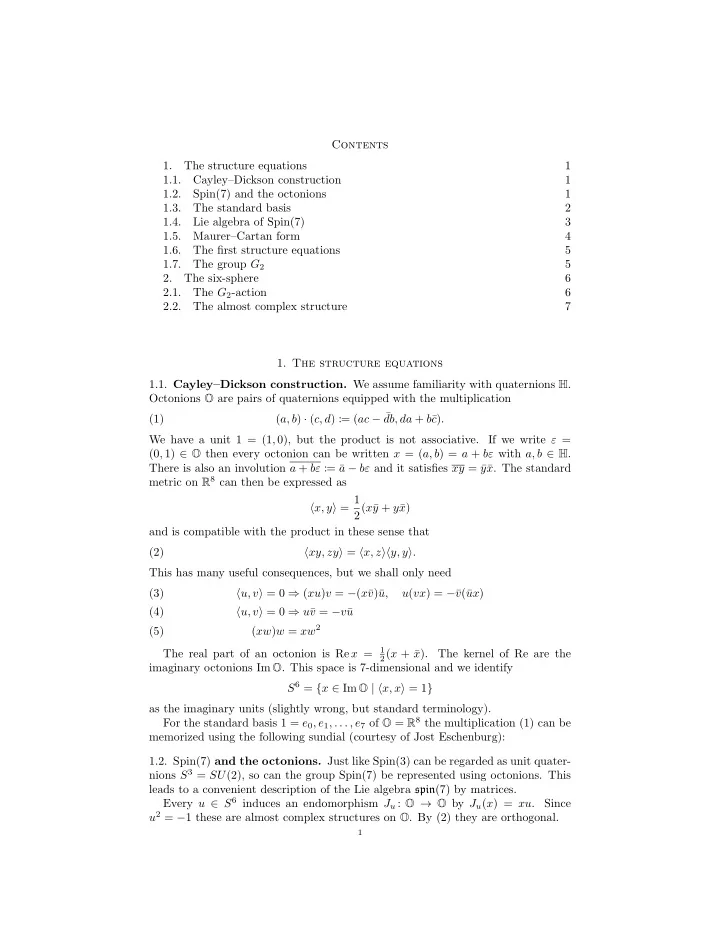
x). The kernel of Re are the imaginary octonions Im O. This space is 7-dimensional and we identify S6 = {x ∈ Im O | x, x = 1} as the imaginary units (slightly wrong, but standard terminology). For the standard basis 1 = e0, e1, . . . , e7 of O = R8 the multiplication (1) can be memorized using the following sundial (courtesy of Jost Eschenburg): 1.2. Spin(7) and the octonions. Just like Spin(3) can be regarded as unit quater- nions S3 = SU(2), so can the group Spin(7) be represented using octonions. This leads to a convenient description of the Lie algebra spin(7) by matrices. Every u ∈ S6 induces an endomorphism Ju : O → O by Ju(x) = xu. Since u2 = −1 these are almost complex structures on O. By (2) they are orthogonal.

1

slide-2
SLIDE 2

2

e1 e2 e3 e4 e5 e6 e7

The sundail shows e1e2 = e4. The dial may be turned to get further relations, for example e2e3 = e5. Moreover, eiej = −ejei when i = j and eiei = −1.

Using the universal property of the Clifford algebra we get a representation J: Cℓ(7) → EndR(O), u → Ju. It is not faithful since the volume element ω = e1 · · · e7 gets mapped to J(ω) = Je1 ◦ · · · ◦ Je7 = id (verify on the basis ei using the sundial). The even part Cℓ0(7) ∼ = Cℓ(6) is a 64-dimensional simple algebra of matrices, and so the restriction of J is automatically an isomorphism. Recall the definition Spin(7) = {x1 · · · x2n ∈ Cℓ×(7) | xi ∈ S6, n ∈ N}. Lemma 1.1. The restriction J: Spin(7) → AutR(O) is a faithful representation, the spinor representation. In particular J: Spin(7) ∼ = Ju | u ∈ S6 for the gener- ated subgroup.

  • Proof. Since Spin(7) ⊂ Cℓ0(7) injectivity of J is clear. To prove the second state-

ment, it remains to compute the image. By definition J(Spin(7)) ⊂ J(S6). Con- versely, any Ju with u ∈ S6 belongs to J(Spin(7)) because Ju = Ju◦Jω = J(u·ω)

  • 1.3. The standard basis. We view O = R ⊗R O ⊂ C ⊗R O embedded as the real
  • part. Re(u), Im(u), u for u ∈ C ⊗R O always refers to the real part, imaginary part,

complex conjugation with respect to the C-factor. By complexifying the spinor representation we shall regard Spin(7) as a linear subgroup of AutC(C ⊗R O). In H ⊂ O we have elements j = e2, k = e3. We shall write e1 = jk instead

  • f the imaginary unit, because we need ‘i’ to denote the complex structure on the

complexification C ⊗R O (lying in the first factor). Recall ε = (0, 1) = e4. Definition 1.2. The standard basis of C ⊗R O is (6) N = 1 2(1 − iε) ¯ N = 1 2(1 + iε) F1 = jN ¯ F1 = j ¯ N F2 = kN ¯ F2 = k ¯ N F3 = (kj)N ¯ F3 = (kj) ¯ N (note that the conjugation only takes place in the C-factor) These vector are orthogonal to each other and all have length 1/ √

  • 2. Also JεN =

Nε = 1

2(ε + i) = iN etc., and so

(C ⊗R O)1,0 = N, F1, F2, F3, (C ⊗R O)0,1 = ¯ N, ¯ F1, ¯ F2, ¯ F3, where the complex structure Jε on O is understood.

slide-3
SLIDE 3

3

1.4. Lie algebra of Spin(7). Using the standard basis, Spin(7) ⊂ AutC(C ⊗R O) may be regarded as a linear subgroup of GL8(C). Our next goal is to explicitly understand which subalgebra of C8×8 the Lie algebra spin(7) is. Lemma 1.3. L = {Jε ◦ Ju | u ∈ Im O, ε, u = 0} is a 6-dimensional subspace of spin(7), viewed as a subset of EndC(C ⊗R O). In particular [L, L] ⊂ spin(7).

  • Proof. The exponential map of the linear group Spin(7) ⊂ AutC(C ⊗R O) is the

matrix exponential. For an imaginary unit u orthogonal to ε the series expansion shows exp(tJεJu) = cos(t) id + sin(t)JεJu. Here we use JεJu = −JuJε and (JεJu)2 = − id from (3). The right hand side belongs to Spin(7) because it is J−εJcos(t)ε−sin(t)u and cos(t)ε − sin(t)u ∈ S6. Since L is a vector space, we see that u may have any length.

  • To determine the commutator, we must understand the transformations JεJu.

The orthogonal complement of ε in Im O can be parameterized by a = (a1, a2, a3) ∈ C3 by setting u = 2 Re(a1F1 + a2F2 + a3F3) ∈ Im O. Then we can represent JεJu in the basis (N, F, ¯ N, ¯ F). The result of the compu- tation is the following skew Hermitian 8 × 8 matrix (7) JεJu =     −iat ia [−i¯ a] i¯ at −i¯ a [ia]     using the notation [a] =   a3 −a2 −a3 a1 a2 −a1   for a ∈ C3 (note [a]t = −[a]). In par- ticular, the Lie subgroup belonging to L consists completely of complex antilinear transformations of (O, Jε). Lemma 1.4. [L, L] = κ ¯ κ

  • κ ∈ su(4)
  • .
  • Proof. Let u = 2 Re(aF) and v = 2 Re(bF), using vector notation. Then letting

κa,b = −i Ima, b (b × a)t ¯ a × ¯ b ba∗ − ab∗ + i Ima, bF3

  • we have

[JεJu, JεJv] = 2 κa,b ¯ κa,b

  • .

From this we see ‘⊂’ in the statement of Lemma 1.4. For the converse, we compute κa,b for (a, b) = (e1, e2), (ie1, ie2), (e1, e3), (ie1, ie3), (e2, e3), (ie2, ie3)     1 ∓1 ±1 −1     ,     −1 ∓1 1 ±1     ,     1 −1 ∓1 ±1    

slide-4
SLIDE 4

4

and for (a, b) = (ie1, e1), (ie2, e2), (ie3, e3)     −i −i i i     ,     −i i −i i     ,     −i i i −i     and finally for (a, b) = (ie1, e2), (e1, ie2), (ie1, e3), (e1, ie3), (ie2, e3), (e2, ie3)     i ±i ±i i     ,     −i ±i −i ±i     ,     i i ±i ±i     , These 15 matrices are linearly independent over the reals. Since dimR su(4) = 15 we must have equality in the statement of the lemma.

  • Because dimR spin(7) = dimR so(7) = 21 we now see:

Proposition 1.5. We have L ∩ [L, L] = {0}, dimR L = 6, dimR[L, L] = 15. Con- sequently, spin(7) = L ⊕ [L, L] is the Lie subalgebra of matrices (8)     ic −b∗ −at b D a [¯ a] −a∗ −ic −bt ¯ a [a] ¯ b ¯ D     where a, b ∈ C3, c ∈ R, and D ∈ C3×3 satisfy D + D∗ = 0, tr D + ic = 0. 1.5. Maurer–Cartan form. Definition 1.6. Let G be a Lie group. Then Maurer–Cartan form is the g-valued 1-form φ(X ∈ TgG) := (ℓg−1)∗X. Thus it is the unique left-invariant g-valued 1-form with φe = idg. If we introduce a basis of g, then the corresponding components of φg determine a basis of T ∗

g G.

This gives a global frame of T ∗G. Definition 1.7. Let α ∈ Ωp(M; Km×k) and β ∈ Ωq(M; Kk×n) be matrix-valued

  • forms. Their wedge product is

(α∧β)(X1, . . . , Xp+q) =

  • σ∈Shp,q

sgn(σ)α(Xσ(1), . . . , Xσ(p))·β(Xσ(p+1), . . . , Xσ(p+q)) using the matrix multiplication ‘·’. Ordinary matrices (in particular the unit ma- trix) are embedded as constant matrix-valued functions on M. This wedge product is associative and unital, but not graded commutative. We have (9) (α ∧ β)t = (−1)pqβt ∧ αt. When G ⊂ GLn(C) is a linear subgroup, we may write φ = g−1 · dg as a matrix- matrix multiplication, where dg: TgG ⊂ Cn×n denotes the inclusion of tangent

  • spaces. We always have the Maurer–Cartan equation

(10) dφ = d(g−1dg) = −

  • g−1 · dg · g−1

dg = −φ ∧ φ.

slide-5
SLIDE 5

5

Note also the following formula for the right translation (11) ρ∗

aφ = Ada−1 φ.

The components of (8) determine four 1-forms θ, h ∈ Ω1(Spin(7); C3), ρ ∈ Ω1(Spin(7)), κ ∈ Ω1(Spin(7); u(3)) by defining them on the Lie algebra Te Spin(7) by θ = a, h = b, ρ = c, κ = D, and extending in a left-invariant fashion. Hence the Maurer–Cartan form is written (12) φSpin = g−1dg =     iρ −h∗ −θt h κ θ [¯ θ] −θ∗ −iρ −ht ¯ θ [θ] ¯ h ¯ κ     , tr κ + iρ = 0, κ + κ∗ = 0. (the components of φSpin regarded as a map T Spin(7) → C8×8.) 1.6. The first structure equations. Definition 1.8. At each point g ∈ Spin(7) we have an orthonormal frame of C⊗RO, the moving frame on Spin(7), given by (n, f, ¯ n, ¯ f) := (g(N), g(F), g( ¯ N), g( ¯ F)) = (N, F, ¯ N, ¯ F) · g (on the right we mean a row vector times matrix multiplication).

Justify the last equality

Differentiating the definition leads to the first structure equations for Spin(7): (13) d(n, f, ¯ n, ¯ f) = (n, f, ¯ n, ¯ f)g−1dg = (n, f, ¯ n, ¯ f) ·     iρ −h∗ −θt h κ θ [¯ θ] −θ∗ −iρ −ht ¯ θ [θ] ¯ h ¯ κ     1.7. The group G2. Define p: Spin(7) → S7, p(g) = g(1) = n + ¯ n Then (14) dp = dn + d¯ n = i(n − ¯ n)ρ + f(h + θ) + ¯ f(¯ h + ¯ θ): T Spin(7) → O whose kernel is given by ρ = 0 and h+θ = 0. At the neutral element this condition means a = −b and c = 0 and so we have a 21 − 7 = 14-dimensional kernel. It follows that p is a submersion. Therefore p is an open map whose image is also closed since Spin(7) is compact. It follows that p is surjective. We obtain a compact 14-dimensional Lie subgroup, which is simply connected since both S7 and Spin(7) are simply connected (long exact sequence of homotopy groups for a fibration). Definition 1.9. G2 = {g ∈ Spin(7) | g(1) = 1} = p−1(1). There are other possible definitions, for example as automorphisms of the division algebra O. Since g(1) = 1 we regard G2 as a linear subgroup of SO(Im O). Definition 1.10. The standard basis of Im O is (U, F, ¯ F) where U := i(N − ¯ N) = ε. The moving frame on G2 is (u, f, ¯ f) where u = U · g = g(U).

slide-6
SLIDE 6

6

The standard basis is orthogonal, F i and ¯ F i have length 1/ √ 2, while U has unit

  • length. Using a = −b, c = 0, the standard basis of Im O, and (8) we may calculate

g2 as a Lie subalgebra of C7×7 (faithfully represented in the standard basis): (15) g2 =      −ia∗ iat −2ia D [¯ a] 2i¯ a [a] ¯ D  

  • a ∈ C3, D ∈ su(3)

   . The structure equations and the Maurer–Cartan form for G2 are (16) d(u, f, ¯ f) = d

  • (U, F, ¯

F) · g

  • = (U, F, ¯

F)dg = (u, f, ¯ f)φG2 = (u, f, ¯ f) ·   −iθ∗ iθt −2iθ κ [¯ θ] 2i¯ θ [θ] ¯ κ   where now θ ∈ Ω1(G2; C3), κ ∈ Ω1(G2; su(3)). At any point g ∈ G2 the real components of θg, κg form a basis of T ∗

g G2.

Writing out the Maurer–Cartan equation dφG2 = −φG2 ∧φG2 by performing the matrix multiplication ‘∧’ leads to the second structure equations for G2: dθ = −κ ∧ θ + [¯ θ] ∧ ¯ θ (17) dκ = −κ ∧ κ + 2θ ∧ θ∗ − [¯ θ] ∧ [θ] (18) = −κ ∧ κ + 3θ ∧ θ∗ − (θt ∧ ¯ θ)I3 (19)

  • 2. The six-sphere

2.1. The G2-action. Since g ∈ G2 preserves 1 and the inner product, it preserves also the orthogonal complement Im O of 1. This restricts to a left action G2 × S6 → S6, (g, y) → g(y). Proposition 2.1. The action is transitive with stabilizer at ε given by SU(3), embedded as   1 A ¯ A   , A ∈ SU(3). Hence G2/SU(3) = S6 (right cosets by convention) with quotient map (20) u: G2 → S6, u = i(n − ¯ n), u(g) = g(ε). The differential is du = −2iθf + 2i¯ θ ¯ f : TG2 → Im O.

  • Proof. Note that u is the usual orbit map with image G2ε ⊂ S6. The stabilizer is

a closed subgroup whose Lie algebra are those (21) A =   −ia∗ iat −2ia D [¯ a] 2i¯ a [a] ¯ D   with A(ε) = 0. Since U = ε this means a = 0 and so the stabilizer has the same Lie algebra as SU(3). The differential du is immediate from (15). In particular, u is a submersion. The image is therefore open and closed, so all of S6. By the long exact sequence of homotopy groups of the fibration u together with the fact that G2 is connected and S6 is simply-connected, the stabilizer must be simply connected

slide-7
SLIDE 7

7

and is therefore SU(3) (a priori it could have been SU(3)/Γ for a discrete subgroup π1 = Γ of the center of SU(3), see Lie’s Theorem).

  • 2.2. The almost complex structure. For each g ∈ G2 with g(ε) = y we have

an exact sequence 0 → Tg(gSU(3)) → TgG2

du

− → TyS6 → 0. By Proposition 2.1 the kernel Tg(gSU(3)) is the subspace ker θg. Lemma 2.2. Let A ∈ SU(3). Then (using matrix-vector multiplication) ρ∗

Aθ = A−1 · θ,

ρ∗

Aκ = A−1 · κ · A.

(22)

  • Proof. This is a consequence of (11), namely

ρ∗

AφG2 =

  1 A−1 At   ·   −iθ∗ iθt −2iθ κ [¯ θ] 2i¯ θ [θ] ¯ κ   ·   1 A ¯ A  

  • It follows that SU(3) preserves the subspaces θ1, θ2, θ3, ¯

θ1, ¯ θ2, ¯ θ3. The exact sequence and the formula for du shows that θi

g, ¯

θi

g for i = 1, 2, 3 are a basis of

(TyS6)C (note the dependence on g). Hence the following is well-defined: Definition 2.3. T 1,0

y

S6 := θ1|g, θ2|g, θ3|g for any g(ε) = y. This defines an almost complex structure on S6, the standard almost complex structure. Since G2 ⊂ SO(Im O) the standard metric g on Im O is G2-invariant. We denote the induced Hermitian form on Im O ⊗R C by h, defined by h(v1 ⊗ z1, v2 ⊗ z2) = z1¯ z2g(v1, v2). Lemma 2.4. u∗h = 4θt ◦ ¯ θ (symmetric product).

  • Proof. Since u∗h and the right hand side are G2-invariant (left action), it suffices

to check equality at 1 ∈ G2. Let A ∈ g2 be as in (21). Then h(du(A), du(A)) = h(−2iaf + 2i¯ a ¯ f, −2iaf + 2i¯ a ¯ f) = 4a2 = 4(θt ◦ ¯ θ)(A, A)

  • It follows that

√ 2θi is an orthonormal basis of (1, 0)-forms. Hence the (com- plexified) fundamental form ω = g(J·, ·) on S6 can be written u∗ωC = i √ 2θi ∧ √ 2¯ θi = 2iθt ∧ ¯ θ. (one can also directly check that the right hand side is invariant under ρ∗

A for

A ∈ SU(3), using associativity of the the matrix-valued wedge product) The form θ1 ∧ θ2 ∧ θ3 is invariant under SU(3) since by (22) (a11θ1 + a12θ2 + a13θ3) ∧ (a21θ1 + a22θ2 + a23θ3) ∧ (a31θ1 + a32θ2 + a33θ3) = det(A−1)θ1 ∧ θ2 ∧ θ3. (this corresponds to the fact that θ1, θ2, θ3 is preserved by SU(3)) Definition 2.5. Υ ∈ Ω3(S6; C) is the unique complex form with u∗Υ := 8θ1∧θ2∧θ3. Lemma 2.6. dω = −3 Im(Υ)

slide-8
SLIDE 8

8

  • Proof. Using (9), κt = −¯

κ, [θ]t = −[θ] and (17) we find d(θt ∧ ¯ θ) = (dθ)t ∧ ¯ θ − θt ∧ dθ = (−κ ∧ θ + [¯ θ] ∧ ¯ θ)t ∧ ¯ θ − θt ∧ (−¯ κ ∧ ¯ θ + [θ] ∧ θ) = θt ∧ κt ∧ ¯ θ − ¯ θt ∧ [¯ θ]t ∧ ¯ θ + θt ∧ ¯ κ ∧ ¯ θ − θt ∧ [θ] ∧ θ = −θt ∧ [θ] ∧ θ + θt ∧ [θ] ∧ θ = 6(θ123 − θ123) = 12i Im(θ123)

  • A similar computation shows dΥ = 2ω2.