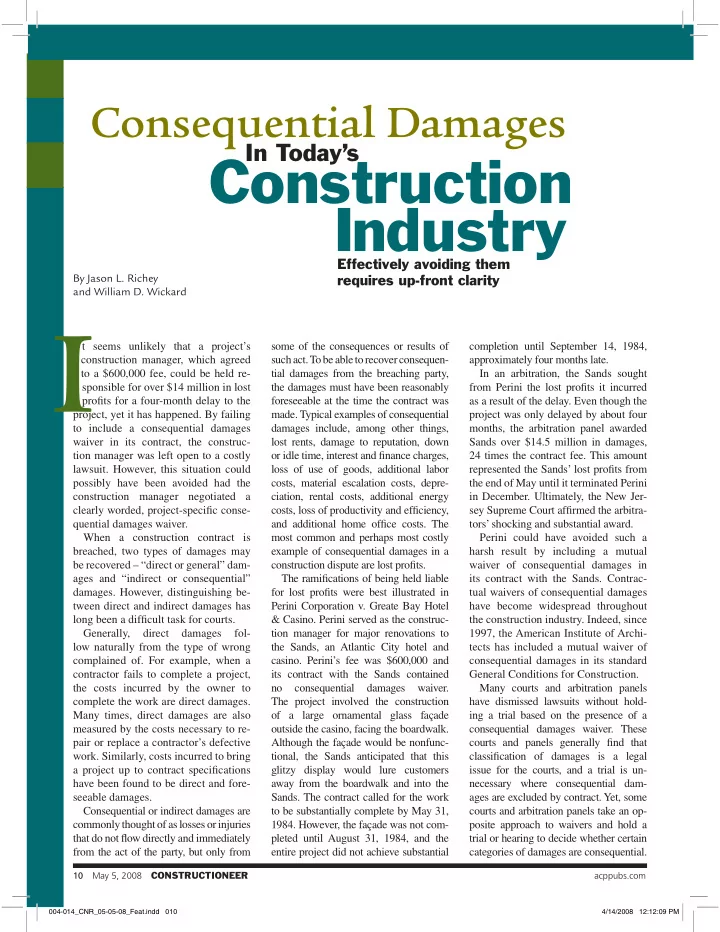
Construction Industry Effectively avoiding them By Jason L. Richey - - PDF document

construction industry
SMART_READER_LITE
LIVE PREVIEW

Construction Industry Effectively avoiding them By Jason L. Richey - - PDF document

Consequential Damages In Todays Construction Industry Effectively avoiding them By Jason L. Richey requires up-front clarity and William D. Wickard t seems unlikely that a projects some of the consequences or results of completion


slide-1
SLIDE 1

10 May 5, 2008 CONSTRUCTIONEER acppubs.com

t seems unlikely that a project’s construction manager, which agreed to a $600,000 fee, could be held re- sponsible for over $14 million in lost profi ts for a four-month delay to the project, yet it has happened. By failing to include a consequential damages waiver in its contract, the construc- tion manager was left open to a costly

  • lawsuit. However, this situation could

possibly have been avoided had the construction manager negotiated a clearly worded, project-specifi c conse- quential damages waiver. When a construction contract is breached, two types of damages may be recovered – “direct or general” dam- ages and “indirect or consequential”

  • damages. However, distinguishing be-

tween direct and indirect damages has long been a diffi cult task for courts. Generally, direct damages fol- low naturally from the type of wrong complained of. For example, when a contractor fails to complete a project, the costs incurred by the owner to complete the work are direct damages. Many times, direct damages are also measured by the costs necessary to re- pair or replace a contractor’s defective

  • work. Similarly, costs incurred to bring

a project up to contract specifi cations have been found to be direct and fore- seeable damages. Consequential or indirect damages are commonly thought of as losses or injuries that do not fl

  • w directly and immediately

from the act of the party, but only from some of the consequences or results of such act. To be able to recover consequen- tial damages from the breaching party, the damages must have been reasonably foreseeable at the time the contract was

  • made. Typical examples of consequential

damages include, among other things, lost rents, damage to reputation, down

  • r idle time, interest and fi

nance charges, loss of use of goods, additional labor costs, material escalation costs, depre- ciation, rental costs, additional energy costs, loss of productivity and effi ciency, and additional home offi ce costs. The most common and perhaps most costly example of consequential damages in a construction dispute are lost profi ts. The ramifi cations of being held liable for lost profi ts were best illustrated in Perini Corporation v. Greate Bay Hotel & Casino. Perini served as the construc- tion manager for major renovations to the Sands, an Atlantic City hotel and

  • casino. Perini’s fee was $600,000 and

its contract with the Sands contained no consequential damages waiver. The project involved the construction

  • f a large ornamental glass façade
  • utside the casino, facing the boardwalk.

Although the façade would be nonfunc- tional, the Sands anticipated that this glitzy display would lure customers away from the boardwalk and into the

  • Sands. The contract called for the work

to be substantially complete by May 31,

  • 1984. However, the façade was not com-

pleted until August 31, 1984, and the entire project did not achieve substantial completion until September 14, 1984, approximately four months late. In an arbitration, the Sands sought from Perini the lost profi ts it incurred as a result of the delay. Even though the project was only delayed by about four months, the arbitration panel awarded Sands over $14.5 million in damages, 24 times the contract fee. This amount represented the Sands’ lost profi ts from the end of May until it terminated Perini in December. Ultimately, the New Jer- sey Supreme Court affi rmed the arbitra- tors’ shocking and substantial award. Perini could have avoided such a harsh result by including a mutual waiver of consequential damages in its contract with the Sands. Contrac- tual waivers of consequential damages have become widespread throughout the construction industry. Indeed, since 1997, the American Institute of Archi- tects has included a mutual waiver of consequential damages in its standard General Conditions for Construction. Many courts and arbitration panels have dismissed lawsuits without hold- ing a trial based on the presence of a consequential damages waiver. These courts and panels generally fi nd that classifi cation of damages is a legal issue for the courts, and a trial is un- necessary where consequential dam- ages are excluded by contract. Yet, some courts and arbitration panels take an op- posite approach to waivers and hold a trial or hearing to decide whether certain categories of damages are consequential.

Construction

In Today’s

Consequential Damages

Industry

Effectively avoiding them requires up-front clarity

By Jason L. Richey and William D. Wickard

004-014_CNR_05-05-08_Feat.indd 010 004-014_CNR_05-05-08_Feat.indd 010 4/14/2008 12:12:09 PM 4/14/2008 12:12:09 PM
slide-2
SLIDE 2

acppubs.com CONSTRUCTIONEER May 5, 2008 11

CAT j

These courts fi nd the precise demarca- tion between direct and consequential damages is a question of fact. As such, including a clearly worded, project-specifi c waiver

  • f

consequential damages in construction contracts has become critically important in today’s construction industry. By defi ning the scope of consequential damages in the contract itself, parties to a construction contract can increase the likelihood a court or arbitration panel will dismiss a claim without a trial. This was dem-

  • nstrated in a recent arbitration where

the owner of a large manufacturing facility alleged it suffered over $15 million in damages because design er- rors had caused the facility to endure a delayed and extended startup pe-

  • riod. These damages included, among
  • ther things, costs to remove waste

produced during the facility’s startup; costs to hire temporary labor to manu- ally move the scrap; costs to hire a back hoe and driver to manage scrap; and costs to pay the facility’s staff for months of idleness before the facility was operational. Nonetheless, the designer’s contract with the owner stated: “In no event, how- ever, shall [the designer] be liable on any theory of liability for any special, punitive, exemplary or Consequential Damages.” Even more importantly, the contract also specifi cally defi ned what the term “Con- sequential Damages” included: “‘Consequential Damages’ shall mean a consequential, indirect or inci- dental loss or damage, including but not limited to, loss of use, loss of product, loss of replacement power and business interruption.”

It seems unlikely that a project’s construction manager, which agreed to a $600,000 fee, could be held responsible for over $14 million in profi ts for a four-month delay to the project, yet it has happened.

004-014_CNR_05-05-08_Feat.indd 011 004-014_CNR_05-05-08_Feat.indd 011 4/14/2008 12:12:09 PM 4/14/2008 12:12:09 PM
slide-3
SLIDE 3

12 May 5, 2008 CONSTRUCTIONEER acppubs.com

Thus, without holding any hearing, the arbitration panel determined that damages for excessive scrap waste, lost product and delay of the facility’s start- up were consequential damages. As a result, the panel dismissed the major- ity of the owner’s claims, reducing the amount of damages the owner could demand by over $10 million. When defi ning the scope of a consequential damages waiver, it is important for both contractors and

  • wners to carefully draft the pro-

vision in a way that will increase the odds that (i) the parties will not dispute what types of damages are recoverable under the contract; and (ii) if there is such a dispute, the waiv- er will be found to be enforceable. Both owners and contractors should avoid general boilerplate “catch-all” consequential damages waivers that do not defi ne what the parties mean by consequential damages. Waivers should be “project-specifi c” in that they should anticipate and defi ne the potential types of damages that could arise with this project and ensure they are clearly waived. Moreover, the parties should ensure the waiver is mutual, i.e., the list of consequential damages should be the same for the

  • wner and contractor.

While following these recommenda- tions does not guarantee a dispute-free project, following them will minimize the chances of a prolonged litigation regarding what constitutes a conse- quential damage. ■ Jason Richey is a partner and Wil- liam Wickard is an associate in the Construction and Engineering Prac- tice Group in the Pittsburgh offi ce of Kirkpatrick & Lockhart Preston Gates Ellis, LLP (K&L Gates).

CONSEQUENTIAL DAMAGES IN TODAY’S CONSTRUCTION INDUSTRY

future

ADVERTISE

See how our publications create response to your products and services.

Look

(800) 486-0014

to the

IMPACT CRUSHERS

FINES ARE REJECTED BEFORE ENTERING CRUSHER BOLT-ON LINERS AND APRON TIPS...STANDARD 12:1 TO 18:1 REDUCTION RATIO OPS (OVERLOAD PROTECTION SYSTEM) FOR OPTIMAL PERFORMANCE

AVAILABLE IN OPEN OR CLOSED CIRCUIT

M M M M

Lititz, PA (717) 625-2800 Keystone Processing Equipment Co.

CNR_KPI-JCI-Keystone (Reg)_DI 004-014_CNR_05-05-08_Feat.indd 012 004-014_CNR_05-05-08_Feat.indd 012 4/14/2008 12:12:09 PM 4/14/2008 12:12:09 PM