CONSTRAINING THE NATURE OF DARK MATTER WITH SUBSTRUCTURE LENSING: - - PowerPoint PPT Presentation

constraining the nature of dark matter with substructure
SMART_READER_LITE
LIVE PREVIEW

CONSTRAINING THE NATURE OF DARK MATTER WITH SUBSTRUCTURE LENSING: - - PowerPoint PPT Presentation

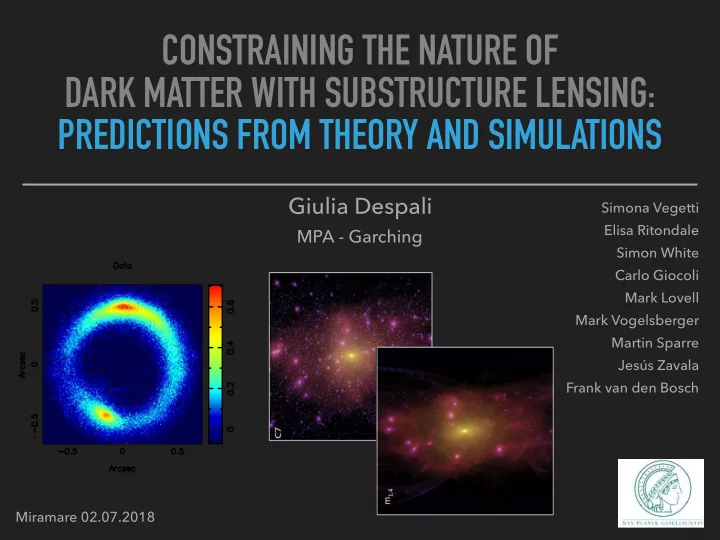
CONSTRAINING THE NATURE OF DARK MATTER WITH SUBSTRUCTURE LENSING: PREDICTIONS FROM THEORY AND SIMULATIONS Giulia Despali Simona Vegetti Elisa Ritondale MPA - Garching Simon White Carlo Giocoli Mark Lovell Mark Vogelsberger Martin Sparre


slide-1
SLIDE 1

CONSTRAINING THE NATURE OF DARK MATTER WITH SUBSTRUCTURE LENSING: PREDICTIONS FROM THEORY AND SIMULATIONS

Giulia Despali

MPA - Garching

Simona Vegetti Elisa Ritondale Simon White Carlo Giocoli Mark Lovell Mark Vogelsberger Martin Sparre Jesús Zavala Frank van den Bosch Miramare 02.07.2018

slide-2
SLIDE 2

CONSTRAINING THE NATURE OF DARK MATTER WITH SUBSTRUCTURE LENSING: PREDICTIONS FROM THEORY AND SIMULATIONS

Giulia Despali

MPA - Garching

Simona Vegetti Elisa Ritondale Simon White Carlo Giocoli Mark Lovell Mark Vogelsberger Martin Sparre Jesús Zavala Frank van den Bosch Miramare 02.07.2018

slide-3
SLIDE 3

PREDICTIONS & NUMERICAL SIMULATIONS

LINE-OF-SIGHT CONTRIBUTION STERILE NEUTRINOS SIDM

(Despali et al. 2018) how many LOS haloes we expect 
 vs substructures in the main lens predictions for CDM vs WDM (Despali, Lovell, Vegetti et al. in prep.) (Despali, Sparre, Vogelsberger, Zavala, Vegetti et al in prep.) subhalo counts from sterile neutrino
 WDM zoom simulations subhalo profiles, distribution and
 lensing power spectrum impact of SIDM on the main halo
 properties different distribution of Einstein 
 rings? subhalo counts and profiles …see Elisa’ s talk!

slide-4
SLIDE 4

PREDICTIONS

LINE-OF-SIGHT CONTRIBUTION

(Despali et al. 2018)

NLOS = Z zS Z Mmax

MLOW (z)

n(m, z)dmdV dz dz lensing is sensitive to the whole mass distribution between the observer and the source

slide-5
SLIDE 5

PREDICTIONS

LINE-OF-SIGHT CONTRIBUTION

(Despali et al. 2018)

NLOS = Z zS Z Mmax

MLOW (z)

n(m, z)dmdV dz dz lensing is sensitive to the whole mass distribution between the observer and the source

“EQUIVALENT LINE-OF-SIGHT” used to rescale the sensitivity 
 function at z ≠ zL

log Mvir(z) = (0.41x + 0.57x2 + 0.9x3)

+ + +

slide-6
SLIDE 6

PREDICTIONS

LINE-OF-SIGHT CONTRIBUTION

(Despali et al. 2018)

nW DM nCDM = (1 + γMhmM −1)β

CDM WDM 3.3keV

slide-7
SLIDE 7

PREDICTIONS

LINE-OF-SIGHT CONTRIBUTION

(Despali et al. 2018)

CDM WDM 3.3keV current detection limit

nW DM nCDM = (1 + γMhmM −1)β

slide-8
SLIDE 8

PREDICTIONS

LINE-OF-SIGHT CONTRIBUTION

(Despali et al. 2018)

CDM WDM 3.3keV current detection limit future

  • bservations

nW DM nCDM = (1 + γMhmM −1)β

slide-9
SLIDE 9

PREDICTIONS

LINE-OF-SIGHT CONTRIBUTION

(Despali et al. 2018)

CDM WDM 3.3keV future

  • bservations

current detection limit

ratio subhaloes/line-of-sight

nW DM nCDM = (1 + γMhmM −1)β

the line-of-sight population dominates

slide-10
SLIDE 10

PREDICTIONS & NUMERICAL SIMULATIONS

LINE-OF-SIGHT CONTRIBUTION STERILE NEUTRINOS SIDM

the LOS population dominates
 and provides cleaner constrains with better sensitivities we’ll be 
 able to discriminate CDM/WDM we need to be careful with mass
 definitions

SUMMARY

slide-11
SLIDE 11

SIMULATIONS

STERILE NEUTRINO DM

  • 4 ETG-analogues selected from the Eagle simulation
  • re-simulated with 2 models of 7.1 keV sterile neutrino: L6 = 8, 11.2
  • DMO and hydro versions 


2 x 10¹³ M⦿
 1 x 6 1012 M⦿
 1x 4 1012 M⦿

1 200 k [h/Mpc] 10 100 1000 Δ2 = k3P(k) 107 108 109 1010 1011 1012 1013 MSK [h-1MO

  • ]

1 10 100 k [h/Mpc]

L6 = 120.0, sin2(2θ) = 8.0x10⁻¹³ L6 = 11.2, sin2(2θ) = 2.1x10⁻¹¹ L6 = 10.0, sin2(2θ) = 3.7x10⁻¹¹ L6 = 9.0, sin2(2θ) = 8.1x10⁻¹¹ L6 = 8.0, sin2(2θ) = 2.1x10⁻¹⁰ CDM

z

(Despali, Lovell et al. in prep.)

slide-12
SLIDE 12

SIMULATIONS

STERILE NEUTRINO DM

(Despali, Lovell et al. in prep.) same number of “luminous” 
 satellites - as in Lovell+16 difference in the “dark” population

slide-13
SLIDE 13

SIMULATIONS

STERILE NEUTRINO DM

(Despali, Lovell et al. in prep.)

slide-14
SLIDE 14

SIMULATIONS

STERILE NEUTRINO DM

colder than the equivalent thermal 
 relic WDM model (Despali, Lovell et al. in prep.)

nW DM nCDM = (1 + γMhmM −1)β

“classic” WDM Sterile Neutrinos

slide-15
SLIDE 15

PREDICTIONS & NUMERICAL SIMULATIONS

LINE-OF-SIGHT CONTRIBUTION STERILE NEUTRINOS SIDM

the LOS population dominates
 and provides cleaner constrains with better sensitivities we’ll be 
 able to discriminate CDM/WDM we need to be careful with mass
 definitions

SUMMARY

the properties of the main lens remain similar slightly colder than the equivalent
 thermal relic models fewer subhaloes


slide-16
SLIDE 16

SIMULATIONS

SELF-INTERACTING DM

Vogelsberger et al. 2014

  • 10 ETG-analogues selected from the Illustris simulation
  • resimulated with SIDM + baryons

(Despali et al. in prep.)

slide-17
SLIDE 17

SIMULATIONS

SELF-INTERACTING DM

similar subhalo population subhaloes have on average more cored profiles (Despali et al. in prep.) might be degenerate with WDM abundances

slide-18
SLIDE 18

SIMULATIONS

SELF-INTERACTING DM

the self-interaction influences the main
 halo profile (Despali et al. in prep.)

slide-19
SLIDE 19

SIMULATIONS

SELF-INTERACTING DM

(Despali et al. in prep.) the self-interaction influences the main
 halo profile in the presence of baryons things are more 
 complicated

slide-20
SLIDE 20

SIMULATIONS

SELF-INTERACTING DM

the self-interaction influences the main
 halo profile in the presence of baryons things are more 
 complicated (Despali et al. in prep.)

slide-21
SLIDE 21

SIMULATIONS

BARYONIC EFFECTS

(Despali & Vegetti 2017)

  • Haloes from the Illustris and EAGLE main runs
  • M ~ 1013 M⦿/h
  • z = 0.2, 0.5, 1
slide-22
SLIDE 22

PREDICTIONS & NUMERICAL SIMULATIONS

LINE-OF-SIGHT CONTRIBUTION STERILE NEUTRINOS SIDM

the LOS population dominates
 and provides cleaner constrains with better sensitivities we’ll be 
 able to discriminate CDM/WDM we need to be careful with mass
 definitions

SUMMARY

the properties of the main lens remain similar slightly colder than the equivalent
 thermal relic models fewer subhaloes
 similar subhalo population but more cored sub profiles stronger effect on the main lens
 properties ..depending on morphological 
 type? ..accretion history? possible different Einstein 
 radii distribution …we need to be careful 
 the baryonic physics 
 effects!