SLIDE 1
Conscience Russell McNeil May 31, 2020 (Draft may contain - - PDF document
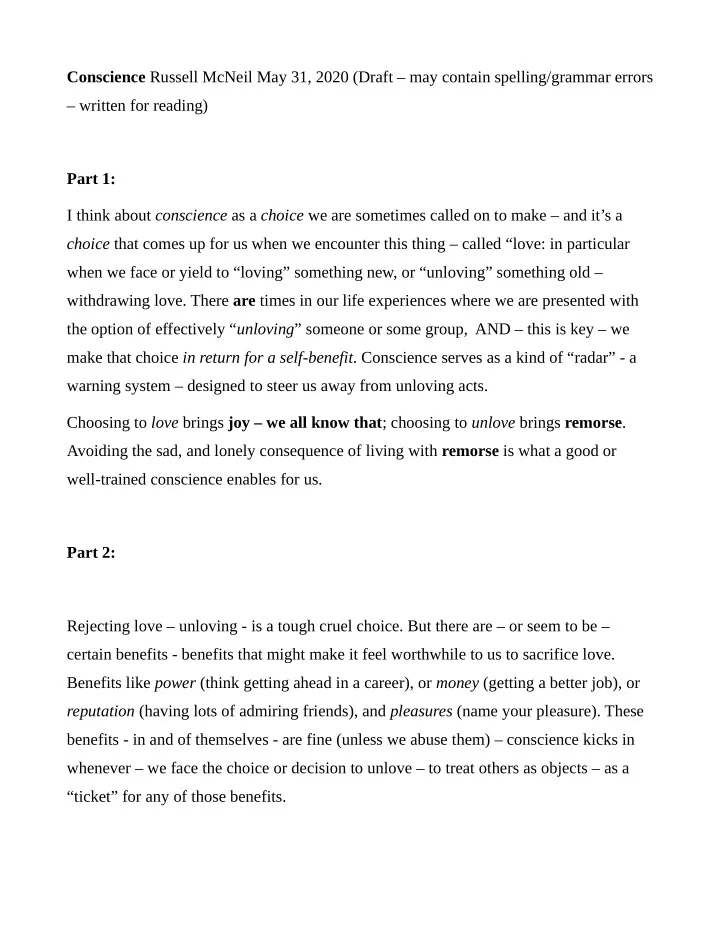
Conscience Russell McNeil May 31, 2020 (Draft may contain spelling/grammar errors written for reading) Part 1: I think about conscience as a choice we are sometimes called on to make and its a choice that comes up for us when we
SLIDE 2
SLIDE 3
Socrates taught how to listen to conscience by asking the right questions – a process requiring a continual examination of our lives. “The unexamined life is not worth living.” In his ultimate exercise of the choice of conscience in the Apology – Socrates chooses death over abandoning his comittment to love – it is an historically true story. Conscience seems real enough. Honestly – I remembered this incident - I will share in a second - only after I was approached to talk about conscience – it was NOT foremost in my mind. I recurred as what has come to be called an “involuntary memory.” It was triggered by the invitation. When I was a seven year old boy in Nova Scotia back in the early 1950’s I very clearly recall being goaded by a bullying, but charismatic older boy (9 or10?) into a conversation about doing something spectacular – but thoroughly bad – an act of vandalism! This fellow wanted me to become - a vandal – to commit an act that would earn me a badge in his little gang. It was one of those “I dare you” moments kids face – do you have what it takes? A serious “dare” - to a kid - is a powerful social tool: depending on how the pressure is applied; to fail a dare risks being labeled a chicken or
- worse. It’s an awkward spot for a child. If I accept the dare I would be embraced by the
“leader of the pack.” My star would rise. I’d be part of a higher order of being. It was all about “reputation.” If I declined the dare I might be hunted, bullied, called names and even targetted by
- lder boys going and coming from school. [Powerful tribal rituals play out in the streets
with children. They are invisible to most adults – and we forget those when we grow up. I ended up hunted for a few months before moving to Toronto later in the year.] Why on earth would an innocent Catholic boy like me – just fresh from his first communion – contemplate an act of vandalism? It was simple enough – reputation! I reasoned that at seven, I would – if caught – be able to manipulate my innocence into
SLIDE 4
forgiveness, and be exonorated. It would be seen as a “boys will be boys” moment - from both the law, and my family. Within my childlike seven year old psychic landscape, this possibility of being special by being bad was short-lived fantasy. Actions have consequences. Once alone later that evening of same day I was dared to this imaginary outlaw act, I heard that voice. What if? (it whispered) What if? The responses I gave to these “what ifs” came at me like a cyclone. What I was imagining could cause pain – to those who loved me. My grandmother saw me as an angel – my actions would make me a devil. I loved her, a lot. She loved me, a lot. Becoming a devil required unloving choices. The very act of imagining what if answers triggered in me my very first sensation of impending remorse – deep remorse. It was a new feeling. Remorse is what happens when you betray someone you love. Conscience works here by allowing my reason to see clearly what the consequences of this choice would be. There was no contest – for me, that night. The decision was uninfluenced my religious indoctrination. I was not thinking about commandments or rules or catechisms, or heaven or hell, or my dad’s stern warnings about falling hanging out with a “wrong” crowd, or the role models portrayed in books about the Hardy Boys, or other popular culture heroes of that time. My religion was not talking to me. My family was not talking to me. My culture was not talking to me. I had to unlove to see my “reputation” rise. Religion, family or culture would not fundmentally change my feelings about that. The choice seems to come before all of those influences. What is this “voice?” An angel? A daimon? The voice of reason? God? All of the above? What it boiled down to was this. I would have to sacrifice love for reputation. To grow in reputation I would have to risk harm and disappointment to people I loved. I would have to sacrifice love. I would have to lie – or deceive (which is the same thing) my
- grandmother. I would have to become inauthentic (false). Parallel moments of struggles
SLIDE 5
with conscience like this perhaps recur for us as we live. Perhaps a first memory like this becomes a template for further exchanges with the inner voice. Conscience can act as a warning that speaks to us whenever we face a “moral” quid pro quo – a trade of this for that: when we decide to trade this love for that reputation; or trade this love for that money; or this love for that power or pleasure (hedonism). When there is a moral choice, conscience is always on the side of love. This does not matter if we view conscience as a daimon, or a voice of god, or a conclusion of reason. Conscience is universal. The right choice is always the one that draws us to truth because that’s what love seeks. No theology or philosophy disagrees with that. You can feel that this awareness of rightness that a trained conscience presents to us in these quid pro quo situations comes from a god, or that it is encoded in our DNA, or it reflects the operation of a natural law – a law that stoic philosophy regards as infallible. At the end of the day, it does not matter if conscience comes from god, science or reason. What matters is conscience manifests the same for everyone. Power, fame, money or hedonism may be okay in themselves, but they are choices limited by moral choices, and those moral choices are guided by a conscience that operates independently of culture, religion, or family. IF our life goals include some measure of power, fame, wealth or hedonism – those goals MAY require treating others as a means to those goals. We may decide to act in unloving ways; we may practice deception - even as we say we are loving. We may use
- thers as stepping stones, often unfairly.
The philosopher Immanuel Kant – who was deeply religious and an accomplished physicist & cosmologist – developed a universal “golden rule” – a true maxim founded
- n reason. It asserted that human beings were ends and ought never be treated as a
- means. He used logic and reason to claim that this universal “golden rule” was a truth
SLIDE 6
that needed no godly stamp of approval. We may never treat another person as a means to get what we want. Our conscience will kick in whenever we make a choice to treat someone as a means to some end, or to treat them as ends in themselves. [Stones “can’t always get what you want ... but you get what you nees]. In fact it’s the opposite. Conscience may allow us to get what we want but only when we treat people as objects - but we do not always get what we truly need - because the price is the sacrifice of the loving bond between
- urselves and the individual (or group) we are using. At the end of the day we
experience remorse or guilt when we make the wrong choice. We experience joy when we make the right choice. This has helpful implications for us. We embrace the right of conscience because we believe in “the inherent worth and dignity of every person.” This is something religion and philosophy – thanks to Kant - share. There is no heirarchy of human worth. We are
- equal. None of our principles would be relevant without the right of conscience.
As I see this, the dilemma conscience presents is clear to us, but the choice can be messed up by pressures from our culture, family, economic status, etc. We don’t always act in ways conscience would direct. If we ignore the voice of conscience, we
- dehumanize. We dehumanize when we objectfy, we treat others as objects; we render
them as not human. Part 3 I will end with this - Stoic perspective – a perspective that aligns with Kant, and science, and religion for that matter. For a stoic, conscience is the power to discriminate between what is “according to nature,” and what is “contrary to nature.” Love is according to
- nature. Remorse is contrary to nature. Withdrawing love is contrary to nature. Here is
how Marcus Aurelius spoke to himself in order to maintain a good conscience:
SLIDE 7
Imitate all this that you may have a good conscience, when your last hour comes:
- 1. Take care that you are not made into a Caesar, that you are not dyed with this dye; for
such things happen.
- 2. Keep yourself then simple, good, pure, serious, free from affectation, a friend of
justice, one who respects nature, kind, affectionate, strenuous in all proper acts.
- 3. Strive to continue to be what your nature wishes to make you.
- 4. Respect nature. Give to Humanity.
- 5. Short is life.
- 6. There is only one fruit of this earthly life, a pious disposition and social acts
- 7. disregard empty fame;
- 8. make efforts to understand things;
- 9. never let anything pass without having first most carefully examined it and clearly
understood it;
- 10. bear with those who blame you unjustly without blaming them in return;
- 11. do nothing in a hurry;
- 12. do not listen to calumnies;
- 13. do not reproach people,
- 14. be not timid, nor suspicious, nor a sophist (a “con” person);
- 15. be satisfied with little