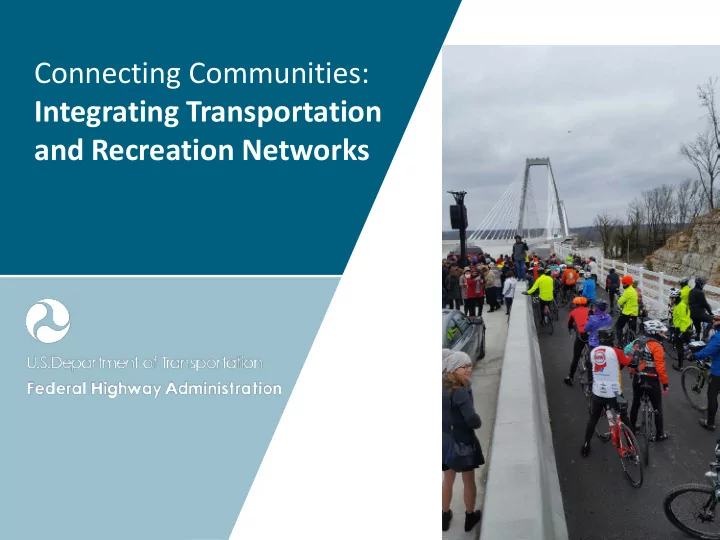
Connecting Communities: Integrating Transportation and Recreation - - PowerPoint PPT Presentation
Connecting Communities: Integrating Transportation and Recreation Networks USDOT Strategic Plan for FY 2018-2022 GOALS Safety Reduce Transportation-Related Fatalities and Serious Injuries Across the Transportation System. Infrastructure
2
USDOT Strategic Plan for FY 2018-2022
GOALS Safety
- Reduce Transportation-Related Fatalities and Serious Injuries Across
the Transportation System. Infrastructure
- Invest in Infrastructure to Ensure Mobility and Accessibility and to
Stimulate Economic Growth, Productivity, and Competitiveness for American Workers and Businesses. Innovation
- Lead in the Development and Deployment of Innovative Practices and
Technologies that Improve the Safety and Performance of the Nation's Transportation System. Accountability
- Serve the Nation with Reduced Regulatory Burden and Greater
Efficiency, Effectiveness, and Accountability.
3
FHWA Achieving Multimodal Networks: Applying Design Flexibility and Reducing Conflicts
Bicyclists
4
National Context
FHWA Programs Support:
- An integrated, safe, accessible, and
convenient transportation system for all
- Connected pedestrian and bicycle
networks
- Design flexibility
- Economic development
- Efficient project development
- Equity, quality of life, and livability
- Multimodal data
- Sustainable transportation policies and
practices
Available at www.fhwa.dot.gov/environment/bicycle_pedestrian
6
Connecting Communities: Integrating Transportation and Recreation
- We can connect and integrate transportation and
recreation infrastructure.
- Trails: spines for transportation networks.
- Transportation and Recreation isn’t either/or!
7
Bridges and Tunnels: Essential Links for Networks
- Long life spans: Plan for future demand, use, and reuse.
- Bridges connect communities.
8
Bridges and Tunnels: Essential Links for Networks
- Reconnect communities.
- Tunnels and underpasses.
9
Recreational trails used for transportation
- Rail-trails and other shared use paths.
- No Federal law or regulation requires pavement,
(accessibility requires “firm and stable”).
- No Federal law or regulation prohibits equestrian use.
10
Recent FHWA Pedestrian and Bicycle Resources
See www.fhwa.dot.gov/environment/bicycle_pedestrian
11
Small Town and Rural Multimodal Networks
- Bicycle and pedestrian design
in a rural context.
- Encourages innovation in
development of safe and appealing networks for bicycling and walking.
- Examples of peer communities
and project implementation.
12
Connected Networks
13
- Provide design flexibility, while
reducing multimodal conflicts and achieving connected networks
- Help practitioners address
topics such as:
– Intersection design – Road diets – Pedestrian crossing treatments – Transit and school access – Freight – Accessibility
Achieving Multimodal Networks: Applying Design Flexibility and Reducing Conflicts
14
15
16
17
Coming Soon ! Coming Soon !
Top Strategies for Accelerating Multimodal Infrastructure Delivery
Proven Safety Countermeasures
safety.fhwa.dot.gov/provencountermeasures
19
Ongoing Research Projects
FHWA has the following research projects underway:
- Every Day Counts /Community Connections Initiative
- Safe Transportation for Every Pedestrian (STEP)
- MySidewalk mobile app
- Rails-with-Trails Effective Practices
- Top Strategies for Accelerating Multimodal Infrastructure Delivery
- Bicycle and Pedestrian Case Studies on project streamlining
20
Integrating Transportation and Recreation: Resources
Shared Use Path presentation: www.fhwa.dot.gov/environment/bicycle_pedestrian/guid ance/design_guidance/design_nonmotor/shared/ Recreational Trail presentation: www.fhwa.dot.gov/environment/bicycle_pedestrian/guid ance/design_guidance/design_nonmotor/recreation/
21
Youth Corps and Workforce Development
- DOT encourages States to have contracts and cooperative
agreements with qualified Youth Service and Conservation Corps.
- Corps work on recreational trails, pedestrian and bicycle
projects, safe routes to school.
- Corps provide workforce development training.
- Agencies can sole source to qualified Corps.
- https://www.fhwa.dot.gov/environment/transportation_alternatives/
guidance/youth_workforcedev.cfm
22
Useful FHWA Websites
- USDOT Bicycle/Pedestrian Website
- https://www.transportation.gov/bicycles-pedestrians
- Pedestrian and Bicycle Information Center
- http://www.pedbikeinfo.org/
- FHWA Office of Safety Website
- https://safety.fhwa.dot.gov/ped_bike/
- FHWA Office of Planning Website
- https://www.fhwa.dot.gov/environment/bicycle_pedestrian/
- FHWA Accessibility Website
- https://www.fhwa.dot.gov/accessibility/
- FHWA Federal-aid Essentials for Local Public Agencies
- https://www.fhwa.dot.gov/federal-aidessentials/index.cfm
23
FHWA Contacts
Divisions: https://www.fhwa.dot.gov/about/field.cfm Local contacts:
Chandra Inglis-Smith WV Division Planner Chandra.Inglis-Smith@dot.gov Shaneka Owens WV Division Safety Engineer Shaneka.Owens@dot.gov Matt Daly WV Division Area Engineer Matt.Daly@dot.gov
National contacts:
Christopher Douwes Office of Planning, Environment, and Realty Christopher.Douwes@dot.gov Cathy Satterfield, P.E. & Gabriel Rousseau Office of Safety Cathy.Satterfield@dot.gov or Gabe.Rousseau@dot.gov Dave Kirschner Office of Operations (MUTCD) David.Kirschner@dot.gov Elizabeth Hilton Office of Infrastructure Elizabeth.Hilton@dot.gov