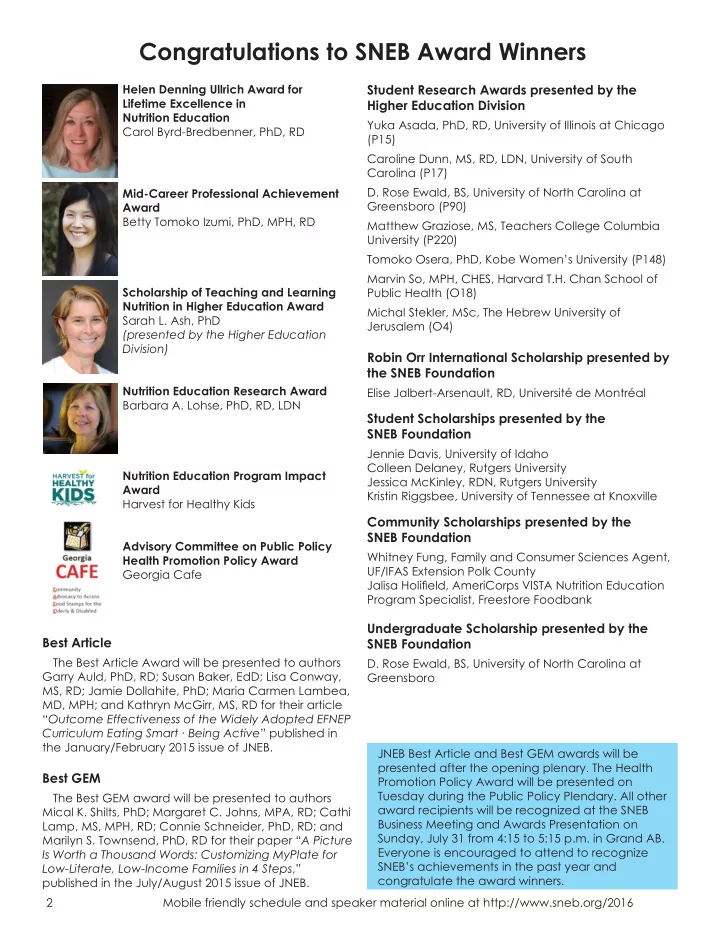
Congratulations to SNEB Award Winners Helen Denning Ullrich Award - - PDF document

congratulations to sneb award winners
SMART_READER_LITE
LIVE PREVIEW

Congratulations to SNEB Award Winners Helen Denning Ullrich Award - - PDF document

Congratulations to SNEB Award Winners Helen Denning Ullrich Award for Student Research Awards presented by the Lifetime Excellence in Higher Education Division Nutrition Education Yuka Asada, PhD, RD, University of Illinois at Chicago Carol


slide-1
SLIDE 1

2 Mobile friendly schedule and speaker material online at http://www.sneb.org/2016

Congratulations to SNEB Award Winners

Helen Denning Ullrich Award for Lifetime Excellence in Nutrition Education Carol Byrd-Bredbenner, PhD, RD Mid-Career Professional Achievement Award Betty Tomoko Izumi, PhD, MPH, RD Scholarship of Teaching and Learning Nutrition in Higher Education Award Sarah L. Ash, PhD (presented by the Higher Education Division) Nutrition Education Research Award Barbara A. Lohse, PhD, RD, LDN Nutrition Education Program Impact Award Harvest for Healthy Kids Advisory Committee on Public Policy Health Promotion Policy Award Georgia Cafe

Best Article

The Best Article Award will be presented to authors Garry Auld, PhD, RD; Susan Baker, EdD; Lisa Conway, MS, RD; Jamie Dollahite, PhD; Maria Carmen Lambea, MD, MPH; and Kathryn McGirr, MS, RD for their article “Outcome Effectiveness of the Widely Adopted EFNEP Curriculum Eating Smart ∙ Being Active” published in the January/February 2015 issue of JNEB.

Best GEM

The Best GEM award will be presented to authors Mical K. Shilts, PhD; Margaret C. Johns, MPA, RD; Cathi Lamp, MS, MPH, RD; Connie Schneider, PhD, RD; and Marilyn S. Townsend, PhD, RD for their paper “A Picture Is Worth a Thousand Words: Customizing MyPlate for Low-Literate, Low-Income Families in 4 Steps,” published in the July/August 2015 issue of JNEB.

Student Research Awards presented by the Higher Education Division

Yuka Asada, PhD, RD, University of Illinois at Chicago (P15) Caroline Dunn, MS, RD, LDN, University of South Carolina (P17)

  • D. Rose Ewald, BS, University of North Carolina at

Greensboro (P90) Matthew Graziose, MS, Teachers College Columbia University (P220) Tomoko Osera, PhD, Kobe Women’s University (P148) Marvin So, MPH, CHES, Harvard T.H. Chan School of Public Health (O18) Michal Stekler, MSc, The Hebrew University of Jerusalem (O4)

Robin Orr International Scholarship presented by the SNEB Foundation

Elise Jalbert-Arsenault, RD, Université de Montréal

Student Scholarships presented by the SNEB Foundation

Jennie Davis, University of Idaho Colleen Delaney, Rutgers University Jessica McKinley, RDN, Rutgers University Kristin Riggsbee, University of Tennessee at Knoxville

Community Scholarships presented by the SNEB Foundation

Whitney Fung, Family and Consumer Sciences Agent, UF/IFAS Extension Polk County Jalisa Holifjeld, AmeriCorps VISTA Nutrition Education Program Specialist, Freestore Foodbank

Undergraduate Scholarship presented by the SNEB Foundation

  • D. Rose Ewald, BS, University of North Carolina at

Greensboro JNEB Best Article and Best GEM awards will be presented after the opening plenary. The Health Promotion Policy Award will be presented on Tuesday during the Public Policy Plendary. All other award recipients will be recognized at the SNEB Business Meeting and Awards Presentation on Sunday, July 31 from 4:15 to 5:15 p.m. in Grand AB. Everyone is encouraged to attend to recognize SNEB’s achievements in the past year and congratulate the award winners.

slide-2
SLIDE 2

10 Mobile friendly schedule and speaker material online at http://www.sneb.org/2016 Helen Denning Ullrich Award for Lifetime Excellence in Nutrition Education Carol Byrd-Bredbenner, PhD, RD, FAND The Helen Denning Ullrich Award for Life- time Excellence in Nutrition Education recog- nizes an outstanding member of SNEB who has signifjcantly contributed to the fjeld of nutrition education and promotion through-

  • ut their career including a record of service

to the Society. The award is named in honor

  • f Helen Denning Ullrich, a loyal member of

the Society and the fjrst editor of the Journal

  • f Nutrition Education and Behavior.

This year’s esteemed recipient is Carol Byrd-Bredbenner, PhD, RD, FAND, Professor of Nutrition/Extension Specialist, Co-Direc- tor of the Nutritional Sciences Graduate Program, and a Fellow of the Institute of Food, Nutrition, and Health at Rutgers University.

  • Dr. Byrd-Bredbenner has been a dedicated researcher, educator

and leader in the nutrition education fjeld for over 30 years. Her research focuses on nutrition education and health promotion with the goal of effecting behavior changes that prevent negative out- comes and promote healthy lifestyles. She leads a team charged to explore intrapersonal, interpersonal, and environmental factors that affect nutrition and health behaviors using a polytheoretical socio- ecological approach. The purpose of her work is to describe these factors, investigate their impact on dietary choices and health, exam- ine how they can be modifjed or mediated to change behaviors to result in healthier lifestyles, expand understanding of the theoretical underpinnings of nutrition education, develop recommendations to improve nutrition education intervention effectiveness, and/or vali- date the recommendations via theory-driven educational program and material design, implementation, and evaluation. Carol’s passion for nutrition education and research is evident through her many programs and publications. Throughout her ca- reer, Dr. Byrd-Bredbenner has been actively engaged in creating ma- terials to translate nutrition science into educational programming for all life stages. One example is her role as lead author of Perspec- tives in Nutrition. Since 2008, Carol has overseen the modifjcation

  • f the text in order to make it more accessible to the learning styles
  • f today’s students, expertly guiding it through three editions. This

textbook is used in nutrition courses at nearly 200 institutions of higher education across the U.S. This book has since been translated into Spanish, Chinese, and Korean and is used to teach the next generation of nutrition professionals worldwide. “It is exciting to think of the tens of thousands of students around the world with whom she has shared her expertise,” Virginia “Ginger” Quick, PhD, RD, wrote of this literary accomplishment. “Writing a textbook of this size and scope is an enormous undertaking.”

  • Dr. Byrd-Bredbenner was truly a trailblazer in nutrition education

computer software. Carol published her fjrst program in 1981 for an Apple II computer. The program, dubbed Apple Pie, is a series

  • f seven nutrition education software packages created for grades 5

through 12. Today, her Apple Pie programs are widely used in fam- ily and consumer science classrooms throughout the country. Food composition and nutrient analysis software are another interest of

  • Dr. Byrd-Bredbenner’s. Carol co-authors You Are What You Eat

and FoodWorks nutrient analysis software packages which support both nutrition education and research programs in 46 countries. Moreover, she led the development of software used to evaluate home food supplies and conducted the most comprehensive audit

  • f home food supplies in over three decades. The results of this

software were used to inform the development of nutrition educa- tion interventions designed to help family food gatekeepers “make

  • ver” their home food supplies to reduce the risk of obesity for

their families. Her nutrition education programs have received numerous awards for their excellence and vast impact. Carol and collabora- tors received the Professional Skill Award from the Association for Communication Excellence in Agriculture, Natural Resources, and Life and Human Sciences. Her innovative Know Before You Serve and Ask Before You Eat programs received the American Dietetic Association’s Anita Owen Award for Innovative Nutrition Educa- tion Programs for the Public. Dr. Byrd-Bredbenner’s work with food allergies extends to the National Institutes of Health, National Institute of Allergies and Infectious Disease Expert Panel to create guidelines for the diagnosis and management of food allergy.

  • Dr. Byrd-Bredbenner has been active within JNEB for decades

as an Editorial Board Member (1986-1992; 2000-2008), Ad Hoc Reviewer (1993-1999; 2008 to present), a member of the Journal Committee (2009-2013), and guest co-editor of one of the fjrst special issues of JNEB (Computers in Nutrition Education, June 1984). When asked what changes she has observed in the fjeld of nutri- tion education over the past 30 years, she wrote, “So much has changed for the better! We have greatly advanced our understand- ing of why consumers eat what they do and how applying theory- based behavior change strategies can help consumers shift toward healthier lifestyles. We have built a tremendous cadre of highly skilled professionals dedicated to improving the way the world eats. Our collaborations with other fjelds, like psychology, marketing, and communications, continue to grow and advance our work. We have so many new and exciting ways to reaching consumers that were not even conceived of just a couple of decades ago. It is exciting to think where we’ll be in the coming years—I am looking forward to being a part of it! To emerging educators Carol gives this advice, “Join SNEB, get actively involved, read every issue of JNEB, network with col- leagues, and share your accomplishments so others can apply them in their nutrition education and health promotion efforts.” Carol adds, “I am so delighted to receive this honor named for Helen Denning Ullrich—she was truly a passionate pioneer and visionary who greatly advanced the fjeld of nutrition education. Receiving this award is truly a refmection of the work of many—my wonderful students, colleagues, and family—without them, this would not be possible! Thank you all!”

Congratulations SNEB Award Winners

slide-3
SLIDE 3

11 SNEB Mid-Career Achievement Award Betty Tomoko Izumi, PhD, MPH, RD

  • Dr. Betty Tomoko Izumi has been contribut-

ing to building the evidence base for link- ing food systems and public health through projects that shorten the food chain and con- nect food producers to consumers since her doctoral studies at Michigan State in the mid-

  • 2000s. For the past six years, she has served as

Principal Investigator for Harvest for Healthy Kids, a collaborative nutrition intervention project with Mt. Hood Community College (M.H.C.C.), Head Start and Early Head Start to promote fruit and vegetable intake among low-income children. Harvest for Healthy Kids is being honored this year with the SNEB Program Impact Award. Since joining the School of Community Health faculty at Port- land State University in 2010, Betty has secured more than $3.5 mil- lion in extramural funding to support projects for which she serves as Principal or Co-Investigator. These projects have made impor- tant contributions in three overlapping areas of nutrition education: nutrition education interventions in early care and preschool educa- tion settings; linking food systems and public health; and measuring snack availability and quality at retail food environments. As Dr. Izumi refmects on her involvement with SNEB she wrote, “SNEB is where I met the colleagues and friends who have inspired me in my career. I wouldn’t be where I am today without their support and encouragement. Getting involved with SNEB in vari-

  • us capacities over the years has helped me to stay connected and
  • grounded. The opportunities have been fun and rewarding!”

She also offers this advice to nutrition educators early in their careers, “Collaborate with your audience to develop programs and

  • policies. Your audience best understands the issue at hand and can

make important contributions to the solution:” Nutrition Education Research Award Barbara Lohse, PhD, RDN

  • Dr. Barbara Lohse is internationally rec-
  • gnized for her exemplary contributions in

the fjeld of nutrition education. Dr. Lohse currently serves as Head of the Wegmans School of Health and Nutrition at the Roch- ester Institute of Technology, overseeing the Nutrition Management and Exercise Science

  • departments. As Head, Barbara is develop-

ing an innovative nutrition program and is creating new graduate programs, using new technology and progressive educational tech-

  • niques. Dr. Lohse brings the Nutrition Education Engineering and

Designs Center (NEEDs) with her to this new leadership position. NEEDs is home to a variety of programs and services including her impressive body of work in Eating Competence with Ellyn Satter and nutrition education programming for pre-school children and young adults. Her online curriculum for low-income house- holds, About Eating, embodies core constructs of the Satter Eating Competence model. Throughout her extensive career, Dr. Lohse has received fund- ing for nearly 50 research and educational projects. The nationally competitive grants she obtained were used to develop and test new approaches to nutrition education for young adults. In all, she has secured more than 20 million dollars in funding for nutrition educa- tion research. One of Dr. Lohse’s current projects is the USDA NIFA funded research programs in collaboration with colleague Leslie Cunningham-Sabo, PhD, RDN. In her role as Research Professor and Senior Instructor at The Pennsylvania State Univer- sity, Dr. Lohse led the annual SNAP-Ed funded research programs.

  • Dr. Lohse continues to advance nutritional and behavioral fjelds

through cutting-edge approach and technique. As put by Susan Nitzke, PhD, past collaborator at the University of Wisconsin- Madison, “With Barbara’s help and leadership, we were able to adapt and test theoretical frameworks based on previous studies in educational psychology, making a signifjcant contribution to this aspect of behavioral nutrition.”

  • Dr. Lohse works diligently to advance the understanding of

factors that infmuence eating behaviors. This is evident through her extensive list of publications. Dr. Lohse began publishing her re- search in the late 1980s, with an article describing the results of her master’s thesis on the therapeutic effjcacy of a hyperimmune bovine colostrum treatment for multiple sclerosis. She has since published 54 peer-reviewed articles in a wide variety of prestigious journals, including Appetite, Journal of the Academy of Nutrition and Dietetics, the International Journal of Behavioral Nutrition and Physical Activity, and Journal of Nutrition Education and Behavior (JNEB). Her stellar publi- cation record for JNEB earned her platinum author recognition this past year.

  • Dr. Lohse offered this advice for nutrition education researchers,

“Successful research requires creativity and perseverance. Consider how you can translate technologies, strategies, and issues from many disciplines for use in nutrition education research. Read and view many types of publications and presentations on a variety of topics and not just science and not only nutrition science. Accept failure and learn from it. Keeping committed to your research goals is es-

  • sential. She lists the following promising research areas:

1. Use of technologies to develop innovative nutrition educa- tion programs and transform novel assessment techniques (e.g., real time evaluation) into standard practices. 2. Identifjcation and evaluation of skills, competencies, and at- tributes that foster capable and effective nutrition educators. 3. Framing nutrition education as more than what and how much to eat, but rather how to approach the eating experi- ence and integrate it with lifestyle, values, and resources to contribute to a healthy society (i.e,, an eating competent society). Develop this frame for parents and carers of young children to carry to future generations. In closing she adds, SNEB is the place to fjnd, connect with, and collaborate with professionals engaged in nutrition education

  • behavior. SNEB is the home of nutrition education. If you are

just starting, in the middle or established in your career in nutrition education, the phrase, Come Home. Come to SNEB, will resonate.

slide-4
SLIDE 4

12 Mobile friendly schedule and speaker material online at http://www.sneb.org/2016 Nutrition Education Program Impact Award Harvest for Healthy Kids Harvest for Healthy Kids is a theory- based (i.e. Social Cognitive Theory) program developed by Mt. Hood Community College (MHCC) Head Start and Portland State Uni- versity to promote fruit and vegetable intake among 3-5 year olds in early care and educa- tion settings. Each month, a target fruit or vegetable is featured twice a week in Head Start meals and classroom activities (e.g. cooking, sensory exploration). To promote its successful implemen- tation, the Harvest for Healthy Kids curriculum is aligned with the Head Start Child Development and Early Learning Framework and each activity is designed to assess multiple areas of child develop- ment and learning. Five years after developing the program, MHCC Head Start continues to feature target foods twice a week in meals and teachers continue to use Harvest for Healthy Kids activities to meet weekly nutrition education and monthly classroom cooking requirements. Harvest for Healthy Kids is included as part of the teachers’ annual pre-service training. Findings from our quasi-experimental evaluation, published in Journal of the Academy of Nutrition and Dietetics, showed that the program had a positive impact on children’s willingness to try and liking of fruits and vegetables (e.g. 44.2% of children liked rutabaga pre-intervention compared with 78.1% post-intervention), two important predictors of intake. Moreover, fjndings from our process evaluation, published in NHSA Dialog, indicated that Head Start teachers found the curriculum to be acceptable, feasible, and easy to understand. Further efforts to disseminate the program beyond MHCC Head Start include a website (www.harvestforhealthykids.org), which provides free access to the curriculum and has over 1,200 registered users; in-person trainings for, to-date, nearly 300 early care and education professionals; and, an online training for early care and education professionals developed by Kansas Child Care Training Opportunities. When asked what the future holds for this program the team responded, “ We are currently focusing our efforts on disseminating the program to early care and education professionals. We are work- ing on the next version of our website and conducting trainings throughout the state of Oregon.” They also offered this advice: 1. Collaborate with your audience from beginning to end, from developing a concept to evaluating your program to dissemi- nation. 2. Build sustainability and institutionalization into your pro- gram from the beginning. 3. Celebrate your successes, no matter how small! Scholarship of Teaching and Learning Nutrition in Higher Education Award Sarah L. Ash, PhD

  • Dr. Ash is Professor of Nutrition at

North Carolina State University were she has been instrumental in improv- ing college student learning, specifjcally in nutrition education. In her many roles both inside and outside of the classroom, Dr. Ash continues to have an impact in her profession and in the lives of students and junior faculty. Dr. Ash’s interest in curriculum devel-

  • pment and innovation began in 1998 when she was appointed

Chair of the Council on Undergraduate Education (CUE), the university’s standing committee that oversees the general education

  • program. This led her to become one of the founding members
  • f the Hewlett Initiative, which began as a two-year planning grant

from the Hewlett Foundation, designed to improve the university’s general education program. As a founding member, Sarah provided signifjcant leadership in promoting faculty development around critical thinking and in the development of their First Year Inquiry freshman seminar program.

  • Dr. Ash continues to act as a leader within the university. She

served for three years on a task force to evaluate the university’s general education requirements, which led to a new General Educa- tion Program that places greater emphasis on examining complex issues through an interdisciplinary lens. Dr. Ash then became a member of the Chancellor’s Task Force on Undergraduate Suc- cess, charged with developing a series of initiatives to increase the success of undergraduate students. Most recently, she has provided leadership in creating the university’s 10-year Quality Enhancement Plan, designed to expand the use of critical and creative thinking beyond the general education program. In 2005, Dr. Ash became the Undergraduate Coordinator of the Nutrition Program, providing leadership in further refjning a curriculum that was fjrst created from a major within Biological

  • Sciences. She developed a new concentration with greater fmexibility

to appeal to a wider range of students and to make it easier for stu- dents to obtain their dietetic certifjcation after gradation. The major has since grown from approximately 100 students in 2005, to over 300 students today.

  • Dr. Ash’s undeniable impact is not limited to undergraduate stu-
  • dents. Sarah developed an active program of scholarship in service-

learning, particularly the role of critical refmection in enhancing learning outcomes, and along with colleagues, developed a nation- ally recognized refmection model designed to produce high quality written products using a rigorous framework. Aspects of this work have formed the basis for many frequently cited publications and invitations to present at national and international meetings and to consult at college campuses. Colleague and faculty fellow L. Suzanne Goodell, PhD, RDN, recently wrote on Dr. Ash’s contribu- tions to faculty development, saying “There are many junior teach- ing faculty in our department who look to Sarah for sage advice

  • n curriculum design,” she writes. “Her openness and candor are

appreciated by all.”

slide-5
SLIDE 5

13 Always the teacher, Dr. Ash has ensured the continued growth of the Society by educating faculty and peers about the organization, then encouraging them to join SNEB and volunteer to serve. As a senior member of SNEB, she has enlisted colleagues to volunteer and get involved with the organization and has most recently pro- vided leadership in the development of the Society’s list of compe- tencies for Nutrition Educators. In recognition of her extraordinary accomplishments, Dr. Ash was awarded the Board of Governors Award of Excellence in Teaching in 2011, the highest honor granted to an educator in the UNC System. Dr. Ash is guided by her philosophies of under- standing why things are; the limitations of knowledge; interactions between science and society; and the importance of her role in this

  • discipline. With a progressive approach, Dr. Ash is dedicated to and

passionate about higher education, leadership, and service to the Society. ACPP Health Promotion Policy Award Georgia CAFE SNEB announces Georgia Community Advocacy to Access Food Stamps for the Elderly and Disabled (Georgia CAFE), as the recipient of the 2016 Health Promotion Policy Award in Nutrition Education Georgia CAFE provides SNAP application assistance to low-income older adults and the disabled in Georgia through community advocate training as well as policy advocacy to streamline SNAP application processes. Since its inception in 2011, the goal of CAFE has been to enhance access to healthy affordable food and food purchasing power of the neediest benefjciaries. The Georgia CAFE project, led by Dr. Jung Sun Lee in the De- partment of Foods and Nutrition at the University Georgia (UGA), is the fjrst-ever UGA-Community-Government Collaborative Project to help low-income older Georgians access food through as- sistance in obtaining benefjts from SNAP. Georgia CAFE has been training more than 100 SNAP advocates and the training models now serve low-income older Georgians in nearly 30 urban and rural counties in Georgia to help them apply and receive SNAP benefjts. Older adults traditionally have lower rates of participation in SNAP than other age groups. In her nomination of Georgia CAFE,

  • Dr. Jung Sun Lee writes, “Typically only one-third of eligible older

adults participate in SNAP compared to 67% of all eligible indi- viduals,” she noted. “Various barriers have been identifjed in the application process, including technology, stigma, confusion about eligibility, and a complicated application process.” The Georgia CAFE project showcases the success of a unique university-community-government partnership model which was critical to create evidence-based strategies for guiding nutrition and aging services and policy decisions and to improve the food security and nutritional well-being of vulnerable older Georgians. The Health Promotion Award is given annually to recognize the efforts of others to shape and promote healthy policies. These awards are given to individuals or groups that have contributed sig- nifjcantly at creating or implementing policies that positively impact health and physical activity.