Congenital Anorectal Disorders I have nothing to disclose Lan Vu, - - PowerPoint PPT Presentation

congenital anorectal disorders i have nothing to disclose
SMART_READER_LITE
LIVE PREVIEW

Congenital Anorectal Disorders I have nothing to disclose Lan Vu, - - PowerPoint PPT Presentation

3/8/2014 Congenital Anorectal Disorders I have nothing to disclose Lan Vu, MD Assistant Professor of Surgery Division of Pediatric Surgery University of California, San Francisco Anorectal malformation Epidemiology: 1 in 5,000 live births


slide-1
SLIDE 1

3/8/2014 1

Congenital Anorectal Disorders

Lan Vu, MD Assistant Professor of Surgery Division of Pediatric Surgery University of California, San Francisco

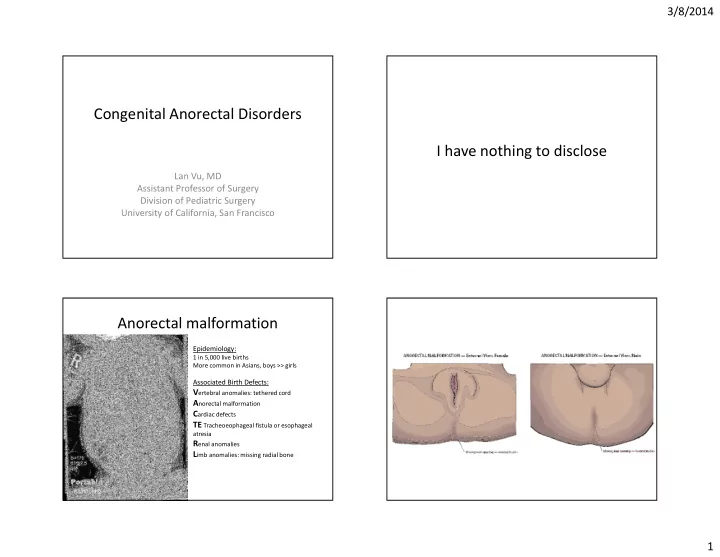
I have nothing to disclose Anorectal malformation

Epidemiology:

1 in 5,000 live births More common in Asians, boys >> girls

Associated Birth Defects:

Vertebral anomalies: tethered cord Anorectal malformation Cardiac defects TE Tracheoeophageal fistula or esophageal

atresia

Renal anomalies Limb anomalies: missing radial bone

slide-2
SLIDE 2

3/8/2014 2

Rectum connects to vaginal opening

Key points for colostomy:

  • 1. At the level of

descending colon: allow for enough length for future pull-through procedure

  • 2. Double barrel stomas:

prevent stool spillage into the blind-ending rectum or into urinary fistula

slide-3
SLIDE 3

3/8/2014 3 Posterior Sagittal Anorectoplasty (PSARP), Alberto Pena (1980) Laparoscopic assisted anorectal pull-through (LAARP), K Georgeson (2000) Refocus: From changing surgical techniques to defining markers of clinical postoperative outcomes and improving postoperative management

Fecal Incontinence

  • Definition: “repetitive (voluntary or

involuntary) passage of stool in inappropriate places by children four years of age and older, at which time a child may be reasonably expected to have completed toilet training and to exercise bowel control”

slide-4
SLIDE 4

3/8/2014 4

Postoperative function and Quality of Life

  • Poor for high ARM, good for low ARM
  • QOL correlates with fecal continence
  • Distinguishing “pseudoincontinence” from

constipation from “true incontinence”

Diagnostic studies to evaluate anatomy and function

  • 34 ARM patients (fecal incontinence)
  • feasibility study to evaluate pelvic anatomy
  • no correlation with clinical management
  • Limitations:
  • Need MRI standards for normal pelvic anatomy
  • Justification of cost
  • 17 ARM patients
  • IAS disruption and pressure > 20 mm Hg

biofeedback and laxatives

  • absence of IAS and pressure < 20 mm Hg

daily enemas

  • Limitations: feasibility of study at young age

Long-term function

  • Australia, 2007: series of 167 patients with ARM from 1982 to 2000

(only 84 patients responded to questionnaires)

  • Soiling problems in 86%, 79%, and 43% (high, intermediate, and

low malformation)

  • Constipation 62%, abdominal pain 49%
  • Behavioral problems 80% (15% suicidal ideation)
  • Pena et al, 2000: series of 1192 patients over 19 years
  • only 38% totally continent
  • 25% suffered fecal incontinence
  • bowel management program to improve quality of life (95%

success)

  • 1. Daily enemas to clean patients with constipation
  • 2. Constipating diet or medication for those with fecal incontinence
  • Continence dependent on level of malformation
  • Stooling problems continue into adolescence
  • Importance of follow-up and bowel management program
slide-5
SLIDE 5

3/8/2014 5

  • 175 patients with ARM (4-17 years)
  • 12%: did not know level of anomaly
  • 33% had bowel management program
  • started at mean age of 3.5 yrs)
  • 50% improved QOL
  • 35% small improvements
  • 10% no improvement

Take-home points

  • VACTERL association
  • Colostomy needs to leave adequate distal

length for future pull-through procedure

  • Long-term quality of life correlates with fecal

continence

  • Early education and initiation of bowel

management program: distinguishing pseuodo-incontinence from true incontinence.