Confronting Suburban Poverty Challenges and Solutions for the Denver - - PowerPoint PPT Presentation

confronting suburban poverty
SMART_READER_LITE
LIVE PREVIEW

Confronting Suburban Poverty Challenges and Solutions for the Denver - - PowerPoint PPT Presentation

Confronting Suburban Poverty Challenges and Solutions for the Denver region Elizabeth Kneebone Brookings Institution Since 2009, the Metropolitan Opportunity Series has tracked the changing geography of poverty and opportunity in nations


slide-1
SLIDE 1

Elizabeth Kneebone Brookings Institution
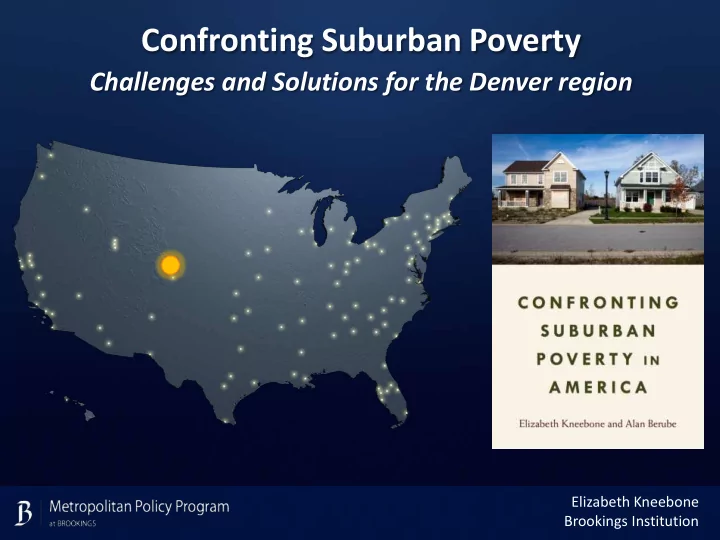
Confronting Suburban Poverty

Challenges and Solutions for the Denver region

slide-2
SLIDE 2

Seattle SF Bay Area LA-Riverside Denver Houston Atlanta Chicago Detroit Cleveland Pittsburgh Washington DC

Since 2009, the Metropolitan Opportunity Series has tracked the changing geography of poverty and opportunity in nation’s largest metro areas

slide-3
SLIDE 3

1

The geography of poverty and

  • pportunity has changed

Current policies are not aligned to this new geography

2 3

We need a new agenda for metropolitan opportunity

slide-4
SLIDE 4

The geography of poverty and opportunity has changed

1

slide-5
SLIDE 5

Today, more poor residents live in suburbs than in cities

Number in poverty, 1970-2012. Source: Brookings analysis of U.S. Census Bureau data

2,000,000 4,000,000 6,000,000 8,000,000 10,000,000 12,000,000 14,000,000 16,000,000 18,000,000

1970 1980 1990 2000 2012

Suburbs Cities

slide-6
SLIDE 6

The number of poor residents in the metro outside of Denver and Aurora grew by 131 percent between 2000 and 2012

Source: Brookings analysis of U.S. Census Bureau data

slide-7
SLIDE 7

Several factors drive the changing geography of poverty

Population Change Immigration Housing Job Location Regional Economy

slide-8
SLIDE 8

Suburban poverty brings added challenges

Transit Access Strained Local Services Limited Philanthropic Resources Change in School Populations

slide-9
SLIDE 9

Current policies are not aligned to this new geography

2

slide-10
SLIDE 10

The legacy system of place-based anti-poverty programs does not map easily onto the suburban landscape $82 billion 81 federal programs 10 agencies

slide-11
SLIDE 11

Suburbs face additional challenges

Lack of Capacity Inflexible, Unreliable Funding Extensive Fragmentation

slide-12
SLIDE 12

3

We need a new agenda for metropolitan opportunity

slide-13
SLIDE 13

Yet innovators across the country are finding creative ways to navigate this system

slide-14
SLIDE 14
slide-15
SLIDE 15

Achieve Scale Collaborate and Integrate Fund Strategically

Regional innovators are making limited resources stretch further to help more people and places by finding ways to:

slide-16
SLIDE 16

Achieve Scale Collaborate and Integrate Fund Strategically

Supporting smart consolidation Streamlining systems and networks Working with high-performance organizations Reducing barriers Building regional capacity Rewarding these approaches

Moving toward enterprise-level funding Using tools that leverage public & private resources Collecting and analyzing data to drive decisions

How can regional leaders in Denver promote these kinds of strategies by:

slide-17
SLIDE 17

Creating a Metropolitan Opportunity Challenge could help bring these solutions to scale in regions across the country

Federal Place-Based Anti-Poverty Programs

$82 Billion; 81 Programs; 10 Agencies

Re-purpose 5% : $4 billion

slide-18
SLIDE 18

www.ConfrontingSuburbanPoverty.org

You can read more about the Metropolitan Opportunity Challenge and the contents of the book on our new website

slide-19
SLIDE 19

The website provides a host of helpful resources:

Profiles of the top 100 metros Case studies of innovators Tips for taking action Video Infographic

slide-20
SLIDE 20

ekneebone@brookings.edu