Conflict of Interest Disclosure From Small Rural Clinic to Modern - - PDF document

conflict of interest disclosure from small rural clinic
SMART_READER_LITE
LIVE PREVIEW

Conflict of Interest Disclosure From Small Rural Clinic to Modern - - PDF document

3/12/19 Conflict of Interest Disclosure From Small Rural Clinic to Modern Patient Centered I have no financial relationships with commercial Medical Home entities that produce health care-related products or services relevant to the content I


slide-1
SLIDE 1

3/12/19 1

From Small Rural Clinic to Modern Patient Centered Medical Home

Matthew Libby, DO, FAAFP Medical Director, Harwich Port Health Center Clinical Director of Informatics Outer Cape Health Services, Inc.

redesigning team structures, workflows, and space during a time of transition and expansion

Conflict of Interest Disclosure

I have no financial relationships with commercial entities that produce health care-related products or services relevant to the content I am planning, developing, or presenting.

Objectives

ØBe able to define core components of a successful team-based care model ØIdentify key steps in implementing systems changes using a Pilot Team ØUnderstand how team-based care can support Quadruple Aim healthcare improvement goals ØExplore challenges with scaling up local changes across an organization

Outline

ØWho is Outer Cape Health Services? ØIdentify motivations to change care model ØForming a pilot team and changing workflows ØExploring effect on Quadruple Aim outcomes ØDesigning new workspaces around the model ØScaling up changes to a multi-site system ØNew challenges and future directions

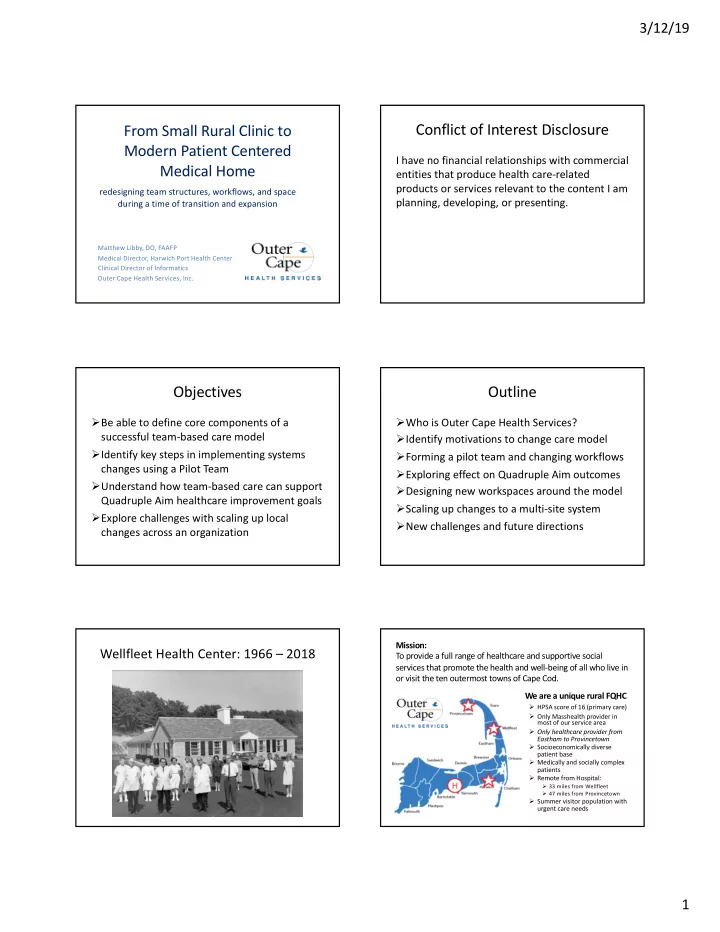
Wellfleet Health Center: 1966 – 2018

Mission: To provide a full range of healthcare and supportive social services that promote the health and well-being of all who live in

  • r visit the ten outermost towns of Cape Cod.

We are a unique rural FQHC

Ø HPSA score of 16 (primary care) Ø Only Masshealth provider in most of our service area Ø Only healthcare provider from Eastham to Provincetown Ø Socioeconomically diverse patient base Ø Medically and socially complex patients Ø Remote from Hospital:

Ø 33 miles from Wellfleet Ø 47 miles from Provincetown

Ø Summer visitor population with urgent care needs

slide-2
SLIDE 2

3/12/19 2

Motivation for Change

ØChallenges with burnout and retention ØChallenges with recruitment ØNeed for expansion

ØMeet community need ØFinancial sustainability

ØNeed for updating outdated facilities ØPayment landscape is changing ØTechnology capabilities are improving

Quadruple Aim

Improve Patient Experience Improve health of population Lower cost

  • f care

Improve staff engagement

Team-Based Care

Schottenfeld L, Petersen D, Peikes D, Ricciardi R, Burak H, McNellis R, Genevro J. Creating Patient-Centered Team-Based Primary Care. AHRQ Pub. No. 16-0002-EF. Rockville, MD: Agency for Healthcare Research and

  • Quality. March 2016.

Original Patient-Centered Medical Home Principles - 2007

Ø Personal physician Ø Physician directed medical practice Ø Whole person orientation Ø Care is coordinated and/or integrated Ø Quality and safety

Ø Evidence-based care Ø Quality improvement Ø Shared decision-making Ø Optimal use of information technology

Ø Enhanced access Ø Payment

Ø Advocated payment for care coordination, telemedicine, etc.

Kellerman R, Kirk L. Principles of the patient-centered medical home. Am Fam Physician. 2007 Sep 15;76(6):774-5.

Starting from Scratch: Empanelment

Mid-Late 2016: empanelment project

Patient

Physician PA/NP

Pre-work: Defining the Team

Mid-Late 2016: empanelment project Nov 2016: Pilot Team formed

Patient

Physician PA/NP MA RN MA

slide-3
SLIDE 3

3/12/19 3

Phase 1: Weekly Team Meetings

Mid-Late 2016: empanelment project Nov 2016: Pilot Team formed

Patient

Physician PA/NP MA RN MA

All team members meet for 30 minutes once a week

Phase 1: Evolving Team Roles

Mid-Late 2016: empanelment project Nov 2016: Pilot Team formed

Patient

Physician PA/NP MA RN MA

Goal: Each team member working to the top of their license

Evolving Team Roles: The Nurse

RN

Care Management Patient Education Vaccine and med admin RN Visits Triage Clinical patient questions Relay test results Prep Rx refills Needs referral No appts available Need records Other random questions

Evolving Team Roles: The Medical Assistant

  • Room patients
  • Perform point of

care testing

  • Obtain records
  • Prompt health

screenings due

  • Run the huddle
  • Patient outreach
  • Complete forms
  • Relay test results
  • Assist the nurses

Phase 1: Co-location

Mid-Late 2016: Empanelment project Nov 2016: Pilot Team formed Jan 2017: Wellfleet colocation

Many Organizational Changes in 2017

Spring 2017: centralized scheduling, medical records, referrals May 2017: new CMO July 2017: Site Medical Director, new schedule templates, panel management time

slide-4
SLIDE 4

3/12/19 4 Many Organizational Changes in 2017

Spring 2017: centralized scheduling, medical records, referrals May 2017: new CMO July 2017: Site Medical Director, new schedule templates, panel management time

Many Organizational Changes in 2017

Spring 2017: centralized scheduling, medical records, referrals May 2017: new CMO July 2017: Site Medical Director, new schedule templates, panel management time

Patient

Physician PA/NP MA RN PSR MA

identify specific patient service representative for each team

Many Organizational Changes in 2017

Spring 2017: centralized scheduling, medical records, referrals May 2017: new CMO July 2017: Site Medical Director, new schedule templates, panel management time Aug 2017: pharmacy call center for refills Sept 2017: first team quality reports

Many Organizational Changes in 2017

Spring 2017: centralized scheduling, medical records, referrals May 2017: new CMO July 2017: Site Medical Director, new schedule templates, panel management time Aug 2017: pharmacy call center for refills Sept 2017: first team quality reports

Updated Quality Program

Metric FY2019 Exclusions Baseline Dec Goal Breast Cancer Screening All Female Patients age 50-74 Bilateral Mastectomy 60% 62% Breast Cancer Screen in last 2 years Z90.13 Hospice Patients Z51.5 Colorectal Cancer Screening All patients Age 50-75 Total Colectomy 64% 66% FIT in last One Year Z90.49 Colonoscopy in last 10 years Hospice Patients Z51.5 Diabetes Control All Diabetics age 18-84 Hospice Patients 67% 69% A1c < 8 is controlled if measured Z51.5 in last one year Gestational Diabetes No result = not controlled O24.419 Pneumoccoccal Vaccination All Patients age 67 and older Allergy to Pneumonia 58% 60% Received BOTH Vaccines: Vaccine Pneumovax 23 Z88.7 Prevnar 13 Well Child Checks All Patients birth to age 20 inclusive None 84% 86% One Preventive Vist in Last 15 months

Pilot Team Refocus 2018

Winter 2018:

  • utreach for well

child and pneumonia vaccine lists Feb-Mar 2018: team develops advanced pre- visit planning checklists April 2018: go live with advanced PVP checklists

slide-5
SLIDE 5

3/12/19 5

Pilot Team Refocus 2018

Winter 2018:

  • utreach for well

child and pneumonia vaccine lists Feb-Mar 2018: team develops advanced pre- visit planning checklists April 2018: go live with advanced PVP checklists

Pilot Team Refocus 2018

Winter 2018:

  • utreach for well

child and pneumonia vaccine lists Feb-Mar 2018: team develops advanced pre- visit planning checklists April 2018: go live with advanced PVP checklists

Pre-visit Planning Checklists Pre-visit Planning Checklists Pilot Team Refocus 2018

Winter 2018:

  • utreach for

well child and pneumonia vaccine lists Feb-Mar 2018: team develops advanced pre-visit planning checklists April 2018: go live with advanced PVP checklists Spring 2018: navigators and care managers join meetings

The Care Team Grows

Patient

Physician PA/NP MA RN RNCM PSR Navigator MA

slide-6
SLIDE 6

3/12/19 6

Pilot Team Refocus 2018

Winter 2018:

  • utreach for

well child and pneumonia vaccine lists Feb-Mar 2018: Team develops advanced pre-visit planning checklists April 2018: go live with advanced PVP checklists Spring 2018: navigators and care managers join meetings May 2018: automated monthly quality reports Summer 2018: Un-blinded data on white board in team room

Quadruple Aim

Improve Patient Experience Improve health of population Lower cost

  • f care

Improve staff engagement

Quadruple Aim

Improve Patient Experience Improve health of population Lower cost

  • f care

Improve staff engagement

What Does the Literature Say?

ØQuestionable Ø“CONCLUSIONS: The PCMH was associated with improvements in patients' experience with access to care but not other domains of care. This study, which took place in a multi-payer community, is

  • ne of the first to find a positive effect of the

PCMH on patient experience.”

Kern LM, Dhopeshwarkar RV, Edwards A, Kaushal R. Patient experience over time in patient-centered medical homes. Close affiliations The American Journal of Managed Care [01 May 2013, 19(5):403-410]

What Does the Literature Say?

ØQuestionable Ø“CONCLUSIONS More than 80% of patients perceived high quality of care in health centers. PCMH attributes related to access to care and communication were associated with greater likelihood of patients reporting high-quality care.”

Lydie A. Lebrun-Harris, PhD, MPH, et.al. Effects of Patient-Centered Medical Home Attributes on Patients’ Perceptions of Quality in Federally Supported Health Centers. Ann Fam Med November/December 2013 vol. 11 no. 6 508-516. 91 92 93 94 95 96 97 201 7 Q2 201 7 Q3 201 7 Q4 201 8 Q1 201 8 Q2

Whole Group Core Provider Measures

Pilot Team All Oute r Cape *Rolling 4 Quarters – started Q2 2017

slide-7
SLIDE 7

3/12/19 7

90 92 94 96 98 100 201 7 Q2 201 7 Q3 201 7 Q4 201 8 Q1 201 8 Q2

Provider Listening

Pilo t Team A ll O u ter Cap e 90 92 94 96 98 100 201 7 Q2 201 7 Q3 201 7 Q4 201 8 Q1 201 8 Q2

Provider Explanation

Pilo t Team A ll O u ter Cap e 90 92 94 96 98 100 201 7 Q2 201 7 Q3 201 7 Q4 201 8 Q1 201 8 Q2

Provider Knowledge of Health History

Pilo t Team A ll O u ter Cap e 90 92 94 96 98 100 201 7 Q2 201 7 Q3 201 7 Q4 201 8 Q1 201 8 Q2

Provider Time Spent

Pilo t Team A ll O u ter Cap e

89 89.5 90 90.5 91 91.5 92 92.5 93 93.5 201 7 Q2 201 7 Q3 201 7 Q4 201 8 Q1 201 8 Q2

Whole Group Provider Influenced Measures

Pilot Team All Oute r Cape *Rolling 4 Quarters – started Q2 2017

82 84 86 88 90 92 94 96 98 100 201 7 Q2 201 7 Q3 201 7 Q4 201 8 Q1 201 8 Q2

Overall Patient Satisfaction

Pilo t Team A ll O u ter Cap e 82 84 86 88 90 92 94 96 98 100 201 7 Q2 201 7 Q3 201 7 Q4 201 8 Q1 201 8 Q2

Provider Wait

Pilo t Team A ll O u ter Cap e 82 84 86 88 90 92 94 96 98 100 201 7 Q2 201 7 Q3 201 7 Q4 201 8 Q1 201 8 Q2

Appointment Wait

Pilo t Team A ll O u ter Cap e 82 84 86 88 90 92 94 96 98 100 201 7 Q2 201 7 Q3 201 7 Q4 201 8 Q1 201 8 Q2

Provider Asst. Courtesy and Helpfulness

Pilo t Team A ll O u ter Cap e

Quadruple Aim

Improve Patient Experience Improve health of population Lower cost

  • f care

Improve staff engagement

Quadruple Aim

Improve Patient Experience Improve health of population Lower cost

  • f care

Improve staff engagement

What Does the Literature Say?

Ø Probably Ø In 19 comparative studies, PCMH interventions had a small positive effect on patient experiences and small to moderate positive effects on the delivery of preventive care services (moderate strength of evidence). Staff experiences were also improved by a small to moderate degree (low strength of evidence). Evidence suggested a reduction in emergency department visits (risk ratio [RR], 0.81 [95% CI, 0.67 to 0.98]) but not in hospital admissions (RR, 0.96 [CI, 0.84 to 1.10]) in older adults (low strength of evidence). There was no evidence for overall cost savings. Ø Limitation: Systematic review is challenging because of a lack of consistent definitions and nomenclature for PCMH.

George L. Jackson, PhD, MHA, et.al. The Patient-Centered Medical Home: A Systematic Review. Ann Intern Med. 2013;158:169-178

slide-8
SLIDE 8

3/12/19 8

What Does the Literature Say?

ØProbably Ø“Conclusion: The PCMH was associated with modest quality improvement. The aspects of the PCMH that drive improvement are distinct from but may be enabled by the EHR.”

Lisa M. Kern, MD, MPH; Alison Edwards, MStat; Rainu Kaushal, MD, MPH. The Patient-Centered Medical Home, Electronic Health Records, and Quality of Care. Ann Intern Med. 2014;160(11):741-749.

What Does the Literature Say?

Ø Probably

Ø “Conclusions and Relevance During a 3-year period, this medical home intervention, which included shared savings for participating practices, was associated with relative improvements in quality, increased primary care utilization, and lower use of emergency department, hospital, and specialty care. With further experimentation and evaluation, such interventions may continue to become more effective.”

Friedberg MW, Rosenthal MB, Werner RM, Volpp KG, Schneider EC. Effects of a Medical Home and Shared Savings Intervention on Quality and Utilization of Care. JAMA Intern Med. 2015;175(8):1362–1368. doi:10.1001/jamainternmed.2015.2047

55% 60% 65% 70% 75% Sep-17 Oct-17 Nov-17 Dec-17 Jan-18 Feb-18 Mar -1 8 Apr-18 May-18 Jun-1 8 Jul-18 Aug-18 Sep-18 Oct-18

Colorectal Cancer Screening Rates

Wellflee t Other Site s 60% 62% 64% 66% 68% 70% 72% 74% 76% 78% Sep-17 Oct-17 Nov-17 Dec-17 Jan-18 Feb-18 Mar -1 8 Apr-18 May-18 Jun-1 8 Jul-18

Well Visit in Last 12 Months, Ages 0 - 20

Wellflee t Other Site s Outreach 50% 55% 60% 65% 70% 75% Jan-18 Feb-18 Mar -1 8 Apr-18 May-18 Jun-1 8 Jul-18 Aug-18 Sep-18 Oct-18

Patients Age 67+ with BOTH pneumonia vaccines

Wellflee t Other Site s Pre-visit Planning Outreach

Quadruple Aim

Improve Patient Experience Improve health of population Lower cost

  • f care

Improve staff engagement

slide-9
SLIDE 9

3/12/19 9

Quadruple Aim

Improve Patient Experience Improve health of population Lower cost

  • f care

Improve staff engagement

What Does the Literature Say?

Ø It probably can – at least for patients with multiple co- morbidities Ø “After accounting for differences at baseline, PCMH practices achieved lower total, inpatient, and specialist PMPM costs, as well as lower relative utilization of hospital admissions and specialist visits… targeting chronically ill patients may be the most effective way to leverage the benefits of PCMH adoption.”

Jason Neal, MA; Ravi Chawla, MBA; Christine M. Colombo, MBA; Richard L. Snyder, MD; and Somesh Nigam, PhD. Medical Homes: Cost Effects of Utilization by Chronically Ill Patients. Am J Manag Care. 2015;21(1):e51-e61

What Does the Literature Say?

Ø It probably can – at least for patients with multiple co- morbidities Ø At the Walter Reed PCMH: “Costs were 11% lower for those with chronic conditions compared to 7% lower for those

  • without. Since treating patients with chronic conditions is 4

times more costly than treating patients without such conditions, the vast majority of dollar savings are attributable to chronic care. Conclusions: Results suggest focusing first on patients with chronic conditions given the greater potential for early gains..”

Eric W. Christensen, Kevin A. Dorrance, Suneil Ramchandani, Sean Lynch, Christine C. Whitmore, Amanda

  • E. Borsky, Linda G. Kimsey, Linda M. Pikulin, Thomas A. Bickett; Impact of a Patient-Centered Medical

Home on Access, Quality, and Cost, Military Medicine, Volume 178, Issue 2, 1 February 2013, Pages 135– 141, https://doi.org/10.7205/MILMED-D-12-00220

Quadruple Aim

Improve Patient Experience Improve health of population Lower cost

  • f care

Improve staff engagement

Quadruple Aim

Improve Patient Experience Improve health of population Lower cost

  • f care

Improve staff engagement

What Does the Literature Say?

ØPromising Ø“Lower burnout may be achieved by medical home models that are appropriately staffed, emphasize participatory decision making, and increase the proportion of time team members spend working to the top of their competency level.”

Helfrich, C.D., Dolan, E.D., Simonetti, J. et al. J GEN INTERN MED (2014) 29(Suppl 2): 659. https://doi.org/10.1007/s11606-013-2702-z

slide-10
SLIDE 10

3/12/19 10

What Does the Literature Say?

Ø Promising Ø “Conclusions and Relevance The extent of PCMH implementation, as measured by the Pi2, was highly associated with important outcomes for both patients and

  • providers. This measure will be used to track the

effectiveness of implementing PACT over time and to elucidate the correlates of desired health outcomes.” Ø Maslach Burnout Inventory emotional exhaustion subscale, 2.29 vs 2.80; P = .02

Nelson KM, Helfrich C, Sun H, et al. Implementation of the Patient-Centered Medical Home in the Veterans Health Administration: Associations With Patient Satisfaction, Quality of Care, Staff Burnout, and Hospital and Emergency Department Use. JAMA Intern Med. 2014;174(8):1350–1358. doi:10.1001/jamainternmed.2014.2488
Quotes from Pilot Team Members:

“Working in our team structure has given each member greater support – we ask each other for help; we offer each other help and it’s not a question of which team member is responsible for a

  • task. We share the responsibility. It’s a good

feeling knowing that you have back up when you need it and often you don’t even need to ask for it – it’s just part of being a strong team.” – Becky Bassett, medical assistant

Quotes from Pilot Team Members:

“I believe the team concept has made getting to know the patients easier, and them knowing us has made them more comfortable.” – Nanette Abeid, RN

Quotes from Pilot Team Members:

“Colocation with my MA and team RN has dramatically improved our team communication, not to mention saved time during patient care.” “Huddling with community navigators and care coordinators has made me feel closer to the Patient Centered Medical Home model more now than ever.” “Seeing our quality metric scores improve and sharing that success with other team members has been the most rewarding.” – Gretchen Eckel, PA-C

Wellfleet Health Center 1966 - 2018 Wellfleet Health Center Design for 2019

slide-11
SLIDE 11

3/12/19 11

Harwich Port Health Center Opened 12/3/2018 Form that supports function Form that supports function

Behavioral Health Clinicians As Team Members

Patient

Physician PA/NP MA RN RNCM PSR BH Clinician Navigator MA

Scaling Up to a Larger Site Scaling Up to Multiple Sites

slide-12
SLIDE 12

3/12/19 12

Challenges with Scaling Up

Challenges Strategies to overcome Getting buy-in from staff Ø Present pilot team results beforehand Ø Invite staff to name the pods/teams Ø Encourage innovation in each team Ensuring the team huddles happen Ø Build schedules around the huddle Ø Invite Navigators, Case Managers Ø Check in regularly for feedback Mismatched FTE ratios or practice scope Ø Larger “pod” concept is more flexible Ø Coverage across teams if needed Ø Team needs inform future hiring Reassignments and turnover of staff Ø Pair new or challenging staff with a clinician leader who is willing to teach Influx of new patients makes quality improvement difficult to demonstrate Ø Robust process for obtaining records Ø Emphasize different goals for new PCPs

Future Goals

ØNCQA Certification – expected by end of 2019 ØQuality

ØExpand quality incentive program to 6 measures ØTrack trends over time at new sites

ØRecruitment

ØStarting 2 physicians and at least 1 AP in 2019 ØMore selective hiring to meet team needs

ØRetention/satisfaction

ØTrack Maslach Burnout Inventory over time ØConsider fully merging physician and AP panels

Recap: Key Steps in Outer Cape’s Implementation

  • 1. Define the teams
  • 2. Prioritize co-location
  • 3. Schedule team meetings every week
  • 4. Job roles: everyone working to top of license
  • 5. Measure population health data
  • 6. Pre-visit planning
  • 7. Outreach by team members
  • 8. Expand the multidisciplinary team

Difficult and sometimes slow work – be persistent!

References

Ø Berwick DM, Nolan TW, Whittington J. The Triple Aim: Care, health, and cost. Health Affairs. 2008 May/June;27(3):759-769. Ø Bodenheimer T, Sinsky C. From triple to quadruple aim: care of the patient requires care of the provider. Ann Fam Med. 2014 Nov- Dec;12(6):573-6. doi: 10.1370/afm.1713. Ø Kellerman R, Kirk L. Principles of the patient-centered medical home. Am Fam Physician. 2007 Sep 15;76(6):774-5. Ø Schottenfeld L, Petersen D, Peikes D, Ricciardi R, Burak H, McNellis R, Genevro J. Creating Patient-Centered Team-Based Primary Care. AHRQ Pub. No. 16-0002-EF. Rockville, MD: Agency for Healthcare Research and Quality. March 2016. Ø Martsolf, G. R., Alexander, J. A., Shi, Y. , Casalino, L. P., Rittenhouse, D. R., Scanlon, D. P. and Shortell, S. M. (2012), The Patient-Centered Medical Home and Patient Experience. Health Serv Res, 47: 2273-2295. doi:10.1111/j.1475-6773.2012.01429.x Ø Hoff, T., Weller, W., & DePuccio, M. (2012). The Patient-Centered Medical Home: A Review of Recent Research. Medical Care Research and Review, 69(6), 619–644. https://doi.org/10.1177/1077558712447688 Ø Robert J. Reid, MD, PhD, et.al. Spreading a Medical Home Redesign: Effects on Emergency Department Use and Hospital Admissions. Ann Fam Med May/June 2013 vol. 11 no. Suppl 1 S19-S26. doi: 10.1370/afm.1476 Ø Kern LM, Dhopeshwarkar RV, Edwards A, Kaushal R. Patient experience over time in patient-centered medical homes. The American Journal of Managed Care [01 May 2013, 19(5):403-410] Ø Lydie A. Lebrun-Harris, PhD, MPH, et.al. Effects of Patient-Centered Medical Home Attributes on Patients’ Perceptions of Quality in Federally Supported Health Centers. Ann Fam Med November/December 2013 vol. 11 no. 6 508-516. Ø Lisa M. Kern, MD, MPH; Alison Edwards, MStat; Rainu Kaushal, MD, MPH. The Patient-Centered Medical Home, Electronic Health Records, and Quality of Care. Ann Intern Med. 2014;160(11):741-749. Ø Friedberg MW, Rosenthal MB, Werner RM, Volpp KG, Schneider EC. Effects of a Medical Home and Shared Savings Intervention on Quality and Utilization of Care. JAMA Intern Med. 2015;175(8):1362–1368. doi:10.1001/jamainternmed.2015.2047 Ø Jason Neal, MA; Ravi Chawla, MBA; Christine M. Colombo, MBA; Richard L. Snyder, MD; and Somesh Nigam, PhD. Medical Homes: Cost Effects of Utilization by Chronically Ill Patients. Am J Manag Care. 2015;21(1):e51-e61 Ø Eric W. Christensen, Kevin A. Dorrance, Suneil Ramchandani, Sean Lynch, Christine C. Whitmore, Amanda E. Borsky, Linda G. Kimsey, Linda M. Pikulin, Thomas A. Bickett; Impact of a Patient-Centered Medical Home on Access, Quality, and Cost, Military Medicine, Volume 178, Issue 2, 1 February 2013, Pages 135–141, https://doi.org/10.7205/MILMED-D-12-00220 Ø Helfrich, C.D., Dolan, E.D., Simonetti, J. et al. J GEN INTERN MED (2014) 29(Suppl 2): 659. https://doi.org/10.1007/s11606-013-2702-z Ø Nelson KM, Helfrich C, Sun H, et al. Implementation of the Patient-Centered Medical Home in the Veterans Health Administration: Associations With Patient Satisfaction, Quality of Care, Staff Burnout, and Hospital and Emergency Department Use. JAMA Intern Med. 2014;174(8):1350–1358. doi:10.1001/jamainternmed.2014.2488