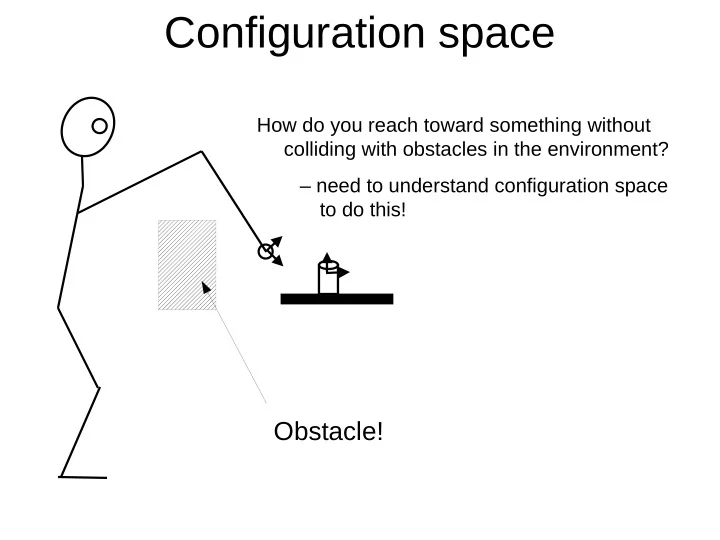
SLIDE 1 Configuration space
How do you reach toward something without colliding with obstacles in the environment? – need to understand configuration space to do this!
Obstacle!
SLIDE 2 Problem we want to solve
Starting configuration Goal configuration Given: – description of the robot arm (the manipulator) – description of the obstacle environment Find: – path from start to goal that does result in a collision
SLIDE 3 Problem we want to solve
This problem statement is actually very general – manipulators
SLIDE 4 Problem we want to solve
This problem statement is actually very general – manipulators – mobile robots
SLIDE 5 Approach: plan in “configuration space”
Convert the original planning problem into a planning problem for a single point.
SLIDE 6 Approach: plan in “configuration space”
Convert the original planning problem into a planning problem for a single point.
workspace configuration space Original problem – plan path for robot arm Equivalent problem: – plan path for a point
SLIDE 7 Approach: plan in “configuration space”
workspace configuration space
Notice the axes! Joint angles! Cartesian space!
SLIDE 8 Approach: plan in “configuration space”
workspace configuration space Every point here corresponds to a single robot configuration here
SLIDE 9 Approach: plan in “configuration space”
workspace configuration space Every point that intersects an obstacle here corresponds to an arm configuration that intersects an obstacle
SLIDE 10 Approach: plan in “configuration space”
workspace configuration space
Free space C-obstacles
SLIDE 11 Configuration space
Dimension = 3
The dimension of a configuration space is the minimum number
- f parameters needed to specify the configuration of the robot
completely. – also called the number of “degrees of freedom” (DOFs)
SLIDE 12 Configuration space
The dimension of a configuration space is the minimum number
- f parameters needed to specify the configuration of the robot
completely. – also called the number of “degrees of freedom” (DOFs)
Dimension = ?
SLIDE 13
Topology of configuration space
What is topology? – the properties of space that are preserved under continuous deformations, such as stretching and bending, but not tearing or gluing The topology of this mug is a torus
SLIDE 14
Topology of configuration space
What is topology? – the properties of space that are preserved under continuous deformations, such as stretching and bending, but not tearing or gluing Torus:
SLIDE 15
Topology of configuration space
What is topology? – the properties of space that are preserved under continuous deformations, such as stretching and bending, but not tearing or gluing Cylinder:
SLIDE 16
Topology of configuration space
What is topology? – the properties of space that are preserved under continuous deformations, such as stretching and bending, but not tearing or gluing Configuration space:
SLIDE 17 Topology of configuration space
What is topology? – the properties of space that are preserved under continuous deformations, such as stretching and bending, but not tearing or gluing Configuration space:
q q1
1
q q2
2
SLIDE 18
Paths in c-space
A path is a function from the unit interval onto configuration space: = start of path = end of path = somewhere in between...
A path
SLIDE 19 Homotopic paths
Two paths are homotopic if it is possible to continuously deform
SLIDE 20
Homotopic paths
How many homotopic paths are their between these two points?
SLIDE 21
Homotopic paths
How many homotopic paths are their between these two points?
SLIDE 22
Homotopic paths
How many homotopic paths are their between these two points?
SLIDE 23 Homotopic paths
Two paths are homotopic if it is possible to continuously deform
SLIDE 24
Connectedness of c-space
C is connected if every two configurations can be connected by a path. C is simply-connected if any two paths connecting the same endpoints are homotopic. Otherwise C is multiply-connected.