Concurrent Programming Multitasking (Interactive) Perform more - - PDF document

concurrent programming
SMART_READER_LITE
LIVE PREVIEW

Concurrent Programming Multitasking (Interactive) Perform more - - PDF document

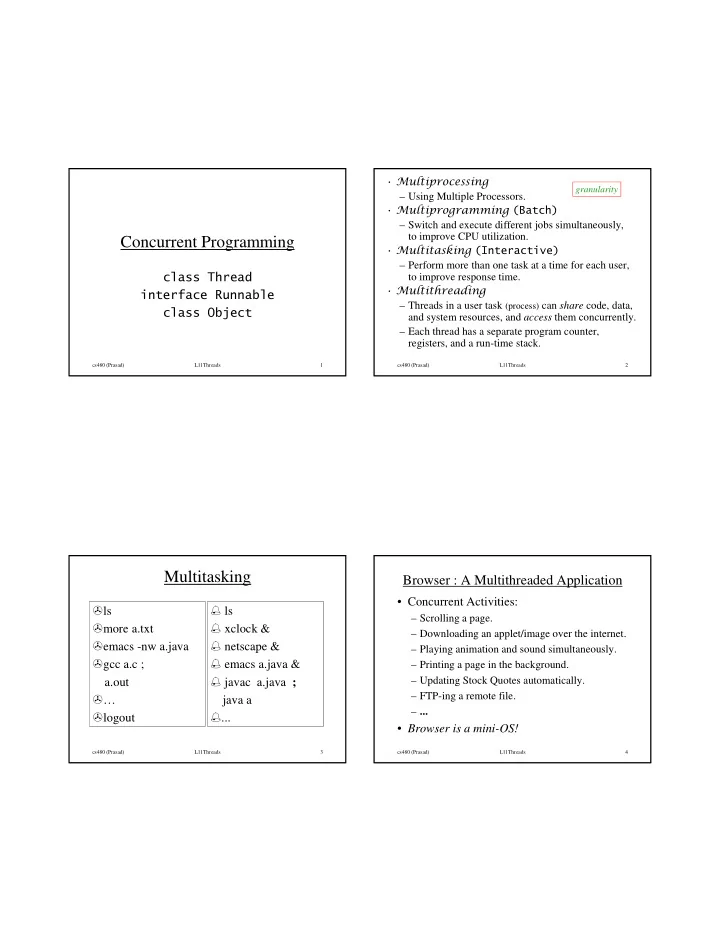
Multiprocessing granularity Using Multiple Processors. Multiprogramming (Batch) Switch and execute different jobs simultaneously, to improve CPU utilization. Concurrent Programming Multitasking (Interactive) Perform


slide-1
SLIDE 1

cs480 (Prasad) L11Threads 1

Concurrent Programming

class Thread interface Runnable class Object

cs480 (Prasad) L11Threads 2

  • Multiprocessing

– Using Multiple Processors.

  • Multiprogramming (Batch)

– Switch and execute different jobs simultaneously, to improve CPU utilization.

  • Multitasking (Interactive)

– Perform more than one task at a time for each user, to improve response time.

  • Multithreading

– Threads in a user task (process) can share code, data, and system resources, and access them concurrently. – Each thread has a separate program counter, registers, and a run-time stack.

granularity

cs480 (Prasad) L11Threads 3

Multitasking

ls more a.txt emacs -nw a.java gcc a.c ; a.out … logout  ls  xclock &  netscape &  emacs a.java &  javac a.java ; java a ...

cs480 (Prasad) L11Threads 4

Browser : A Multithreaded Application

  • Concurrent Activities:

– Scrolling a page. – Downloading an applet/image over the internet. – Playing animation and sound simultaneously. – Printing a page in the background. – Updating Stock Quotes automatically. – FTP-ing a remote file. – ...

  • Browser is a mini-OS!
slide-2
SLIDE 2

cs480 (Prasad) L11Threads 5

Threads in Java

  • A single sequential flow of control

(of execution of expressions and statements) is called a thread.

  • A thread independently executes Java

code, but may share address space with other threads. (cf. Process)

Java primitives for concurrent programming are based on Hoare’s monitors.

cs480 (Prasad) L11Threads 6

Motivation

Application independent interleaving of threads.

  • Support Concurrent Activities
  • Multimedia Applications
  • Advertisements, Sports/stocks ticker
  • Improve user response
  • User input in interactive programs
  • I/O in networked programs “in the background”
  • Improve CPU utilization
  • Demand-driven thread-scheduling

Overall Game Plan

  • How to create and execute multiple threads?
  • Interleaved computations
  • Indiscriminate interleaving interferes with

application semantics

  • Introduce Mutual Exclusion constucts
  • Example: Printing documents on a shared printer
  • Introduce Synchronization constructs
  • Example: Buffering on a shared printer

cs480 (Prasad) L11Threads 7 cs480 (Prasad) L11Threads 8

Java Primitives

  • Mutual exclusion
  • synchronized methods in a class cannot be run

concurrently on behalf of different threads.

  • synchronized statement locks an object.
  • “Object” is an instance of a class

(incl. class Class).

  • Synchronization / Cooperation
  • Methods wait(), notify(), notifyAll() etc.

in class Object enable threads to communicate and regulate each other’s progress.

slide-3
SLIDE 3

cs480 (Prasad) L11Threads 9

Creating Threads

cs480 (Prasad) L11Threads 10

Creating and Running Threads

  • Define subclass of class Thread.

Override run() method.

public void run() { }

  • Create an instance of the subclass, and

invoke start() on it. Now run() method executes in an independent thread.

cs480 (Prasad) L11Threads 11

Example using class Thread

class Echo extends Thread { int id; Echo(int i) { id = i; } public void run() { while (true)

{

System.out.println(id +“ ABC ”); // yield(); } } public static void main (String[] args) { new Echo(1) . start(); new Echo(2) . start(); } }

cs480 (Prasad) L11Threads 12

1 ABC 1 ABC 1 ABC 1 ABC 2 ABC 2 ABC 2 ABC 2 ABC 2 ABC 1 ABC 1 ABC 2 ABC 2 ABC 2 ABC 1 ABC . . .

> javac Echo.java > java Echo

1 ABC 2 ABC 2 ABC 2 ABC 1 ABC 1 ABC 2 ABC 2 ABC 2 ABC 2 ABC 2 ABC 1 ABC 1 ABC 1 ABC

...

1 ABC 1 ABC 1 ABC 1 ABC 1 ABC 1 ABC 1 ABC 1 ABC 1 ABC

... Solaris Windows with yield() in both OS

1 ABC 2 ABC 1 ABC 2ABC 1 ABC 2 ABC 1ABC 2 ABC 1 ABC 2 ABC

...

slide-4
SLIDE 4

cs480 (Prasad) L11Threads 13

Alternative :Creating and Running Threads

  • Threads can also be created from an

instance of a class implementing the

interface Runnable.

  • Required when the class is defined by

extension.

cs480 (Prasad) L11Threads 14

Example using interface Runnable

class Echo implements Runnable { int id; Echo(int i) { id = i; } public void run() { while (true)

{

System.out.println(id +“ ABC ”); // yield(); } } public static void main (String[] args) { new Thread (new Echo(1)) . start(); new Thread (new Echo(2)) . start(); } }

cs480 (Prasad) L11Threads 15

Same Example in C#

using System.Threading; class Echo { int id; Echo(int i) { id = i; } public void run() { while (true) System.Console.WriteLine(id + " ABC "); } public static void Main () { new Thread ( new ThreadStart (new Echo(1).run)) . Start(); new Thread ( new ThreadStart (new Echo(2).run)) . Start(); } }

cs480 (Prasad) L11Threads 16

Alternate Rendition in Java

class Echo implements Runnable { public void run() { try { while (true) { Thread.sleep(1000); System.out.println(“ABC”); } } catch (InterruptedException e) { return; } } public static void main (String[] args) { Runnable r = new Echo(); new Thread(r) . start(); } }

slide-5
SLIDE 5

cs480 (Prasad) L11Threads 17

Threads and Applets

A Simple Bouncing Ball Animation

cs480 (Prasad) L11Threads 18

class Ball { static final int TOP = 10, BOTTOM = 150; int incr = 2; int ypos = TOP; void paint(java.awt.Graphics g) { if (ypos < TOP || ypos > BOTTOM) incr= -incr; ypos += incr; g.setColor(java.awt.Color.cyan); g.fillOval(10,ypos, 10,10); }}

cs480 (Prasad) L11Threads 19

// <applet code=Bounce.class height=200 width=50></applet> public class Bounce extends java.applet.Applet { Ball b; public void init() { b = new Ball(); setBackground(java.awt.Color.red); } public void paint(java.awt.Graphics g) { b.paint(g); repaint(15); /* try { while (true) {

Thread.sleep(15); repaint(); } } catch (InterruptedException e) {}; */

} }

cs480 (Prasad) L11Threads 20

Threaded Applet

public class ThreadedBounce extends java.applet.Applet implements Runnable {

Ball b; Thread t; public void init() { b = new Ball();

setBackground(java.awt.Color.red);

t = new Thread(this); t.start(); } ...

slide-6
SLIDE 6

cs480 (Prasad) L11Threads 21

... public void paint(java.awt.Graphics g) { b.paint(g); // moved the code from here } public void run() { try { while (true) { Thread.sleep(15); repaint(); } } catch (InterruptedException e) {}; } }

cs480 (Prasad) L11Threads 22

Another version of Threaded Applet

public class ThreadedColorBounce extends java.applet.Applet implements Runnable { Ball b; Thread t; public void init() { b = new Ball(); setBackground(java.awt.Color.red); } public void start() { if ( t == null) { t = new Thread(this); t.start(); }} ...

cs480 (Prasad) L11Threads 23

public void stop() { t = null; } public void paint(java.awt.Graphics g) { b.paint(g); } public void run() { try { while (true) { Thread.sleep(15); repaint(); } } catch (InterruptedException e) {}; } }

cs480 (Prasad) L11Threads 24

Color Changing Ball

class ColorBall extends Thread { static final int TOP = 10, BOTTOM = 150; java.awt.Color c = java.awt.Color.cyan; int incr = 2; int ypos = TOP; public ColorBall(){ start(); } void paint(java.awt.Graphics g) { if (ypos < TOP || ypos > BOTTOM) incr= -incr; ypos += incr; g.setColor(c); g.fillOval(10,ypos, 10,10); }

...

slide-7
SLIDE 7

cs480 (Prasad) L11Threads 25

...

public void run() { try { while (true) { sleep(600); c = new java.awt.Color( (float) Math.random(), (float) Math.random(), (float) Math.random() ); } } catch (InterruptedException e) {}; } }

cs480 (Prasad) L11Threads 26

Mutual Exclusion

Sharing Data

cs480 (Prasad) L11Threads 27

Threads Sharing Data

class Shared { private int cnt = 0; // synchronized void print(String Id) { System.out.print(Id + “:” + cnt ); System.out.println( “-” + ++cnt); } } class Shared { private int cnt = 0; void print(String Id) { synchronized (this) { System.out.print(Id + “:” + cnt ); System.out.println( “-” + ++cnt); } } }

cs480 (Prasad) L11Threads 28

class SharingThread extends Thread { private static Shared s = new Shared(); String Id; SharingThread (String Name) { Id = Name; start(); } public void run () { while (true) { s.print(Id); // yield(); } } public static void main (String [] args) { new SharingThread(“A”) ; new SharingThread(“B”) ; } }

slide-8
SLIDE 8

cs480 (Prasad) L11Threads 29

Motivation for Mutual Exclusion

Concurrent Access Mutual Exclusion with yield()

A:368-369 A:369-370 B:370-371 A:370-372 A:372-373 A:373-374 A:374-375 B:371-376 B:376-377 B:377-378 B:378-379 B:379A:375-381 A:381-382 A:382-383 A:383-384

  • 380

A:828-829 B:829-830 B:830-831 A:831-832 B:832-833 A:833-834 B:834-835 A:835-836 B:836-837 B:837-838 A:838-839 B:839-840

A:693-694 A:694-695 A:695-696 B:696-697 B:697-698 B:698-699 B:699-700 B:700-701 B:701-702 A:702-703 A:703-704 A:704-705 A:705-706

...

cs480 (Prasad) L11Threads 30

// C# Equivalent using System; using System.Threading; class Shared { private int cnt = 0; public void print(String Id) { lock (this) { Console.Write(Id + ":" + cnt); Console.WriteLine("-" + ++cnt); }; } } class SharingThread { private static Shared s = new Shared(); String Id; SharingThread (String Name) { Id = Name; } public void run () { while (true) { s.print(Id); } } public static void Main (string [] args) { new Thread (new ThreadStart (new SharingThread("A").run) ). Start() ; new Thread (new ThreadStart (new SharingThread("B").run) ). Start() ; } }

cs480 (Prasad) L11Threads 31

Interaction of Language Features

run() method case study

cs480 (Prasad) L11Threads 32

Subclassing : Access Control

class Thread { ... public void run() { } } class SubThread extends Thread { public void run() { ... } /******************ILLEGAL******************** void run() { ... } *******************ILLEGAL********************/ }

  • Otherwise, run() can be invoked on a SubThread

instance via (its reference in) a Thread variable (due to dynamic binding) in another package.

Thread t = new SubThread(); t.run()

slide-9
SLIDE 9

cs480 (Prasad) L11Threads 33

Subclassing : Exception

class Thread { ... public void run() { } } class SubThread extends Thread { public void run() { ... } /******************ILLEGAL******************** public void run() throws InterruptedException { sleep(1000); } *******************ILLEGAL********************/ }

  • run() invoked on a SubThread instance via a Thread

variable (by dynamic binding) can violate the contract that

run() of class Thread does not throw any exception. Thread t = new SubThread(); t.run()

cs480 (Prasad) L11Threads 34

Subclassing : synchronized

  • A synchronized method can override or be
  • verridden by a non-synchronized method.

However, this does not alter “synchronized”-status

  • f the overridden method accessible using super.
  • The locks are released when synchronized

statements and synchronized method invocations complete abruptly by throwing an exception. Incorporating threads in the language enables dealing with problematic interactions with other language features.

cs480 (Prasad) L11Threads 35

synchronized methods

  • A method that is not synchronized can run

concurrently with a synchronized method

  • n behalf of different threads.
  • The “locking”-analogy breaks down here.
  • For concreteness, consider an example involving two

threads: (i) T1 running synchronized method m1 and (ii) T2 running ordinary method m2 on the same

  • bject O.
  • A synchronized method can call another

synchronized method in the same thread.

  • Recursion meaningful

Synchronized instance methods can run concurrently with ordinary methods on the same object.

cs480 (Prasad) L11Threads 36

T1 T2 O syn m1 m2 syn m3

slide-10
SLIDE 10

cs480 (Prasad) L11Threads 37

synchronized methods

  • A synchronized instance (resp. static)

method locks instance (resp. static) fields.

  • A synchronized instance method does not protect

static fields, and they can corrupt it thro an update.

  • For concreteness, consider an example involving two

threads T1 and T2 running synchronized instance methods m1 and m2 on objects O1 and O2 of the same class C. Both m1 and m2 are permitted to concurrently access the static fields of C, and there is potential for corruption. In such situations, static fields must be accessed in the body of instance methods using calls to synchronized static methods.

Synchronized instance methods run

  • n

distinct

  • bjects

in different threads can clash on static fields. Hence, synchronized static methods necessary to protect static fields from concurrent access.

cs480 (Prasad) L11Threads 38

T1 T2 O1 syn m1 syn m2 O2 Class C

cs480 (Prasad) L11Threads 39

Thread Scheduling

cs480 (Prasad) L11Threads 40

Blocked Thread

  • A thread is blocked (that is, it is not runnable) if it is:

– sleeping. – suspended. – waiting. – executing a “blocked” method. – “blocked” for I/O.

  • Java neither detects nor prevents deadlocks.
slide-11
SLIDE 11

cs480 (Prasad) L11Threads 41

Thread Scheduling

  • Java runs a non-blocked (runnable)

highest-priority thread.

  • A thread can be preempted by a higher

priority thread that becomes runnable.

– The scheduler may however choose to run lower priority thread, to avoid starvation.

  • The same (highest) priority threads are

run in round-robin fashion.

cs480 (Prasad) L11Threads 42

Scheduling Ambiguity

  • JVM on Windows uses time-slicing

to schedule same priority threads. (“Fair policy”)

  • JVM on Solaris chooses one of the

same priority threads to run until the thread voluntarily relinquishes the CPU (by

sleeping, yielding, or exiting), or

until a higher priority thread preempts it.

cs480 (Prasad) L11Threads 43

Cooperative Concurrent Threads

Producer-Consumer Problem Bounded-Buffer Problem (Clients and Servers : Resource Sharing)

cs480 (Prasad) L11Threads 44

Simplistic 1-Cell Buffer

class Buffer { Object x; // synchronized public void put (Object _x, String id) { System.out.println( "Done << " + id + " puts " + _x); x = _x; } // synchronized public Object get (String id) { System.out.println( "Done >> " + id + " gets " + x); return x; } }

slide-12
SLIDE 12

cs480 (Prasad) L11Threads 45

class Producer extends Thread { private Random r = new Random(); Buffer b; String id; public Producer(Buffer _b, String _id) { b = _b; id = _id; } public void run () { int delay; Integer ir;

try {

while (true) { delay = Math.abs(r.nextInt() % 1999) + 50; sleep(delay); ir = new Integer(delay);

System.out.println("Ready << "+id+" puts "+ ir);

b.put(ir, id);

} }catch (Exception e){System.out.println("Exception$ " + e);}; } }

cs480 (Prasad) L11Threads 46

class Consumer extends Thread { private Random r = new Random(); Buffer b; String id; public Consumer(Buffer _b, String _id) { b = _b; id = _id; } public void run () { int delay; Integer ir = null;

try {

while (true) { delay = Math.abs(r.nextInt() % 1999) + 50; sleep(delay);

System.out.println("Ready >> " + id + " gets ");

ir = (Integer) b.get(id); } } catch (Exception e) {System.out.println("Exception$ " + e);}; } }

cs480 (Prasad) L11Threads 47

Producer-Consumer : Bounded Buffer

public class PCB { public static void main(String[] args) { Buffer b = new Buffer(); new Consumer(b,"C1") . start(); new Producer(b,"P1") . start(); try {Thread.sleep(1000); } catch (Exception e){}; new Consumer(b,"C2") . start(); new Producer(b,"P2") . start(); } }

cs480 (Prasad) L11Threads 48

Unfettered Run

Ready >> C1 gets Ready << P2 puts 493 Done >> C1 gets null Done << P2 puts 493 Ready << P1 puts 1591 Done << P1 puts 1591 Ready << P1 puts 488 Done << P1 puts 488 Ready >> C2 gets Done >> C2 gets 488 Ready >> C1 gets Done >> C1 gets 488 Ready >> C2 gets Done >> C2 gets 488 Ready << P1 puts 745 Done << P1 puts 745 ... ... Ready << P2 puts 815 Done << P2 puts 815 Ready >> C2 gets Done >> C2 gets 815 Ready << P1 puts 1223 Done << P1 puts 1223 Ready >> C1 gets Done >> C1 gets 1223 Ready << P2 puts 403 Done << P2 puts 403 Ready >> C2 gets Done >> C2 gets 403 ...

(transient stability?!) premature puts gets

slide-13
SLIDE 13

cs480 (Prasad) L11Threads 49

Concurrency control : class Buffer

class Buffer { Object x; boolean empty = true; public synchronized void put (Object _x, String id) throws Exception { ...} public synchronized Object get (String id) throws Exception { ... } }

  • Two producers (consumers) cannot put(get) two

items in (from) the same buffer slot simultaneously.

  • Two producers (consumers) cannot put(get) two

items in (from) the same buffer slot without an intervening consumer (producer).

  • A consumer (producer) is not permitted to get

(put) an item from (into) buffer if empty (full).

cs480 (Prasad) L11Threads 50

public synchronized void put (Object _x, String id) throws Exception {

while (!empty) wait(); empty = ! empty;

System.out.println("Done << "+id+" puts "+ _x);

x = _x; notifyAll(); }

  • Note that if-then cannot replace while because

notifyAll, due to a consumer, can wake up two waiting producers, and only one producer will find the buffer empty. (“race condition”)

cs480 (Prasad) L11Threads 51

public synchronized Object get (String id) throws Exception {

while (empty) wait(); empty = ! empty;

System.out.println("Done >> "+id+" gets "+x);

notifyAll(); return x; }

  • Note that notify cannot always be used in place of

notifyAll because a consumer may be woken up.

  • while required because notifyAll due to a producer

does not guarantee that wait-ing consumers will find an item in the buffer.

cs480 (Prasad) L11Threads 52

Synchonization and Mutual Exclusion

Ready >> C2 gets Ready >> C1 gets Ready << P1 puts 1672 Done << P1 puts 1672 Done >> C2 gets 1672 Ready << P2 puts 774 Done << P2 puts 774 Done >> C1 gets 774 Ready << P1 puts 168 Done << P1 puts 168 Ready >> C1 gets Done >> C1 gets 168 Ready << P2 puts 1263 Done << P2 puts 1263 Ready >> C1 gets Done >> C1 gets 1263 … ... Ready << P1 puts 622 Done << P1 puts 622 Ready >> C1 gets Done >> C1 gets 622 Ready >> C2 gets Ready << P2 puts 1447 Done << P2 puts 1447 Done >> C2 gets 1447 Ready << P2 puts 96 Done << P2 puts 96 Ready << P2 puts 95 Ready >> C1 gets Done >> C1 gets 96 Done << P2 puts 95 ...

slide-14
SLIDE 14

cs480 (Prasad) L11Threads 53

Methods in class Object

  • public final void wait() throws

InterruptedException {...}

  • Current thread is suspended (after atomically

releasing the lock on this) until some other thread invokes notify() or notifyAll() or interrupts.

  • public final void notify() {...}
  • Notifies exactly one thread waiting on this object for

a condition to change. The awakened thread cannot proceed until this thread relinquishes the lock.

  • public final void notifyAll() {...}

– These methods must be invoked inside synchronized code or else IllegalMonitorStateException will be thrown.

cs480 (Prasad) L11Threads 54

Single Cell Buffer in C#

using System; using System.Threading; class Buffer { Object x; bool empty = true; public void put (Object _x, string id) { lock(this){ while (!empty) Monitor.Wait(this); empty = ! empty; Console.WriteLine("Done << " + id + " puts " + _x); x = _x; Monitor.PulseAll(this); } } public Object get (string id) { lock(this){ while (empty) Monitor.Wait(this); empty = ! empty; Console.WriteLine("Done >> " + id + " gets " + x); Monitor.PulseAll(this); return x; } } } cs480 (Prasad) L11Threads 55 class Producer { private System.Random r = new System.Random(); Buffer b; String id; public Producer(Buffer _b, String _id) { b = _b; id = _id; } public void run () { int delay; try { while (true) { delay = r.Next(2000) + 50; Thread.Sleep(delay); Console.WriteLine("Ready << " + id + " puts " + delay); b.put(delay, id); } } catch (Exception e){Console.WriteLine("Exception$ " + e);}; } } cs480 (Prasad) L11Threads 56 class Consumer { private System.Random r = new System.Random(); Buffer b; String id; public Consumer(Buffer _b, String _id) { b = _b; id = _id; } public void run () { int delay; try { while (true) { delay = r.Next(2000) + 50; Thread.Sleep(delay); Console.WriteLine("Ready >> " + id + " gets "); delay = (int) b.get(id); } } catch (Exception e) {Console.WriteLine("Exception$ " + e);}; } }

slide-15
SLIDE 15

cs480 (Prasad) L11Threads 57 public class PCB { public static void Main(string[] args) { Buffer b = new Buffer();

new Thread( new ThreadStart(new Consumer(b,"C1").run)) . Start(); new Thread( new ThreadStart(new Producer(b,"P1").run)) . Start(); try {Thread.Sleep(1000);} catch (Exception e){Console.WriteLine("Exception$ " + e);}; new Thread( new ThreadStart(new Consumer(b,"C2").run)) . Start(); new Thread( new ThreadStart(new Producer(b,"P2").run)) . Start();

} }