Concepts of Concurrent Computation computation? Turing machines or - - PowerPoint PPT Presentation

concepts of concurrent computation
SMART_READER_LITE
LIVE PREVIEW

Concepts of Concurrent Computation computation? Turing machines or - - PowerPoint PPT Presentation

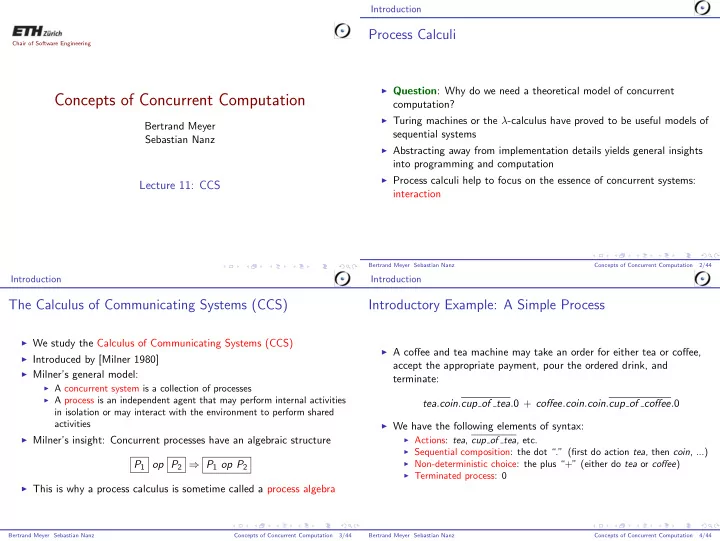
Introduction Process Calculi Chair of Software Engineering Question : Why do we need a theoretical model of concurrent Concepts of Concurrent Computation computation? Turing machines or the -calculus have proved to be useful models of


slide-1
SLIDE 1 Chair of Software Engineering

Concepts of Concurrent Computation

Bertrand Meyer Sebastian Nanz

Lecture 11: CCS

Introduction

Process Calculi

◮ Question: Why do we need a theoretical model of concurrent

computation?

◮ Turing machines or the λ-calculus have proved to be useful models of

sequential systems

◮ Abstracting away from implementation details yields general insights

into programming and computation

◮ Process calculi help to focus on the essence of concurrent systems:

interaction

Bertrand Meyer Sebastian Nanz Concepts of Concurrent Computation 2/44

Introduction

The Calculus of Communicating Systems (CCS)

◮ We study the Calculus of Communicating Systems (CCS) ◮ Introduced by [Milner 1980] ◮ Milner’s general model: ◮ A concurrent system is a collection of processes ◮ A process is an independent agent that may perform internal activities

in isolation or may interact with the environment to perform shared activities

◮ Milner’s insight: Concurrent processes have an algebraic structure

P1 op P2 ⇒ P1 op P2

◮ This is why a process calculus is sometime called a process algebra Bertrand Meyer Sebastian Nanz Concepts of Concurrent Computation 3/44

Introduction

Introductory Example: A Simple Process

◮ A coffee and tea machine may take an order for either tea or coffee,

accept the appropriate payment, pour the ordered drink, and terminate: tea.coin.cup of tea.0 + coffee.coin.coin.cup of coffee.0

◮ We have the following elements of syntax: ◮ Actions: tea, cup of tea, etc. ◮ Sequential composition: the dot “.” (first do action tea, then coin, ...) ◮ Non-deterministic choice: the plus “+” (either do tea or coffee) ◮ Terminated process: 0 Bertrand Meyer Sebastian Nanz Concepts of Concurrent Computation 4/44
slide-2
SLIDE 2

Introduction

Introductory Example: Execution of a Simple Process

◮ When a process executes it performs some action, and becomes a

new process

◮ The execution of an action a is symbolized by a transition a

− → tea.coin.cup of tea.0 + coffee.coin.coin.cup of coffee.0

tea

− → coin.cup of tea.0

coin

− → cup of tea.0

cup of tea

− →

Bertrand Meyer Sebastian Nanz Concepts of Concurrent Computation 5/44

Syntax of CCS

Syntax of CCS

Bertrand Meyer Sebastian Nanz Concepts of Concurrent Computation 6/44

Syntax of CCS

Syntax of CCS

◮ Goal: In the following we introduce the syntax of CCS step-by-step

Basic principle

  • 1. Define atomic processes that model the simplest possible behavior
  • 2. Define composition operators that build more complex behavior from

simpler ones

Bertrand Meyer Sebastian Nanz Concepts of Concurrent Computation 7/44

Syntax of CCS

The Terminal Process

The simplest possible behavior is no behavior

Terminal process

We write 0 (pronounced “nil”) for the terminal or inactive process

◮ 0 models a system that is either deadlocked or has terminated ◮ 0 is the only atomic process of CCS Bertrand Meyer Sebastian Nanz Concepts of Concurrent Computation 8/44
slide-3
SLIDE 3

Syntax of CCS

Names and Actions

◮ We assume an infinite set A of port names, and a set

¯ A = {¯ a | a ∈ A} of complementary port names

Input actions

When modeling we use a name a to denote an input action, i.e. the receiving of input from the associated port a

Output actions

We use a co-name a to denote an output action, i.e. the sending of output to the associated port a

Internal actions

We use τ to denote the distinguished internal action

◮ The set of actions Act is given by Act = A ∪ ¯

A ∪ {τ}

Bertrand Meyer Sebastian Nanz Concepts of Concurrent Computation 9/44

Syntax of CCS

Action Prefixing

The simplest actual behavior is sequential behavior

Action prefixing

If P is a process we write α.P to denote the prefixing of P with the action α

◮ α.P models a system that is ready to perform the action, α, and then

behaves as P, i.e. α.P

α

− → P

Bertrand Meyer Sebastian Nanz Concepts of Concurrent Computation 10/44

Syntax of CCS

Example: Action Prefixing

A process that starts a timer, performs some internal computation, and then stops the timer: go.τ.stop.0

go

− → τ.stop.0

τ

− → stop.0

stop

− → 0

Bertrand Meyer Sebastian Nanz Concepts of Concurrent Computation 11/44

Syntax of CCS

Process Interfaces

Interfaces

The set of input and output actions that a process P may perform in isolation constitutes the interface of P

◮ The interface enumerates the ports that P may use to interact with

the environment Example: The interface of the coffee and tea machine is: tea, coffee, coin, cup of tea, cup of coffee

Bertrand Meyer Sebastian Nanz Concepts of Concurrent Computation 12/44
slide-4
SLIDE 4

Syntax of CCS

Non-deterministic Choice

A more advanced sequential behavior is that of alternative behaviors

Non-deterministic choice

If P and Q are processes then we write P + Q to denote the non-deterministic choice between P and Q

◮ P + Q models a process that can either behave as P (discarding Q)
  • r as Q (discarding P)
Bertrand Meyer Sebastian Nanz Concepts of Concurrent Computation 13/44

Syntax of CCS

Example: Non-deterministic Choice

tea.coin.cup of tea.0 + coffee.coin.coin.cup of coffee.0

tea

− → coin.cup of tea. Note that:

◮ prefixing binds harder than plus and ◮ the choice is made by the initial coffee/tea button press Bertrand Meyer Sebastian Nanz Concepts of Concurrent Computation 14/44

Syntax of CCS

Process Constants and Recursion

The most advanced sequential behavior is the recursive behavior

Process constants

A process may be the invocation of a process constant, K ∈ K This is only meaningful if K is defined beforehand

Recursive definition

If K is a process constant and P is a process we write K def = P to give a recursive definition of the behavior of K (recursive if P invokes K)

Bertrand Meyer Sebastian Nanz Concepts of Concurrent Computation 15/44

Syntax of CCS

Example: Recursion (1)

A system clock, SC, sends out regular clock signals forever: SC def = tick.SC The system SC may behave as: tick.SC

tick

− → SC

tick

− → . . .

Bertrand Meyer Sebastian Nanz Concepts of Concurrent Computation 16/44
slide-5
SLIDE 5

Syntax of CCS

Example: Recursion (2)

A fully automatic coffee and tea machine CTM works as follows: CTM def = tea.coin.cup of tea.CTM + coffee.coin.coin.cup of coffee.CTM The system CTM may e.g. do: tea.coin.cup of tea.CTM + coffee.coin.coin.cup of coffee.CTM

tea

− → coin.cup of tea.CTM

coin

− → cup of tea.CTM

cup of tea

− → CTM

α

− → . . . This will serve drinks ad infinitum

Bertrand Meyer Sebastian Nanz Concepts of Concurrent Computation 17/44

Syntax of CCS

Parallel Composition

Finally: concurrent behavior

Parallel composition

If P and Q are processes we write P | Q to denote the parallel composition of P and Q

◮ P | Q models a process that behaves like P and Q in parallel: ◮ Each may proceed independently ◮ If P is ready to perform an action a and Q is ready to perform the

complementary action a, they may interact

Bertrand Meyer Sebastian Nanz Concepts of Concurrent Computation 18/44

Syntax of CCS

Example: Parallel Composition

Recall the coffee and tea machine: CTM def = tea.coin.cup of tea.CTM + coffee.coin.coin.cup of coffee.CTM Now consider the regular customer – the Computer Scientist, CS: CS def = tea.coin.cup of tea.teach.CS + coffee.coin.coin.cup of coffee.publish.CS

Bertrand Meyer Sebastian Nanz Concepts of Concurrent Computation 19/44

Syntax of CCS

Example: Parallel Composition

Recall the coffee and tea machine: CTM def = tea.coin.cup of tea.CTM + coffee.coin.coin.cup of coffee.CTM Now consider the regular customer – the Computer Scientist, CS: CS def = tea.coin.cup of tea.teach.CS + coffee.coin.coin.cup of coffee.publish.CS

◮ CS must drink coffee to publish ◮ CS can only teach on tea Bertrand Meyer Sebastian Nanz Concepts of Concurrent Computation 19/44
slide-6
SLIDE 6

Syntax of CCS

Example: Parallel Composition

On an average Tuesday morning the system CTM | CS is likely to behave as follows: (tea.coin.cup of tea.CTM + coffee.coin.coin.cup of coffee.CTM) | (tea.coin.cup of tea.teach.CS + coffee.coin.coin.cup of coffee.publish.CS)

τ

− → (coin.cup of tea.CTM) | (coin.cup of tea.teach.CS)

τ

− → (cup of tea.CTM) | (cup of tea.teach.CS)

τ

− → CTM | (teach.CS)

teach

− → CTM | CS

◮ Note that the synchronisation of actions such as tea/tea is expressed

by a τ-action (i.e. regarded as an internal step)

Bertrand Meyer Sebastian Nanz Concepts of Concurrent Computation 20/44

Syntax of CCS

Restriction

We control unwanted interactions with the environment by restricting the scope of port names

Restriction

if P is a process and A is a set of port names we write P A for the restriction of the scope of each name in A to P

◮ Removes each name a ∈ A and the corresponding co-name a from

the interface of P

◮ Makes each name a ∈ A and the corresponding co-name a

inaccessible to the environment

Bertrand Meyer Sebastian Nanz Concepts of Concurrent Computation 21/44

Syntax of CCS

Example: Restriction

◮ Recall the coffee and tea machine and the computer scientist:

CTM | CS

◮ Restricting the coffee and tea machine on coffee makes the

coffee-button inaccessible to the computer scientist: (CTM {coffee}) | CS

◮ As a consequence CS can only teach, and never publish Bertrand Meyer Sebastian Nanz Concepts of Concurrent Computation 22/44

Syntax of CCS

Summary: Syntax of CCS

P ::= K | process constants (K ∈ K) α.P | prefixing (α ∈ Act)

  • i∈I Pi

| summation (I is an arbitrary index set) P1|P2 | parallel composition P L restriction (L ⊆ A) The set of all terms generated by the abstract syntax is called CCS process expressions

Notation

P1 + P2 =

i∈{1,2} Pi

Nil = 0 =

i∈∅ Pi Bertrand Meyer Sebastian Nanz Concepts of Concurrent Computation 23/44
slide-7
SLIDE 7

Syntax of CCS

CCS Program

CCS program

A collection of defining equations of the form K def = P where K ∈ K is a process constant and P ∈ P is a CCS process expression

◮ Only one defining equation per process constant ◮ Recursion is allowed: e.g. A def

= a.A | A

◮ Note that the program itself gives only the definitions of process

constants: we can only execute processes (which can however mention the process constants defined in the program)

Bertrand Meyer Sebastian Nanz Concepts of Concurrent Computation 24/44

Syntax of CCS

Exercise: Syntax of CCS

Which of the following expressions are correctly built CCS expressions? Assume that A, B are process constants and that a, b are port names.

◮ a.b.A + B ◮ (a.0 + a.A) {a, b} ◮ (a.0 | a.A) {a, τ} ◮ τ.τ.B + 0 ◮ (a.b.A + a.0) | B ◮ (a.b.A + a.0).B Bertrand Meyer Sebastian Nanz Concepts of Concurrent Computation 25/44

Syntax of CCS

Exercise: Syntax of CCS

Which of the following expressions are correctly built CCS expressions? Assume that A, B are process constants and that a, b are port names.

◮ a.b.A + B ◮ (a.0 + a.A) {a, b} ◮ (a.0 | a.A) {a, τ} ◮ τ.τ.B + 0 ◮ (a.b.A + a.0) | B ◮ (a.b.A + a.0).B Bertrand Meyer Sebastian Nanz Concepts of Concurrent Computation 25/44

Syntax of CCS

Exercise: Syntax of CCS

Which of the following expressions are correctly built CCS expressions? Assume that A, B are process constants and that a, b are port names.

◮ a.b.A + B ◮ (a.0 + a.A) {a, b} ◮ (a.0 | a.A) {a, τ} ◮ τ.τ.B + 0 ◮ (a.b.A + a.0) | B ◮ (a.b.A + a.0).B Bertrand Meyer Sebastian Nanz Concepts of Concurrent Computation 25/44
slide-8
SLIDE 8

Syntax of CCS

Exercise: Syntax of CCS

Which of the following expressions are correctly built CCS expressions? Assume that A, B are process constants and that a, b are port names.

◮ a.b.A + B ◮ (a.0 + a.A) {a, b} ◮ (a.0 | a.A) {a, τ} x ◮ τ.τ.B + 0 ◮ (a.b.A + a.0) | B ◮ (a.b.A + a.0).B Bertrand Meyer Sebastian Nanz Concepts of Concurrent Computation 25/44

Syntax of CCS

Exercise: Syntax of CCS

Which of the following expressions are correctly built CCS expressions? Assume that A, B are process constants and that a, b are port names.

◮ a.b.A + B ◮ (a.0 + a.A) {a, b} ◮ (a.0 | a.A) {a, τ} x ◮ τ.τ.B + 0 ◮ (a.b.A + a.0) | B ◮ (a.b.A + a.0).B Bertrand Meyer Sebastian Nanz Concepts of Concurrent Computation 25/44

Syntax of CCS

Exercise: Syntax of CCS

Which of the following expressions are correctly built CCS expressions? Assume that A, B are process constants and that a, b are port names.

◮ a.b.A + B ◮ (a.0 + a.A) {a, b} ◮ (a.0 | a.A) {a, τ} x ◮ τ.τ.B + 0 ◮ (a.b.A + a.0) | B ◮ (a.b.A + a.0).B Bertrand Meyer Sebastian Nanz Concepts of Concurrent Computation 25/44

Syntax of CCS

Exercise: Syntax of CCS

Which of the following expressions are correctly built CCS expressions? Assume that A, B are process constants and that a, b are port names.

◮ a.b.A + B ◮ (a.0 + a.A) {a, b} ◮ (a.0 | a.A) {a, τ} x ◮ τ.τ.B + 0 ◮ (a.b.A + a.0) | B ◮ (a.b.A + a.0).B x Bertrand Meyer Sebastian Nanz Concepts of Concurrent Computation 25/44
slide-9
SLIDE 9

Operational Semantics of CCS

Operational Semantics of CCS

Bertrand Meyer Sebastian Nanz Concepts of Concurrent Computation 26/44

Operational Semantics of CCS

Operational Semantics

◮ Goal: Formalize the execution of a CCS process

Syntax

CCS (process term + equations) − →

Semantics

LTS (labelled transition systems)

Bertrand Meyer Sebastian Nanz Concepts of Concurrent Computation 27/44

Operational Semantics of CCS

Labelled Transition System

Definition

A labelled transition system (LTS) is a triple (Proc, Act, { α − →| α ∈ Act}) where

◮ Proc is a set of processes (the states), ◮ Act is a set of actions (the labels), and ◮ for every α ∈ Act, α

− → ⊆ Proc × Proc is a binary relation on processes called the transition relation We use the infix notation P

α

− → P′ to say that (P, P′) ∈

α

− → It is customary to distinguish the initial process (the start state)

Bertrand Meyer Sebastian Nanz Concepts of Concurrent Computation 28/44

Operational Semantics of CCS

Labelled Transition Systems

Conceptually it is often beneficial to think of a (finite) LTS as something that can be drawn as a directed (process) graph

◮ Processes are the nodes ◮ Transitions are the edges

Example: The LTS {{P, Q, R}, {a, b, τ}, {P

a

− → Q, P

b

− → R, Q

τ

− → R}} corresponds to the graph P Q R a b τ

◮ Question: How can we produce an LTS (semantics) of a process

term (syntax)?

Bertrand Meyer Sebastian Nanz Concepts of Concurrent Computation 29/44
slide-10
SLIDE 10

Operational Semantics of CCS

Informal Translation

◮ Terminal process: 0

behavior:

◮ Action prefixing: α.P

behavior: α.P P α

◮ Non-deterministic choice:

α.P + β.Q behavior: α.P + β.Q P Q α β

◮ Recursion:

X def = · · · .α.X behavior: X α.X · · · α

Bertrand Meyer Sebastian Nanz Concepts of Concurrent Computation 30/44

Operational Semantics of CCS

Informal Translation

◮ Parallel composition:

α.P | β.Q Combines sequential composition and choice to obtain interleaving behavior: α.P | β.Q P | β.Q α.P | Q P | Q α β β α

◮ What about interaction? Bertrand Meyer Sebastian Nanz Concepts of Concurrent Computation 31/44

Operational Semantics of CCS

Process Interaction

◮ Concurrent processes, i.e. P and Q in P | Q, may interact where their

interfaces are compatible

◮ A synchronizing interaction between two processes (sub-systems), P

and Q, is an activity that is internal to P | Q

◮ Parallel composition:

α.P | β.Q Allows interaction if β = α behavior: a.P | a.Q P | a.Q a.P | Q P | Q a a a a τ

Bertrand Meyer Sebastian Nanz Concepts of Concurrent Computation 32/44

Operational Semantics of CCS

Structural Operational Semantics for CCS

Structural Operational Semantics (SOS) [Plotkin 1981]

Small-step operational semantics where the behavior of a system is inferred using syntax driven rules Given a collection of CCS defining equations, we define the following LTS (Proc, Act, {

a

− →| a ∈ Act}):

◮ Proc is the set of all CCS process expressions ◮ Act is the set of all CCS actions including τ ◮ the transition relation is given by SOS rules of the form:

RULE premises conclusion conditions

Bertrand Meyer Sebastian Nanz Concepts of Concurrent Computation 33/44
slide-11
SLIDE 11

Operational Semantics of CCS

SOS rules for CCS

ACT α.P

α

− → P SUMj Pj

α

− → P′

j
  • i∈I Pi
α

− → P′

j

j ∈ I COM1 P

α

− → P′ P|Q

α

− → P′|Q COM2 Q

α

− → Q′ P|Q

α

− → P|Q′ COM3 P

a

− → P′ Q

a

− → Q′ P|Q

τ

− → P′|Q′ RES P

α

− → P′ P L

α

− → P′ L α, α ∈ L CON P

α

− → P′ K

α

− → P′ K def = P

Bertrand Meyer Sebastian Nanz Concepts of Concurrent Computation 34/44

Operational Semantics of CCS

Exercise: Derivations

Let A def = a.A. Show that

  • (A | a.0) | b.0
  • a

− →

  • (A | a.0) | b.0
  • .

(A | a.0) | b.0

a

− → (A | a.0) | b.0

Bertrand Meyer Sebastian Nanz Concepts of Concurrent Computation 35/44

Operational Semantics of CCS

Exercise: Derivations

Let A def = a.A. Show that

  • (A | a.0) | b.0
  • a

− →

  • (A | a.0) | b.0
  • .

COM1 A | a.0

a

− → A | a.0 (A | a.0) | b.0

a

− → (A | a.0) | b.0

Bertrand Meyer Sebastian Nanz Concepts of Concurrent Computation 35/44

Operational Semantics of CCS

Exercise: Derivations

Let A def = a.A. Show that

  • (A | a.0) | b.0
  • a

− →

  • (A | a.0) | b.0
  • .

COM1 COM1 A

a

− → A A

def

= a.A A | a.0

a

− → A | a.0 (A | a.0) | b.0

a

− → (A | a.0) | b.0

Bertrand Meyer Sebastian Nanz Concepts of Concurrent Computation 35/44
slide-12
SLIDE 12

Operational Semantics of CCS

Exercise: Derivations

Let A def = a.A. Show that

  • (A | a.0) | b.0
  • a

− →

  • (A | a.0) | b.0
  • .

COM1 COM1 CONa.A

a

− → A A

a

− → A A

def

= a.A A | a.0

a

− → A | a.0 (A | a.0) | b.0

a

− → (A | a.0) | b.0

Bertrand Meyer Sebastian Nanz Concepts of Concurrent Computation 35/44

Operational Semantics of CCS

Exercise: Derivations

Let A def = a.A. Show that

  • (A | a.0) | b.0
  • a

− →

  • (A | a.0) | b.0
  • .

COM1 COM1 CON ACT a.A

a

− → A A

a

− → A A

def

= a.A A | a.0

a

− → A | a.0 (A | a.0) | b.0

a

− → (A | a.0) | b.0

Bertrand Meyer Sebastian Nanz Concepts of Concurrent Computation 35/44

Operational Semantics of CCS

Restriction and Interaction

a.0 | a.0 0 | a.0 a.0 | 0 0 | 0 a a a a τ LTS of a.0 | a.0 LTS of (a.0 | a.0) {a}

Bertrand Meyer Sebastian Nanz Concepts of Concurrent Computation 36/44

Operational Semantics of CCS

Restriction and Interaction

a.0 | a.0 0 | a.0 a.0 | 0 0 | 0 a a a a τ (a.0 | a.0) {a} 0 | 0 τ LTS of a.0 | a.0 LTS of (a.0 | a.0) {a}

◮ Restriction can be used to produce closed systems, i.e. their actions

can only be taken internally (visible as τ-actions)

Bertrand Meyer Sebastian Nanz Concepts of Concurrent Computation 36/44
slide-13
SLIDE 13

Behavioral Equivalence

Behavioral Equivalence

Bertrand Meyer Sebastian Nanz Concepts of Concurrent Computation 37/44

Behavioral Equivalence

Behavioral Equivalence

◮ Goal: Express the notion that two concurrent systems “behave in the

same way”

◮ We are not interested in syntactical equivalence, but only in the fact

that the processes have the same behavior

◮ Main idea: two processes are behaviorally equivalent if and only if an

external observer cannot tell them apart

◮ Bisimulation [Park 1980]: Two processes are equivalent if they have

the same traces and the states that they reach are also equivalent

Bertrand Meyer Sebastian Nanz Concepts of Concurrent Computation 38/44

Behavioral Equivalence

Strong Bisimilarity

Let (Proc, Act, {

α

− → | α ∈ Act}) be an LTS

Strong Bisimulation

A binary relation R ⊆ Proc × Proc is a strong bisimulation iff whenever (P, Q) ∈ R then for each α ∈ Act:

◮ if P α

− → P′ then Q

α

− → Q′ for some Q′ such that (P′, Q′) ∈ R

◮ if Q α

− → Q′ then P

α

− → P′ for some P′ such that (P′, Q′) ∈ R

Strong Bisimilarity

Two processes P1, P2 ∈ Proc are strongly bisimilar (P1 ∼ P2) if and only if there exists a strong bisimulation R such that (P1, P2) ∈ R ∼ = ∪{R | R is a strong bisimulation}

Bertrand Meyer Sebastian Nanz Concepts of Concurrent Computation 39/44

Behavioral Equivalence

Strong Bisimilarity of CCS Processes

◮ The concept of strong bisimilarity is defined for LTS ◮ The semantics of CCS is given in terms of LTS, whose states are CCS

processes

◮ Thus, the definition also applies to CCS processes ◮ Two processes are bisimilar if there is a concrete strong bisimulation

relation that relates them

◮ To show that two processes are bisimilar it suffices to exhibit such a

concrete relation

Bertrand Meyer Sebastian Nanz Concepts of Concurrent Computation 40/44
slide-14
SLIDE 14

Behavioral Equivalence

Example: Strong Bisimulation

Consider the processes P and Q with the following behavior: P P1 P2 a a b b Q1 Q a b We claim that they are bisimilar

Bertrand Meyer Sebastian Nanz Concepts of Concurrent Computation 41/44

Behavioral Equivalence

Example: Strong Bisimulation

To show our claim we exhibit the following strong bisimulation relation: R = {(P, Q), (P1, Q1), (P2, Q1)}

◮ (P, Q) is in R ◮ R is a bisimulation: ◮ For each pair of states in R , all possible transitions from the first can

be matched by corresponding transitions from the second

◮ For each pair of states in R , all possible transitions from the second

can be matched by corresponding transitions from the first

Bertrand Meyer Sebastian Nanz Concepts of Concurrent Computation 42/44

Behavioral Equivalence

Example: Strong Bisimulation

Graphically, we show R with dotted lines: P P1 P2 a a b b Q1 Q a b Now it is easy to see that:

◮ For each pair of states in R , all possible transitions from the first

can be matched by corresponding transitions from the second

◮ For each pair of states in R , all possible transitions from the second

can be matched by corresponding transitions from the first

Bertrand Meyer Sebastian Nanz Concepts of Concurrent Computation 43/44

Behavioral Equivalence

Exercise: Strong Bisimulation

Consider the processes P

def

= a.(b.0 + c.0) Q

def

= a.b.0 + a.c.0 and show that P ∼ Q

Bertrand Meyer Sebastian Nanz Concepts of Concurrent Computation 44/44