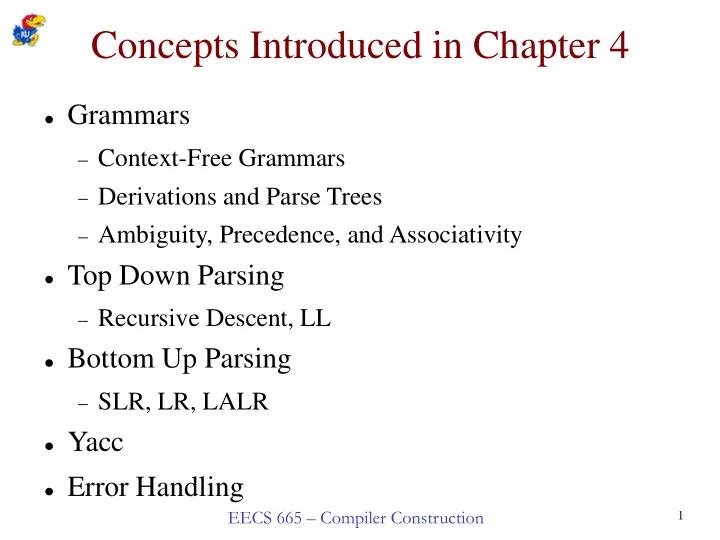
Concepts Introduced in Chapter 4 Grammars Context-Free Grammars - - PowerPoint PPT Presentation

concepts introduced in chapter 4
SMART_READER_LITE
LIVE PREVIEW

Concepts Introduced in Chapter 4 Grammars Context-Free Grammars - - PowerPoint PPT Presentation

Concepts Introduced in Chapter 4 Grammars Context-Free Grammars Derivations and Parse Trees Ambiguity, Precedence, and Associativity Top Down Parsing Recursive Descent, LL Bottom Up Parsing SLR, LR, LALR Yacc


slide-1
SLIDE 1

1

EECS 665 – Compiler Construction

Concepts Introduced in Chapter 4

 Grammars

 Context-Free Grammars  Derivations and Parse Trees  Ambiguity, Precedence, and Associativity

 Top Down Parsing

 Recursive Descent, LL

 Bottom Up Parsing

 SLR, LR, LALR

 Yacc  Error Handling

slide-2
SLIDE 2

2

EECS 665 – Compiler Construction

Grammars

G = (N, T, P, S)

  • 1. N is a finite set of nonterminal symbols
  • 2. T is a finite set of terminal symbols
  • 3. P is a finite subset of

(N ∪ T)* N (N ∪ T)*  (N ∪ T)* An element ( α, β ) ∈ P is written as α → β and is called a production.

  • 4. S is a distinguished symbol in N and is called the

start symbol.

slide-3
SLIDE 3

3

EECS 665 – Compiler Construction

Example of a Grammar

expression → expression + term expression → expression - term expression → term term → term * factor term → term / factor term → factor factor → ( expression ) factor → id

slide-4
SLIDE 4

4

EECS 665 – Compiler Construction

Advantages of Using Grammars

 Provides a precise, syntactic specification of a

programming language.

 For some classes of grammars, tools exist that can

automatically construct an efficient parser.

 These tools can also detect syntactic ambiguities

and other problems automatically.

 A compiler based on a grammatical description of a

language is more easily maintained and updated.

slide-5
SLIDE 5

5

EECS 665 – Compiler Construction

Role of a Parser in a Compiler

 Detects and reports any syntax errors.  Produces a parse tree from which intermediate code

can be generated.

followed by Fig. 4.1

slide-6
SLIDE 6

6

EECS 665 – Compiler Construction

Conventions for Specifying Grammars in the Text

 terminals

 lower case letters early in the alphabet (a, b, c)  punctuation and operator symbols [(, ), ',', +, ]  digits  boldface words (if, then)

 nonterminals

 uppercase letters early in the alphabet (A, B, C)  S is the start symbol  lower case words

slide-7
SLIDE 7

7

EECS 665 – Compiler Construction

Conventions for Specifying Grammars in the Text (cont.)

 grammar symbols (nonterminals or terminals)

 upper case letters late in the alphabet (X, Y, Z)

 strings of terminals

 lower case letters late in the alphabet (u, v, ..., z)

 sentential form (string of grammar symbols)

 lower case Greek letters (α, β, γ)

slide-8
SLIDE 8

8

EECS 665 – Compiler Construction

Chomsky Hierarchy

A grammar is said to be

  • 1. regular if it is

where each production in P has the form

  • a. right-linear

A → wB or A → w

  • b. left-linear

A → Bw or A → w where A, B ∈ N and w ∈ T*

slide-9
SLIDE 9

9

EECS 665 – Compiler Construction

Chomsky Hierarchy (cont)

  • 2. context-free : each production in P is of the form

A → α where A ∈ N and α ∈ ( N ∪ T)*

  • 3. context-sensitive : each production in P is of the

form α →β where |α|  |β|

  • 4. unrestricted if each production in P is of the form

α→β where α ≠ ε

slide-10
SLIDE 10

10

EECS 665 – Compiler Construction

Derivation

 Derivation  a sequence of replacements from the start symbol

in a grammar by applying productions

 E → E + E | E * E | ( E ) |  E | id

 Derive  - ( id + id ) from the grammar  E ⇒  E ⇒  ( E ) ⇒  ( E + E ) ⇒  ( id + E )

⇒  ( id + id )

 thus E derives - ( id + id )

  • r E

+⇒ - ( id + id )

slide-11
SLIDE 11

11

EECS 665 – Compiler Construction

Derivation (cont.)

 Leftmost derivation

 each step replaces the leftmost nonterminal  derive id + id * id using leftmost derivation

 E ⇒ E + E ⇒ id + E ⇒ id + E * E ⇒

id + id * E ⇒ id + id * id

 L(G) - language generated by the grammar G  Sentence of G

 if S +⇒ w, where w is a string of terminals inL(G)

 Sentential form

 if S *⇒ α, where α may contain nonterminals

slide-12
SLIDE 12

12

EECS 665 – Compiler Construction

Parse Tree

 Parse tree pictorially shows how the start symbol of a

grammar derives a specific string in the language.

 Given a context-free grammar, a parse tree has the

properties:

 The root is labeled by the start symbol.  Each leaf is labeled by a token or ε.  Each interior node is labeled by a nonterminal.  If A is a nonterminal labeling some interior node and

X1,X2, X3, .., Xn are the labels of the children of that node from left to right, then A →X1, X2, X3, .. Xn is a production of the grammar.

slide-13
SLIDE 13

13

EECS 665 – Compiler Construction

Example of a Parse Tree

list → list + digit | list  digit | digit

followed by Fig. 4.4

slide-14
SLIDE 14

14

EECS 665 – Compiler Construction

Parse Tree (cont.)

 Yield

 the leaves of the parse tree read from left to right, or  the string derived from the nonterminal at the root of the

parse tree

 An ambiguous grammar is one that can generate

two or more parse trees that yield the same string.

slide-15
SLIDE 15

15

EECS 665 – Compiler Construction

Example of an Ambiguous Grammar

string → string + string string → string - string string → 0 | 1 | 2 | 3 | 4 | 5 | 6 | 7 | 8 | 9

  • a. string → string + string → string  string + string

→ 9  string + string → 9  5 + string → 9  5 + 2

  • b. string → string - string → 9  string

→ 9  string + string → 9  5 + string → 9  5 + 2

slide-16
SLIDE 16

16

EECS 665 – Compiler Construction

Precedence

By convention 9 + 5 * 2 * has higher precedence than + because it takes its operands before +

slide-17
SLIDE 17

17

EECS 665 – Compiler Construction

Precedence (cont.)

 If different operators have the same precedence then

they are defined as alternative productions of the same nonterminal. expr → expr + term | expr  term | term term → term * factor | term / factor | factor factor → digit | (expr)

slide-18
SLIDE 18

18

EECS 665 – Compiler Construction

Associativity

By convention 9  5  2 left (operand with  on both sides is taken by the operator to its left) a = b = c right

slide-19
SLIDE 19

19

EECS 665 – Compiler Construction

Eliminating Ambiguity

 Sometimes ambiguity can be eliminated by

rewriting a grammar.

stmt → if expr then stmt | if expr then stmt else stmt |

  • ther

 How do we parse:

if E1 then if E2 then S1 else S2

followed by Fig. 4.9

slide-20
SLIDE 20

20

EECS 665 – Compiler Construction

Eliminating Ambiguity (cont.)

stmt → matched_stmt | unmatched_stmt

matched_stmt → if expr then matched_stmt else matched_stmt |

  • ther

unmatched_stmt → if expr then stmt | if expr then matched_stmt else unmatched_stmt

slide-21
SLIDE 21

21

EECS 665 – Compiler Construction

Parsing

 Universal  Top-down

 recursive descent  LL

 Bottom-up

 LR

 SLR  canonical LR  LALR

slide-22
SLIDE 22

22

EECS 665 – Compiler Construction

Top-Down vs Bottom-Up Parsing

 top-down

 Have to eliminate left recursion in the grammar.  Have to left factor the grammar.  Resulting grammars are harder to read and understand.

 bottom-up

 Difficult to implement by hand, so a tool is needed.

slide-23
SLIDE 23

23

EECS 665 – Compiler Construction

Top-Down Parsing

Starts at the root and proceeds towards the leaves. Recursive-Descent Parsing - a recursive procedure is associated with each nonterminal in the grammar. Example

type → simple | id | array [ simple ] of type

simple → integer | char | num dotdot num

followed by Fig. 4.12

slide-24
SLIDE 24

24

EECS 665 – Compiler Construction

void type() { if ( lookahead == INTEGER || lookahead == CHAR || lookahead == NUM) simple(); else if (lookahead == '^') { match('^'); match(ID); } else if (lookahead == ARRAY) { match(ARRAY); match('['); simple(); match(']'); match(OF); type(); } else error(); }

Example of Recursive Descent Parsing

slide-25
SLIDE 25

25

EECS 665 – Compiler Construction

void simple() { void match(token t) if (lookahead == INTEGER) { match(INTEGER); if (lookahead == t) else if (lookahead == CHAR) lookahead = nexttoken(); match(CHAR); else else if (lookahead== NUM) { error(); match(NUM); } match(DOTDOT); match(NUM); } else error(); }

Example of Recursive Descent Parsing (cont.)

slide-26
SLIDE 26

26

EECS 665 – Compiler Construction

Top-Down Parsing (cont.)

 Predictive parsing needs to know what first symbols

can be generated by the right side of a production.

 FIRST(α) - the set of tokens that appear as the first

symbols of one or more strings generated from α. If α is ε or can generate , then ε is also in FIRST(α).

 Given a production

A → α | β predictive parsing requires FIRST(α) and FIRST(β) to be disjoint.

slide-27
SLIDE 27

27

EECS 665 – Compiler Construction

Eliminating Left Recursion

 Recursive descent parsing loops forever on left recursion.

 Immediate Left Recursion

Replace A → Aα | β with A → βA´ A´ → αA´ | ε Example: A

α β

E → E + T | T E +T T T → T * F | F T *F F F → (E) | id becomes E

TE´ E´

+TE´ | ε T

FT´

slide-28
SLIDE 28

28

EECS 665 – Compiler Construction

Eliminating Left Recursion (cont.)

In general, to eliminate left recursion given A1, A2, ..., An for i = 1 to n do { for j = 1 to i-1 do { replace each Ai → Aj  with Ai →δ1  | ... | δk  where Aj → δ1 | δ2 | ... | δk are the current Aj productions } eliminate immediate left recursion in Ai productions eliminate ε transitions in the Ai productions } This fails only if cycles ( A +⇒ A) or A → ε for some A.

slide-29
SLIDE 29

29

EECS 665 – Compiler Construction

Example of Eliminating Left Recursion

1. X → YZ | a 2. Y → ZX | Xb 3. Z → XY | ZZ | a A1 = X A2 = Y A3 = Z i = 1 (eliminate immediate left recursion) nothing to do

slide-30
SLIDE 30

30

EECS 665 – Compiler Construction

Example of Eliminating Left Recursion (cont.)

i = 2, j = 1 Y → Xb ⇒ Y → ZX | YZb | ab now eliminate immediate left recursion Y → ZXY´ | ab Y´ Y´ → ZbY´ | ε now eliminate transitions Y → ZXY´ | abY´ | ZX | ab Y´ → ZbY´ | Zb i = 3, j = 1 Z → XY ⇒ Z →YZY | aY | ZZ | a

slide-31
SLIDE 31

31

EECS 665 – Compiler Construction

Example of Eliminating Left Recursion (cont.)

i = 3, j = 2 Z →YZY ⇒ Z → ZXY´ZY | ZXZY | abY´ZY | abZY | aY | ZZ | a now eliminate immediate left recursion Z → abY´ZYZ´ | abZYZ´ | aYZ´ | aZ´ Z´ → XY´ZYZ´ | XZYZ´ | ZZ´ | ε eliminate ε transitions Z → abY´ZYZ´ | abY´ZY | abZYZ´ |abZY | aY | aYZ´ | aZ´ | a Z´ → XY´ZYZ´ | XY´ZY | XZYZ´ | XZY | ZZ´ | Z

slide-32
SLIDE 32

32

EECS 665 – Compiler Construction

Left-Factoring

A → αβ| α ⇒ A → αA A → β | γ Example: Left factor stmt → if cond then stmt else stmt | if cond then stmt becomes stmt → if cond then stmt E E → else stmt | ε Useful for predictive parsing since we will know which production to choose.

slide-33
SLIDE 33

33

EECS 665 – Compiler Construction

Nonrecursive Predictive Parsing

 Instead of recursive descent, it is table-driven and

uses an explicit stack. It uses

  • 1. a stack of grammar symbols ($ on bottom)
  • 2. a string of input tokens ($ on end)
  • 3. a parsing table [NT, T] of productions

followed by Fig. 4.19

slide-34
SLIDE 34

34

EECS 665 – Compiler Construction

Algorithm for Nonrecursive Predictive Parsing

  • 1. If top == input == $ then accept
  • 2. If top == input then

pop top off the stack advance to next input symbol goto 1

  • 3. If top is nonterminal

fetch M[top, input] If a production replace top with rhs of production Else parse fails goto 1

  • 4. Parse fails

followed by Fig. 4.17, 4.21

slide-35
SLIDE 35

35

EECS 665 – Compiler Construction

First

FIRST(α) = the set of terminals that begin strings derived from α. If α is ε or generates ε, then ε is also in FIRST(α). 1. If X is a terminal then FIRST(X) = {X} 2. If X → aα, add a to FIRST(X) 3. If X → ε, add ε to FIRST(X) 4. If X → Y1, Y2, ..., Yk and Y1, Y2, ..., Yi-1 *⇒ ε where i  k Add every non ε in FIRST(Yi) to FIRST(X) If Y1, Y2, ..., Yk *⇒ ε, add ε to FIRST(X)

slide-36
SLIDE 36

36

EECS 665 – Compiler Construction

FOLLOW(A) = the set of terminals that can immediately follow A in a sentential form.

  • 1. If S is the start symbol, add $ to FOLLOW(S)
  • 2. If A →αBβ, add FIRST(β) - {ε} to FOLLOW(B)
  • 3. If A →αB or A →αBβ and β*⇒ ε,

add FOLLOW(A) to FOLLOW(B)

FOLLOW

slide-37
SLIDE 37

37

EECS 665 – Compiler Construction

Production FIRST FOLLOW E → TE´ { (, id } { ), $ } E´ → +TE´ | ε { +, ε } { ), $ } T → FT´ { (, id } { +, ), $ } T´ → *FT´ | ε {*, ε } { +, ), $ } F → (E) | id { (, id } {*, +, ), $ }

Example of Calculating FIRST and FOLLOW

slide-38
SLIDE 38

38

EECS 665 – Compiler Construction

Production FIRST FOLLOW X → Ya { } { } Y → ZW { } { } W → c | ε { } { } Z → a | bZ { } { }

Another Example of Calculating FIRST and FOLLOW

slide-39
SLIDE 39

39

EECS 665 – Compiler Construction

Constructing Predictive Parsing Tables

For each A → α do

  • 1. Add A → α to M[A, a] for each a in FIRST(α)
  • 2. If ε is in FIRST(α)
  • a. Add A → α to M[A, b] for each b in

FOLLOW(A)

  • b. If $ is in FOLLOW(A) add A →α to M[A, $]
  • 3. Make each undefined entry of M an error.
slide-40
SLIDE 40

40

EECS 665 – Compiler Construction

LL(1)

First ''L''

  • scans input from left to right

Second ''L''

  • produces a leftmost derivation

1

  • uses one input symbol of lookahead at

each step to make a parsing decision A grammar whose predictive parsing table has no multiply-defined entries is LL(1). No ambiguous or left-recursive grammar can be LL(1).

slide-41
SLIDE 41

41

EECS 665 – Compiler Construction

A grammar is LL(1) iff for each set of productions where A→α1 | α2 | ... | αn, the following conditions hold. 1. FIRST(αi) intersect FIRST(αj) =  where 1 ≤ i ≤ n and 1 ≤ j ≤ n and i ≠ j

  • 2. If αi *⇒ ε then

a. α1, ..,αi-1,αi+1, ..,αn does not *⇒ ε b. FIRST(αj) intersect FOLLOW(A) =  where j ≠ i and 1 ≤ j ≤ n

When Is a Grammar LL(1)?

slide-42
SLIDE 42

42

EECS 665 – Compiler Construction

Production FIRST FOLLOW S → iEtSS′ | a { i, a } { e, $ } S′→ eS | ε { e, ε } { e, $ } E → b { b } { t } Nonterminal a b e i t $ S S→a S→iEtSS′ S′ S′→eS S′→ε S′→ε E E→b So this grammar is not LL(1).

Checking If a Grammar is LL(1)

slide-43
SLIDE 43

43

EECS 665 – Compiler Construction

Bottom-Up Parsing

 Bottom-up parsing

 attempts to construct a parse tree for an input string

beginning at the leaves and working up towards the root

 is the process of reducing the string w to the start

symbol of the grammar

 at each step, we need to decide

 when to reduce  what production to apply

 actually, constructs a right-most derivation in reverse

followed by Fig. 4.25

slide-44
SLIDE 44

44

EECS 665 – Compiler Construction

Shift-Reduce Parsing

 Shift-reduce parsing is bottom-up.  A handle is a substring that matches the rhs of a

production.

 A shift moves the next input symbol on a stack.  A reduce replaces the rhs of a production that is found on

the stack with the nonterminal on the left of that production.

 A viable prefix is the set of prefixes of right sentential

forms that can appear on the stack of a shift-reduce parser

followed by Fig. 4.35

slide-45
SLIDE 45

45

EECS 665 – Compiler Construction

Model of an LR Parser

 Each Si is a state.  Each Xi is a grammar symbol (when implemented

these items do not appear in the stack).

 Each ai is an input symbol.  All LR parsers can use the same algorithm (code).  The action and goto tables are different for each LR

parser.

slide-46
SLIDE 46

46

EECS 665 – Compiler Construction

LR(k) Parsing

''L'' - scans input from left to right ''R'' - constructs a rightmost derivation in reverse ''k'' - uses k symbols of lookahead at each step to make a parsing decision Uses a stack of alternating states and grammar symbols. The grammar symbols are optional. Uses a string of input symbols ($ on end). Parsing table has an action part and a goto part.

slide-47
SLIDE 47

47

EECS 665 – Compiler Construction

LR (k) Parsing (cont.)

If config == (s0 X1 s1 X2 s2 ... Xm sm, ai ai+1 ... an$)

  • 1. if action [sm, ai] == shift s then

new config is (s0 X1 s1 X2 s2 ... Xm sm ais, ai+1 ... an$)

  • 2. if action [sm, ai] == reduce A→β and

goto [sm-r, A] == s ( where r is the length of β) then new config is (s0 X1 s1 X2 s2...Xm-r sm-r As, ai ai+1...an$)

  • 3. if action [sm, ai] == ACCEPT then stop
  • 4. if action [sm, ai] == ERROR then attempt recovery

Can resolve some shift-reduce conflicts with lookahead. ex: LR(1) Can resolve others in favor of a shift. ex: S →iCtS | iCtSeS

slide-48
SLIDE 48

48

EECS 665 – Compiler Construction

Advantages of LR Parsing

 LR parsers can recognize almost all programming

language constructs expressed in context -free grammars.

 Efficient and requires no backtracking.  Is a superset of the grammars that can be handled

with predictive parsers.

 Can detect a syntactic error as soon as possible on a

left-to-right scan of the input.

slide-49
SLIDE 49

49

EECS 665 – Compiler Construction

LR Parsing Example

  • 1. E → E + T
  • 2. E → T
  • 3. T → T * F
  • 4. T → F
  • 5. F → ( E )
  • 6. F → id

followed by Fig. 4.37

slide-50
SLIDE 50

50

EECS 665 – Compiler Construction

LR Parsing Example

It produces rightmost derivation in reverse:

E → E + T → E + F → E + id → T + id → T * F + id → T * id + id → F * id + id → id * id + id

followed by Fig. 4.38

slide-51
SLIDE 51

51

EECS 665 – Compiler Construction

Calculating the Sets of LR(0) Items

LR(0) item - production with a dot at some position in the right side Example: A→BC has 3 possible LR(0) items A→·BC A→B·C A→BC· A→ε has 1 possible item A→· 3 operations required to construct the sets of LR(0) items: (1) closure, (2) goto, and (3) augment

followed by Fig. 4.32

slide-52
SLIDE 52

52

EECS 665 – Compiler Construction

Example of Computing the Closure of a Set of LR(0) Items

Grammar Closure (I0) for I0 = {E´→·E} E´ →E E´ →·E E →E + T | T E →·E + T T →T * F | F E →·T F →( E ) | id T →·T * F T →·F F →·( E ) F →· id

slide-53
SLIDE 53

53

EECS 665 – Compiler Construction

Calculating Goto of a Set of LR(0) Items

Calculate goto (I,X) where I is a set of items and X is a grammar symbol. Take the closure (the set of items of the form A→αX·β) where A→α·Xβ is in I. Grammar Goto (I1,+) for I1= {E´→E·,E→E·+T}

E´ → E E → E + ·T E → E + T | T T → ·T * F T → T * F | F T → ·F F → ( E ) | id F → ·( E ) F → ·id Goto (I2,*) for I2={E→T·,T→T·*F} T → T * ·F F → ·( E ) F → ·id

slide-54
SLIDE 54

54

EECS 665 – Compiler Construction

Augmenting the Grammar

followed by Fig. 4.33, 4.31

 Given grammar G with start symbol S, then an

augmented grammar G´ is G with a new start symbol S´ and new production S´→S.

slide-55
SLIDE 55

55

EECS 665 – Compiler Construction

followed by Fig. 4.31, A

Analogy of Calculating the Set of LR(0) Items with Converting an NFA to a DFA

 Constructing the set of items is similar to converting

an NFA to a DFA

 each state in the NFA is an individual item  the closure (I) for a set of items is the same as the

ε-closure of a set of NFA states

 each set of items is now a DFA state and goto

(I,X) gives the transition from I on symbol X

slide-56
SLIDE 56

56

EECS 665 – Compiler Construction

Sets of LR(0) Items Example

S → L = R | R L → *R | id R → L

followed by Fig. 4.39

slide-57
SLIDE 57

57

EECS 665 – Compiler Construction

Constructing SLR Parsing Tables

Let C = {I0, I1, ..., In} be the parser states.

  • 1. If [A→α·aβ] is in Ii and goto (Ii, a) = Ij then set

action [i, a] to 'shift j'.

  • 2. If [A→α·] is in Ii, then set action [i, a] to 'reduce A→α'for

all a in the FOLLOW(A). A may not be S´.

  • 3. If [S´→ S·] is in Ii, then set action [i, $] to 'accept'.
  • 4. If goto (Ii, A)=Ij, then set goto[i, A] to j.
  • 5. Set all other table entries to 'error'.
  • 6. The initial state is the one holding [S´→·S].

followed by Fig. 4.37

slide-58
SLIDE 58

64

EECS 665 – Compiler Construction

Using Ambiguous Grammars

  • 1. E → E + E

E → E + T | T

  • 2. E → E * E

instead of T → T * F | F

  • 3. E → ( E )

F → ( E ) | id

  • 4. E → id

See Figure 4.48. Advantages: Grammar is easier to read. Parser is more efficient.

followed by Fig. 4.48

slide-59
SLIDE 59

65

EECS 665 – Compiler Construction

Using Ambiguous Grammars (cont.)

Can use precedence and associativity to solve the problem.

See Fig 4.49.

shift / reduce conflict in state action[7,+]=(s4,r1) s4 = shift 4 or E → E + E r1 = reduce 1 or E → E + E id + id + id  cursor here

action[7,*]=(s5,r1) action[8,+]=(s4,r2) action[8,*]=(s5,r2)

followed by Fig. 4.49

slide-60
SLIDE 60

66

EECS 665 – Compiler Construction

Another Ambiguous Grammar

  • 0. S → S
  • 1. S → iSeS
  • 2. S → iS
  • 3. S → a

See Figure 4.50. action[4,e]=(s5,r2)

followed by Fig. 4.50, 4.51

slide-61
SLIDE 61

67

EECS 665 – Compiler Construction

Ambiguities from Special-Case Productions

E → E sub E sup E E → E sub E E → E sup E E → { E } E → c

slide-62
SLIDE 62

68

EECS 665 – Compiler Construction

Ambiguities from Special-Case Productions (cont)

  • 1. E → E sub E sup E

FIRST(E) = { '{', c}

  • 2. E → E sub E

FOLLOW(E) = {sub,sup,'}',$}

  • 3. E → E sup E
  • 4. E → { E }

sub, sup have equal precedence

  • 5. E → c

and are right associative

followed by Fig. B

slide-63
SLIDE 63

69

EECS 665 – Compiler Construction

Ambiguities from Special-Case Productions (cont)

  • 1. E → E sub E sup E

FIRST(E) = { '{', c}

  • 2. E → E sub E

FOLLOW(E) = {sub,sup,'}',$}

  • 3. E → E sup E
  • 4. E → { E }

sub, sup have equal precedence

  • 5. E → c

and are right associative action[7,sub]=(s4,r2) action[7,sup]=(s10,r2) action[8,sub]=(s4,r3) action[8,sup]=(s5,r3) action[11,sub]=(s5,r1,r3) action[11,sup]=(s5,r1,r3) action[11,}]=(r1,r3) action[11,$]=(r1,r3)

followed by Fig. C

slide-64
SLIDE 64

70

EECS 665 – Compiler Construction

YACC

Yacc source program declaration %% translation rules %% supporting C-routines

followed by Fig. 4.57

slide-65
SLIDE 65

71

EECS 665 – Compiler Construction

YACC Declarations

 In declarations:

 Can put ordinary C declarations in

%{ ... %}

 Can declare tokens using

 %token  %left  %right

 Precedence is established by the order the operators

are listed (low to high).

slide-66
SLIDE 66

72

EECS 665 – Compiler Construction

YACC Translation Rules

 Form

A : Body ; where A is a nonterminal and Body is a list of nonterminals and terminals.

 Semantic actions can be enclosed before or after

each grammar symbol in the body.

 Yacc chooses to shift in a shift/reduce conflict.  Yacc chooses the first production in a

reduce/reduce conflict.

slide-67
SLIDE 67

73

EECS 665 – Compiler Construction

Yacc Translation Rules (cont.)

 When there is more than one rule with the same

left hand side, a '|' can be used. A : B C D ; A : E F ; A : G ; => A : B C D | E F | G ;

slide-68
SLIDE 68

74

EECS 665 – Compiler Construction

%token IF ELSE NAME /* defines multicharacter tokens */ %right '=' /* low precedence, a=b=c shifts */ %left '+' '-' /* mid precedence, a-b-c reduces */ %left '*' '/' /* high precedence, a/b/c reduces */ %% stmt : expr ';' | IF '(' expr ')' stmt | IF '(' expr ')' stmt ELSE stmt ; /* prefers shift to reduce in shift/reduce conflict */ expr : NAME '=' expr /* assignment */ | expr '+' expr | expr '-' expr | expr '*' expr | expr '/' expr | '-' expr %prec '*' /* can override precedence */ | NAME ; %% /* definitions of yylex, etc. can follow */

Example of a Yacc Specification

slide-69
SLIDE 69

75

EECS 665 – Compiler Construction

Yacc Actions

 Actions are C code segments enclosed in { } and

may be placed before or after any grammar symbol in the right hand side of a rule.

 To return a value associated with a rule, the action

can set $$.

 To access a value associated with a grammar

symbol on the right hand side, use $i, where i is the position of that grammar symbol.

 The default action for a rule is

{ $$ = $1; }

followed by Fig. 4.58, 4.59

slide-70
SLIDE 70

76

EECS 665 – Compiler Construction

Syntax Error Handling

 Errors can occur at many levels

 lexical - unknown operator  syntactic - unbalanced parentheses  semantic - variable never declared  logical - dereference a null pointer

 Goals of error handling in a parser

 detect and report the presence of errors  recover from each error to be able to detect subsequent

errors

 should not slow down the processing of correct programs

slide-71
SLIDE 71

77

EECS 665 – Compiler Construction

Syntax Error Handling (cont.)

 Viable−prefix property - detect an error as soon as

see a prefix of the input that is not a prefix of any string in the language.

slide-72
SLIDE 72

78

EECS 665 – Compiler Construction

Error-Recovery Strategies

 Panic- mode

 skip until one of a synchronizing set of tokens is found

(e.g. ';', ''end''). Is very simple to implement but may miss detection of some error (when more than one error in a single statement)

 Phase- level

 replace prefix of remaining input by a string that allows

the parser to continue. Hard for the compiler writer to anticipate all error situations

slide-73
SLIDE 73

79

EECS 665 – Compiler Construction

Error-Recovery Strategies (cont...)

 Error productions

 augment the grammar of the source language to include

productions for common errors. When production is used, an appropriate error diagnostic would be issued. Feasible to only handle a limited number of errors.

 Global correction

 choose minimal sequence of changes to allow a least-

cost correction. Too costly to actually be implemented in a parser. Also the closest correct program may not be what the programmer intended.