Concept 17.4: Translation is the RNA-directed synthesis of a - - PDF document

concept 17 4 translation is the rna directed synthesis of
SMART_READER_LITE
LIVE PREVIEW

Concept 17.4: Translation is the RNA-directed synthesis of a - - PDF document

Concept 17.4: Translation is the RNA-directed synthesis of a polypeptide: a closer look A cell translates an mRNA message into protein with the help of transfer RNA (tRNA) Molecules of tRNA are not identical: Each carries a specific


slide-1
SLIDE 1

1

Concept 17.4: Translation is the RNA-directed synthesis of a polypeptide: a closer look

  • A cell translates an mRNA message into

protein with the help of transfer RNA (tRNA)

  • Molecules of tRNA are not identical:

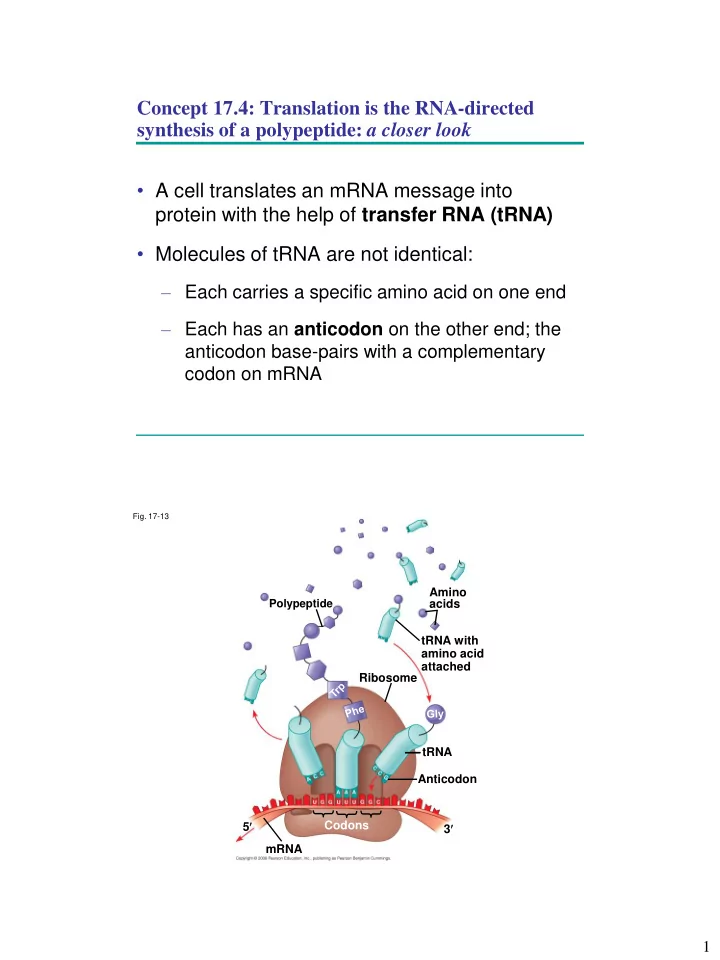
– Each carries a specific amino acid on one end – Each has an anticodon on the other end; the anticodon base-pairs with a complementary codon on mRNA

  • Fig. 17-13

Polypeptide Ribosome

Amino acids tRNA with amino acid attached tRNA Anticodon Codons 3 5 mRNA

slide-2
SLIDE 2

2

The Structure and Function of Transfer RNA

A C C

  • A tRNA molecule consists of a single RNA

strand that is only about 80 nucleotides long

  • Flattened into one plane to reveal its base

pairing, a tRNA molecule looks like a cloverleaf

  • Because of hydrogen bonds, tRNA actually

twists and folds into a three-dimensional molecule

  • tRNA is roughly L-shaped
  • Fig. 17-14

Amino acid attachment site 3 5 Hydrogen bonds Anticodon (a) Two-dimensional structure Amino acid attachment site 5 3 Hydrogen bonds 3 5 Anticodon Anticodon (c) Symbol used in this book (b) Three-dimensional structure

slide-3
SLIDE 3

3

  • Accurate translation requires two steps:

– First: a correct match between a tRNA and an amino acid, done by the enzyme aminoacyl- tRNA synthetase – Second: a correct match between the tRNA anticodon and an mRNA codon

  • Flexible pairing at the third base of a codon is

called wobble and allows some tRNAs to bind to more than one codon

  • Fig. 17-15-1

Amino acid Aminoacyl-tRNA synthetase (enzyme)

ATP

Adenosine

P P P

slide-4
SLIDE 4

4

  • Fig. 17-15-2

Amino acid Aminoacyl-tRNA synthetase (enzyme)

ATP

Adenosine

P P P

Adenosine

P P P

i

P P

i i

  • Fig. 17-15-3

Amino acid Aminoacyl-tRNA synthetase (enzyme)

ATP

Adenosine

P P P

Adenosine

P P P

i

P P

i i

tRNA tRNA Aminoacyl-tRNA synthetase Computer model AMP

Adenosine

P

slide-5
SLIDE 5

5

  • Fig. 17-15-4

Amino acid Aminoacyl-tRNA synthetase (enzyme)

ATP

Adenosine

P P P

Adenosine

P P P

i

P P

i i

tRNA tRNA Aminoacyl-tRNA synthetase Computer model AMP

Adenosine

P

Aminoacyl-tRNA (“charged tRNA”)

Ribosomes

  • Ribosomes facilitate specific coupling of tRNA

anticodons with mRNA codons in protein synthesis

  • The two ribosomal subunits (large and small)

are made of proteins and ribosomal RNA (rRNA)

slide-6
SLIDE 6

6

  • Fig. 17-16

Growing polypeptide Exit tunnel Large subunit Small subunit tRNA molecules E P A mRNA 5 3 (a) Computer model of functioning ribosome P site (Peptidyl-tRNA binding site) E site (Exit site) A site (Aminoacyl- tRNA binding site) E P A Large subunit mRNA binding site Small subunit (b) Schematic model showing binding sites Amino end Growing polypeptide Next amino acid to be added to polypeptide chain mRNA tRNA E 3 5 Codons (c) Schematic model with mRNA and tRNA

  • Fig. 17-16a

Growing polypeptide Exit tunnel tRNA molecules Large subunit Small subunit

(a) Computer model of functioning ribosome

mRNA E P A 5 3

slide-7
SLIDE 7

7

  • Fig. 17-16b

P site (Peptidyl-tRNA binding site) A site (Aminoacyl- tRNA binding site) E site (Exit site) mRNA binding site Large subunit Small subunit

(b) Schematic model showing binding sites

Next amino acid to be added to polypeptide chain Amino end Growing polypeptide mRNA tRNA E P A E Codons

(c) Schematic model with mRNA and tRNA

5 3

  • A ribosome has three binding sites for tRNA:

– The A site holds the tRNA that carries the next amino acid to be added to the chain – The P site holds the tRNA that carries the growing polypeptide chain – The E site is the exit site, where discharged tRNAs leave the ribosome

slide-8
SLIDE 8

8

Translation Stage 1:

Ribosome Association and Initiation of Translation

  • The initiation stage of translation brings together

mRNA, a tRNA with the first amino acid, and the two ribosomal subunits

  • First, a small ribosomal subunit binds with mRNA

and a special initiator tRNA

  • Then the small subunit moves along the mRNA

until it reaches the start codon on mRNA (5’- AUG-3’)

  • Proteins called initiation factors bring in the large

subunit that completes the translation initiation complex

  • Fig. 17-17

3 3 5 5 U U A A C G GTP GDP Initiator tRNA mRNA 5 3 Start codon mRNA binding site Small ribosomal subunit 5 P site Translation initiation complex 3 E A Large ribosomal subunit

slide-9
SLIDE 9

9

Translation Stage 2:

Elongation of the Polypeptide Chain

  • During the elongation stage, amino acids are

added one by one to the preceding amino acid

  • Each addition involves proteins called

elongation factors and occurs in three steps: codon recognition, peptide bond formation, and translocation

  • Fig. 17-18-1

Amino end

  • f polypeptide

mRNA 5 3 E

P site A site

slide-10
SLIDE 10

10

  • Fig. 17-18-2

Amino end

  • f polypeptide

mRNA 5 3 E

P site A site GTP

GDP

E P A

  • Fig. 17-18-3

Amino end

  • f polypeptide

mRNA 5 3 E

P site A site GTP

GDP

E P A E P A

slide-11
SLIDE 11

11

  • Fig. 17-18-4

Amino end

  • f polypeptide

mRNA 5 3 E

P site A site GTP

GDP

E P A E P A

GDP

GTP

Ribosome ready for next aminoacyl tRNA E P A

Translation Stage 3:

Termination of Translation

  • Termination occurs when a stop codon in the

mRNA reaches the A site of the ribosome

  • The A site accepts a protein called a release

factor

  • The release factor causes the addition of a

water molecule instead of an amino acid

  • This reaction releases the polypeptide, and the

translation assembly then comes apart

slide-12
SLIDE 12

12

  • Fig. 17-19-1

Release factor 3 5 Stop codon (UAG, UAA, or UGA)

  • Fig. 17-19-2

Release factor 3 5 Stop codon (UAG, UAA, or UGA) 5 3 2 Free polypeptide 2 GDP

GTP

slide-13
SLIDE 13

13

  • Fig. 17-19-3

Release factor 3 5 Stop codon (UAG, UAA, or UGA) 5 3 2 Free polypeptide 2 GDP

GTP

5 3

Polyribosomes

  • A number of ribosomes can translate a single

mRNA simultaneously, forming a polyribosome (or polysome)

  • Polyribosomes enable a cell to make many

copies of a polypeptide very quickly

slide-14
SLIDE 14

14

  • Fig. 17-20

Growing polypeptides Completed polypeptide Incoming ribosomal subunits Start of mRNA (5 end) End of mRNA (3 end) (a) Ribosomes mRNA (b) 0.1 µm

Protein Folding and Post-Translational Modifications

  • During and after synthesis, a polypeptide chain

spontaneously coils and folds into its three- dimensional shape

  • Proteins may also require post-translational

modifications before doing their job

  • Some polypeptides are activated by enzymes

that cleave them

  • Other polypeptides come together to form the

subunits of a protein

slide-15
SLIDE 15

15

Targeting Polypeptides to Specific Locations

  • Two populations of ribosomes are evident in

cells: free ribsomes (in the cytoplasm) and bound ribosomes (attached to the ER)

  • Free ribosomes mostly synthesize proteins that

function in the cytoplasm

  • Bound ribosomes make proteins of the

endomembrane system and proteins that are secreted from the cell

  • Ribosomes are identical and can switch from

free to bound

  • Polypeptide synthesis always begins in the

cytosol

  • Synthesis finishes in the cytosol unless the

polypeptide signals the ribosome to attach to the ER

  • Polypeptides destined for the ER or for

secretion are marked by a signal peptide

slide-16
SLIDE 16

16

  • A signal-recognition particle (SRP) binds to

the signal peptide

  • The SRP brings the signal peptide and its

ribosome to the ER

  • Fig. 17-21

Ribosome mRNA Signal peptide Signal- recognition particle (SRP) CYTOSOL Translocation complex SRP receptor protein ER LUMEN Signal peptide removed ER membrane Protein

What happens to a protein when the cell doesn’t need it anymore?

(We’ll talk more about this later.)