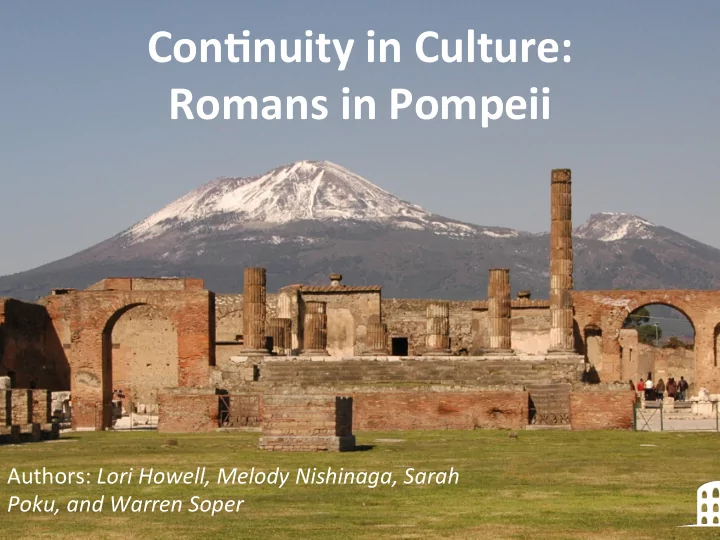
Con$nuity in Culture: Romans in Pompeii Authors: Lori Howell, Melody - - PowerPoint PPT Presentation

con nuity in culture romans in pompeii
SMART_READER_LITE
LIVE PREVIEW

Con$nuity in Culture: Romans in Pompeii Authors: Lori Howell, Melody - - PowerPoint PPT Presentation

Con$nuity in Culture: Romans in Pompeii Authors: Lori Howell, Melody Nishinaga, Sarah Poku, and Warren Soper Pompeii Meaning of the Name Pompeii Italic root: the number 5 Two possible meanings: Five ethnic groups joined together


slide-1
SLIDE 1

Con$nuity in Culture: Romans in Pompeii

Authors: Lori Howell, Melody Nishinaga, Sarah Poku, and Warren Soper

slide-2
SLIDE 2

Pompeii Meaning of the Name

  • Pompeii

– Italic root: the number 5 – Two possible meanings:

  • Five ethnic groups joined

together as a federa$on to control the mouth of the Sarno.

  • Five is the number of

fingers on one hand. Symbolism: Pompeii fathered all the groups from the (undefined and vague) neighboring region.

slide-3
SLIDE 3
  • As early as 300 BC, Pompeii was built of durable materials (mud

brick, stone and wood) and had taken on the configura$on that was to persist up un;l Vesuvius’ erup;on on 79 AD

  • But the area around Pompeii had frequent earthquakes
slide-4
SLIDE 4
  • Pompeii

controlled the mouth of the Sarno River and all trade along the river

  • Main economy

was trade of agricultural products

slide-5
SLIDE 5
  • A Samnite city,

Pompeii was a close ally of Rome

– Romans were interested in trade with the Samnites

  • In 80 B.C. during the

Italian Civil War Sulla conquered Pompeii

  • The gradual

assimila$on of Roman culture followed in Pompeii

slide-6
SLIDE 6

Please get into your groups! On your table, you will see the name

  • f a person.

By the end of today, you will find

  • ut if you have survived the

erup$on of Vesuvius.

slide-7
SLIDE 7

Satellite image

  • f
  • Mt. Vesuvius
slide-8
SLIDE 8

Map of the wind direc;on of the volcanic ash

slide-9
SLIDE 9

View the Video “Pompeii Deconstructed”

Or next slide

slide-10
SLIDE 10

Imagine yourself…

In Pompeii on August 24, 79 AD.

Instead of Previous Slide

Play the Video “A Day in Pompeii”

slide-11
SLIDE 11

Pompeii Then

slide-12
SLIDE 12

Pompeii Now

slide-13
SLIDE 13
  • AYer the erup;on in 79 A.D, Pompeii was lost

un;l serious excava;ons began in 1748. Even then, no one was sure if the site was Stabiae

  • r Pompeii.
slide-14
SLIDE 14

Charles III Bourbon, King of Spain and Naples

  • Workmen on his summer house

uncovered ar;facts from Pompeii.

  • Charles saw the sight as a way

to gain influence

  • Excava$ons and Archaeological

discoveries led to Poli$cal Influence

  • Ar;facts from Pompeii now at

the Na;onal Archaeological Museum in Naples

slide-15
SLIDE 15
  • Whereas Rome exists in layers (building over buildings),

Pompeii is a city frozen in $me

  • In Pompeii, tourists can see the skeleton of a complete

city of ancient ;mes (minus all decora;ve elements and free-standing objects)

– It is possible to see walls, houses, temples, streets, fountains, and theatres – Furniture, décor, utensils, sculptures, ornaments, frescoes, and mosaics primarily in Na$onal Archaeological Museum in Naples

TODAY

slide-16
SLIDE 16

Did you die or survive?