Computing Hermitian Determinantal Representations of Plane Curves - - PowerPoint PPT Presentation

computing hermitian determinantal representations of
SMART_READER_LITE
LIVE PREVIEW

Computing Hermitian Determinantal Representations of Plane Curves - - PowerPoint PPT Presentation

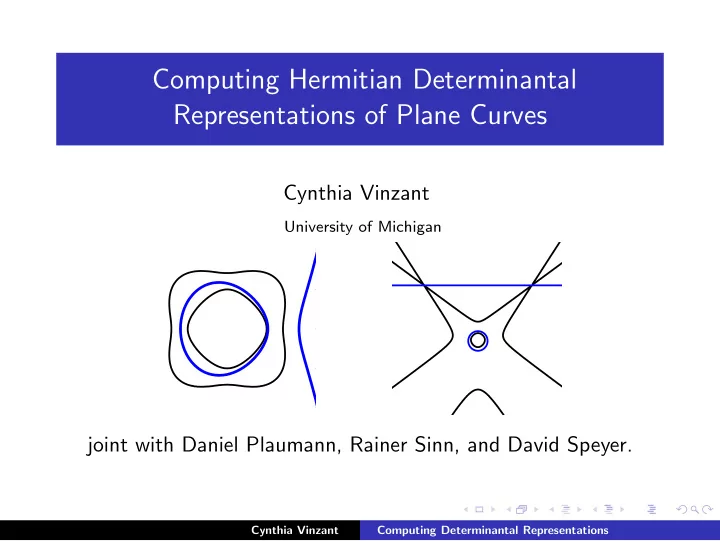
Computing Hermitian Determinantal Representations of Plane Curves Cynthia Vinzant University of Michigan 0.2 2 0.0 1 0 0.2 1 0.4 2 0.6 1.5 1.0 0.5 0.0 0.5 1.0 1.5 2 1 0 1 2 joint with Daniel Plaumann, Rainer Sinn, and David


slide-1
SLIDE 1

Computing Hermitian Determinantal Representations of Plane Curves

Cynthia Vinzant

University of Michigan

2 1 1 2 2 1 1 2 1.5 1.0 0.5 0.0 0.5 1.0 1.5 0.6 0.4 0.2 0.0 0.2

joint with Daniel Plaumann, Rainer Sinn, and David Speyer.

Cynthia Vinzant Computing Determinantal Representations

slide-2
SLIDE 2

Determinantal Representations

A determinantal representation of f ∈ R[x1, . . . , xn]d is f = det n

  • i=1

xiMi

  • where Mi are d × d matrices.

Cynthia Vinzant Computing Determinantal Representations

slide-3
SLIDE 3

Determinantal Representations

A determinantal representation of f ∈ R[x1, . . . , xn]d is f = det n

  • i=1

xiMi

  • where Mi are d × d matrices.

Ex: x2 − y2 − z2 = det x − y z z x + y

  • = det
  • x

1 1

  • + y

−1 1

  • + z

1 1

  • Cynthia Vinzant

Computing Determinantal Representations

slide-4
SLIDE 4

Determinantal Representations

A determinantal representation of f ∈ R[x1, . . . , xn]d is f = det n

  • i=1

xiMi

  • where Mi are d × d matrices.

Ex: x2 − y2 − z2 = det x − y z z x + y

  • = det
  • x

1 1

  • + y

−1 1

  • + z

1 1

  • A representation

i xiMi is definite if the Mi are real symmetric

  • r Hermitian and there is a positive definite matrix in their span,

M(e) =

  • i

eiMi ≻ 0 for some e ∈ Rn.

Cynthia Vinzant Computing Determinantal Representations

slide-5
SLIDE 5

Hyperbolic Polynomials

f = det(

i xiMi) with i eiMi ≻ 0

⇒ f is hyperbolic with respect to e. (roots of f (e + tx) are real for every x ∈ Rn) e

2 1 1 2 3 4 3 2 1 1 2 3

e

2 1 1 2 2 1 1 2 2 1 1 2 2 1 1 2

a hyperbolic cubic a hyperbolic quartic a not-hyperbolic quartic

Cynthia Vinzant Computing Determinantal Representations

slide-6
SLIDE 6

Hyperbolic Polynomials

f = det(

i xiMi) with i eiMi ≻ 0

⇒ f is hyperbolic with respect to e. (roots of f (e + tx) are real for every x ∈ Rn) e

2 1 1 2 3 4 3 2 1 1 2 3

e

2 1 1 2 2 1 1 2 2 1 1 2 2 1 1 2

a hyperbolic cubic a hyperbolic quartic a not-hyperbolic quartic Hyperbolic plane curves consist of degree/2 nested ovals in P2(R).

Cynthia Vinzant Computing Determinantal Representations

slide-7
SLIDE 7

Definite Determinantal Representations

Question: What hyperbolic polynomials have definite determinantal representations f = det(

i xiMi)?

Cynthia Vinzant Computing Determinantal Representations

slide-8
SLIDE 8

Definite Determinantal Representations

Question: What hyperbolic polynomials have definite determinantal representations f = det(

i xiMi)?

Related Question: What convex semialgebraic sets can be written as a slice of the cone of positive semidefinite matrices?

Cynthia Vinzant Computing Determinantal Representations

slide-9
SLIDE 9

Definite Determinantal Representations

Question: What hyperbolic polynomials have definite determinantal representations f = det(

i xiMi)?

Related Question: What convex semialgebraic sets can be written as a slice of the cone of positive semidefinite matrices?

Theorem (Helton-Vinnikov 2007)

If a polynomial f ∈ R[x, y, z]d is hyperbolic with respect to e ∈ R3 then there exist real symmetric matrices A, B, C ∈ Rd×d

sym with

f = det(xA + yB + zC) and e1A + e2B + e3C ≻ 0.

Cynthia Vinzant Computing Determinantal Representations

slide-10
SLIDE 10

Constructions

Computing real symmetric determinantal representations is hard. One can use . . .

  • theta functions

(` a la Helton and Vinnikov)

  • homotopy continuation

(Leykin and Plaumann)

Cynthia Vinzant Computing Determinantal Representations

slide-11
SLIDE 11

Constructions

Computing real symmetric determinantal representations is hard. One can use . . .

  • theta functions

(` a la Helton and Vinnikov)

  • homotopy continuation

(Leykin and Plaumann) These slow down around degree ≈ 6, 7.

Cynthia Vinzant Computing Determinantal Representations

slide-12
SLIDE 12

Constructions

Computing real symmetric determinantal representations is hard. One can use . . .

  • theta functions

(` a la Helton and Vinnikov)

  • homotopy continuation

(Leykin and Plaumann) These slow down around degree ≈ 6, 7. Computing Hermitian determinantal representations is easier.

Cynthia Vinzant Computing Determinantal Representations

slide-13
SLIDE 13

Interlacing and Distinguishing Definiteness

Theorem (Plaumann-V. 2013)

For a Hermitian matrix of linear forms M(x) =

i xiMi, the matrix

M(e) is (positive or negative) definite if and only if the top left (d − 1) × (d − 1) minor of M interlaces det(M) with respect to e.

Cynthia Vinzant Computing Determinantal Representations

slide-14
SLIDE 14

Interlacing and Distinguishing Definiteness

Theorem (Plaumann-V. 2013)

For a Hermitian matrix of linear forms M(x) =

i xiMi, the matrix

M(e) is (positive or negative) definite if and only if the top left (d − 1) × (d − 1) minor of M interlaces det(M) with respect to e.

e

2 1 1 2 2 1 1 2

e

2 1 1 2 2 1 1 2

interlacer non-interlacer

Cynthia Vinzant Computing Determinantal Representations

slide-15
SLIDE 15

Interlacing and Distinguishing Definiteness

Theorem (Plaumann-V. 2013)

For a Hermitian matrix of linear forms M(x) =

i xiMi, the matrix

M(e) is (positive or negative) definite if and only if the top left (d − 1) × (d − 1) minor of M interlaces det(M) with respect to e.

e

2 1 1 2 2 1 1 2

e

2 1 1 2 2 1 1 2

interlacer non-interlacer Example of an interlacer: the directional derivative

n

  • i=1

ei ∂f ∂xi

Cynthia Vinzant Computing Determinantal Representations

slide-16
SLIDE 16

Interlude: adjugate matrices

For a matrix M, let Madj denote its adjugate (or classical adjoint). Some observations about the matrix Madj . . .

Cynthia Vinzant Computing Determinantal Representations

slide-17
SLIDE 17

Interlude: adjugate matrices

For a matrix M, let Madj denote its adjugate (or classical adjoint). Some observations about the matrix Madj . . .

  • If M =

i xiMi, the entries of Madj have degree d − 1.

Cynthia Vinzant Computing Determinantal Representations

slide-18
SLIDE 18

Interlude: adjugate matrices

For a matrix M, let Madj denote its adjugate (or classical adjoint). Some observations about the matrix Madj . . .

  • If M =

i xiMi, the entries of Madj have degree d − 1.

  • M · Madj

= Madj · M = det(M)I.

Cynthia Vinzant Computing Determinantal Representations

slide-19
SLIDE 19

Interlude: adjugate matrices

For a matrix M, let Madj denote its adjugate (or classical adjoint). Some observations about the matrix Madj . . .

  • If M =

i xiMi, the entries of Madj have degree d − 1.

  • M · Madj

= Madj · M = det(M)I.

  • Madj(p) has rank ≤ 1 for every point p in V(det(M)).

Cynthia Vinzant Computing Determinantal Representations

slide-20
SLIDE 20

Interlude: adjugate matrices

For a matrix M, let Madj denote its adjugate (or classical adjoint). Some observations about the matrix Madj . . .

  • If M =

i xiMi, the entries of Madj have degree d − 1.

  • M · Madj

= Madj · M = det(M)I.

  • Madj(p) has rank ≤ 1 for every point p in V(det(M)).

Idea (Dixon 1902): Construct a d × d matrix of forms of degree d − 1 whose 2 × 2 minors lie in the ideal f .

Cynthia Vinzant Computing Determinantal Representations

slide-21
SLIDE 21

Interlude: adjugate matrices

For a matrix M, let Madj denote its adjugate (or classical adjoint). Some observations about the matrix Madj . . .

  • If M =

i xiMi, the entries of Madj have degree d − 1.

  • M · Madj

= Madj · M = det(M)I.

  • Madj(p) has rank ≤ 1 for every point p in V(det(M)).

Idea (Dixon 1902): Construct a d × d matrix of forms of degree d − 1 whose 2 × 2 minors lie in the ideal f .

  • (Madj)11 interlaces det(M)

⇒ M(e) ≻ 0.

Cynthia Vinzant Computing Determinantal Representations

slide-22
SLIDE 22

Interlacers → Definite Determinantal Representations

Theorem (Plaumann-V. 2013)

Suppose g1 ∈ R[x, y, z]d−1 interlaces f with respect to e ∈ R3 and split the points V(f , g1) into disjoint sets S ∪ S. e

2 1 1 2 2 1 1 2

Cynthia Vinzant Computing Determinantal Representations

slide-23
SLIDE 23

Interlacers → Definite Determinantal Representations

Theorem (Plaumann-V. 2013)

Suppose g1 ∈ R[x, y, z]d−1 interlaces f with respect to e ∈ R3 and split the points V(f , g1) into disjoint sets S ∪ S. If g = (g1, . . . , gd) is a basis C[x, y, z]d−1 ∩ I(S), e

2 1 1 2 2 1 1 2

Cynthia Vinzant Computing Determinantal Representations

slide-24
SLIDE 24

Interlacers → Definite Determinantal Representations

Theorem (Plaumann-V. 2013)

Suppose g1 ∈ R[x, y, z]d−1 interlaces f with respect to e ∈ R3 and split the points V(f , g1) into disjoint sets S ∪ S. If g = (g1, . . . , gd) is a basis C[x, y, z]d−1 ∩ I(S), then there is a Hermitian matrix M = xA + yB + zC with e

2 1 1 2 2 1 1 2

(Madj)(1,·) = g, M(e) ≻ 0, and f = det(M).

Cynthia Vinzant Computing Determinantal Representations

slide-25
SLIDE 25

Algorithm (PSSV)

Input: f ∈ R[x, y, z]d and e ∈ R3 with f hyperbolic w.resp. to e.

e

2 1 1 2 2 1 1 2

Cynthia Vinzant Computing Determinantal Representations

slide-26
SLIDE 26

Algorithm (PSSV)

Input: f ∈ R[x, y, z]d and e ∈ R3 with f hyperbolic w.resp. to e.

  • Let g1 = e1 ∂f

∂x + e2 ∂f ∂y + e3 ∂f ∂z . e

2 1 1 2 2 1 1 2

Cynthia Vinzant Computing Determinantal Representations

slide-27
SLIDE 27

Algorithm (PSSV)

Input: f ∈ R[x, y, z]d and e ∈ R3 with f hyperbolic w.resp. to e.

  • Let g1 = e1 ∂f

∂x + e2 ∂f ∂y + e3 ∂f ∂z .

  • Compute the d(d − 1) points VC(f ) ∩ VC(g1).

e

2 1 1 2 2 1 1 2

Cynthia Vinzant Computing Determinantal Representations

slide-28
SLIDE 28

Algorithm (PSSV)

Input: f ∈ R[x, y, z]d and e ∈ R3 with f hyperbolic w.resp. to e.

  • Let g1 = e1 ∂f

∂x + e2 ∂f ∂y + e3 ∂f ∂z .

  • Compute the d(d − 1) points VC(f ) ∩ VC(g1).
  • Split VC(f ) ∩ VC(g1) into disjoint, conjugate sets S ∪ S.

e

2 1 1 2 2 1 1 2

Cynthia Vinzant Computing Determinantal Representations

slide-29
SLIDE 29

Algorithm (PSSV)

Input: f ∈ R[x, y, z]d and e ∈ R3 with f hyperbolic w.resp. to e.

  • Let g1 = e1 ∂f

∂x + e2 ∂f ∂y + e3 ∂f ∂z .

  • Compute the d(d − 1) points VC(f ) ∩ VC(g1).
  • Split VC(f ) ∩ VC(g1) into disjoint, conjugate sets S ∪ S.

e

2 1 1 2 2 1 1 2

  • Extend g1 to a basis g = (g1, . . . , gd) of the space of polynomials in

C[x, y, z]d−1 that vanish at the points S.

Cynthia Vinzant Computing Determinantal Representations

slide-30
SLIDE 30

Algorithm (PSSV)

Input: f ∈ R[x, y, z]d and e ∈ R3 with f hyperbolic w.resp. to e.

  • Let g1 = e1 ∂f

∂x + e2 ∂f ∂y + e3 ∂f ∂z .

  • Compute the d(d − 1) points VC(f ) ∩ VC(g1).
  • Split VC(f ) ∩ VC(g1) into disjoint, conjugate sets S ∪ S.

e

2 1 1 2 2 1 1 2

  • Extend g1 to a basis g = (g1, . . . , gd) of the space of polynomials in

C[x, y, z]d−1 that vanish at the points S.

  • In the 3d2 variables Ai,j, Bi,j, Ci,j, solve the 2d

d+2

2

  • affine

equations coming from the polynomial vector equations g · (xA + yB + zC) = (f , 0 . . . 0) (xA + yB + zC) · g T = (f , 0 . . . 0)T.

Cynthia Vinzant Computing Determinantal Representations

slide-31
SLIDE 31

Algorithm (PSSV)

Input: f ∈ R[x, y, z]d and e ∈ R3 with f hyperbolic w.resp. to e.

  • Let g1 = e1 ∂f

∂x + e2 ∂f ∂y + e3 ∂f ∂z .

  • Compute the d(d − 1) points VC(f ) ∩ VC(g1).
  • Split VC(f ) ∩ VC(g1) into disjoint, conjugate sets S ∪ S.

e

2 1 1 2 2 1 1 2

  • Extend g1 to a basis g = (g1, . . . , gd) of the space of polynomials in

C[x, y, z]d−1 that vanish at the points S.

  • In the 3d2 variables Ai,j, Bi,j, Ci,j, solve the 2d

d+2

2

  • affine

equations coming from the polynomial vector equations g · (xA + yB + zC) = (f , 0 . . . 0) (xA + yB + zC) · g T = (f , 0 . . . 0)T. Output: Hermitian matrices A, B, C ∈ Cd×d with f = det(xA + yB + zC) and e1A + e2B + e3C ≻ 0.

Cynthia Vinzant Computing Determinantal Representations

slide-32
SLIDE 32

A quartic example

f = x4 − 4x2y2 + y4 − 4x2z2 − 2y2z2 + z4 (hyperbolic w.resp. to (1, 0, 0))

1.5 1.0 0.5 0.0 0.5 1.0 1.5 0.6 0.4 0.2 0.0 0.2

Cynthia Vinzant Computing Determinantal Representations

slide-33
SLIDE 33

A quartic example

f = x4 − 4x2y2 + y4 − 4x2z2 − 2y2z2 + z4 (hyperbolic w.resp. to (1, 0, 0)) Let g1 =

1 4∂f /∂x = x3 − 2xy 2 − 2xz2.

1.5 1.0 0.5 0.0 0.5 1.0 1.5 0.6 0.4 0.2 0.0 0.2

Cynthia Vinzant Computing Determinantal Representations

slide-34
SLIDE 34

A quartic example

f = x4 − 4x2y2 + y4 − 4x2z2 − 2y2z2 + z4 (hyperbolic w.resp. to (1, 0, 0)) Let g1 =

1 4∂f /∂x = x3 − 2xy 2 − 2xz2.

Split V(f ) ∩ V(g1) = S ∪ S where S = {[0 : ±1 : 1], [2 : ± √ 3 : i], [2 : i : ± √ 3]}.

1.5 1.0 0.5 0.0 0.5 1.0 1.5 0.6 0.4 0.2 0.0 0.2

Cynthia Vinzant Computing Determinantal Representations

slide-35
SLIDE 35

A quartic example

f = x4 − 4x2y2 + y4 − 4x2z2 − 2y2z2 + z4 (hyperbolic w.resp. to (1, 0, 0)) Let g1 =

1 4∂f /∂x = x3 − 2xy 2 − 2xz2.

Split V(f ) ∩ V(g1) = S ∪ S where S = {[0 : ±1 : 1], [2 : ± √ 3 : i], [2 : i : ± √ 3]}.

1.5 1.0 0.5 0.0 0.5 1.0 1.5 0.6 0.4 0.2 0.0 0.2

The cubics in C[x, y, z]3 vanishing at S are spanned by g = (g1, g2, g3, g4), where g2 = ix3 + 4ixy 2 − 4x2z − 4y 2z + 4z3, g3 = −3ix3 + 4x2y + 4ixy 2 − 4y 3 + 4yz2, g4 = −x3 − 2ix2y − 2ix2z + 4xyz.

Cynthia Vinzant Computing Determinantal Representations

slide-36
SLIDE 36

Example: f = x4 − 4x2y 2 + y 4 − 4x2z2 − 2y 2z2 + z4

From the vector of cubics g = (g1, . . . , g4), we solve the polynomial vector equations

1.5 1.0 0.5 0.0 0.5 1.0 1.5 0.6 0.4 0.2 0.0 0.2

g · (xA + yB + zC) = (f , 0) and (xA + yB + zC) · gT = (f , 0)T.

Cynthia Vinzant Computing Determinantal Representations

slide-37
SLIDE 37

Example: f = x4 − 4x2y 2 + y 4 − 4x2z2 − 2y 2z2 + z4

From the vector of cubics g = (g1, . . . , g4), we solve the polynomial vector equations

1.5 1.0 0.5 0.0 0.5 1.0 1.5 0.6 0.4 0.2 0.0 0.2

g · (xA + yB + zC) = (f , 0) and (xA + yB + zC) · gT = (f , 0)T.

  • ne entry

→ 15 affine equations in Aij, Bij, Cij

Cynthia Vinzant Computing Determinantal Representations

slide-38
SLIDE 38

Example: f = x4 − 4x2y 2 + y 4 − 4x2z2 − 2y 2z2 + z4

From the vector of cubics g = (g1, . . . , g4), we solve the polynomial vector equations

1.5 1.0 0.5 0.0 0.5 1.0 1.5 0.6 0.4 0.2 0.0 0.2

g · (xA + yB + zC) = (f , 0) and (xA + yB + zC) · gT = (f , 0)T.

  • ne entry

→ 15 affine equations in Aij, Bij, Cij Unique solution:

xA + yB + zC = 1 8     14x 2z 2ix − 2y 2i(y − z) 2z x −ix + 2y −2ix − 2y x ix − 2z −2i(y − z) ix + 2y −ix − 2z 4x    

Cynthia Vinzant Computing Determinantal Representations

slide-39
SLIDE 39

Example: f = x4 − 4x2y 2 + y 4 − 4x2z2 − 2y 2z2 + z4

From the vector of cubics g = (g1, . . . , g4), we solve the polynomial vector equations

1.5 1.0 0.5 0.0 0.5 1.0 1.5 0.6 0.4 0.2 0.0 0.2

g · (xA + yB + zC) = (f , 0) and (xA + yB + zC) · gT = (f , 0)T.

  • ne entry

→ 15 affine equations in Aij, Bij, Cij Unique solution:

xA + yB + zC = 1 8     14x 2z 2ix − 2y 2i(y − z) 2z x −ix + 2y −2ix − 2y x ix − 2z −2i(y − z) ix + 2y −ix − 2z 4x    

determinant = (1/256) · f , positive definite at (x, y, z) = (1, 0, 0)

Cynthia Vinzant Computing Determinantal Representations

slide-40
SLIDE 40

Numerical computations

For randomly generated hyperbolic polynomials, this method computes determinantal representa- tions fairly quickly (in Mathematica). Average computation times: degree 5 6 7 8 9 10 15 time (sec) 0.4 0.8 1.7 3.2 6.1 10.7 110

Cynthia Vinzant Computing Determinantal Representations

slide-41
SLIDE 41

References

  • A. C. Dixon. Note on the reduction of a ternary quantic to a

symmetrical determinant. Cambr. Proc., 11, (1902) 350–351.

  • J. W. Helton and V. Vinnikov. Linear matrix inequality

representation of sets. Comm. Pure Appl. Math., 60(5), (2007) 654–674.

  • Anton Leykin and D. Plaumann. Determinantal representations of

hyperbolic curves via polynomial homotopy continuation. arXiv:1212.3506

  • D. Plaumann and C. Vinzant. Determinantal representations of

hyperbolic plane curves: An elementary approach. J. Symbolic Comput., 57 (2013), 48–60.

Thanks!

Cynthia Vinzant Computing Determinantal Representations