SLIDE 1
Computer Vision
Presented by Alex Golts
SPORTS
SLIDE 2 Talk Outline
- General overview
- Applications & examples
- Main challenges
- “FoxTrax” – Hockey puck tracking system
- Players tracking system
- Summary
- R. Cavallaro. The FoxTrax hockey puck tracking system. IEEE
Computer Graphics and applications, 17(2):6–12, 1997. Computer vision system for tracking players in sports games, J Pers, S Kovacic, ISPA’00
SLIDE 3 General Overview
Computer vision is used in sports for several kinds of benefits:
- Improving broadcast / viewer experience
- Improving the training process of professional athletes
- Automatic sports analysis and interpretation
- Helping / improving referee decisions
- Commercial benefit
SLIDE 4 Applications & Examples
Improving broadcast / viewer experience
- “Fox Trax” – Hockey puck tracking system
System will be described later on …
SLIDE 5 Applications & Examples
Improving broadcast / viewer experience
- Drawing virtual marks across a football field
SLIDE 6 Applications & Examples
Improving the training process of professional athletes
- Estimation of center-of-mass by manually fitting a skeleton model
SLIDE 7 Applications & Examples
Automatic sports analysis and interpretation
- Tracking of players in a sports game
System will be described later on …
SLIDE 8 Applications & Examples
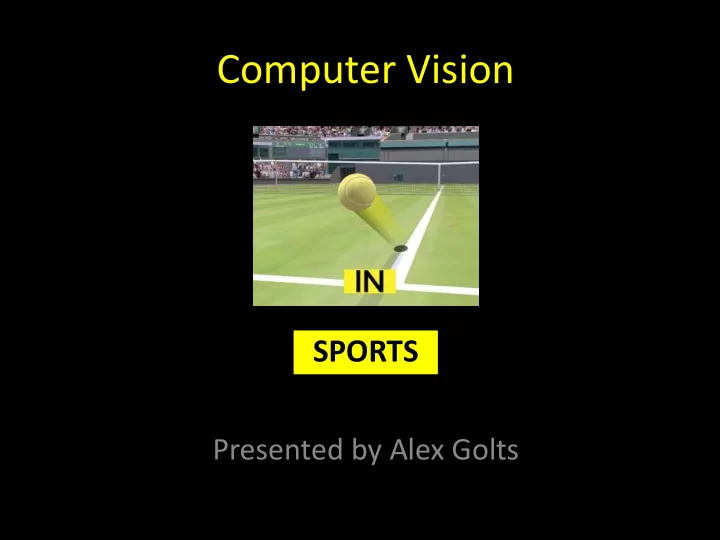
Helping / improving referee decisions
SLIDE 9 Applications & Examples
Commercial benefit
- Real time billboard substitution in video streams
SLIDE 10 Main challenges
- Changing / unknown environment – lighting, background,
clothing, scale, moving camera …
- Real-time live performance
- Provide innovation and value-for-money
- Robustness and accuracy
- Convince “conservative” regulators and critics…
SLIDE 11
FoxTrax
Problem
Hockey puck is difficult to follow for viewers
SLIDE 12 FoxTrax
In 1996, Fox Sports wanted to highlight the puck for the viewers without players feeling any difference.
- Highlight should be made even when the puck is hidden
behind objects.
- Puck speed can reach over 100mph, and sometimes get
blurred / disappear between TV scan lines. Simply processing the raw broadcast video was not enough
SLIDE 13
FoxTrax
Solution: IR emitting puck
SLIDE 14 System Architecture
Puck 20 Pulse detectors 10 IR cameras 4 Broadcast cameras Tripods Sync CV System
Broadcast video
(ϴ,φ) angles
IR video Glowing Puck 125𝜈𝑡𝑓𝑑 pulses
SLIDE 15 System Architecture
125𝜈𝑡𝑓𝑑 pulses
SLIDE 16 Computer Vision System
Calibration
- Measuring rink dimensions – Origin is defined at the
central face-off circle. Rink borders are measured using laser range-finder.
- Camera position calibration – For both IR and broadcast cameras.
Puck is placed at points of known location at the rink, and viewed from all cameras. Software computes camera positions.
- Distortion correction – For both IR and broadcast cameras.
Compute the distortion maps in the lab.
SLIDE 17
Computer Vision System
Triangulation
At least 2 IR images with line-of-sight to the puck Puck (X,Y,Z) coordinates
SLIDE 18 Computer Vision System
Projection
- Tripod (ϴ,φ) angles
- Broadcast camera
zoom state
𝐷𝑏𝑛𝑓𝑠𝑏 𝑁𝑏𝑢𝑠𝑗𝑦
Puck (X, Y, Z) coordinates Puck (x,y) camera coordinates
Add Glow
SLIDE 19 Computer Vision System
Delay and past data usage
- The algorithm works at 30[Hz] with a 5 frames delay.
- Additional 5 frames delay was added – allows to deal with
the puck being “lost” for 5 frames – by interpolation.
- Special effects added depending on puck speed
SLIDE 20
FoxTrax
Result – 1996 NHL All-Star game
SLIDE 21
FoxTrax – The end
At first, the new technology was successful, but many hockey fans (especially Canadians) disliked it. It lasted until 1998’s all star game.
SLIDE 22 FoxTrax – Summary
- The solution worked as expected. People were happy at first
- “Die hard” hockey fans are hard to please.
- Solution (For today): It’s a free country, Just make it optional!
- Or make the effect less “video game” like.
- Solution seems too expensive, and “heavy”
(remember it’s 1996). Seems like today it might be possible to achieve with just a CV algorithm (?)
SLIDE 23 Computer Vision System for Tracking Players in Sports Games
Problem
Indoor sports game
Computer Vision System
Player spatio- temporal trajectories
SLIDE 24 Players Tracking System
Cameras
Computer Vision System
SLIDE 25 Distortion Calibration
Computer Vision System 𝑒𝑠 = cos 𝑏𝑠𝑑𝑢𝑏𝑜 𝑆 ℎ 𝑒𝑆
𝑠𝑚 𝑆𝑚
𝑆𝑚 = ℎ 2 ∙ 𝑓−2𝑠𝑚
ℎ − 1
𝑓−𝑠𝑚
ℎ
Players Tracking System
SLIDE 26 Player tracking – motion detection
- Subtract each frame, 𝐷 from reference frame, 𝑆
(empty court): 𝐸 = 𝑆𝐷 − 𝑆𝑆 + 𝐻𝐷 − 𝐻𝑆 + 𝐶𝐷 − 𝐶𝑆
- Apply noise filtering and threshold
- Results in many false detections due to shadows,
noise etc’… Human intervention often required
Players Tracking System
SLIDE 27 Player tracking – template tracking
Computer Vision System
- 14 2D templates (16x16 pixels) - 𝐿
𝑘 (𝑘 = 1, … , 14):
Players Tracking System
SLIDE 28 Player tracking – template tracking
Computer Vision System
- For each pixel’s R,G and B components, compute the correlation:
𝐺
𝑘 𝑦, 𝑧 = 𝐿 𝑘 ⊗ 𝐽(𝑦, 𝑧)
14x3 = 42 coefficients per pixel
𝑘 𝑦, 𝑧 are calculated from the reference
frame, 𝑆.
𝑘 𝑦, 𝑧 are calculated by averaging the last 𝑜
coefficients 𝐺
𝑘 𝑦, 𝑧 . Represents “average” player
appearance.
Players Tracking System
SLIDE 29 Player tracking – template tracking
- A distance measure is calculated to compare 𝐺
𝑘, 𝐼 𝑘 and
𝐻
𝑘 in each pixel
𝑒𝐻𝐺 = (𝐺
𝑘 − 𝐻 𝑘)2 42 𝑘=1
𝑒𝐺𝐼 = (𝐼
𝑘 − 𝐺 𝑘)2 42 𝑘=1
𝑡 = 𝑒𝐺𝐼 𝑒𝐺𝐼 + 𝑒𝐻𝐺
Players Tracking System
SLIDE 30 Player tracking – template tracking
Similarity measure Difference image Real player image
Players Tracking System
SLIDE 31 Player tracking – color tracking
Computer Vision System
- Based on prior knowledge of the player’s uniform color –
(𝐷𝑆, 𝐷𝐻, 𝐷𝐶).
- The algorithm searches for the pixel with the most similar
color to the player’s color in a limited area around the last player position.
𝑇 𝑦, 𝑧 = (𝐽𝑆 𝑦, 𝑧 − 𝐷𝑆)2 + (𝐽𝑆 𝑦, 𝑧 − 𝐷𝑆)2+(𝐽𝑆 𝑦, 𝑧 − 𝐷𝑆)2
Players Tracking System
SLIDE 32 Results
Computer Vision System
- 3 methods were tested: A – motion detection, B – color tracking,
C – color + template tracking.
- Tested on 30 seconds of handball match, and 50 seconds of a
“test sequence” where the players stood still (measured distances correspond to noise).
Players Tracking System
SLIDE 33 Summary
Computer Vision System
- Semi-automatic system that outputs players trajectories.
Human interventions are required for error-free performance.
- 3 algorithmic approaches were tested.
- The system can serve as base for a complete sports analysis system.
- Semi-real-time. 5[Hz] can be achieved at best. However, today much
faster computers are available.
- Resolution was low. Each player takes only 10-15 pixels in the image.
- These relatively poor results perhaps explain why “Fox Sports” went
for a much more sophisticated approach.
Players Tracking System
SLIDE 34 Computer Vision in Sports
Summary
Computer Vision System
- CV is used in sports used for: broadcast, training, automatic analysis,
decision making and commerce.
- In broadcast enhancement and auto-analysis, object tracking is often
- needed. Hockey puck tracking, and players tracking systems were
discussed.
- Most of CV technology in sports is implemented in industrial
products, and not properly documented (besides patents). Academic works are not easy to come by, and there’s room for development.
- Besides the technological challenges, progress depends on
acceptance of change in a conservative environment, strict regulations, and the real need for improvement.
SLIDE 35
Thank You