Computer Science and Logic A Match Made in Heaven Luca Aceto - - PowerPoint PPT Presentation

computer science and logic a match made in heaven
SMART_READER_LITE
LIVE PREVIEW

Computer Science and Logic A Match Made in Heaven Luca Aceto - - PowerPoint PPT Presentation

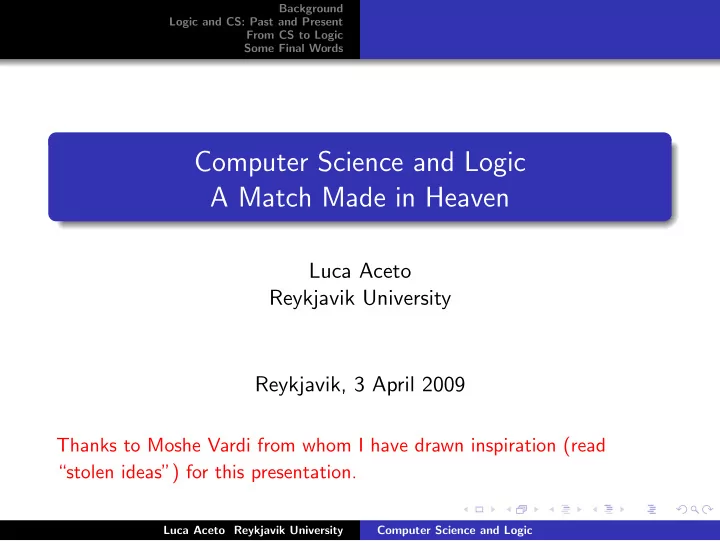
Background Logic and CS: Past and Present From CS to Logic Some Final Words Computer Science and Logic A Match Made in Heaven Luca Aceto Reykjavik University Reykjavik, 3 April 2009 Thanks to Moshe Vardi from whom I have drawn inspiration


slide-1
SLIDE 1

Background Logic and CS: Past and Present From CS to Logic Some Final Words

Computer Science and Logic A Match Made in Heaven

Luca Aceto Reykjavik University Reykjavik, 3 April 2009

Thanks to Moshe Vardi from whom I have drawn inspiration (read “stolen ideas”) for this presentation.

Luca Aceto Reykjavik University Computer Science and Logic

slide-2
SLIDE 2

Background Logic and CS: Past and Present From CS to Logic Some Final Words

Why This Talk Today?

The importance of logic for CS is perhaps not sufficiently appreciated. My message in a nutshell Logic - used by mathematicians but not talked about, talked about by philosophers but not used. Talked about, used and revitalized by computer scientists! Roadmap of the talk:

1 Background 2 Logic and CS: Past and present 3 Logic from CS 4 Conclusion Luca Aceto Reykjavik University Computer Science and Logic

slide-3
SLIDE 3

Background Logic and CS: Past and Present From CS to Logic Some Final Words

Why This Talk Today?

The importance of logic for CS is perhaps not sufficiently appreciated. My message in a nutshell Logic - used by mathematicians but not talked about, talked about by philosophers but not used. Talked about, used and revitalized by computer scientists! Roadmap of the talk:

1 Background 2 Logic and CS: Past and present 3 Logic from CS 4 Conclusion Luca Aceto Reykjavik University Computer Science and Logic

slide-4
SLIDE 4

Background Logic and CS: Past and Present From CS to Logic Some Final Words

Why This Talk Today?

The importance of logic for CS is perhaps not sufficiently appreciated. My message in a nutshell Logic - used by mathematicians but not talked about, talked about by philosophers but not used. Talked about, used and revitalized by computer scientists! Roadmap of the talk:

1 Background 2 Logic and CS: Past and present 3 Logic from CS 4 Conclusion Luca Aceto Reykjavik University Computer Science and Logic

slide-5
SLIDE 5

Background Logic and CS: Past and Present From CS to Logic Some Final Words

Mathematics and the Natural Sciences

E.P. Wigner (1960): On the Unreasonable Effectiveness of Mathematics in the Natural Sciences. “The book of nature is written in the language of mathematics.” (Galileo) Numerous examples of the effectiveness of mathematics in the physical sciences. The empirical law of epistemology The mathematical formulation of the laws of nature is both appropriate and accurate. Mathematics is the correct language for formulating the laws of nature. Question: What is the correct language for computer science?

Luca Aceto Reykjavik University Computer Science and Logic

slide-6
SLIDE 6

Background Logic and CS: Past and Present From CS to Logic Some Final Words

Mathematics and the Natural Sciences

E.P. Wigner (1960): On the Unreasonable Effectiveness of Mathematics in the Natural Sciences. “The book of nature is written in the language of mathematics.” (Galileo) Numerous examples of the effectiveness of mathematics in the physical sciences. The empirical law of epistemology The mathematical formulation of the laws of nature is both appropriate and accurate. Mathematics is the correct language for formulating the laws of nature. Question: What is the correct language for computer science?

Luca Aceto Reykjavik University Computer Science and Logic

slide-7
SLIDE 7

Background Logic and CS: Past and Present From CS to Logic Some Final Words

Mathematical Logic

Mathematical logic was developed in an attempt to confront the crisis in the foundations of mathematics at the turn of the 20th century. Hilbert’s Program (1900–1928) Formalize mathematics and establish that it is consistent, complete and decidable. Hilbert firmly believed that these goals can be achieved.

Luca Aceto Reykjavik University Computer Science and Logic

slide-8
SLIDE 8

Background Logic and CS: Past and Present From CS to Logic Some Final Words

The Demise of Hilbert’s Program

  • K. G¨
  • del (1931–1933):

— Incompleteness of ordinary arithmetic. — Impossibility of proving consistency within “reasonably rich formalisms”.

  • A. Church and A. Turing (1936–1937): Undecidability of first-order

logic — The set of valid first-order sentences is not decidable. — The set of all first-order sentences that true in arithmetic is not recursively enumerable. Mathematicians breathe a sigh of relief!

Luca Aceto Reykjavik University Computer Science and Logic

slide-9
SLIDE 9

Background Logic and CS: Past and Present From CS to Logic Some Final Words

The Demise of Hilbert’s Program

  • K. G¨
  • del (1931–1933):

— Incompleteness of ordinary arithmetic. — Impossibility of proving consistency within “reasonably rich formalisms”.

  • A. Church and A. Turing (1936–1937): Undecidability of first-order

logic — The set of valid first-order sentences is not decidable. — The set of all first-order sentences that true in arithmetic is not recursively enumerable. Mathematicians breathe a sigh of relief!

Luca Aceto Reykjavik University Computer Science and Logic

slide-10
SLIDE 10

Background Logic and CS: Past and Present From CS to Logic Some Final Words

Where is Logic Today?

Google, 2 April 2009 at 21:37 GMT: Logic and Computer Science: roughly 13,700,000 hits Logic and Mathematics: roughly 3,310,000 hits Logic and Philosophy: roughly 6,250,000 hits

Luca Aceto Reykjavik University Computer Science and Logic

slide-11
SLIDE 11

Background Logic and CS: Past and Present From CS to Logic Some Final Words

Logic in Computer Science

During the last 30 years, there has been extensive and growing interaction between logic and computer science. Concepts and methods of logic play a central role in CS: logic is the calculus of CS. Logic has been much more effective in CS than it has been in mathematics.

  • M. Davis (1988)

When I was a student, even the topologists regarded mathematical logicians as living in outer space. Today, the connections between logic and computers are a matter of engineering practice at every level of computer organization.

Luca Aceto Reykjavik University Computer Science and Logic

slide-12
SLIDE 12

Background Logic and CS: Past and Present From CS to Logic Some Final Words

Why?

Alan Turing I expect that digital computing machines will eventually stimulate a considerable interest in symbolic logic. . . The language in which

  • ne communicates with these machines . . . forms a sort of symbolic

logic. Logic provides: formalisms to describe mathematical structures languages to describe properties of mathematical structures languages to describe dynamic processes a clear distinction between syntax and semantics Michael Jackson: “Description is our business”

Luca Aceto Reykjavik University Computer Science and Logic

slide-13
SLIDE 13

Background Logic and CS: Past and Present From CS to Logic Some Final Words

And Logic Begat CS!

When dinosaurs roamed the earth, there was logic: Outcome of Hilbert’s program: formalization of algorithms Stored-program computer: universal Turing machine Functional programming: the λ-calculus Recursive-function theory: precursor of complexity theory Automata theory: finite automata Yes, but that was then. What about now?

Luca Aceto Reykjavik University Computer Science and Logic

slide-14
SLIDE 14

Background Logic and CS: Past and Present From CS to Logic Some Final Words

And Logic Begat CS!

When dinosaurs roamed the earth, there was logic: Outcome of Hilbert’s program: formalization of algorithms Stored-program computer: universal Turing machine Functional programming: the λ-calculus Recursive-function theory: precursor of complexity theory Automata theory: finite automata Yes, but that was then. What about now?

Luca Aceto Reykjavik University Computer Science and Logic

slide-15
SLIDE 15

Background Logic and CS: Past and Present From CS to Logic Some Final Words

Impact of Logic in CS

Logic has been effective in several different areas of CS, including: Computer-aided verification Database systems Computational complexity Programming languages Computer security Artificial intelligence Digital design Logic programming (of course!) Software engineering . . . (add you own favourite!)

Luca Aceto Reykjavik University Computer Science and Logic

slide-16
SLIDE 16

Background Logic and CS: Past and Present From CS to Logic Some Final Words

Exhibit 1: Computer-aided verification

Model Checking = Graphs + Logic + Algorithms.

1 Graphs describe the behaviour of the design space to be

  • analyzed. (Nodes = States, Edges = State Transitions)

2 Logic is used to describe (un)desirable properties of the

  • design. (Every sent message will eventually be delivered.)

3 Algorithms are used for a systematic exploration of the design

state space. Impact: Widely used in the HW industry and spreading in the SW industry.

Luca Aceto Reykjavik University Computer Science and Logic

slide-17
SLIDE 17

Background Logic and CS: Past and Present From CS to Logic Some Final Words

Exhibit 1: Computer-aided verification

Model Checking = Graphs + Logic + Algorithms.

1 Graphs describe the behaviour of the design space to be

  • analyzed. (Nodes = States, Edges = State Transitions)

2 Logic is used to describe (un)desirable properties of the

  • design. (Every sent message will eventually be delivered.)

3 Algorithms are used for a systematic exploration of the design

state space. Impact: Widely used in the HW industry and spreading in the SW industry.

Luca Aceto Reykjavik University Computer Science and Logic

slide-18
SLIDE 18

Background Logic and CS: Past and Present From CS to Logic Some Final Words

Exhibit 2: Logic and databases

A multi-billion dollar success! First-order logic lies at the core of modern database systems (SQL, QBE) Efficient query evaluation is based on relational algebra (aka cylindrical algebra (Alfred Tarski)) Semistructured data: XML: trees Data Type Definition: Tree automata XML queries: tree transducers

Luca Aceto Reykjavik University Computer Science and Logic

slide-19
SLIDE 19

Background Logic and CS: Past and Present From CS to Logic Some Final Words

Exhibit 3: Logic and complexity

Complexity: Computational complexity: amount of resources, such as time

  • r space, required by a machine that solves a problem.

Descriptive complexity: syntactic complexity of describing a problem in some logical formalism. An amazing connection: The two are intimately related! Machine independent Machine based FO(LFP) PTIME SO∃ NP SO(TC) PSPACE

Luca Aceto Reykjavik University Computer Science and Logic

slide-20
SLIDE 20

Background Logic and CS: Past and Present From CS to Logic Some Final Words

Exhibit 4: Logic and programming languages

Logic has been the primary tool in the systematic development of programming languages. In particular, formal semantics type theory rewriting systems . . . (add you own favourite!) Logic is not only used to design languages and compilers, but is also applied directly to “real” software artifacts.

Luca Aceto Reykjavik University Computer Science and Logic

slide-21
SLIDE 21

Background Logic and CS: Past and Present From CS to Logic Some Final Words

Exhibit 5: Logic and security

Areas of applicability: numerous! Access control policies Trust management Cryptographic protocol analysis . . . (add you own favourite!) Means of application: numerous! Authentication logics Temporal and epistemic logics Linear logic Model checking Theorem proving

Luca Aceto Reykjavik University Computer Science and Logic

slide-22
SLIDE 22

Background Logic and CS: Past and Present From CS to Logic Some Final Words

Logic from CS

CS problems invigorate logic research. Unlike traditional mathematical logic, we focus on the study

  • f logics over finite structures (e.g., databases): birth of

finite-model theory. CS studies powerful extensions of first-order logic: e.g., fixed-point logics in concurrency theory and databases Emphasis on the connection between logics and automata. Major role for modal and temporal logics. New logics have to be invented, e.g., authentication logics in security. New notions of inference, e.g., non-monotonic inference in AI. Focus on logics of uncertainty, e.g., in decision support systems.

Luca Aceto Reykjavik University Computer Science and Logic

slide-23
SLIDE 23

Background Logic and CS: Past and Present From CS to Logic Some Final Words

Logic in CS

Logic is mainly used as a formalism for describing objects and specifying their properties. Logic in CS is an applied science combining foundational research with applications. (See, e.g., the work on SAT solvers.) Logic (in CS) is an experimental science!

Luca Aceto Reykjavik University Computer Science and Logic

slide-24
SLIDE 24

Background Logic and CS: Past and Present From CS to Logic Some Final Words

Take-home Message

Logic is the most applied branch of mathematics today, thanks to CS. The rules of logic, not those of Nature, put limits and frame the work of a computer scientist. Hence, CS practitioners must know some logic. IMHO, logic ought to be integrated in the CS curriculum.

Luca Aceto Reykjavik University Computer Science and Logic

slide-25
SLIDE 25

Background Logic and CS: Past and Present From CS to Logic Some Final Words

Take-home Quotation

Arnold Schwarzenegger in “Twins” You have no respect for logic; I have no respect for people who have no respect for logic. Arnold proceeds to beat up the thug.

Thank you!

Luca Aceto Reykjavik University Computer Science and Logic

slide-26
SLIDE 26

Background Logic and CS: Past and Present From CS to Logic Some Final Words

Take-home Quotation

Arnold Schwarzenegger in “Twins” You have no respect for logic; I have no respect for people who have no respect for logic. Arnold proceeds to beat up the thug.

Thank you!

Luca Aceto Reykjavik University Computer Science and Logic