Computer Networks CSE 461 3 Projects (10+15+15%) Group of 3 Can - - PowerPoint PPT Presentation

computer networks cse 461 3 projects 10 15 15 group of 3
SMART_READER_LITE
LIVE PREVIEW

Computer Networks CSE 461 3 Projects (10+15+15%) Group of 3 Can - - PowerPoint PPT Presentation

Computer Networks CSE 461 3 Projects (10+15+15%) Group of 3 Can be same or different Individual assignments (20%) Mid term (20%) Final (20%) The Main Point 1. To learn how the Internet works What really happens when you


slide-1
SLIDE 1

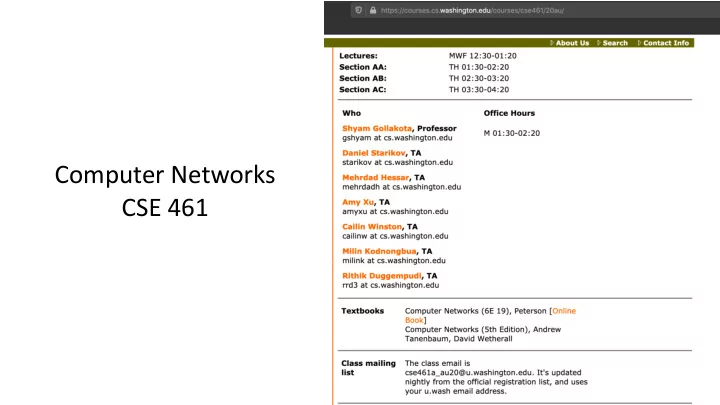
Computer Networks CSE 461

slide-2
SLIDE 2

3 Projects (10+15+15%)

  • Group of 3
  • Can be same or different

Individual assignments (20%) Mid term (20%) Final (20%)

slide-3
SLIDE 3

The Main Point

  • 1. To learn how the Internet works »

– What really happens when you “browse the web”? – What are TCP/IP, DNS, HTTP, NAT, VPNs, 802.11 etc. anyway?

  • 2. To learn the fundamentals of

computer networks

Computer Networks 3

slide-4
SLIDE 4

Computer Networks 4

Why learn about the Internet?

  • 1. Curiosity »
  • 2. Impact on our world »
  • 3. Job prospects!
slide-5
SLIDE 5

From this experimental network …

Computer Networks 5

ARPANET ~1970

(a) Dec. 1969. (b) July 1970. (c) March 1971.

slide-6
SLIDE 6

Computer Networks 6

  • An everyday institution

used at work, home, and on-the-go

  • Visualization contains

millions of links

Attribution: By The Opte Project [CC-BY-2.5], via Wikimedia Commons

Internet ~2005

slide-7
SLIDE 7

Internet – Societal Impact

  • An enabler of societal change

– Easy access to knowledge – Electronic commerce – Personal relationships – Discussion without censorship

Computer Networks 7

slide-8
SLIDE 8

Internet – Economic impact

  • An engine of economic growth

– Advertising-sponsored search – “Long tail” online stores – Online marketplaces – Crowdsourcing

Computer Networks 8

slide-9
SLIDE 9

The Main Point (2)

  • 1. To learn how the Internet works
  • 2. To learn the fundamentals of

computer networks

– What hard problems must they solve? – What design strategies have proven valuable?

Computer Networks 9

slide-10
SLIDE 10

Computer Networks 10

Why learn the Fundamentals?

  • 1. Apply to all computer

networks

  • 2. Intellectual interest »
  • 3. Change / reinvention »
slide-11
SLIDE 11

Computer Networks 11

Fundamentals – Intellectual Interest

  • Example key problem: Reliability!

– Any part of the Internet might fail – Messages might be corrupted – So how do we provide reliability?

  • Reliability solutions

– Codes to detect/correct errors – Routing around failures ...

slide-12
SLIDE 12

Fundamentals – Intellectual Interest (2)

Computer Networks 12

Key problem Example solutions Reliability despite failures Codes for error detection/correction Routing around failures Network growth and evolution Addressing and naming Protocol layering Allocation of resources like bandwidth Multiple access Congestion control Security against various threats Confidentiality of messages Authentication of communicating parties

slide-13
SLIDE 13

Fundamentals – Reinvention

  • The Internet is constantly being re-invented!

– Growth over time and technology trends drive upheavals in Internet design and usage »

  • Today’s Internet is different from yesterday’s

– And tomorrow’s will be different again – But the fundamentals remain the same

Computer Networks 13

slide-14
SLIDE 14

Computer Networks 14

Fundamentals – Reinvention (2)

  • At least a billion

Internet hosts and growing …

slide-15
SLIDE 15

Fundamentals – Reinvention (3)

  • Examples of upheavals in the past 1-2 decades

Computer Networks 15

Growth / Tech Driver Upheaval Emergence of the web Content Distribution Networks Digital songs/videos Peer-to-peer file sharing Falling cost/bit Voice-over-IP calling Many Internet hosts IPv6 Wireless advances Mobile devices

slide-16
SLIDE 16

Computer Networks 16

Not a Course Goal

  • To learn IT job skills

– How to configure equipment

  • e.g., Cisco certifications

– But course material is relevant, and we use hands-on tools

slide-17
SLIDE 17

Computer Networks 17

Example Uses of Networks

  • Work:

– Email, file sharing, printing, …

  • Home:

– Movies / songs, news, calls / video / messaging, e-commerce, …

  • Mobile:

– Calls / texts, games, videos, maps, information access …

slide-18
SLIDE 18

Computer Networks 18

Example Uses of Networks

  • Work:

– Email, file sharing, printing, …

  • Home:

– Movies / songs, news, calls / video / messaging, e-commerce, …

  • Mobile:

– Calls / texts, games, videos, maps, information access …

What do these uses tell us about why we build networks?

slide-19
SLIDE 19

Computer Networks 19

For User Communication

  • From the telephone onwards:

– VoIP (voice-over-IP) – Video conferencing – Instant messaging – Social networking

→Enables remote communication

– Need low latency for interactivity

slide-20
SLIDE 20

Computer Networks 20

For Resource Sharing

  • Many users may access the

same underlying resource

– E.g., 3D printer, search index, machines in the cloud

slide-21
SLIDE 21

Computer Networks 21

For Computer Communication

  • To let computers interact with
  • ther computers

– E.g., e-commerce, reservations

→Enables automated information processing across different parties

slide-22
SLIDE 22

Computer Networks 22

To Connect Computers to the Physical World

  • For gathering sensor data, and for

manipulating the world

– E.g., webcams, location on mobile phones, door locks, …

  • This is a rich, emerging usage
slide-23
SLIDE 23

Parts of a Network (2)

Computer Networks 23

node app link

slide-24
SLIDE 24

Parts of a Network (3)

Computer Networks 24

host app link router

slide-25
SLIDE 25

Component Names

Computer Networks 25

Component Function Example Application, or app, user Uses the network Skype, iTunes, Amazon Host, or end-system, edge device, node, source, sink Supports apps Laptop, mobile, desktop Router, or switch, node, hub, intermediate system Relays messages between links Access point, cable/DSL modem Link, or channel Connects nodes Wires, wireless

slide-26
SLIDE 26

Computer Networks 26

Types of Links

  • Full-duplex

– Bidirectional

  • Half-duplex

– Bidirectional

  • Simplex

– unidirectional

slide-27
SLIDE 27

Computer Networks 27

Wireless Links

  • Message is broadcast

– Received by all nodes in range – Not a good fit with our model

slide-28
SLIDE 28

Computer Networks 28

Wireless Links (2)

  • Often show logical links

– Not all possible connectivity

slide-29
SLIDE 29

Computer Networks 29

A Small Network

  • Connect a couple of computers
  • Next, a large network …
slide-30
SLIDE 30

Source: Internet2

slide-31
SLIDE 31

Computer Networks 31

Example Networks (2)

  • WiFi (802.11)
  • Enterprise / Ethernet
  • ISP (Internet Service Provider)
  • Cable / DSL
  • Mobile phone / cellular (2G, 3G, 4G)
  • Bluetooth
  • Telephone
  • Satellite ...
slide-32
SLIDE 32

Network names by scale

Computer Networks 32

Scale Type Example Vicinity PAN (Personal Area Network) Bluetooth (e.g., headset) Building LAN (Local Area Network) WiFi, Ethernet City MAN (Metropolitan Area Network) Cable, DSL Country WAN (Wide Area Network) Large ISP Planet The Internet (network of all networks) The Internet!

slide-33
SLIDE 33

Computer Networks 33

Internetworks

  • An internetwork, or internet,

is what you get when you join networks together

– Just another network

  • The Internet (capital “I”) is the

internet we all use

slide-34
SLIDE 34

Computer Networks 34

Key Interfaces

  • Between (1) apps and network,

and (2) network components

– More formal treatment later on

host app

slide-35
SLIDE 35

Computer Networks 35

Key Interfaces (2)

  • 1. Network-application interfaces

define how apps use the network

– Sockets are widely used in practice

host app

slide-36
SLIDE 36

Computer Networks 36

  • 2. Network-network interfaces

define how nodes work together

– Traceroute can peek in the network

Key Interfaces (3)

host app

slide-37
SLIDE 37

Computer Networks 37

Network-Application Interface

  • Defines how apps use the network

– Lets apps talk to each other via hosts; hides the details of the network

host app app host

slide-38
SLIDE 38

Computer Networks 38

Motivating Application

  • Simple client-server setup

request reply

slide-39
SLIDE 39

Computer Networks 39

Motivating Application (2)

  • Simple client-server setup

– Client app sends a request to server app – Server app returns a (longer) reply

  • This is the basis for many apps!

– File transfer: send name, get file (§6.1.4) – Web browsing: send URL, get page – Echo: send message, get it back

  • Let’s see how to write this app …
slide-40
SLIDE 40

Computer Networks 40

Socket API

  • Simple abstraction to use the network

– The network service API used to write all Internet applications – Part of all major OSes and languages;

  • riginally Berkeley (Unix) ~1983
  • Supports two kinds of network services

– Streams: reliably send a stream of bytes » – Datagrams: unreliably send separate

  • messages. (Ignore for now.)
slide-41
SLIDE 41

Computer Networks 41

Socket API (2)

  • Sockets let apps attach to the

local network at different ports

Socket, Port #1 Socket, Port #2

slide-42
SLIDE 42

Computer Networks 42

Network Service API Hides Details

  • Apps talk to other apps with no real

idea of what is inside the network

– This is good! But you may be curious …

host app app host

???

slide-43
SLIDE 43

Computer Networks 43

Traceroute

  • Widely used command-line tool to

let hosts peek inside the network

– On all OSes (tracert on Windows) – Developed by Van Jacobson ~1987 – Uses a network-network interface (IP) in ways we will explain later

: Credit: Wikipedia (public domain)

Van Jacobson

slide-44
SLIDE 44

Traceroute (2)

  • Probes successive hops to find network path

Computer Networks 44

. . . Local Host Remote Host

slide-45
SLIDE 45

Traceroute (3)

Computer Networks 45

. . . Local Host Remote Host 1 hop 2 hops 3 hops N-1 hops N hops

slide-46
SLIDE 46

Using Traceroute

Computer Networks 46

slide-47
SLIDE 47

Using Traceroute (2)

  • ISP names and places are educated guesses

Computer Networks 47

. . . My computer www.uw.edu (www1.cac.washington.edu) tde 3 hops Telefonica 4 hops Level3 6 hops pnw-gigapop 1 hop UW 3 hops NYC San Jose Seattle UW Home 1 hop 100 ms 180 ms >200 ms