Computer Engineering Computer Engineers Logic Design Elect - - PDF document

computer engineering
SMART_READER_LITE
LIVE PREVIEW

Computer Engineering Computer Engineers Logic Design Elect - - PDF document

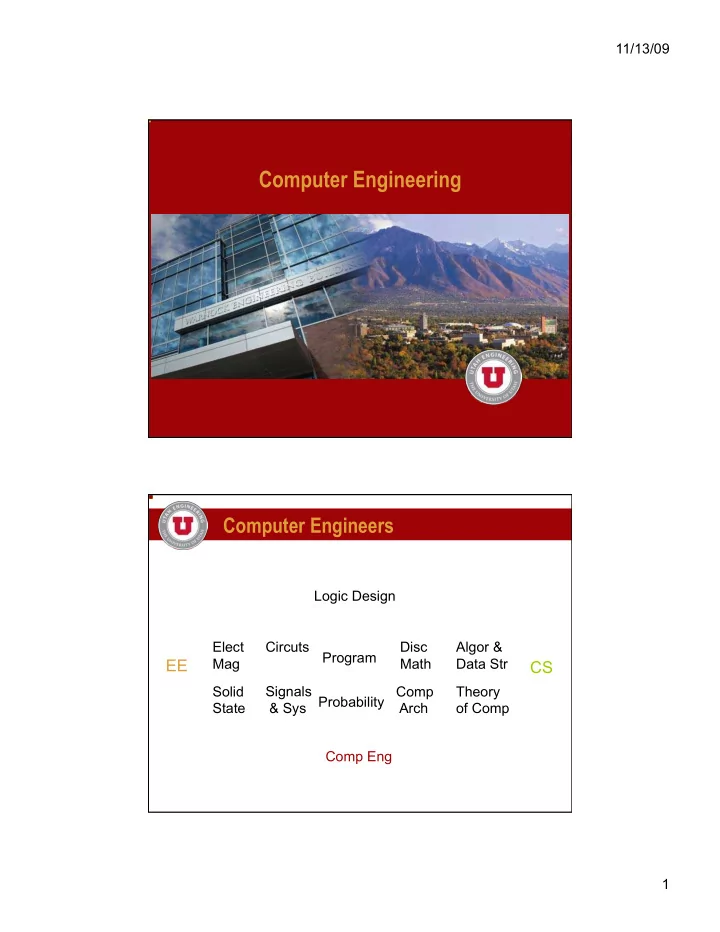
11/13/09 Computer Engineering Computer Engineers Logic Design Elect Circuts Disc Algor & Program EE Mag Math Data Str CS Signals Solid Comp Theory Probability State & Sys Arch of Comp Comp Eng 1 11/13/09 Computer


slide-1
SLIDE 1

11/13/09 1

Computer Engineering

Computer Engineers

EE CS

Elect Mag Solid State Circuts Signals & Sys Disc Math Comp Arch Algor & Data Str Theory

  • f Comp

Program Probability Logic Design Comp Eng

slide-2
SLIDE 2

11/13/09 2

Computer Engineers

An undergrad program that hits the sweet spot between EE and CS that involves designing computers!

– i.e. Fun Stuff!

CS EE

Computer Engineering!

Engineering and Computer Science

  • Computers are Everywhere
  • Create, Innovate
  • Serve Humanity by Improving

– Environment – Safety – Productivity – Communications – Energy Availability and Efficiency – Health

slide-3
SLIDE 3

11/13/09 3

  • Computer Architecture
  • Computer Circuits
  • Computer Systems
  • System Software
  • Networks
  • Digital & Analog Systems

Computer Engineering

Ultimately

  • Engineering requirement

– what we build must work

  • Ethical requirement

– what we create must help

  • lots of dimensions for this responsibility
  • Skill requirements

– science: math, physics, chemistry, materials, CS, … – engineering: state of the art, current practice, technology trends, manufacturing, testability, maintenance, life cycle costs, … – art: creative component that is clearly evident in the great engineers

slide-4
SLIDE 4

11/13/09 4

CE - A student perspective

  • Undergraduate program

– joint offering by ECE and SoC

  • some required courses, electives, &

a senior project or thesis – details http://www.ce.utah.edu – numerous faculty involved in CE research » check the ECE & SoC web pages to explore further

  • Graduate programs

– both MS and Ph.D. offered separately by ECE and SoC

Computer Engineering Curriculum

  • Design and build computer systems

– software and hardware design skills

  • System software

– compiler, operating system, software engineering, … – as opposed to application software

  • applications are the target system “user”
  • used in design evaluation (pre- and post-build)
  • Hardware: possibly many disciplines and levels

– Basic circuit design and testing – VLSI chip design: analog and digital

  • Courses exist to get you started in all of these

areas

– context can be either embedded or high performance systems

slide-5
SLIDE 5

11/13/09 5

CS/ECE 3710: Computer Design Lab

  • Taught in Fall semester, 3 credits
  • Prereqs: CS/EE 3700, CS/EE 3810

– Student groups design, build, and test their own computer system on an FPGA – Typically a 16bit processor designed using schematics, Verilog, and Xilinx-based prototyping boards

  • i.e. completely student-designed from the gates up

to the software – Bread and butter for a Computer Engineer!

3710: Xilinx Spartan3-based Boards

  • 500k-gate Spartan

FPGA

  • 360Kbits RAM
  • 20 18x18

multipliers

  • 16-char, 2-line LCD
  • 256Mbit SDRAM
  • Connectors for VGA,

PS/2, RS232,

slide-6
SLIDE 6

11/13/09 6

Right Now in 3710...

  • Processors are processing…
  • Groups are extending things to use the

VGA, serial, PS/2, Nintendo, dance pad,

  • etc. ports

– designing their own VGA controller – writing interactive video games in assembly using keyboard for input (or other things) and VGA display for output – using 3-d graphics using their own “graphics accelerator” – all sorts of other interesting things

  • Watch for a CS/EE 3710 demo day towards

the end of fall semester

Examples from Years Past

slide-7
SLIDE 7

11/13/09 7

CE Senior Projects at Utah

  • Logistics

– Senior project is capstone project course

  • team based
  • student teams choose their own project

– for once you get to pick your own homework assignment

  • best mechanism to demonstrate your abilities to future

employers

– CE Senior Project is a year long activity

  • Spring term of junior year: plan and propose
  • Summer: get parts and start building (optional)
  • Fall term of senior year: build and demonstrate

– Exit interview feedback

  • rave reviews for being hard, fun, and instructive

04 Projects

  • Satellite Tracking station
  • Weaver – a 802.11 remote control vehicle interface

– camera on car: image and commands to base station via wireless – car has autonomous anti-collision capability (infrared)

  • GPS Hummer

– autonomous navigation and anti-collision – some AI in route finding since Hummer remembers obstacles that it saw previously

  • PCI Coprocessor

– efficient acceleration via PCI add-on

  • Jiggawax

– build your own iPod

  • RVI – remote vehicle interface

– control via web or cell phone – control windows, engine, and door locks from RF base station

slide-8
SLIDE 8

11/13/09 8

05 Projects

  • Carputer

– OBDII car data and 802.11g auto-sync to base station – monitor your car or your kids

  • IR tag

– paintball without the mess

  • Athlete monitor system

– real time tracking of position and heart rate to central coaching station – GPS, RF, and HRM on-athlete

  • Multi-carrier reflectometry

– finding faults in aircraft wires without tearing the plane apart

  • Glider avionics package

– using accelerometers, GPS, and strain sensors

06 projects

  • PEN

– electronic paper – the only paper you’ll ever buy!

  • Recipedia

– a cook book that talks and listens to you

  • GPS tracker

– use campus ubiquitous wireless to keep track of where things are via your cell phone or computer

  • OmegaCore

– a DVR that knows how to remove commercials for you

  • NoCPR

– bathtub drowning prevention

  • Tracking Visor

– virtual reality on your head

slide-9
SLIDE 9

11/13/09 9

Senior Project Synopsis

  • This was just a peek
  • Just remember

– if you can imagine it you can usually build it

  • there are some things you just can’t do in a year

– all it takes is dedication and time

  • same is true in industry - time and resource constraints

change however

  • Huge diversity of both opportunities and

problems

  • You might have noticed the world isn’t

perfect

– so help fix it!

CE and Sustainability

  • Power is a major issue in computer design

– High performance chips need a lot of power – High performance computing takes a lot of chips – The amount of electricity used for the world’s computers is pretty amazing... – Think before you Google?

slide-10
SLIDE 10

11/13/09 10

Intel Core2 Duo

  • 65nm process, 75W, 144 mm2 die
  • 291,000,000 total transistors

That’s a LOT of transistors

  • Where are they used?

– Mostly for memory! – Around 6 transistors per bit of memory – Intel Core2 Duo: 4MB shared L2 cache, 32K Icache 32K Dcache on each core – 4*10242*8 + 2(64*1024*8) = 34,603,008 bits – 35,000,000 bits * 6 = 210,000,000 transistors – Core2 Duo has around 291,000,000 total transistors… – Quad Core has around 820,000,000

slide-11
SLIDE 11

11/13/09 11

Issues

  • That’s a LOT of transistors!

– Need CAD tools and hierarchy to help

  • That’s also a LOT of power

– V=IR, P = I2R – 75W @ 1.5v = 50A going into your chip…

Power Dissipation

slide-12
SLIDE 12

11/13/09 12

Heat Dissipation

  • 100 W light bulb has surface area of 120 cm2
  • Pentium4 die dissipates 110 W over ~1.5 cm2
  • Nvidia GTX280 – 236 W over ~1.5cm2 (105° C)

– Chips have enormous power densities – Cooling is a serious challenge

  • Package spreads heat to larger surface area

– Heat sinks may increase surface area further – Fans increase airflow rate over surface area – Liquid cooling used in extreme cases ($$$)

GPUs and Power

Highly customized processing for graphics

– Lots of matrix/vector floating point pipelines – Lots of on-chip memory bandwidth

– 3GHz P4 (2005): 6GFLOPS peak ~65-115watts

– NVIDIA GeForce FX5900 (2004): 53 GFLOPS

  • 128 FP units in parallel at 450MHz

– NVIDIA GeForce 7800 (2006) GTX512: 200GFLOPS

  • 192 FP units at 550 MHz, 80 watts

– NVIDIA GeForce GTX 280 (2008): 933GFLOPS

  • 240 cores, 1.3GHz, 3 flops/sec/core, 236 watts... 105°C
  • 1GB GDDR3, 512bit interface, 141.7 GB/sec
slide-13
SLIDE 13

11/13/09 13

Chip Power Density Thermal Solutions

  • Heat sink

– Mounted on processor package

  • Passive cooling

– Remote system fan

  • Active cooling

– Fan mounted on sink

  • Heat spreaders

– Increase surface area – Example: Metal plate under laptop keyboard

  • a. Heat sink mounting for low-power chip
  • b. Package design for high-power chips

“Thermal Challenges during Microprocessor Testing”, Intel Technology Journal, Q3 2000

slide-14
SLIDE 14

11/13/09 14

Alternative View of “Computing Power” Alternative View of “Computing Power”

Old News!

slide-15
SLIDE 15

11/13/09 15

Consider...

  • June 2009

– Random sample showed 66,000 online players on Call of Duty Xbox live – Equivalent to the entire city of Muncie Indiana...

  • What do big data centers look like?

– Microsoft, Google, Yahoo, Facebook, etc... – Thousands and Thousands of servers! – 365/24 – Total cost in US alone in 2006 just for electricity (not equipment) was around $4.5 Billion – ~2% of total electricity usage in the US – AND, that’s old news! (2006)

Source: EnergyStar Report to Congress, 2007 Source: NYT Magazine, June 2009

Old Data Centers

  • Racks of

machines

  • n raised

flooring

  • Cool air

flowing up through the floor and out the ceiling

slide-16
SLIDE 16

11/13/09 16

Original Google Server c1990? Google: First Production Server There were 30 of these in their first data center in 1999

slide-17
SLIDE 17

11/13/09 17

Old Data Center: Good Old Data Center: Bad

slide-18
SLIDE 18

11/13/09 18

More recent data centers

An overhead view of a Quality Technology Services data center in the Atlanta area.

New Data Centers: Wow

  • Servers are crammed into standard 35ft cargo containers
  • Each container has power (up to 250 KWatts), networking,

cooling, and over 1000 servers

  • Self-contained and stackable...
slide-19
SLIDE 19

11/13/09 19

Container-Style Data Centers Container-Style Data Centers

One Google data center might have 45 containers That’s over 60,000 servers, and power in megawatts!

slide-20
SLIDE 20

11/13/09 20

Lots of Data Centers! Sustainability?

  • Data centers are multiplying!
  • Starting to consume a noticeable fraction
  • f the world’s electricity output!

– Are Facebook and Twitter worth the energy? – Is this growth in power and resources used for computing sustainable? – Does YouTube give back value to offset the carbon costs of downloading all those videos?

slide-21
SLIDE 21

11/13/09 21

Sustainability?

  • On the other hand...

– Each Google search “costs” roughly 0.2g of CO2 – In the time it takes you to do one Google search, your own computer uses more energy than Google does answering your query.

Source: http://www.google.com/corporate/green/datacenters/

Sustainability?

  • No easy answers!
  • Not exactly related to the Computer

Engineering program at the U either...

  • But, Interesting stuff to think about!
  • Lots of research by Computer Engineering

faculty that addresses issues of power use in computers

– Architecture, circuits, software, etc. – Not necessarily directly related to reducing data center energy costs, but it’s all related at some level

slide-22
SLIDE 22

11/13/09 22

Summary

  • Exciting Opportunities in Computer

Engineering

– Challenging Curriculum – Science, Engineering and Math plus Creativity – Financial Rewards – Job Satisfaction

  • Help Solve the World’s Grand Challenges

– Energy – Environment – Safety – Productivity – Communications