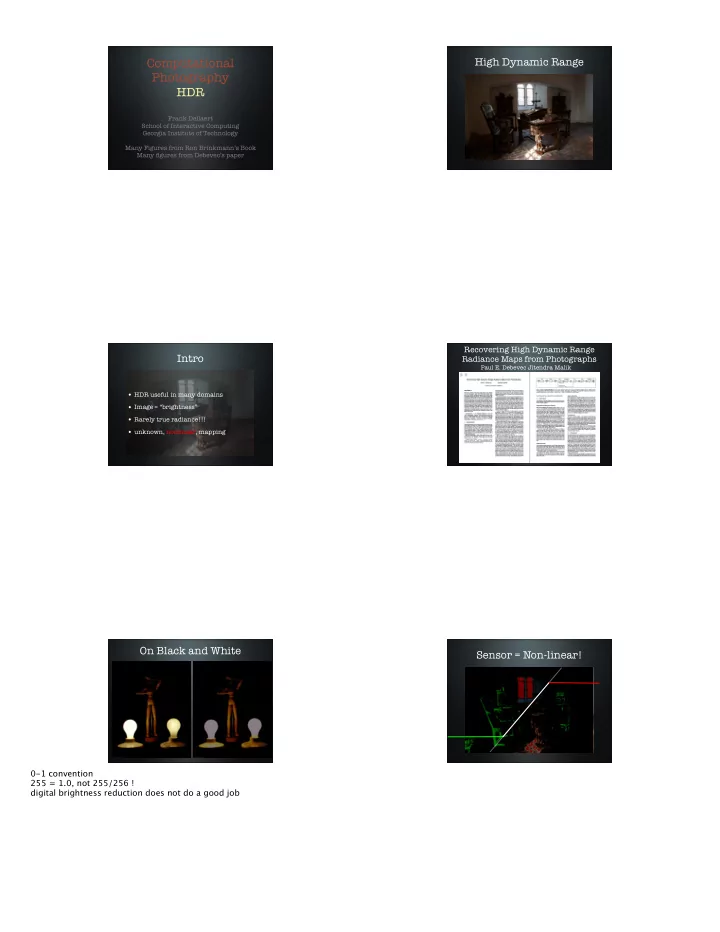
Computational High Dynamic Range Photography HDR Frank Dellaert - - PDF document

computational
SMART_READER_LITE
LIVE PREVIEW

Computational High Dynamic Range Photography HDR Frank Dellaert - - PDF document

Computational High Dynamic Range Photography HDR Frank Dellaert School of Interactive Computing Georgia Institute of Technology Many Figures from Ron Brinkmanns Book Many figures from Debevecs paper Recovering High Dynamic Range


slide-1
SLIDE 1

Computational Photography HDR

Frank Dellaert School of Interactive Computing Georgia Institute of Technology Many Figures from Ron Brinkmann’s Book Many figures from Debevec’s paper

High Dynamic Range Intro

  • HDR useful in many domains
  • Image = “brightness”
  • Rarely true radiance!!!
  • unknown, nonlinear, mapping

Recovering High Dynamic Range Radiance Maps from Photographs

Paul E. Debevec Jitendra Malik

On Black and White

0-1 convention 255 = 1.0, not 255/256 ! digital brightness reduction does not do a good job

Sensor = Non-linear!

slide-2
SLIDE 2

Source of Nonlinearity

  • Photographic Process:
  • Film Curve (base level, saturation)
  • Development/scanning/ADC
  • Digital Cameras:
  • Saturation, Bleeding
  • Re-mapping (12bit->8bit)

Bracketing Bracketing

Q: How do you expose detail in shadows ? A: increase exposure time, increase aperture

Bracketing

Technique = Bracketing, E-split Lesson: white <> white !!! black <> black !!!

Image Acquisition

  • Irradiance E
  • Exposure Time ∆t
  • Exposure X = E×∆t
  • Pixel Values Z = f(X) = f(E×∆t)

Bracketing Image Formation

Exposure X (photons) = exposure time ∆t × E Pixel values Z = f(X) Z2=f(X2)=f(E ∆t2) Z1=f(X1)=f(E ∆t1) Irradiance Image E (photons/sec)

slide-3
SLIDE 3

HDR Acquisition

E=f-1(Z1)/∆t1 E=f-1(Z2)/∆t2

Caveats:

  • Known camera model f
  • Inverse of f does not exist for extremes
  • Treat superwhite/superblack differently

Average

Estimating f

Taking the log makes time additive

Known! 1M unknowns? 256 unknowns? pM measured!

My Iterative Procedure

  • f-1: Z -> X is lookup table
  • f size 256
  • Guess f-1 (linear in

certain range)

  • Estimate E with first

guess: OK result

  • Re-estimate f-1 from

(Z,X) pairs...

  • Iterate until converged

Estimating f, Debevec...

Just linear least-squares!!!

Results from Paper

slide-4
SLIDE 4

Results Debevec HRD Examples

  • http://gl.ict.usc.edu/Data/

HighResProbes/hdrvr/uffizi.html

Hugin

  • http://hugin.sourceforge.net/

“Floating Point” HDRI

Note: the DISPLAY shows everything above 1.0 as white

Float/2 Fixed/2

HDR and FP subtly difgerent

slide-5
SLIDE 5

HDR Motion Blur Real vs. Fake Out-of-focus