Computation of point sets on the sphere with good separation, - - PowerPoint PPT Presentation

computation of point sets on the sphere with good
SMART_READER_LITE
LIVE PREVIEW

Computation of point sets on the sphere with good separation, - - PowerPoint PPT Presentation

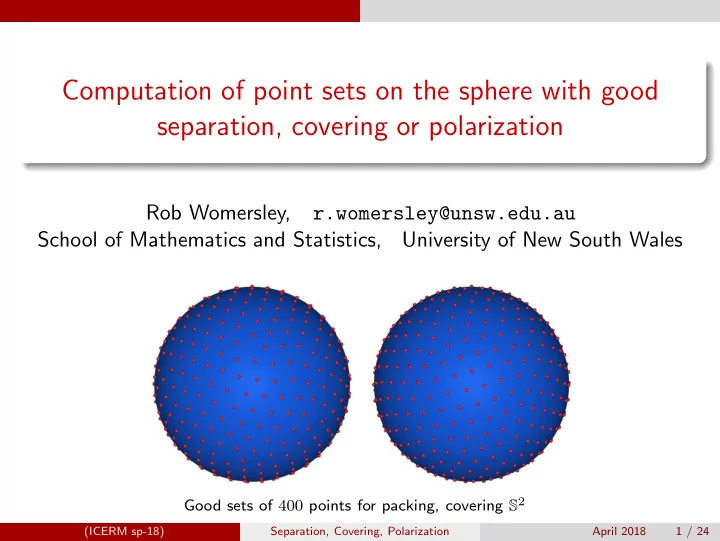
Computation of point sets on the sphere with good separation, covering or polarization Rob Womersley, r.womersley@unsw.edu.au School of Mathematics and Statistics, University of New South Wales Good sets of 400 points for packing, covering S 2


slide-1
SLIDE 1

Computation of point sets on the sphere with good separation, covering or polarization

Rob Womersley, r.womersley@unsw.edu.au School of Mathematics and Statistics, University of New South Wales

Good sets of 400 points for packing, covering S2

(ICERM sp-18) Separation, Covering, Polarization April 2018 1 / 24

slide-2
SLIDE 2

Outline

1

Spheres and point sets Spheres and point sets Separation/Packing Covering/Mesh norm Riesz s-energy Polarization Parametrizations

2

Best packing

3

Best covering

4

Best polarization

(ICERM sp-18) Separation, Covering, Polarization April 2018 2 / 24

slide-3
SLIDE 3

Spheres and point sets Spheres and point sets

Unit sphere

Unit sphere Sd =

  • x ∈ Rd+1 : |x| = 1
  • Sets of distinct points XN = {x1, . . . , xN} ⊂ Sd

x · y =

d+1

  • i=1

xiyi, |x|2 = x · x

Distance: : x, y ∈ Sd

Euclidean distance |x − y|2 = 2(1 − x · y) Geodesic distance: dist (x, y) = arccos(x · y) |x − y| = 2 sin(dist (x, y) /2)

Spherical cap centre z ∈ Sd, radius α C (z; α) =

  • x ∈ Sd : dist (x, z) ≤ α
  • (ICERM sp-18)

Separation, Covering, Polarization April 2018 3 / 24

slide-4
SLIDE 4

Spheres and point sets Separation/Packing

Packing/Separation

Separation: δ(XN) := min

i=j dist (xi, xj)

Packing radius = δ(XN)/2 Best packing: δN := max

XN⊂Sd δ(XN) ∼ csep d N −1/d

(ICERM sp-18) Separation, Covering, Polarization April 2018 4 / 24

slide-5
SLIDE 5

Spheres and point sets Covering/Mesh norm

Mesh norm/Covering radius/Fill radius

Covering radius: h(XN) := max

x∈Sd

min

j=1,...,N dist (x, xj)

Mesh ratio: ρ(XN) := 2h(XN )

δ(XN ) ≥ 1

Best covering: hN := min

XN⊂Sd h(XN) ∼ ccov d N −1/d

(ICERM sp-18) Separation, Covering, Polarization April 2018 5 / 24

slide-6
SLIDE 6

Spheres and point sets Riesz s-energy

Riesz energy and sums of distances

E(s; XN) =                 

N

  • i=1

N

  • j=1

j=i

1 |xi − xj|s if s = 0;

N

  • i=1

N

  • j=1

j=i

log 1 |xi − xj|, if s = 0. Es,N =    min

XN⊂Sd E(s; XN)

s > 0; max

XN⊂Sd E(s; XN)

s ≤ 0. Asymptotics (N → ∞) for s = 0 (Log), 0 < s < d, s = d, s > d s > d uniformly distributed As s → ∞ get best packing (separation) Borodachov, Hardin & Saff monograph

(ICERM sp-18) Separation, Covering, Polarization April 2018 6 / 24

slide-7
SLIDE 7

Spheres and point sets Polarization

Polarization

Function Us(x, XN) := sign(s)

N

  • j=1

1 |x − xj|s . Polarization U ∗

s (XN) = min x∈Sd Us(x, XN)

Optimal set of N points X ∗

N satisfy

Ms,N := max

XN⊂Sd U ∗ s (XN) = max XN⊂Sd min x∈Sd Us(x, XN).

Ms,N ≥ Es,N

N−1

As s → ∞ get best covering Erd´ elyi and Saff (2013), ..., Borodachov, Hardin & Saff monograph

(ICERM sp-18) Separation, Covering, Polarization April 2018 7 / 24

slide-8
SLIDE 8

Spheres and point sets Polarization

Polarization N = 12, d = 2, s = 3

(ICERM sp-18) Separation, Covering, Polarization April 2018 8 / 24

slide-9
SLIDE 9

Spheres and point sets Parametrizations

Parametrizations

Criteria invariant under

rotation of point set permutation of points

Criteria depend only on

distance/angle/inner product between points, or distance/angle/inner product with another point on Sd

Aim: always feasible XN ⊂ Sd Spherical parametrization

For S2: polar angle θ ∈ [0, π], azimuthal angle φ ∈ [0, 2π) Derivative discontinuities at poles Rotation to fix

first point at north pole (θ = 0) second point on prime meridian (φ = 0)

Issues if using gradient differences to estimate second order information

Minimax = ⇒ derivative discontinuities/generalized gradients

  • eg. |x| = max(x, −x) = min v

s.t. v ≥ x, v ≥ −x

(ICERM sp-18) Separation, Covering, Polarization April 2018 9 / 24

slide-10
SLIDE 10

Spheres and point sets Parametrizations

Inner products

Matrix of distinct points X = [x1 · · · xN] ∈ Rd+1×N Set A(XN) = {z = xi · xj ∈ [−1, 1), j > i}, |A(XN)| ≤ N(N−1)

2

Best packing: min

XN⊂Sd max i=j xi · xj

Matrix of inner products Z = XT X ∈ RN×N

Z is symmetric, positive semi-definite X 0 = ⇒ SDP diag(Z) = e where e = (1, . . . , 1)T ∈ Rd+1 rank(Z) = d + 1 = ⇒ fixed (low) rank correlation matrix

1 2 3 4 5 6 7 104

  • 1
  • 0.8
  • 0.6
  • 0.4
  • 0.2

0.2 0.4 0.6 0.8 1 PK points, N = 400, maximum inner product = 0.98296

(ICERM sp-18) Separation, Covering, Polarization April 2018 10 / 24

slide-11
SLIDE 11

Best packing

Best packing

Best packing min

XN⊂Sd max i=j

xi · xj

Finite minimax problem: convert to Minimize v XN ⊂ Sd Subject to v ≥ xi · xj, 1 ≤ i < j ≤ N Number of variables n = Nd − d(d+1)

2

Vertex solution/strongly unique local minimum

n + 1 active constraints/inner products achieving max Positive Lagrange multipliers for active constraints/0 in interior of generalized gradient

Fewer active constraints = ⇒ curvature critical More active constraints = ⇒ degeneracy

(ICERM sp-18) Separation, Covering, Polarization April 2018 11 / 24

slide-12
SLIDE 12

Best packing

Largest inner products

PK points on S2, N = 400, Number of variables n = 797 Number active inner products: xi · xj > v − ǫ ǫ = 10−15 = ⇒ 792, ǫ = 10−6 = ⇒ 798, ǫ = 10−5 = ⇒ 801

200 400 600 800 1000 1200 1400 1600 1800 2000 10-20 10-15 10-10 10-5 100

400 PK points, v - xi xj (ICERM sp-18) Separation, Covering, Polarization April 2018 12 / 24

slide-13
SLIDE 13

Best packing

Nearest neighbour distances

PK points on S2, N = 400

(ICERM sp-18) Separation, Covering, Polarization April 2018 13 / 24

slide-14
SLIDE 14

Best packing

Good separation for N = 4, ..., 1050

PK points: Good packing ME points: Low Riesz s = 1 (Coulomb) energy (Kuijlaars, Saff, Sun, 2007) CV points: Good covering

100 200 300 400 500 600 700 800 900 1000

Number of points N

10-1 100

Euclidean separation distance on S2

Euclidean limit 3.8093 N-1/2 PK points 3.58 N-1/2 ME points 3.42 N-1/2 CV points 3.07 N-1/2

(ICERM sp-18) Separation, Covering, Polarization April 2018 14 / 24

slide-15
SLIDE 15

Best covering

Best covering

Best covering max

XN⊂Sd min x∈Sd

max

j=1,...,N x · xj

Continuous maximin problem: convert to finite problem Facets F(XN) of convex hull of XN

Facet F ∈ F(XN) = ⇒ set of d + 1 elements of {1, . . . , N} 2N − 4 Delaunay triangles for XN ⊂ S2

Circumcentres c(F) of facet F ∈ F(XN)

c(F) equidistant from d + 1 vertices determining facet F Solve Bu = e, B = [xT

i , i ∈ F],

e = (1, . . . , 1)T ∈ Rd+1 = ⇒z(F) = 1/u2, c(F) = z(F)u

Best covering: Finite maximin problem max

XN⊂Sd

min

F ∈F(XN ) z(F)

where z(F) = c(F) · xj for each j ∈ F small changes in XN can change set of facets F(XN ) (eg. square)

(ICERM sp-18) Separation, Covering, Polarization April 2018 15 / 24

slide-16
SLIDE 16

Best covering

Circumcentres

CV points on S2, N = 400

2N − 4 = 796 facets F (Delaunay triangles) 604 facets within 10−6 of minimum inner product

100 200 300 400 500 600 700 800 0.9936 0.9938 0.994 0.9942 0.9944 0.9946 0.9948 0.995 0.9952 CV points, N = 400, 796 facet inner products

(ICERM sp-18) Separation, Covering, Polarization April 2018 16 / 24

slide-17
SLIDE 17

Best covering

Good Covering for N = 4, ..., 1050

PK points: Good packing ME points: Low Riesz s = 1 (Coulomb) energy (Damelin, Maymeskul, 2005)

CV points: Good covering 100 200 300 400 500 600 700 800 900 1000 Number of points N 10-1 100 Euclidean covering radius on S2

PK points 2.79 N-1/2 ME points 2.42 N-1/2 CV points 2.26 N-1/2 Euclidean bound 2.0 N-0.5

(ICERM sp-18) Separation, Covering, Polarization April 2018 17 / 24

slide-18
SLIDE 18

Best covering

Consistency checks

Separation/Packing

If you remove one of the points achieving the minimum separation, the separation cannot get worse δN−1 ≥ δN

Covering/Mesh norm

If you add a point at the circumcentre of one of the facets achieving the maximum distance (deep hole) then covering radius cannot get worse hN+1 ≤ hN

Only (good) local optima; no guarantee of global optimality

Try a variety of starting point sets Try starting from a point set obtained by deleting/adding a point Try starting from local perturbations of a point set Points sets with special structure (symmetry) hard to find ...

(ICERM sp-18) Separation, Covering, Polarization April 2018 18 / 24

slide-19
SLIDE 19

Best polarization

Best polarization

Optimal polarization, parameter s > 0 max

XN⊂Sd min x∈Sd N

  • j=1

1 |x − xj|s

Continuous maximin problem: convert to finite problem Find all local minimizers x achieving (close to) global minimum U ∗

s (XN) of Us(x, XN) := N j=1 1 |x−xj|s

Assumption: Local minimizers achieving global minimum satisfy second

  • rder sufficient conditions, so are isolated

Finite set Ms(XN) = {x∗ ∈ Sd : Us(x∗, XN) = U ∗

s (XN)}

Finite maximin problem Maximize v XN ⊂ Sd Subject to v ≤ Us(x∗, XN) for x∗ ∈ Ms(XN)

(ICERM sp-18) Separation, Covering, Polarization April 2018 19 / 24

slide-20
SLIDE 20

Best polarization

PE points, local minima

PE points: Good polarization, N = 400

(ICERM sp-18) Separation, Covering, Polarization April 2018 20 / 24

slide-21
SLIDE 21

Best polarization

PE points, active local minima

PE points: Good polarization, N = 400

100 200 300 400 500 600 700

Triangles

391.6 391.65 391.7 391.75 391.8 391.85 391.9 391.95 392

N = 400 points, s = 1.0, Polarization = 3.91626618e+02, Ntri = 796, Nloc = 592

(ICERM sp-18) Separation, Covering, Polarization April 2018 21 / 24

slide-22
SLIDE 22

Best polarization

Good polarization s = 1, N = 4, . . ., 500

50 100 150 200 250 300 350 400 450 500 50 100 150 200 250 300 350 400 450 500 Number of points N Polarization MN

s , Energy EN s / (N−1) for max polarization points on Sd, d = 2, s = 1,

Polarization MN

s

0.898 N1.014 Energy EN

s /(N−1)

0.772 N1.034 50 100 150 200 250 300 350 400 450 500 −1.2 −1.1 −1 −0.9 −0.8 −0.7 −0.6 −0.5 −0.4 Number of points N Coefficient of second term for max polarization points on Sd for d = 2, s = 1 Polarization: (MN

s −N)/ N1/2

Energy: (EN

s − N2) / N3/2

−1.10610

(ICERM sp-18) Separation, Covering, Polarization April 2018 22 / 24

slide-23
SLIDE 23

Best polarization

Good polarization for increasing s

−2 −1 1 2 3 4 5 6 7 8 0.095 0.1 0.105 0.11 0.115 0.12 0.125 Riesz index s Covering radius for N = 500 good polarization points

(ICERM sp-18) Separation, Covering, Polarization April 2018 23 / 24

slide-24
SLIDE 24

Best polarization

Acknowledgements

ICERM National Computational Infrastructure (NCI), supported by the Australian Government. Linux computational cluster Katana supported by the Faculty of Science, UNSW Sydney.

Thank You

(ICERM sp-18) Separation, Covering, Polarization April 2018 24 / 24