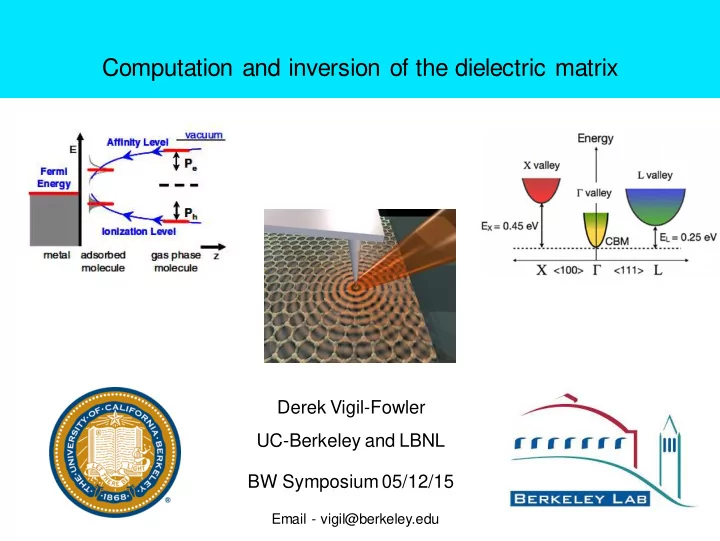
SLIDE 1 Computation and inversion of the dielectric matrix
Derek Vigil-Fowler UC-Berkeley and LBNL BW Symposium 05/12/15
Email - vigil@berkeley.edu
SLIDE 2
Materials Science for Energy, Technology
SLIDE 3
Materials Science for Energy, Technology
SLIDE 4
Dielectric response :
SLIDE 5
Dielectric response : E&M
SLIDE 6
Dielectric response : E&M
SLIDE 7
Dielectric response : quantum mechanics
SLIDE 8
Dielectric response : quantum mechanics
SLIDE 9
Dielectric response : quantum mechanics
SLIDE 10
Pictorially
SLIDE 11
Pictorially
SLIDE 12
How to do one big matrix multiplication + inversion?
SLIDE 13
How to do one big matrix multiplication + inversion?
Parallelism!
SLIDE 14
How to do one big matrix multiplication + inversion?
BLAS + ScaLAPACK + MPI/OpenMP
SLIDE 15
Distributed matrix multiplication
SLIDE 16
Distributed matrix multiplication
SLIDE 17 Problem with scheme : many frequencies done serially
- Lots of communication and array assignments
- All processors work on 1 frequency
– But ScaLAPACK doesn’t scale past ~ few hundred processors! – Smaller problems : can’t utilize ScaLAPACK enough
→ Wasted processors
SLIDE 18
Solution : do many frequencies in parallel!
SLIDE 19
Solution : do many frequencies in parallel!
SLIDE 20
Solution : do many frequencies in parallel!
SLIDE 21
Results
SLIDE 22 Results
Bulk Si with 288 proc CO with 144 proc nfreq_par 1 2 8 1 2 8 Matmul total 13.12 8.934 4.395 9.31 6.89 2.13 Matmul prep 10.75 7.08 3.23 1.27 1.01 0.66 Matmul dgemm 2.17 1.75 1.135 1.85 1.60 0.90 Matmul comm 0.2 0.104 0.027 6.18 4.27 0.57 Invert total 0.744 0.26 0.064 5.28 2.60 0.93
SLIDE 23 Conclusions
- Parallelizing over frequencies reduced communication,
array assignment, and saturates ScalaPACK : faster run- time.
- Also, for big problems will allow scaling to higher
processors counts for the frequency-dependent inverse dielectric matrix, a quantity of wide interest
SLIDE 24 Acknowledgments
- Blue Waters Graduate Fellowship
- Jack Deslippe – NERSC
- Felipe Homrich da Jornada – UC-Berkeley
This research is part of the Blue Waters sustained-petascale computing project, which is supported by the National Science Foundation (awards OCI-0725070 and ACI-1238993) and the state of Illinois. Blue Waters is a joint effort of the University of Illinois at Urbana-Champaign and its National Center for Supercomputing Applications.
SLIDE 25