Complicated Death, Complicated Grief Helping a Community Heal - - PDF document

complicated death complicated grief
SMART_READER_LITE
LIVE PREVIEW

Complicated Death, Complicated Grief Helping a Community Heal - - PDF document

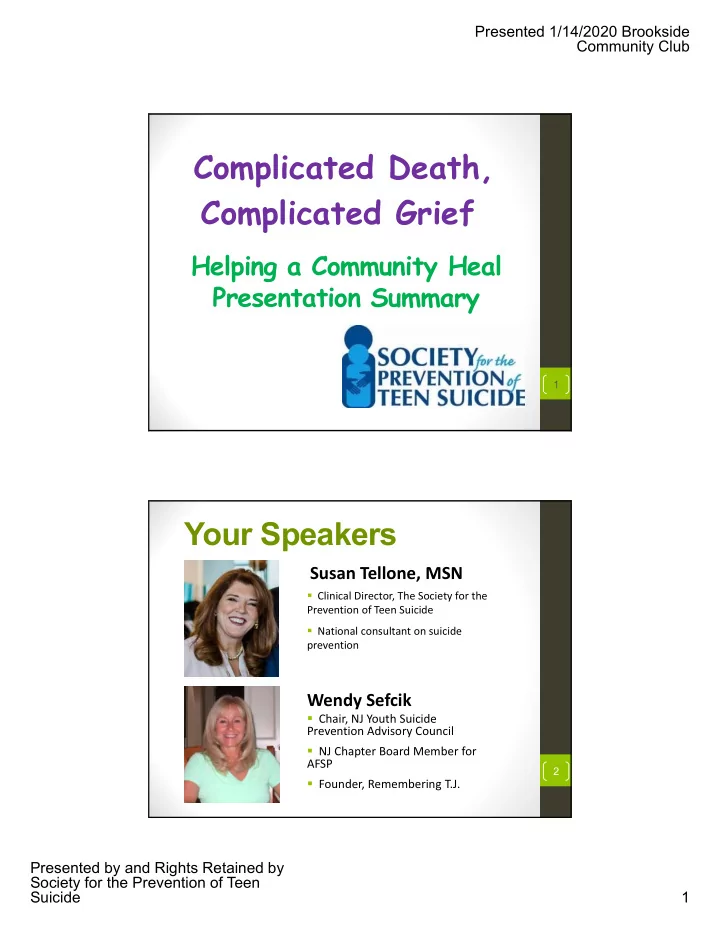
Presented 1/14/2020 Brookside Community Club Complicated Death, Complicated Grief Helping a Community Heal Presentation Summary 1 Your Speakers Susan Tellone, MSN Clinical Director, The Society for the Prevention of Teen Suicide


slide-1
SLIDE 1

Presented 1/14/2020 Brookside Community Club Presented by and Rights Retained by Society for the Prevention of Teen Suicide 1

Helping a Community Heal Presentation Summary

Complicated Death, Complicated Grief

1

Your Speakers

  • Clinical Director, The Society for the

Prevention of Teen Suicide

  • National consultant on suicide

prevention

2

Susan Tellone, MSN Wendy Sefcik

  • Chair, NJ Youth Suicide

Prevention Advisory Council

  • NJ Chapter Board Member for

AFSP

  • Founder, Remembering T.J.
slide-2
SLIDE 2

Presented 1/14/2020 Brookside Community Club Presented by and Rights Retained by Society for the Prevention of Teen Suicide 2

And the work has already begun:

  • The Mendhams Stigma Free Task Force
  • School response – Traumatic Loss Coalition
  • Key stakeholder community meeting
  • Mendham Community Information Board
  • Community Mental Health Needs Survey
  • “Raising Resilient Teens” Parent Panel

presentation – Black River Middle School on February 19th

  • Morris County Youth Wellness Summit

3

The Value of Community Mourning

“Community gathers as an effective group to do the work for each

  • ther that would take a lot longer for an

individual to do alone” ‐ John O’Donohue

Postvention 4

slide-3
SLIDE 3

Presented 1/14/2020 Brookside Community Club Presented by and Rights Retained by Society for the Prevention of Teen Suicide 3

5

Healing After Traumatic Death

Helping Parents Help Their Kids

Start With Yourself: What are Your Reactions ?

  • Our tendency as adults is to focus first on

helping our children, not ourselves

  • Whether we tell them or not, our kids can

figure out how we feel

  • If you expect your kids to be honest and open

with you, you have to be honest and open with yourself

6

slide-4
SLIDE 4

Presented 1/14/2020 Brookside Community Club Presented by and Rights Retained by Society for the Prevention of Teen Suicide 4

7

Why Grief of Children Is Different than Adults

  • Lack of experience with death
  • Immature cognitive development or

understanding of death

  • Limited ability to verbalize feelings
  • Perception of time is different from adults:

focus on proximal past & future

8

Steps To Help You Deal With Your Child’s Reactions….

1. Understand that there are no answers ‐ don’t feel pressured to have the ‘right answer’ 2. Realize you may not understand your child’s reactions 3. Some children will show their sadness, others will have no reaction, don’t talk them out of their feelings – we need to allow them to feel what they feel 4. Understand that reaction may not surface for a while‐ kids have grief closets, too!

slide-5
SLIDE 5

Presented 1/14/2020 Brookside Community Club Presented by and Rights Retained by Society for the Prevention of Teen Suicide 5

How To Help Your Child

  • Avoid gossip about the cause of the death
  • Remain nonjudgmental about the deceased
  • Share your reactions with your child
  • Validate his/her response
  • Ask them to “ tell me more”
  • Acknowledge rumors & put into context

9 10

What to Say…

  • Acknowledge that sometimes the death of

another person can make us think about death

  • urselves
  • Validate that these thoughts can be

upsetting/scary – don’t try to make them go away!

  • Reinforce the importance of sharing these

thoughts with a trusted adult

slide-6
SLIDE 6

Presented 1/14/2020 Brookside Community Club Presented by and Rights Retained by Society for the Prevention of Teen Suicide 6

11

What to Say…

  • Remind kids about the importance of caring for

each other. If they hear a friend or peer talk about suicide, they need to immediately inform a trusted adult.

  • Ask them to think about the people they

consider to be ‘trusted adults’

  • Encourage them to add names to that list
  • vertime
  • Remind them about in‐school resources

12

What to Say…

  • Discuss “curriculum reminders’’ and empower

them to address concerns with you or with faculty

  • “Sometimes classroom content will remind you of

upsetting things in your life, like this event. If that happens, approach your teacher and explain your

  • reactions. If necessary, ask for an alternate

assignment.”

slide-7
SLIDE 7

Presented 1/14/2020 Brookside Community Club Presented by and Rights Retained by Society for the Prevention of Teen Suicide 7

If You’re Worried About Your Child…

  • ASK your child about your concerns.
  • BE SPECIFIC with the reasons for your concern
  • LISTEN to the answer
  • PARAPHRASE what you hear your child say
  • OFFER TO HELP and follow through
  • ASK ABOUT SUICIDE DIRECTLY
  • DON'T MINIMIZE

13

If You’re Worried…

  • ACT IMMEDIATELY IF YOU HAVE CONCERNS

ABOUT SUICIDE OR YOUR CHILD TALKS ABOUT SUICIDE!

  • Call your local hospital emergency room
  • If your local hospital can't help, call the

National Suicide Crisis Line…1‐800‐273‐8255

  • Look in your phone book for local hotlines

14

slide-8
SLIDE 8

Presented 1/14/2020 Brookside Community Club Presented by and Rights Retained by Society for the Prevention of Teen Suicide 8

15

Feelings

Hopelessness, anxiety, desperation

Actions

Aggression, risky behavior, online suicide searches

Changes

Observable changes in behavior, w ithdraw al from friends or changes in social activity; anger or hostility, changes in sleep

Situations

Stressful situations including loss, change, humiliation, trouble at home or legal troubles are triggers for suicide

Threats

Talking about, w riting about or making plans for suicide

Warning Signs Fostering Protective Factors

  • Teach your children it is okay to ask for help
  • Give children permission to talk about traumatic

events like suicide

  • Help children identify trusted adults
  • Encourage participation in school & community

activities

  • Acknowledge your child’s efforts
  • Be a good listener, as often as you can
  • Encourage problem solving skills
  • Get a mental health evaluation if you need it

16

slide-9
SLIDE 9

Presented 1/14/2020 Brookside Community Club Presented by and Rights Retained by Society for the Prevention of Teen Suicide 9

How To Help Your Child?

  • Introduce topic of help‐seeking
  • Encourage peer responsibility
  • Discourage secret‐keeping
  • Review adult resources
  • Keep channels of communication open

17

What can we do next?

  • Community Educational Workshops
  • Suicide Prevention Curriculum
  • Lifelines Suicide Prevention Trilogy
  • Suicide Awareness Events
  • Continue the conversation about mental

health and suicide

  • Connect community members and youth with

local resources

  • Adopt the competent community model as
  • utlined in Lifelines

18

slide-10
SLIDE 10

Presented 1/14/2020 Brookside Community Club Presented by and Rights Retained by Society for the Prevention of Teen Suicide 10

Additional Resources

2nd Floor Youth Helpline (New Jersey Only)

  • Call or Text 888‐222‐2228
  • www.2ndfloor.org

Crisis Text Line

  • Text “Home” to 741‐741
  • www.crisistextline.org

National Suicide Prevention Lifeline

  • 1‐800‐273‐8255
  • www.suicidepreventionlifeline.org

American Foundation for Suicide Prevention

  • www.afsp.org

19

WWW.SPTSUSA.ORG

www.sptsusa.org/mendham

20