SLIDE 1
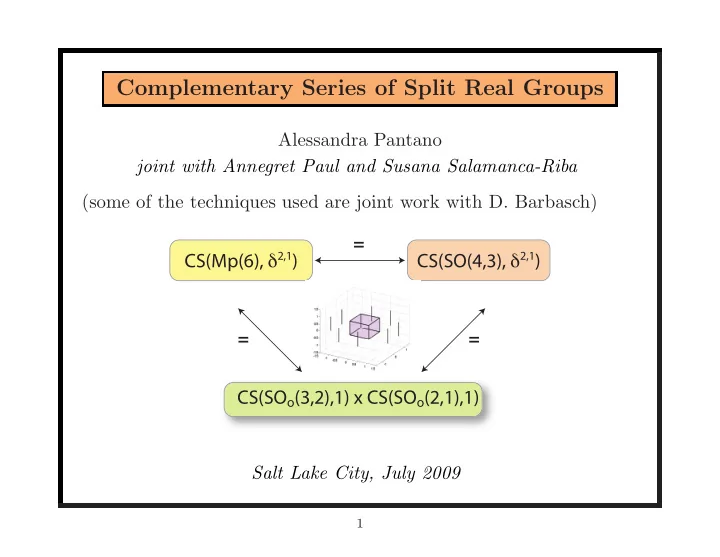
Complementary Series of Split Real Groups
Alessandra Pantano joint with Annegret Paul and Susana Salamanca-Riba (some of the techniques used are joint work with D. Barbasch)
CS(SO(4,3), δ2,1) CS(Mp(6), δ2,1) CS(SOo(3,2),1) x CS(SOo(2,1),1)
= = = Salt Lake City, July 2009
1
SLIDE 2 Introduction Aim Discuss the unitarity of minimal principal series
- f Mp(2n) and SO(n + 1, n).
Union of spherical complementary series
- f certain orthogonal groups
Genuine complementary series
Complementary series
? ? ?
2
SLIDE 3 PART 1
Genuine Complementary Series of Mp(2n)
Union of spherical complementary series
- f certain orthogonal groups
Genuine complementary series
Complementary series
? ? ?
FIRST
3
SLIDE 4 NOTATION
- G := Mp(2n) the connected double cover of Sp (2n, R)
- K :=
U(n) the maximal compact subgroup of G = {[g, z] ∈ U(n) × U(1): det(g) = z2}
- g0 = k0 ⊕ p0
- a0 := maximal abelian subspace of p0
- M := ZK(a0)
- ∆(g0, a0) = {±ǫk ± ǫl}k,l=1...n ∪ {±2ǫk}k=1...n
type Cn
all permutations and sign changes
4
SLIDE 5 The group M and its genuine representations M = ZK(a0) subgroup of K generated by the elements mk =
k , 1, . . . , 1), i
- , k = 1 . . . n (of order 4)
Genuine M-types Irreducible repr.s δ of M s.t. δ([I, −1]) = +1.
m2
k = [I, −1] → each generator mk acts by ±i
S keeps track of which generators act by −i δS(mk) = −i if k ∈ S +i
Mp(6) m1 m2 m3 δ{2,3} +i −i −i
5
SLIDE 6 An action of the Weyl group on genuine M-types W acts on M ← (sα · δ)(m) := δ(σ−1
α mσα)
∀ m ∈ M, ∀ α ∈ ∆ The stabilizer of δ in W is W δ := {w ∈ W : w · δ ≃ δ} . For all S ⊂ {1, . . . , n}, set q = |S|, p = |Sc|.
- W δS ≃ W (Cp) × W (Cq) ← s2ǫk & sǫk±ǫl, k, l in S or SC
- W · δS = {δT : |T | = q, |T c| = p}
W-orbits of genuine M-types pairs (p, q): p, q ∈ N, p + q = n Pick representatives δp,q := δ{p+1,...,n}. δp,q(mk) = +i if k ≤ p −i if k > p.
6
SLIDE 7 The group K and its genuine representations Maximal compact subgroup of G: K = U(n) Genuine K-types parameterized by highest weight (a1, . . . , an) with a1 ≥ a2 ≥ · · · ≥ an and aj ∈ Z + 1
2, ∀ j
fine K-types highest weight restriction to M Λp(Cn) ⊗ det−1/2 ( 1
2, . . . , 1 2
, − 1
2, . . . , − 1 2
) W · δp,q
- If we restrict a fine K-type to M, we get one full W-orbit in
M
- Each genuine M-type δ is contained in a unique fine K-type µδ.
7
SLIDE 8 Genuine Complementary Series of Mp(2n)
- MA := Levi factor of a minimal parabolic
- δ:= genuine irreducible representation of M
- ν:= real character of A
- P = MAN:= a minimal parabolic making ν weakly dominant.
Minimal Principal Series IP (δ, ν) := IndG
P (δ ⊗ ν ⊗ 1)
Langlands Quotient J(δ, ν) := composition factor of IP (δ, ν) ⊇ µδ δ-Complementary Series CS(G, δ) := {ν ∈ a∗
R | J(δ, ν) is unitary}
Problem: Find CS(Mp(2n), δp,q)
8
SLIDE 9
THEOREM 1
Theorem 1: For all ν ∈ a∗
R, write ν := (νp|νq). The map:
CS(Mp(2n), δp,q) → CS(SO(p + 1, p)0, 1) × CS(SO(q + 1, q)0, 1) ν → (νp, νq) is a well defined injection. (1 denotes the trivial M-type) Spherical complementary series of real split orthogonal groups are known (Barbasch). Hence this theorem provides explicit necessary conditions for the unitarity of genuine principal series of Mp(2n).
9
SLIDE 10 Example: CS(Mp(6), δ2,1) → CS(SO(3, 2)0, 1) × CS(SO(2, 1)0, 1)
CS(SO(3, 2)0, 1)
ν2 3/2 1/2 ν1
CS(SO(2, 1)0, 1) . . . ♣
♣ ♣ ♣ ♣ ♣ ♣ ♣ ♣ . . .
2
2 1 2
r r
1
3 2
2
⇒ CS(Mp(6), δ2,1) embeds into:
10
SLIDE 11
A reformulation of THEOREM 1 For all p, q ∈ N s.t. p + q = n, set: Gδp,q ≡ SO(p + 1, p)0 × SO(q + 1, q)0 and note that W(Gδp,q) = W δp,q. Gδp,q := connected real split group whose root system is dual to the system of good roots for δp,q. Theorem 1: The δp,q-complementary series of Mp(2n) embeds into the spherical complementary series of Gδp,q. Proof: based on Barbasch’s idea to use calculations on petite K-types to compare unitary parameters for different groups.
11
SLIDE 12 Comparing unitary parameters for Mp(2n) and Gδp,q J(δp,q, ν) unitary for Mp(2n)
- T(µ, δp,q, ν)
- pos. semidefinite
∀µ ∈ K < − | ? | ? | | − > J(1, ν) unitary for Gδp,q
- A(ψ, 1, ν)
- pos. semidefinite
∀ψ ∈ W δp,q
- A(ψ, 1, ν)
- pos. semidefinite
∀ψ ∈ W δp,q relevant
12
SLIDE 13 A matching of operators Key Proposition: ∀ relevant W δp,q-type ψ, ∃ a “petite” K-type µ s.t. T (µ, δp,q, ν)
= A(ψ, 1, ν)
Sketch of the proof:
- T(µ, δp,q, ν) is defined on HomM(µ, δp,q)
- This space carries a representation ψµ of W δp,q ← = W(Gδp,q)
- Attached to ψµ, ∃ a spherical operator A(ψµ, 1, ν) for Gδp,q
- If µ is petite, T(µ, δp,q, ν) = A(ψµ, 1, ν)
- For all ψ ∈
W δp,q relevant, ∃ µ ∈ K petite such that ψ = ψµ.
13
SLIDE 14 A matching of relevant W δp,q-types with petite K-types ((p − s) × (s)) ⊗ triv 1
2, . . . , 1 2
, − 1
2, . . . , − 1 2
, − 3
2, . . . , − 3 2
(p − s, s) ⊗ triv 3
2, . . . , 3 2
, 1
2, . . . , 1 2
, − 1
2, . . . , − 1 2
triv ⊗ ((q − r) × (r)) 3
2, . . . , 3 2
, 1
2, . . . , 1 2
, − 1
2, . . . , − 1 2
triv ⊗ (q − r, r) 1
2, . . . , 1 2
, − 1
2, . . . , − 1 2
, − 3
2, . . . , − 3 2
14
SLIDE 15 J(δp,q, ν) unitary for Mp(2n)
- T(µ, δp,q, ν)
- pos. semidefinite
∀µ ∈ K ⇓ T(µ, δp,q, ν)
∀µ ∈ K petite ==> ↑ | J(1, ν) unitary for Gδp,q
- A(ψ, 1, ν)
- pos. semidefinite
∀ψ ∈ W δp,q
- A(ψ, 1, ν)
- pos. semidefinite
∀ψ ∈ W δp,q relevant ∀ ψ ∈ W δp,q relevant, ∃ µ ∈ K petite s.t. A(ψ, 1, ν)=T(µ, δp,q, ν)
15
SLIDE 16 Non-unitarity certificates Let Gδp,q = SO(p + 1, p)0 × SO(q + q, q)0. For all ν = (νp|νq): J(δp,q, ν) unitary for Mp(2n) ==> J(1, ν) unitary for Gδp,q. The spherical unitary dual of split orthogonal groups is known. So we get non-unitarity certificates for genuine L.Q.s of Mp(2n). Theorem 1’: If
- the spherical L.Q. J(1, νp) of SO(p + 1, p)0 is not unitary, or
- the spherical L.Q. J(1, νq) of SO(q + 1, q)0 is
not unitary then the genuine L.Q. J(δp,q, (νp|νq)) of Mp(2n) is also not unitary.
16
SLIDE 17 An example of non-unitarity certificate Let ν = (ν1, . . . , νn). We may assume: ν1 ≥ · · · ≥ νp ≥ 0 and νp+1 ≥ · · · ≥ νn ≥ 0, by W δp,q-invariance. (Recall W δp,q = W(Cp) × W(Cq).) If any of the following conditions holds:
- νp > 1/2
- νn > 1/2
- νa − νa+1 > 1, for some a with 1 ≤ a ≤ p − 1, or
- νa − νa+1 > 1, for some a with p + 1 ≤ a ≤ n − 1
then the genuine Langlands quotient J(δp,q, ν) of Mp(2n) is not unitary.
17
SLIDE 18 An application This non-unitarity certificate is a key ingredient in the classification
- f the ω-regular unitary dual of Mp(2n).
Definition: A representation of Mp(2n) is called ω-regular if its infinitesimal character is at least as regular as the one of the
- scillator representation.
Corollary: The only ω-regular complementary series repr.s of Mp(2n) are the two even oscillator representations: J
2, . . . , 3 2, 1 2
2, . . . , 3 2, 1 2
18
SLIDE 19 PART 2
Complementary Series of SO(n + 1, n)
Union of spherical complementary series
- f certain orthogonal groups
Genuine complementary series
Complementary series
?
⊆
NEXT
?
19
SLIDE 20 NOTATION
- G := SO(n + 1, n)
- K := S(O(n + 1) × O(n))
maximal compact
- ∆(g0, a0) = {±ǫk ± ǫl} ∪ {±ǫk}
type Bn← dual to previous case
← same Weyl group as before
- M := ZK(a0) = {diag(1, tn, . . . , t1, t1, . . . , tn): tj = ±1, ∀ j}
20
SLIDE 21 M-types M is generated by the elements mk = diag(1, . . . , 1, −1
n+2−k, 1, . . . , 1,
−1
n+1+k, 1, . . . , 1)
k = 1 . . . n (of order 2). M-types ⇔ Subsets S ⊂ {1 . . . n} ← same parametrization as before The set S keeps track of which generators act by −1: δS(mk) = −1 if k ∈ S +1
SO(4, 3) m1 m2 m3 δ{2,3} +1 −1 −1
21
SLIDE 22 W -orbits of M-types Just like before, we look at the action of W on
- M. Then
- W δS ≃ W(Bp) × W(Bq) , for q = |S|, p = |Sc| ←
same as before
- W · δS = {δT : |T| = q, |T c| = p}
- W-orbits of M-types pairs (p, q): p, q ∈ N, p + q = n
↑ same parametrization as before Pick representatives δp,q := δ{p+1,...,n}. δp,q(mk) = +1 if k ≤ p −1 if k > p.
22
SLIDE 23 K-types (n even) K = S(O(n + 1) × O(n)), n even K-types (a1, . . . , a n
2 ; b1, . . . , b n 2 ) with aj, bj ∈ Z, ∀ j and
a1 ≥ · · · ≥ a n
2 ≥ 0; b1 ≥ · · · ≥ b n 2 ≥ 0.
If b n
2 = 0, there is also a sign ǫ = ±1.
Fine K-types realization
q < n
2
(0, . . . , 0; 1, . . . , 1
q
, 0, . . . , 0; +) triv ⊗ ΛqCn W · δp,q q = n
2
(0, . . . , 0; 1, . . . , 1) triv ⊗ Λ
n 2 Cn
W · δp,q q > n
2
(0, . . . , 0; 1, . . . , 1
n−q
, 0, . . . , 0; −) triv ⊗ ΛqCn W · δp,q
23
SLIDE 24 K-types (n odd) K = S(O(n + 1) × O(n)), n odd K-types (a1, . . . , a n+1
2
; b1, . . . , b n−1
2
) with aj, bj ∈ Z, ∀ j and a1 ≥ · · · ≥ a n+1
2
≥ 0; b1 ≥ · · · ≥ b n−1
2
≥ 0. If a n+1
2
= 0, there is also a sign ǫ = ±1. Fine K-types realization
q < n
2
(0, . . . , 0; 1, . . . , 1
q
, 0, . . . , 0; +) triv ⊗ ΛqCn W · δp,q q > n
2
(0, . . . , 0; 1, . . . , 1
n−q
, 0, . . . , 0; −) triv ⊗ ΛqCn W · δp,q
24
SLIDE 25 Complementary Series of SO(n + 1, n)
- MA: Levi factor of a minimal parabolic
- δ ∈
M
R
- P = MAN:= a minimal parabolic making ν weakly dominant.
Minimal Principal Series IP (δ, ν) Langlands Quotient J(δ, ν) δ-Complementary Series CS(SO(n + 1, n), δ)={ν|J(δ, ν) unitary} Problem: Find CS(SO(n + 1, n), δp,q)
25
SLIDE 26
THEOREM 2 Theorem 2: For all ν ∈ a∗
R, write ν := (νp|νq). The map:
CS(SO(n + 1, n), δp,q) → CS(SO(p + 1, p)0, 1)xCS(SO(q + 1, q)0, 1) ν → (νp, νq) is a well defined injection. (1 denotes the trivial M-type.) ↑ same embedding as before
26
SLIDE 27
A reformulation of THEOREM 2 Set: Gδp,q ≡ SO(p + 1, p)0 × SO(q + 1, q)0 ← same as before and note that W(Gδp,q) = W δp,q. Gδp,q := connected real split group whose root system is equal to the system of good roots for δp,q. Theorem 2: The δp,q-complementary series of SO(n + 1, n) embeds into the spherical complementary series of Gδp,q. Proof: based on a matching of relevant W-types for Gδp,q with petite K-types for SO(n + 1, n).
27
SLIDE 28
A matching of relevant W δp,q-types with petite K-types Recall that W δp,q = W(Bp) × W(Bq) and K = S(O(n + 1) × O(n)). ((p − s) × (s)) ⊗ triv Λs(Cn+1) ⊗ Λq+s(Cn) (p − s, s) ⊗ triv an irreducible submodule of triv ⊗ [Λs(Cn) ⊗ Λq+s(Cn)] triv ⊗ ((q − r) × (r)) Λr(Cn+1) ⊗ Λq−r(Cn) triv ⊗ (q − r, r) an irreducible submodule of triv ⊗ [Λr(Cn) ⊗ Λq−r(Cn)]
28
SLIDE 29 PART 3
An example: n = 3
Union of spherical complementary series
- f certain orthogonal groups
Genuine complementary series
Complementary series
?
⊆ ⊆
n = 3
29
SLIDE 30 CS(SO(4,3), δ2,1) CS(Mp(6), δ2,1) CS(SOo(3,2),1) x CS(SOo(2,1),1)
⊆ ⊆
Are these “proper containments” or “equalities”? Are the L.Q.s JMp(6)(δ2,1, ν) and JSO(4,3)(δ2,1, ν) unitary for all points ν of the unit cube and all points ν of the 8 line segments?
30
SLIDE 31 Unitarity of JMp(6)(δ2,1, ν) for ν in the unit cube Theorem.The Langlands quotient J(δ, ν) of Mp(2n) is unitary for all ν in the unit cube {x ∈ a∗
R | 0 ≤ |xj| ≤ 1/2, ∀ j}.
- Proof. Note that:
- For ν = 0, all the operators T(µ, δ, ν) are positive definite.
- The signature of T(µ, δ, ν) can only change along the
reducibility hyperplanes: ν, β ∈ 2Z + 1 for some root β which is good for δ ν, β ∈ 2Z \ {0} for a root β which is bad for δ.
- Away from these hyperplanes, I(δ, ν) is irreducible (= J(δ, ν)),
and the operators T(µ, δ, ν) have constant signature. In particular, J(δ, ν) is unitary throughout the unit cube.
31
SLIDE 32 Unitarity of JMp(6)(δ2,1, ν) for ν = 3
2, 1 2|t
2]
Theorem.The repr. J(δp,q, ν) of Mp(2n) is unitary ∀ ν=(νp|νq) s.t.
- νp ∈ CS(SO(p + 1, p)0, 1), with 0 ≤ |aj| ≤ 3/2 or aj ∈ Z + 1
2
- νq ∈ CS(SO(q + 1, q)0, 1), with 0 ≤ |aj| ≤ 1
2.
- Proof. Let P1 be a parabolic with M1A1 := Mp(2p) ×
- GL(1, R)
q . By double induction, J(δp,q, ν) is the Langlands quotient of I(νq) := IndMp(2n)
M1A1N1
- (J(δp,0, νp) ⊗ δ0,q) ⊗ νq ⊗ 1
- .
Here J(δp,0, νp) is a pseudopsherical repr. of Mp(2p). By results of ABPTV, J(δp,0, νp) is unitary ∀ νp ∈ CS(SO(p + 1p)0, 1). Then the repr. I(νq) of Mp(2n) is unitary at νq=0 (unitarily induced). For all ν of interest, I(νq) is irreducible, hence it stays unitary by the principle of unitary deformation.
32
SLIDE 33
Corollary
CS(SO(4,3), δ2,1) CS(Mp(6), δ2,1) CS(SOo(3,2),1) x CS(SOo(2,1),1)
= = =
33
SLIDE 34
More generally. . . For all n ≤ 4 and for all δ = δp,q, the following equalities hold:
CS(SO(n+1,n), δp,q) CS(Mp(2n), δp,q) CS(SOo(p+1,p),1) x CS(SOo(q+1,q),1)
= = =
34
SLIDE 35
PART 4
A natural conjecture Equalities hold for all n and all choices of δp,q
CS(SO(n+1,n), δp,q) CS(Mp(2n), δp,q) CS(SOo(p+1,p),1) x CS(SOo(q+1,q),1)
= = =
35
SLIDE 36 Conjectures 1 and 2
CS(SO(n+1,n), δp,q) CS(Mp(2n), δp,q) CS(SOo(p+1,p),1) x CS(SOo(q+1,q),1)
⊆ ⊆
⊆
⊆
- Remark. We may assume p ≥ q, because
- JMp(2n)(δp,q, (νp|νq)) = JMp(2n)(δq,p, (νp|νq))∗
- JSO(n+1,n)(δp,q, (νp|νq)) = JSO(n+1,n)(δq,p, (νq|νp)) ⊗ χ
(χ = a unitary character).
36
SLIDE 37 (More) evidence for these conjectures
If (p, q) = (n, 0), the conjectures hold for all n. This is the pseudospherical case for Mp(2n) and the spherical case for SO(n + 1, n). (For Mp(2n), the result is due to ABPTV; for SO(n + 1, n), it is an empty statement.)
- A large family of examples
Assume p > q. The conjectures hold for all ν = (ρp|νq) with ⋆ ρp =
2, p − 3 2, . . . , 3 2, 1 2
- = the infinitesimal character of
the trivial representation of SO(p + 1, p)0, ⋆ νq ∈ CS(SO(q + 1, q)0, 1).
37
SLIDE 38 PART 5
CS(SO(n+1,n), δp,q) CS(Mp(2n), δp,q) CS(SOo(p+1,p),1) x CS(SOo(q+1,q),1)
?
NEXT
⊆ ⊆
⊆
⊆
38
SLIDE 39 Conjecture 3 Conjecture 3 For all n and all choices of δp,q: CS(Mp(2n), δp,q) = CS(SO(n + 1, n), δp,q).
CS(SO(n+1,n), δp,q) CS(Mp(2n), δp,q) CS(SOo(p+1,p),1) x CS(SOo(q+1,q),1)
=
⊆ ⊆
⊆
⊆
- Conjecture 3 is true for n = 2, 3, and 4.
- Conjecture 3 is independent of Conjectures 1 and 2. ←
new tools!
39
SLIDE 40 θ-correspondence Consider G = Sp(2n, R), G′ = O(m + 1, m) ⊂ Sp(2n(2m + 1), R). Let ˜ G and ˜ G′ be their preimages in Mp(2n(2m + 1)): ˜ G = Mp(2n) ˜ G′ = O(m + 1, m) linear cover.
- (G, G′) is a dual pair in Sp(2n(2m+1), R) (mutual centralizers)
- The θ-correspondence gives a bijection between certain genuine
irreducible representations of ˜ G and ˜ G′. We can re-interpret this correspondence as a map: π ∈
- Mp(2n)gen ↔ π′ ∈
- SO(m + 1, m).
40
SLIDE 41 Some results of Adams, Barbasch and Li For all k ≥ 0, let ρk=
2, . . . , 1 2
- . The θ-correspondence maps:
JMp(2n)(δp,q, ν) → JSO(n+k+1,n+k)(δp+k,q, (ρk|ν)) JMp(2n+2k)(δp+k,q, (ρk|ν)) ← JSO(n+1,n)(δp,q, ν) for all p ≥ q. If k ≥ n + 1, both arrows preserve unitarity. (Stable Range) Remark: If k = 0, the correspondence JMp(2n)(δp,q, ν) ↔ JSO(n+1,n)(δp,q, ν) is not known to preserve unitarity. Conj.3 JMp(2n)(δp,q, ν) unitary ⇔ JSO(n+1,n)(δp,q, ν) unitary
41
SLIDE 42 THEOREM 3 Theorem 3: Conjecture 3 holds in each of the following cases: (i) Conj.s A1 & A2 hold (ii) Conj.s A1 & B1 hold (iii) Conj.s A2 & B2 hold (iv) Conj.s B1 & B2 hold. Conjecture A (ρn+2|ν) ∈ CS(Mp(4n + 4), δp+n+2,q)
⇓ Conj. A2 ν ∈ CS(Mp(2n), δp,q) Conjecture B (ρn+2|ν) ∈ CS(SO(2n + 3, 2n + 2), δp+n+2,q)
⇓ Conj. B2 ν ∈ CS(SO(n + 1, n), δp,q)
42
SLIDE 43 THEOREM 3 (a sketch of the proof) The idea of the proof is similar to the one in ABPTV. We show that:
JMp(2n)(δp,q,ν) unitary
JSO(n+1,n)(δp,q,ν) unitary
- Conj. B2 or A1
- Conj. B1 or A2
Key ingredients:
- Results on θ-correspondence (Adams, Barbasch, Li, Przebinda).
- Non-unitarity certificates for both Mp(2n) and SO(n + 1, n).
43
SLIDE 44 JMp(2n)(δp,q, ν) unitary = ⇒
- Conj. B2 JSO(n+1,n)(δp,q, ν) unitary
JMp(2n)(δp,q,ν) unit. JSO(n+1,n)(δp,q,ν) unit. JSO(2n+3,2n+2)(δp+n+2,q,(ρn+2|ν)) unit.
S t abl e range
44
SLIDE 45 JMp(2n)(δp,q, ν) unitary ⇐ =
- Conj. B1 JSO(n+1,n)(δp,q, ν) unitary
JMp(2n)(δp,q,ν) unit. JSO(n+1,n)(δp,q,ν) unit. JMp(2n+2)(δp+1,q,ν’) unit. JMp(2n-2k)(δp-k,q,ν’’) unit.
by non-unitary certificates for SO(n+1,n)
Low Rank (Howe)
Stable range
JSO(2n+3,2n+2)(δp+n+2,q,(ρn+2|ν)) unit.
by non-unitary certificates for Mp(2n)
45
SLIDE 46 Conclusions
CS(SO(n+1,n), δp,q) CS(Mp(2n), δp,q) CS(SOo(p+1,p),1) x CS(SOo(q+1,q),1)
=
⊆ ⊆
⊆
⊆
- Conj. A or Conj. B
- Conj. 1 ⇒ Conj. A.
- Conj. 2 ⇒ Conj. B.
If either Conj. 1 (alone) or Conj. 2 (alone) holds, then the 3 parameter sets are all equal.
46