Complement Space Classes Definition coPSPACE = { L : L PSPACE } - - PowerPoint PPT Presentation

complement space classes
SMART_READER_LITE
LIVE PREVIEW

Complement Space Classes Definition coPSPACE = { L : L PSPACE } - - PowerPoint PPT Presentation

Complement Space Classes Definition coPSPACE = { L : L PSPACE } Logarithmic Space Complexity coL = { L : L L } Claim: coPSPACE = PSPACE Nabil Mustafa Claim: coL = L All deterministic classes are closed under complement. Computability


slide-1
SLIDE 1

Logarithmic Space Complexity

Nabil Mustafa Computability and Complexity

Nabil Mustafa Logarithmic Space Complexity

Complement Space Classes

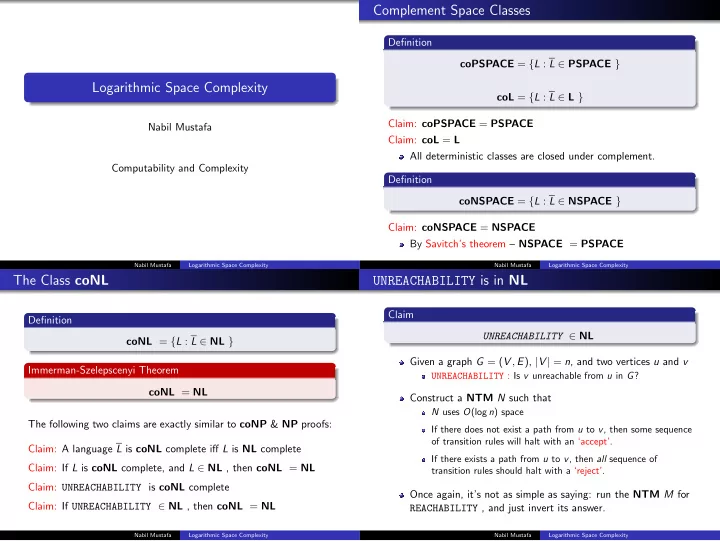
Definition coPSPACE = {L : L ∈ PSPACE } coL = {L : L ∈ L } Claim: coPSPACE = PSPACE Claim: coL = L All deterministic classes are closed under complement. Definition coNSPACE = {L : L ∈ NSPACE } Claim: coNSPACE = NSPACE By Savitch’s theorem – NSPACE = PSPACE

Nabil Mustafa Logarithmic Space Complexity

The Class coNL

Definition coNL = {L : L ∈ NL } Immerman-Szelepscenyi Theorem coNL = NL The following two claims are exactly similar to coNP & NP proofs: Claim: A language L is coNL complete iff L is NL complete Claim: If L is coNL complete, and L ∈ NL , then coNL = NL Claim: UNREACHABILITY is coNL complete Claim: If UNREACHABILITY ∈ NL , then coNL = NL

Nabil Mustafa Logarithmic Space Complexity

UNREACHABILITY is in NL

Claim UNREACHABILITY ∈ NL Given a graph G = (V , E), |V | = n, and two vertices u and v UNREACHABILITY : Is v unreachable from u in G? Construct a NTM N such that N uses O(log n) space If there does not exist a path from u to v, then some sequence

  • f transition rules will halt with an ‘accept’.

If there exists a path from u to v, then all sequence of transition rules should halt with a ‘reject’. Once again, it’s not as simple as saying: run the NTM M for REACHABILITY , and just invert its answer.

Nabil Mustafa Logarithmic Space Complexity
slide-2
SLIDE 2

A Counting Problem CC

A Counting Problem CC : Given G = (V , E) and a vertex u, count the number of vertices reachable from v in G. Have not formally described TM for non-boolean functions For a TM it is obvious: Put the output on the work-tape before halting. Write-only output tape space does not matter. For a NTM it is less clear: The NTM ends in many ways, with possibly different answers So, what could be a consistent definition of the output? A NTM N computes a non-boolean function f iff All sequences that halt with an ‘accept’ must have the same

  • utput string

All other sequences must halt with a ‘reject’ state

Nabil Mustafa Logarithmic Space Complexity

Proof of coNL = NL

Claim If CC ∈ NL , then UNREACHABILITY ∈ NL Set sum = number of nodes reachable from u Set counter = 0 For each vertex t = v in G Guess if t is reachable from u If the guess is that t is reachable Guess a path from u to t Verify that that path is correct. If verification fails at any stage, halt with ‘reject’ If verification succeeds, increment counter. If counter = sum, ‘accept’ Otherwise, ‘reject’ Claim The above algorithm uses O(log n) non-deterministic space

Nabil Mustafa Logarithmic Space Complexity

Proof of coNL = NL

Remember our objective: If v is not reachable from u, at least one sequence should result in an ‘accept’ If v is reachable, all sequences should result in a reject Assume v is not reachable from u. ∃ sequence of guesses that identify vertices connected to u ∃ guesses which verify correctly the connecting path from u Therefore counter gets incremented: sum times. The NTM halts with an accept. Correctness: If, not counting v, there are already sum connected vertices, this implies that v is not reachable from u. Assume v is reachable from u. No matter what we guess, we never incorrectly say a vertex t is reachable when it is not Therefore, even if we guess the connected vertices correctly, counter will become at most sum − 1. Correctness: Therefore, we always reject.

Nabil Mustafa Logarithmic Space Complexity

CC ∈ NL

Claim CC ∈ NL Proof. We know that REACHABILITY is in NL CC is just summing up REACHABILITY over all vertices: Set counter = 0 For each vertex t in G Guess a path from u to t Verify that that path is correct. If verification fails at any stage, halt with ‘reject’ If verification succeeds, increment counter. Output counter Problem? All paths reject! Only works if every vertex is reachable.

Nabil Mustafa Logarithmic Space Complexity
slide-3
SLIDE 3

CC ∈ NL

Claim CC ∈ NL Proof. CC is just summing up REACHABILITY over all vertices carefully: Set counter = 0 For each vertex t in G Guess if t is reachable from u If the guess is that t is reachable

Guess a path from u to t Verify that that path is correct. If verification fails at any stage, halt with ‘reject’ If verification succeeds, increment counter.

Output counter Problem? All paths with subsets of reachable vertices guessed correctly give different answers (including the correct one!)

Nabil Mustafa Logarithmic Space Complexity

CC ∈ NL

Let Ti be the count of vertices reachable from u in at most i steps. Claim If we know Ti, we can compute Ti+1. Set Ti+1 = 0 For each vertex t in G Set counter = 0, r = 0 For each vertex s in G Guess if s ∈ Ti If the guess is that s ∈ Ti

Guess a path of length i from u to s Verify that the path is correct If verification fails at any stage, halt with ‘reject’ If verification succeeds, counter++. If (s, t) ∈ E, set r = 1

If counter = Ti, halt with ‘reject’ If r = 1, increment Ti+1

Nabil Mustafa Logarithmic Space Complexity

CC ∈ NL

Note that Tn−1 is the answer to problem CC . Construct Ti inductively T0 = 1 – just u itself. To compute Ti+1, we only need Ti Can’t afford to keep all Tj, only Ti to compute Ti+1 Reuse the space for computing each Ti+1 The algorithm described is correct. Each path that halts with ‘accept’ gives the same answer. Pretty easy to see that we check for each type of failure. Proof given nicely in Papadimitriou’s book. Space used is O(log n) Re-use space over Ti, so consider space for each Ti Use constant number of vertex indices – O(log n) Use constant number of counters – O(log n)

Nabil Mustafa Logarithmic Space Complexity

UNREACHABILITY ∈ NL

UNREACHABILITY We now give the ‘certificate’-based proof of the previous theorem. We know that if UNREACHABILITY ∈ NL then NL = coNL UNREACHABILITY CLAIM: UNREACHABILITY ∈ NL we only need to show O(log − n) space Algorithm A such that ∃ polynomial sized certificate and A(< G, s, t >, u) = 1 iff t is not reachable from s in G. Nabil’s Note: These are unedited slides of Laiq.

Nabil Mustafa Logarithmic Space Complexity
slide-4
SLIDE 4

UNREACHABILITY ∈ NL - PROOF Let Ci be the set of vertices reachable from s in at most i steps vertices are labeled from 1 to n so that each could be represented by log-n bits. The certificate only sequence of vertices from s to v (for v ∈ Ci) Certificate could be checked using read-once Access first vertex of sequence should be s. for s > 0, vj−1 and vj should have an edge. vk = v (last vertex should be v) certificate is at most polynomial sized.

Nabil Mustafa Logarithmic Space Complexity

UNREACHABILITY ∈ NL - PROOF

  • ur Algorithm will use following 2 procedures

Given |Ci| , certify if v / ∈ Ci (1) Given |Ci| , certify if |Ci| = c (2) NOTE: (2) will be applied iteratively to find Max-Size of sets C1, C2, C3, ..., Cn and then will use (1) to certify that t / ∈ Cn

Nabil Mustafa Logarithmic Space Complexity

PROOF - UNREACHABILITY / ∈ NL

Procedure-1 Given |Ci| , certify if v / ∈ Ci Certificate here is the list of certificates for every u ∈ Ci sorted in ascending order of Vertex labels The Algorithms checks Each certificate is valid u’s label (whose certificate is given) is larger than previous vertex’s label no certificate is provided for v total number of certificate = |Ci| if v / ∈ Ci then certificate will be accepted if v ∈ Ci then there won’t be |Ci| certificate for |Ci| vertices

  • ther than v
Nabil Mustafa Logarithmic Space Complexity

PROOF - UNREACHABILITY / ∈ NL

Given |Ci−1| , certify if v / ∈ Ci Similar to previous procedure Certificate here is the list of |Ci−1| certificates certifying u ∈ Ci−1 for every u ∈ Ci−1 The Algorithms checks Each certificate is valid u’s label (whose certificate is given) is larger than previous vertex’s label verify no certificate is given for v or Neighbor of v total number of certificates = |Ci| since v ∈ Ci iff ∃ u ∈ Ci−1 such that u = v or u is neighbor

  • f v.

so the procedure provides correct results

Nabil Mustafa Logarithmic Space Complexity
slide-5
SLIDE 5

PROOF - UNREACHABILITY / ∈ NL

Given |Ci−1| , certify if |Ci| = c The certificate that |Ci| = c will have n certificates There is a certificate for every u ∈ Ci There is a certificate for every u / ∈ Ci Algorithm will verify all certificates and count the certificates for u ∈ Ci Accepts if count = c

Nabil Mustafa Logarithmic Space Complexity