Complaint handling and good administrative practice by Greg Andrews, - - PDF document

complaint handling and good administrative practice by
SMART_READER_LITE
LIVE PREVIEW

Complaint handling and good administrative practice by Greg Andrews, - - PDF document

Complaint handling and good administrative practice by Greg Andrews, former Deputy Ombudsman, New South Wales Australia A shortened version of this paper was delivered to the National Conference of the Ombudsman Republik Indonesia Sinergitas


slide-1
SLIDE 1

Complaint handling and good administrative practice by Greg Andrews, former Deputy Ombudsman, New South Wales Australia

A shortened version of this paper was delivered to the National Conference of the Ombudsman Republik Indonesia “Sinergitas Rencana Tindak dalam Perumusan dan Penyelenggaraan Pelayanan Publik yang Berkuailitas dan Bebas dari Prilaku Maladministrasi demi Pencapaian Target Reformasi Birokrasi” Jakarta 15 December 2011

Today you will be learning a lot about the role of the Ombudsman’s Office and the obligations upon you as government officials to implement complaint handling systems and to deal with citizen and customer

  • complaints. I want to start by talking about the big

picture and where complaint handling fits into it and why it is important.

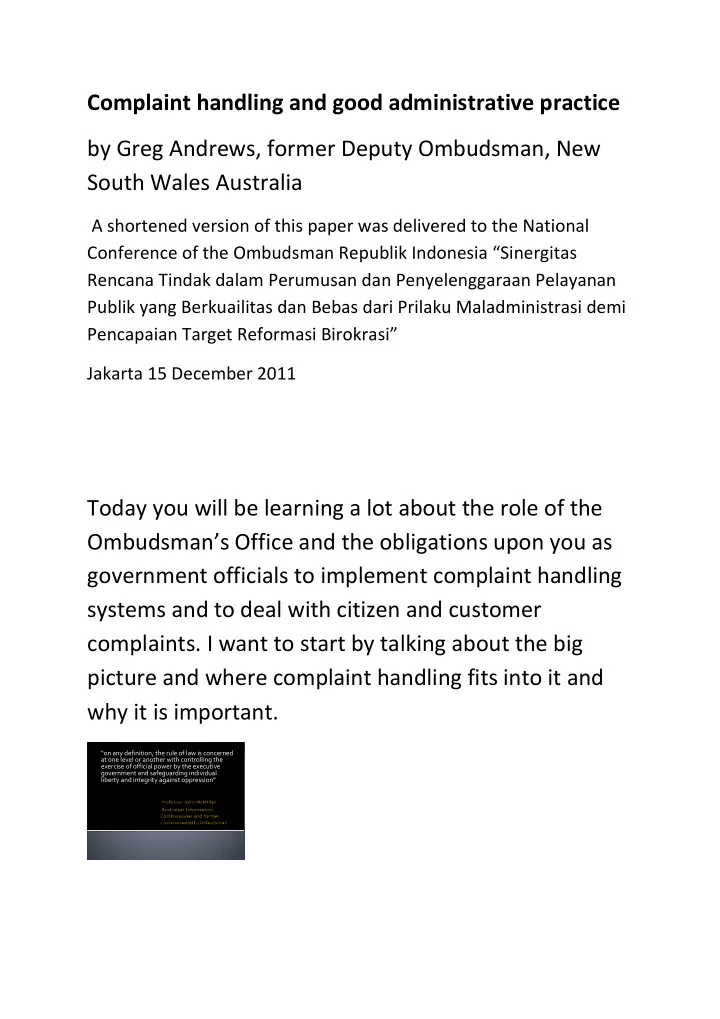
“on any definition, the rule of law is concerned at one level or another with controlling the exercise of official power by the executive government and safeguarding individual liberty and integrity against oppression”

slide-2
SLIDE 2

First of all, I am sure we are all concerned about the rule of law. As one of my former colleagues puts it, “on any definition, the rule of law is concerned at one level

  • r another with controlling the exercise of official

power by the executive government and safeguarding individual liberty and integrity against oppression”1. A basic principle is that agencies and officers of government agencies require legal authority for any action they undertake and must comply with the law in discharging their functions. That applies from the highest Minister to the lowliest desk official. For that safeguard to be a reality, there must be a legal mechanism by which the rule of law can be upheld. The courts are one way of ensuring this. However, all countries have found that this is usually a long and costly route to find administrative justice. Many countries , like Indonesia, have established the office of the Ombudsman. This office is seen as a more informal, less costly and speedy dispute resolution mechanism to compliment the courts in upholding the rule of law as it applies to government administration. In 1970 there were fewer than 20 countries that had

1 Professor John McMillan, The Ombudsman and the Rule of Law, Paper to Australian Institute of

Administrative Law Forum No44, Canberra 6 November 2004.

slide-3
SLIDE 3

an Ombudsman but now over 100 countries have established an Ombudsman office by one name or the

  • ther. So, the establishment of the Ombudsman of the

Republic of Indonesia is part of a global trend that crosses political, cultural and language barriers. From a rule of law perspective, complaint handling by the Ombudsman bolsters the notion that government is bound by rules and that there can be an independent evaluation of whether there has been compliance with the rules.

Government accountability and complaint handling go hand in hand. Recognition of the right of citizens to challenge government decisions can be an important marker of whether democracy and the rule of law are being practiced.

Government accountability and complaint handling go hand in hand. In Australia we take this notion for granted because we have a long history of developing citizen rights and institutions like the Ombudsman have been around for almost forty years. This of course is not the case everywhere. The struggle for democracy is still vigorous in many countries like we have recently seen by the developments in the Middle East. Those events remind us that in many countries the ability of

slide-4
SLIDE 4

citizens to question or complain about government actions is still hotly contested. Recognition of the right of citizens to challenge government decisions can be an important marker of whether democracy and the rule of law are being practiced. In any well developed democracy, you will find an acceptance of the notion that citizens have a right to make complaints about poor service and to dispute decisions made by government officials. You will also find that there are agencies like the Ombudsman where citizens can go for an independent and impartial investigation of their grievance if they are not satisfied with the response from the government agency. Accountability So what we are really talking about here is the accountability of government officials and agencies. Accountability is fundamental to good governance in modern open societies. It is necessary not only to ensure that the taxes and revenue raised by government is strictly used for the purposes which they were allocated , but also to ensure that

slide-5
SLIDE 5

government administration is transparent, efficient and in accordance with the law. Public acceptance of Government and the roles of

  • fficials depends upon trust and confidence [–and

that trust and confidence is] based upon the administration being held accountable for its actions.2 .

Citizens only trust public

  • fficials and the

government when they are accountable

The last point is extremely important. For the citizens to accept the legitimacy of its government and the public officials who serve it, they must have trust and confidence in them. That trust and confidence can

  • nly be developed when there is proper accountability

–when the bureaucracy is open to having their decisions and actions re-examined when citizens are dissatisfied; when they are responsive to citizen complaints. Over the last three decades we have witnessed significant reforms in public sector administrations around the world that recognise the importance of

2 Administrative Review Council, Contracting Out of Government Services (ARC Report No 42, 1998) 5, quoting Industry Commission,

Competitive Tendering and Contracting by Public Sector Agencies (Report No 48, 1996) 4–5

slide-6
SLIDE 6

accountability and the need to be responsive to citizens concerns and complaints. I want to mention a few of these which I think will give you a picture of where new Indonesian initiatives like the establishment of the Ombudsman Office and the passage of Law number 25 of 2009 regarding public services fit into this global trend of public sector reform. I n

 Making administration accountable and

citizen friendly.

 Ensuring transparency and the right to

information.

 Taking measures to cleanse and motivate the

civil service.

 Adopting a stakeholder approach.  Saving time for officials and clients

the 1990s the United Kingdom led the way with its Citizen’s Charter initiative. It aimed to improve public services in the UK by:

 Making administration accountable and citizen

friendly.

 Ensuring transparency and the right to information.  Taking measures to cleanse and motivate the civil

service.

 Adopting a stakeholder approach, and  Saving time for officials and clients

A critical part of that reform was a requirement on the main public service agencies to identify who its customers where, to set standards of performance and to communicate those standards to their customers and clients. These charters set out the levels of

slide-7
SLIDE 7

service provision that the public could expect to receive—allowing people to be clear about what they were entitled to, and making it clear to service providers the standards they were committed to

  • meet. This was done by the publication of 42 Service

Charters by the main agencies.

Belgium Canada Spain France USA Ireland Portugal Denmark Australia Malaysia Nepal; And many others

In the years that followed, other countries adopted this idea and we saw the development of Service Charters in countries like Belgium, Canada, Spain, France, the USA, Ireland, Portugal, Denmark and Australia. The idea has also spread to Asian countries. Malaysia introduced Client Charters and even in tiny countries like Nepal we have seen Citizen Charters developed at the local government level. In the United States of America, during the Clinton administration, Vice President Al Gore was charged with undertaking a National Performance Review to make the American government work better. Significant public sector reforms came out of that

  • review. One of the key reforms was a focus on the

citizen as customer and setting standards of customer

slide-8
SLIDE 8
  • service. President Clinton actually issued an executive
  • rder on Setting Customer Service Standards.

 Identify customers who are or should be served by the

agency

 Survey customers to determine the kind and quality of

services they want and their level of satisfaction with existing services

 Post service standards and measure results against them  Benchmark customer service standards against the best in

business

 Survey front-line employees on barriers to, and ideas for,

matching the best in business

 Provide customers with choices in both the sources of

service and the means of delivery

 Make information, services, and complaint systems easily

accessible

 Provide the means to address customer complaints

President Clinton’s Executive Order 12862 ‘Setting Customer Service Standards’  Identify customers who are or should be served by the agency  Survey customers to determine the kind and quality of services they want and their level of satisfaction with existing services  Post service standards and measure results against them  Benchmark customer service standards against the best in business  Survey front-line employees on barriers to, and ideas for, matching the best in business  Provide customers with choices in both the sources of service and the means of delivery  Make information, services, and complaint systems easily accessible  Provide the means to address customer complaints So the core ideas behind UK Citizens Charters of identifying customers, developing service standards

slide-9
SLIDE 9

and making information about the services and standards available to citizens was picked up by the Clinton administration. But it went further – it also introduced the idea of asking citizens about the kind and quality of services they wanted and setting service standards around those things, benchmarking service standards against the private sector, measuring customer satisfaction with services, and providing mechanisms for citizens to make complaints.

 Ask us what we want rather than telling us what

we need

 Don’t give people the run around from one

department to another

 Treat us with courtesy, respect and enthusiasm  Treat us like valued customers  Make it easy to deal with the government  Provide reliable and timely help  Provide options for where and how to get

services

 Provide clear advice, letters, publications and

forms

Following that Executive Order, US Federal Agencies did go out and ask their customers what they wanted by way of good service. People said this:  Ask us what we want rather than telling us what we need  Don’t give people the run around from one department to another  Treat us with courtesy, respect and enthusiasm  Treat us like valued customers  Make it easy to deal with the government  Provide reliable and timely help

slide-10
SLIDE 10

 Provide options for where and how to get services  Provide clear advice, letters, publications and forms There have been similar customer consultation exercises done in many other countries since then and the answers have always been roughly the same. I am sure if you went out and asked your clients and customers this question you would get similar answers. So this list gives us a good guide to what we as public servants should be striving to achieve. The list of wants is relatively simple but achieving it takes time and

  • commitment. I know that in Australia we are still

working hard at trying to achieve many of these things. The approaches to implementing these sorts of reforms has become more sophisticated over the

  • years. For example, in Australia and other countries

that adopted the Service Charter idea, initially we saw agencies develop service standards that were too easily achieved or were not that important to their

  • customers. The service standards didn’t actually help

them improve their efficiency. So the next phase of reform was to concentrate more

  • n measuring customer expectations and then

developing service standards that were directly linked to what the customers and clients actually wanted, not

slide-11
SLIDE 11

what public officials thought was important or what they could deliver. This generally raised the bar and made agencies more responsive to customer needs.

CITIZENS FIRST

¥ Citizens understand that government has a more difficult role than the private sector, balancing efficiency with the public interest. However, they still expect the quality of government services to be as high or higher than that of private sector services. ¥ Citizens assessments of service quality are determined primarily by five factors: timeliness, knowledge and competence of staff, courtesy/comfort, fair treatment, and outcome.

The Canadians have been the world leaders in this aspect of accountability. They developed a public sector reform program called Citizens First. For over ten years they have been undertaking highly sophisticated surveys that measure customer satisfaction with services provided by government agencies across Canada. These surveys allow the Canadian government and its agencies to benchmark their services against each other, against other jurisdictions, to track progress over time and also to help them identify priorities for improvement. Just like our experience in Australia, the Canadians found that their citizens had got used to receiving good customer service from private sector agencies who competed for their business. Citizens then transferred those expectations across to the public

  • sector. They basically said why shouldn’t we get the
slide-12
SLIDE 12

best possible service from the public sector that my taxes pay for. In the early years the Canadians identified that citizens judged the quality of the service given by public sector agencies by assessing five important things. timeliness, knowledge and competence of staff, courtesy/comfort, fair treatment, and the actual outcome. Knowing the criteria which people use to evaluate quality service is useful to the public sector. It is useful because it gives us a guide to what citizens think is

  • important. That enables us to concentrate our

improvement efforts on those things and not waste

  • ur time and resources making changes to things that

have no impact on people’s perceptions of good customer service. Research in other countries including Australia also indicates that reliability of service is another key driver

  • f satisfaction – people will judge the quality of public

services by their perception of how well public servants perform their services accurately and dependably.

slide-13
SLIDE 13

Over recent years, this sort of research has become even more sophisticated. In New South Wales where I come from, there was a very big survey of citizens experiences with government services conducted about two years ago. It found the drivers of our citizens judgements about the quality of customer services provided by government agencies were their perceptions about : access & timing, process and outcome, location and presentation, professionalism and their assessment of how good the communication and outcome was. Now if you look carefully, each of these categories is broken down into the main elements . Perceptions about access and timing for instance are based on judgements about things like the ease of access to the public service, waiting times, the time taken to complete transactions, the number of people you had to deal with to complete a transaction, and the general availability of the service. Another major driver is people’s perceptions about the process and outcome

  • factors. This includes perceptions based on

assessments of the friendliness of the public servants,

slide-14
SLIDE 14

the fairness with how they were treated, the reliability

  • f the service and so on.

So these are the same drivers as identified by the Canadian public service just a little more detailed. This sort of research has also been done in the UK and the United States too and they also came up with very similar drivers. So these things appear to be universal psychological constructs that people everywhere use to judge service quality. Another important finding that also comes out of this research around the world is the finding about what is the most important driver of dissatisfaction. The research shows the things that drive people to hate the public service the most, is their perceptions about fairness, reliability, accuracy and how any problems are

  • handled. So, if you don’t get those things right, if

people think they are treated unfairly, that the public

  • fficial is not reliable, that transactions are not

accurate and that their concerns and problems are not handled well, then they will be dissatisfied with the service - even if they get what they came for.

slide-15
SLIDE 15

Now I have spent a lot of time talking about customer service and how important it is in public sector reform. That leads me to complaint handling. One of the things that all of these public sector reforms recognised was the importance of complaint handling in the provision

  • f public services. You will remember from the slide I

showed you earlier that the final two orders in President Clintons Executive Order were:  Make information, services, and complaint systems easily accessible  Provide the means to address customer complaints In Canada one of the first things they did when they developed their Citizens First reform was to publish a guideline on Effective Complaint Management3. Much

  • f the material they used was adapted from a

publication I wrote for the NSW Ombudsman on Effective Complaint Handling. They also relied upon work that had been done in the UK where a Citizens Charter Complaints Task Force also published a guide

  • n Effective Complaints Systems in the early 1990s4.

Since then there have been various complaint system guides published in different countries by various agencies including many Ombudsman Offices. One of

3 Treasury Board of Canada Secretariat, Quality Service Effective Complaint Management (Guide XI),

http://www.tbs-sct.gc.ca/pubs_pol/opepubs/tb_o/11qg01-eng.asp

4 Cabinet Office, The Citizen’s Charter Complaints Task Force, Effective Complaint Systems Principles and

Checklist, London 1993.

slide-16
SLIDE 16

the best and most recent is a Guide to Complaint Handling and Public Enquires published by the Efficiency Unit of the Hong Kong government which I can highly recommend. It draws on a lot of these earlier guidelines and summarises the conventional wisdom about internal complaint systems very well.

http://www.eu.gov.hk/english/publication/pub _bp/files/A_Guide_to_Complaints_Handling_a nd_Public_Enquiries.pdf

It has chapters on setting up a complaint system, handling the initial contact, investigating a complaint, providing a good quality response, handling repeated complaints, and learning from complaints. Not only does the guideline set out the golden rules for each of those things, but it spells out what the separate roles are for senior management, middle management and frontline staff in relation to each of those different activities. There is also an international standard on complaint handling ISO 10002-2006.

Customer satisfaction—Guidelines for complaints handling in organizations (ISO 10002:2006)

http://infostore.saiglobal.com/store/Details.aspx?DocN=AS0733773117AT It lists nine guiding principles for best

practice complaints management.

slide-17
SLIDE 17

They are:  Visibility – the complaint process must be publicised internally and externally so people know about it  Accessibility –Complainants should have ready access to the complaints process and there should be flexibility in the way complaints can be made.  Responsiveness –Complaints should be acknowledged “immediately” by the organisation and complainants should be kept informed about the progress of their complaint  Objectivity – Complaints should be dealt with in “an equitable, objective and unbiased manner”.  No Charge –No charges should be made for accessing the complaint process.  Confidentiality –Complainant details should only be made available within an organisation in order to address the complaint and should not be

  • therwise disclosed –except with the consent of

the customer/complainant.  Customer-focused approach –An organisation “should be open to feedback including complaints, and should show commitment to resolving complaints by its actions

slide-18
SLIDE 18

 Accountability –An organisation should establish clear arrangements with respect to complaints handling and reporting back on actions taken on complaints  Continual Improvement -“The continual improvement of the complaints handling process and the quality of products [and services] should be a permanent objective of the organisation. The concerns about setting up effective complaint systems in public service agencies was not just some fad of the 1990s. It has continued to be a central part

  • f major public sector reforms in many countries.

In the UK for instance, the Government issued a major policy paper as recently as 2008 on citizen empowerment called Communities in Control: real people, real power5 . It aimed to put citizen customers at the heart of the design and delivery

  • f local public services, including policing. One of

its main themes was redress, which includes having effective complaint mechanisms. This is what the White Paper had to say about complaints:-

5 UK Government White Paper : Communities Real People Real Power 2008

slide-19
SLIDE 19

The principles that underpin complaints procedures should be that:

The citizen is the most important person in any transaction, and has a right to decent, agreed standards of service and care

 everyone should have easy access to clear information  both sides should have a clear understanding of what is expected

from each other

 systems of redress and compensation should be clearly explained

and understood

 services should learn from the complaints received and make sure

that this learning influences delivery next time’

‘The principles that underpin complaints procedures should be that:

  • The citizen is the most important person in any

transaction, and has a right to decent, agreed standards of service and care

  • everyone should have easy access to clear

information

  • both sides should have a clear understanding of

what is expected from each other

  • systems of redress and compensation should be

clearly explained and understood

  • services should learn from the complaints

received and make sure that this learning influences delivery next time’ What the International standard and all these various guidelines and white papers recognise is that an effective complaints system is an essential part of the provision of quality service by government agencies.

slide-20
SLIDE 20

An effective complaint system serves four main functions:

 An accountability mechanism  An internal quality control mechanism  A mechanism to provide redress and

corrective action

 A mechanism to contribute to organisational

improvements

Firstly, they are an important tool of accountability by providing a mechanism for citizens to have government agencies review their actions and decisions when they are thought to be wrong, or unfair or unreasonable. This provides accountability in two ways. It provides accountability directly to the affected persons who make complaints. Also, the very existence of the complaint system provides an assurance to the wider public that the agency is accountable and because of that is more likely to act in a responsive and proper way. A second function is that a complaint system provides an internal quality control mechanism for agencies to check that the individual conduct and decisions of their employees are proper and correct. Thirdly, they are a mechanism for providing redress and corrective action when things have actually gone wrong – in this sense, the complaint process is a second chance to provide good customer service to ensure legal rights and

slide-21
SLIDE 21

entitlements of the individual complainant are honoured, Fourthly, at a higher level, a good complaint system provides data that can be used as an insight into the effectiveness of an organisation’s policies and programs. If used well, this can lead to system and organisational improvements. So there are real advantages to a government agency of having an effective complaint system. That is why many governments are now requiring agencies to have effective complaint systems and also monitoring how well they are performing in dealing with complaints. Here is an example from Hong Kong where the government regularly surveys its agencies to see how they are dealing with complaints. The other big reform we are seeing is a whole of government approach to the provision of information and complaint handling about government services.

slide-22
SLIDE 22

For example, over 10 years ago the Singapore Government created a single gateway to government information and service known as the eCitizen Portal. The eCitizen portal (www.ecitizen.gov.sg) brings together online information and transactional services from many government agencies in one single window on the

  • Internet. The customers' needs and interests

determine the organization and service delivery principles for eCitizen. The Singapore Government is also using this portal to consult citizens about new government initiatives. This has been copied by other governments.

 Singapore - eCitizen portal

(www.ecitizen.gov.sg)

 Tapai

  • Gov –TW (www.gov.tw)

 Korea - Government for Citizen (G4C) e-Service

Centre (www.egov.go.kr)

 Malaysia -Public Complaints Bureau  Hong Kong – 1823 call centre

slide-23
SLIDE 23

In Tapai, the government established GOV.TW, a centralized government portal (www.gov.tw) to integrate all online government services and

  • information. The website also provides an interactive

communication between citizens and the government with a public forum, a public opinion survey and a public feedback mailbox and query system. In South Korea, the Government for Citizen (G4C) e- Service Centre (www.egov.go.kr) is an integrated portal where citizens can transact with the government on the

  • Internet. The site offers access to almost 400 public

services as well as information on some 4,000 different types of civil matters. Specifically, this Government for Citizens portal allows citizens to get online services for various permits, authorization and certificates; receive information services on legislative or administrative notices and relevant laws; get payment services including tax refunds and social welfare payments. Citizens also get the opportunity to participate in government administration by requesting public

  • hearings. Almost all agencies in Korea have at least a

team or division that handles complaints from citizens that are received directly or referred by the eService

  • Centre. The eService Centre is run by the

Ombudsman’s Office in Korea In Malaysia while they do not have an Ombudsman, but there is a government agency called the Public Complaints Bureau which serves as a conduit between the Government and the

slide-24
SLIDE 24

people in handling the multitude of complaints by the public against government agencies. The Bureau not only receives complaints, but particularly at the local level, it also monitors the public service and identifies areas of public service inefficiencies and forwards them to the respective agencies for action. They also track complaints that are mentioned in the daily media to make sure they get follow up action and are resolved. The PCB has also been working on setting up an integrated complaints management system that will allow citizens to channel their complaints through a web based complaints management system to any government agency “anytime, anywhere”. To highlight the Malaysian government’s emphasis on the need to take complaints seriously, in 2009 the Development Administration Circular No 1/2009 was issued which specified the need to appoint a senior officer at the level of Deputy Secretary General/Deputy Director General/or Deputy State Secretary to monitor public complaints in their respective agencies. In Hong Kong there is the 1823 central call centre where again you can find information about every

slide-25
SLIDE 25

government agency and particularly information about how to make complaints and to who you send them. As you can see in this slide, if you click

  • n the name of the agency it brings up details of

the complaint centre or senior person to contact with complaints. In Hong Kong the government has also recognised the need for senior government officials like yourselves to play an active part in changing the public service culture and making sure that effective complaint handling becomes an important and normal daily activity in every government agency.

Handling complaints well is a mark of good

  • government. Doing so depends not just on

well trained frontline staff but on the commitment, understanding and attention

  • f the heads of bureaux and departments

and all levels in between.

Henry Tang Chief Secretary for Administration Government of the Hong Kong Special Administrative Region

So there is long line of public sector reforms in democratic countries that have tried to make the public service more responsive to the needs and expectations of their citizens and to make them work more efficiently and effectively. Nearly all of these reforms have required public service agencies to implement effective complaint handling procedures. And in all of the countries I have mentioned they have also established an

slide-26
SLIDE 26

Ombudsman Office or something very similar. They have established the Ombudsman to make sure these things happen. If citizen complaints are not handled properly by the government agencies they deal with, citizens now have an independent, impartial and powerful investigatory body to go to make sure that there grievance is properly evaluated and considered. So my basic message is you are not alone in having to implement these new laws. Most other countries have already been there and done that. The laws on the public service and the Ombudsman Office picks up the core features of many of these public sector reforms that have already happened in other countries over many

  • years. Law 25 on the public services could actually

be said to be a best practice example of the policy initiatives that have been tried and tested in other

  • countries. But having a law is one thing –putting it

into practice is another. Effective complaint handling is not rocket science but it also it is not easy. Good complaint handling is a skill that needs training and development. It also requires a change in mind set –a cultural

  • change. Some people are better at it than others.

It requires superior communication skills and the power to make changes. But it is worthwhile.

slide-27
SLIDE 27

All the evaluations of the Citizen’s Charter movement and the National Performance Review in the USA showed that public sector performance did improve because of these initiatives and that their citizens did become more trusting and confident in their governments as a result. And that is precisely one of the key objectives of the Indonesian Law 25 of 2009 on public services – building trust and confidence in the public sector of Indonesia. I will leave you with a quote from a United Kingdom publication about fixing complaints in the public service. I think it contains a lot of wisdom and insight.

In the perfect world we deliver right the first time,

  • n time, every time and every contact has value for

the customer. But we all live in a real world where all human endeavours contain error. Even the best public services, therefore, will fail. What distinguishes the best organisations is the quality of the solution and the people putting it right.

From Forward to Getting it right, and right the wrongs. Practitioner Tool Kit Department of Communities and Local Government, UK 30 June 2009

In the perfect world we deliver right the first time,

  • n time, every time and every contact has value

for the customer. But we all live in a real world where all human endeavours contain error. Even the best public services, therefore, will fail. What distinguishes the best organisations is the quality

  • f the solution and the people putting it right6.

6 From Forward to Getting it right, and right the wrongs.

Practitioner Tool Kit Department of Communities and Local Government, UK 30 June 2009

slide-28
SLIDE 28

I sincerely hope that when I visit Indonesia again in a couple of years, the Ombudsman will tell me stories about how various organisations represented in this room today are distinguishing themselves by being good complaint handlers and how they have outstanding records for finding quality solutions and putting things right for the citizens they serve. Thank you.