
SLIDE 1
Compiling Distributed System Models into Implementations with PGo
Finn Hackett, Ivan Beschastnikh
Renato Costa, Matthew Do
1
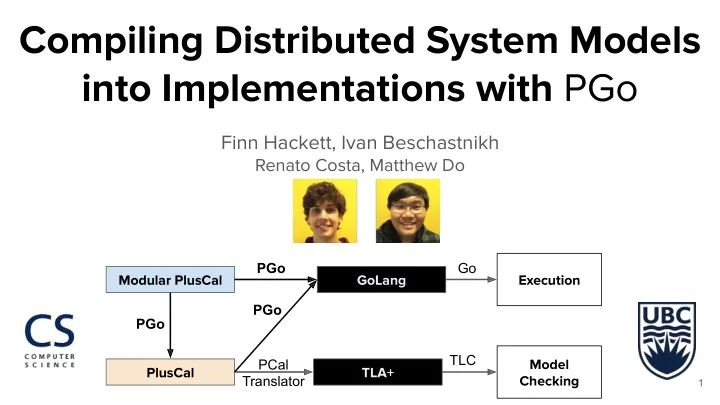
Modular PlusCal PlusCal Execution TLA+ GoLang Model Checking PGo PCal Translator PGo PGo TLC Go
Compiling Distributed System Models into Implementations with PGo - - PowerPoint PPT Presentation
Compiling Distributed System Models into Implementations with PGo Finn Hackett, Ivan Beschastnikh Renato Costa, Matthew Do PGo Go Modular PlusCal GoLang Execution PGo PGo TLC PCal Model PlusCal TLA+ Checking Translator 1 Motivation
Finn Hackett, Ivan Beschastnikh
Renato Costa, Matthew Do
1
Modular PlusCal PlusCal Execution TLA+ GoLang Model Checking PGo PCal Translator PGo PGo TLC Go
◆ Asynchronous network ◆ Crashes ◆ Network delays, partial failures...
2
◆ Asynchronous network ◆ Crashes ◆ Network delays, partial failures...
3
Service Outage Data loss Degraded Performance
4
[1] Mark Cavage. 2013. There's Just No Getting around It: You're Building a Distributed System. Queue 11, 4, Pages 30 (April 2013) [2] Fletcher Babb. Amazon’s AWS DynamoDB Experiences Outage, Affecting Netflix, Reddit, Medium, and More. en-US. Sept. 2015 [3] Shannon Vavra. Amazon outage cost S&P 500 companies $150M. axios.com, Mar 3, 2017
◆ Many of which may lack a precise definition of expected behavior
5
6
◆ Verdi [PLDI’15], IronFleet [SOSP’15] ◆ Require a lot of developer effort and expertise
◆ FlyMC [EuroSys’19], CMC [OSDI’02], MaceMC [NSDI’07], MODIST [NSDI’09] ◆ State-space explosion: many states irrelevant to high-level properties
◆ P# [FAST’16], D3S [NSDI’08], Friday [NSDI’07], Dapper [TR’10] ◆ Incomplete; requires runtime detection or extensive test harness
7
Model Specification Model Checker
trace
8
9
Initial state: both accounts have positive balance Transfer Amount between accounts Property: transfer should preserve positive balances
10
Error: our model does not check if Alice has sufficient funds!
11
12
Modular PlusCal PlusCal Execution TLA+ GoLang Model Checking PGo PCal Translator PGo PGo TLC Go
13
◆ Compatible with existing PlusCal/TLA+/TLC eco-system ◆ Mechanize the implementation = less dev work ◆ Maintain one definitive version of the system
◆ No free lunch: concrete details have to be provided somehow
◆ Software evolution: unclear how to reapply the changes to model?
14
15
16
variables network = <<>>; ... readMessage: \* blocking read from the network await Len(network[self]) > 0; msg := Head(network[self]); network := [network EXCEPT ![self] = Tail(network[self])]; readMessage: // blocking read from the network env.Lock(“network”) network := env.Get(“network”) if !(Len(network.Get(self)) > 0) { env.Unlock(“network”) goto readMessage } msg = Head(network.Get(self)) env.Set(“network”, network.Update(self, Tail(network.Get(self)))) env.Unlock(“network”)
We model a network read, but this implementation does not do that Almost all this code is for the model checker This algorithm is not abstract enough Not a blocking network read PlusCal Go
17
variables network = <<>>; ... readMessage: NetworkRead(msg, self); Network semantics become a one-liner All processes will share the same view of and access to the environment Semantics still rely
The macro body could be replaced by a real-world implementation
readMessage: msg := ReadNetwork(self)
Assumes one canonical network Go PlusCal
18
archetype AServer(ref network, ...) ... readMessage: msg := network[self]; Complex network semantics can become a variable read or write Processes are parameterised by an abstraction over the environment Any number of model checker and implementation behaviors can be defined elsewhere, since the environment is abstract
readMessage: msg := network.Read(self)
MPCal
◆ Archetypes can only interact with arguments passed to them ◆ Archetype arguments encapsulate their environment and are called resources ◆ Each resource can be mapped to an abstraction for model checking when archetypes are instantiated
19
◆ Archetypes: define API to be used to interact with the concrete system ◆ Mapping Macros: allow definition of abstractions ◆ Instances: Configures abstract environment for model checking
20
mapping macro TCPChannel{ read { await Len($variable) > 0; with (msg = Head($variable)) { $variable := Tail($variable); yield msg; }; } write { await Len($variable) < BUFFER_SIZE; yield Append($variable, $value); } }
MPCal archetype AServer(ref network, ...) ... readMessage: msg := network[self]; MPCal variables network = <<>>; process (Server = 0) == instance AServer(ref network, ...) mapping network[_] via TCPChannel MPCal MPCal
21
AServer [ client_id -> \* return address path -> \* resource requested ] to: client_id "data..." filesystem network
variables network = <<>>; process (Server = 0) variable msg; { readMessage: await Len(network[self]) > 0; msg := Head(network[self]); network := [network EXCEPT ![self] = Tail(network[self])]; sendPage: await Len(network[msg.client_id]) < BUFFER_SIZE; network := [network EXCEPT ![msg.client_id] = Append(network[msg.client_id], WEB_PAGE)]; goto readMessage; }
PlusCal
22
Abstract environment: network as sequences Abstractly represents reading a message from the network Model checking concern: only send messages if the buffer has space Model website data as a constant called WEB_PAGE
archetype AServer(ref network, file_system) variable msg; { readMessage: msg := network[self]; sendPage: network[msg.client_id] := file_system[msg.path]; goto readMessage; }
23
Archetype has access to: a network, a filesystem Interacting with the network becomes straightforward Reading from the filesystem becomes clear, unlike just passing around a WEB_PAGE placeholder MPCal
mapping macro TCPChannel{ read { await Len($variable) > 0; with (msg = Head($variable)) { $variable := Tail($variable); yield msg; }; } write { await Len($variable) < BUFFER_SIZE; yield Append($variable, $value); } }
24
MPCal Abstract blocking network read semantics Abstract buffered network write semantics What happens when a variable is read, transform the underlying value $variable and yield the result. What happens when a variable is written, apply the new $value to the underlying $variable and yield the new underlying value.
mapping macro WebPages { read { yield WEB_PAGE; } write { assert(FALSE); yield $value; } }
25
MPCal Reading modeled lossily by returning a constant Writing not modeled, so represented by failure
variables network = <<>>; process (Server = 0) == instance AServer(ref network, filesystem) mapping network[_] via TCPChannel mapping filesystem[_] via WebPages;
26
MPCal Same model checking abstractions Function-mapping syntax mapping pipe via ... ; Mappings without the [_] also exist: Server is an instance
mapping macros and parameters expanded
27
PlusCal Modular PlusCal Abstract environment; require manual edits in the generated implementation that can introduce bugs Abstractions are isolated: not included in archetypes. Behavior can be preserved if abstractions have implementations with matching semantics Protocol updates are difficult; developer needs to reapply manual changes Protocol updates can be applied any time; generated code is isolated from execution environment
model to PlusCal
correctness properties
counterexample
system model in MPCal
model to Go
concrete implementation for abstractions
main function (bootstrap)
deployed in a distributed environment
28
29
30
◆ Refinement
31
32
archetype AServer(ref network, file_system) variable msg; { readMessage: msg := network[self]; sendPage: network[msg.client_id] := file_system[msg.path]; goto readMessage; }
MPCal
archetype ALoadBalancer(ref network) variables msg, next = 0; { rcvMsg: msg := network[LoadBalancerId]; assert(msg.message_type = GET_PAGE); sendServer: next := (next % NUM_SERVERS) + 1; mailboxes[next] := [ message_id |-> next, client_id |-> msg.client_id, path |-> msg.path ]; goto rcvMsg; }
MPCal
33
variables network = <<>>; process (Server = 0) == instance AServer(ref network, filesystem) mapping network[_] via TCPChannel mapping filesystem[_] via WebPages; process (LoadBalancer = 1) == instance ALoadBalancer(ref network) mapping network[_] via TCPChannel;
TLC explores all possible interleavings between two processes (instances)
MPCal
34
archetype ALoadBalancer(ref network) variables msg, next = 0; { rcvMsg: msg := network[LoadBalancerId]; assert(msg.message_type = GET_PAGE); sendServer: next := (next % NUM_SERVERS) + 1; mailboxes[next] := [ message_id |-> next, client_id |-> msg.client_id, path |-> msg.path ]; goto rcvMsg; } MPCal archetype AServer(ref network, file_system) variable msg; { readMessage: msg := network[self]; sendPage: network[msg.client_id] := file_system[msg.path]; goto readMessage; } MPCal
Labels define atomic steps in the model (or actions) Possible behaviors
rcvMsg sendServer readMessage sendPage readMessage sendPage rcvMsg sendServer rcvMsg readMessage sendServer sendPage
Impossible behavior
sendServer rcvMsg readMessage sendPage
◆ Prohibitively expensive, especially in a distributed system context
◆ Exploit the fact that archetypes can only perform externally visible
◆ Achieve concurrency while preserving atomicity when it matters ◆ Devise an algorithm to safely execute the statements in a step
35
36
archetype AServer(ref network, file_system) variable msg; { start: print “Waiting for message”; readMessage: msg := network[self]; sendPage: network[msg.client_id] := file_system[msg.path]; goto readMessage; }
MPCal
◆ Their effects are “invisible” ◆ Equivalent to some sequential execution explored by TLC
37
◆ Let implementation dictate safety of concurrent execution ◆ If exclusive access is needed (such as in our log), locks can be used
archetype ALoadBalancer(ref network) variables msg, next = 0; { rcvMsg: msg := network[LoadBalancerId]; assert(msg.message_type = GET_PAGE); sendServer: next := (next % NUM_SERVERS) + 1; network[next] := [ message_id |-> next, client_id |-> msg.client_id, path |-> msg.path ]; goto rcvMsg; }
MPCal
archetype AServer(ref network, file_system) variable msg; { start: print “Waiting for message”; readMessage: msg := network[self]; sendPage: network[msg.client_id] := file_system[msg.path]; goto readMessage; }
MPCal
◆ Steps in an archetype may be executed concurrently with steps from
◆ Acquire all resources used in the step ◆ Execute all statements in order ◆ Release all resources at the end
38
39
s1: if (r1 > 0) { r2 := 0; }
MPCal
s2: if (r2 > 0) { r1 := 0; }
MPCal
s1 acquires r1 s2 acquires r2 s1 acquires r2 s2 acquires r1 Deadlock
◆ Acquire all resources used in the step, in consistent order ◆ Execute all statements in order ◆ Release all resources at the end
40
s1: if (r1 > 0) { r2 := 0; }
MPCal
s2: if (r2 > 0) { r1 := 0; }
MPCal
◆ One of the labels does not use any resource: equivalent to sequential execution ◆ Labels use disjoint sets of resources: equivalent to sequential execution (steps interact with different parts of the environment) ◆ Labels use overlapping sets of resources: if resources require exclusive access, they should implement that behavior when being acquired.
41
42
process (Server = 0) == instance AServer(ref network, filesystem) mapping filesystem[_] via WebPages MPCal sendPage: network[msg.client_id] := file_system[msg.path]; goto readMessage; MPCal MPCal
43
44
Main loop: only exit when the step is complete Resources not mapped as functions acquired in consistent
Execute the statements defined in the model Resource mapped as function is used in a statement If it cannot be acquired (potential deadlock), restart from scratch When all statements are executed, make environment changes externally visible
◆ If implementation matches abstraction, code generated by PGo does not need to be manually edited
45
◆ A way to “acquire” them before use (enforcing exclusive access if necessary) ◆ Interacting with the environment (reading, writing) ◆ Making environment changes visible at the end of the atomic step ◆ Aborting local interaction if step needs to be restarted
46
47
type ArchetypeResource interface { Acquire(ResourceAccess) error Read() (interface{}, error) Write(interface{}) error Release() error Abort() error Less(ArchetypeResource) error }
Go Called before the resource is read or written Only call that can make externally visible effects Discards interactions when actions need to be restarted Allow resources to be comparable (enforcing consistent order)
◆ To flag unrecoverable environment errors ◆ To request that an action be restarted (e.g., potential deadlock)
48
Environment Errors Restart Request I/O error reading or writing to a file or socket; network operation timeout Attempt to read a socket when no message is available; attempting to lock shared data that is already locked
49
50
◆ Scheduling setup ◆ Network communication ◆ Global state ◆ Others: file system, time, shared resources, etc...
51
◆ TLA+ weak fairness
52
Proposer Acceptor Learner Proposer Learner Acceptor Learner Acceptor Proposer
◆ Makes it easier to migrate PlusCal spec to Modular PlusCal
◆ Objects are owned by only one at a time, but can move over time ◆ (Many exciting future work directions hide here :-)
53
Node has value for data it owns No state kept if not owned Ownership may be outdated
54
55
56
◆ Defines interaction of a load balancer, multiple servers and multiple
◆ Serializable key-value consistency semantics ◆ Replicated state machines using Lamport logical locks to determine
◆ An assignment at UBC in Winter 2019
* as described in Implementing Fault-Tolerant Services Using the State Machine Approach: a Tutorial
57
Specification Archetypes Mapping macros MPCal LOC Load balancer 3 2 79 Replicated KV 5 6 291 Implementation PGo-gen Go LOC Manual Go LOC Total Go LOC Load balancer 494 85 579 Replicated KV 3,395 234 3,629
58
Specification Archetypes Mapping macros MPCal LOC Load balancer 3 2 79 Replicated KV 5 6 291
59
Implementation PGo-gen Go LOC Manual Go LOC Total Go LOC Load balancer 494 85 579 Replicated KV 3,395 234 3,629 PGo
◆ Load balancer: different numbers of clients/servers; files of different sizes; verified result was received by client as expected ◆ Replicated Key-Value Store: Different numbers of clients/replicas; keys and values as random bytes of configurable length; clients issue request sequentially or concurrently; at the end: all replicas are consistent. ◆ All tested student solutions had bugs when the same test suite was used!
60
61
Implementation PGo version (gen) Manual version Load balancer 579 (494) 156 Replicated KV 3,629 (3,395) 406 5-8x LOC increase
62
Load balancer with one or multiple clients performing 10 (left) or 100 (right) requests per client.
63
64
Time it takes for three clients to perform 100 operations, first sequentially (left) and then concurrently (right).
65
66
◆ Trusted: TLC model checker, PGo compiler and runtime, Java compiler and runtime, Go compiler and runtime, operating system.
◆ Limited ways to deal with failures; lack of language support
◆ Restarting actions can be expensive
◆ Go favors performance over fairness; mismatch with original model
67
68
https://github.com/ubc-nss/pgo