Contracts vs. Implementations: Where? Common Eiffel Errors: - - PowerPoint PPT Presentation

contracts vs implementations where common eiffel errors
SMART_READER_LITE
LIVE PREVIEW

Contracts vs. Implementations: Where? Common Eiffel Errors: - - PowerPoint PPT Presentation

Contracts vs. Implementations: Where? Common Eiffel Errors: Instructions for Implementations : inst 1 , inst 2 Contracts vs. Implementations Boolean expressions for Contracts: exp 1 , exp 2 , exp 3 , exp 4 , exp 5 feature -- Commands


slide-1
SLIDE 1

Common Eiffel Errors: Contracts vs. Implementations

EECS3311 A: Software Design Winter 2020 CHEN-WEI WANG

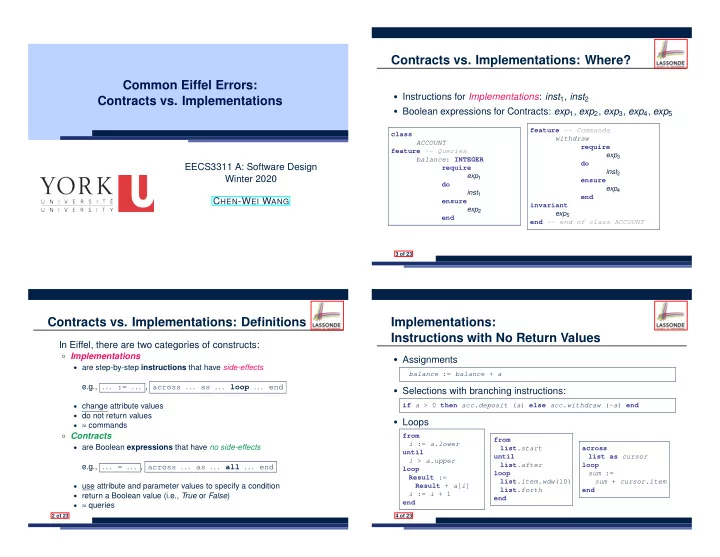
Contracts vs. Implementations: Definitions

In Eiffel, there are two categories of constructs:

○ Implementations

  • are step-by-step instructions that have side-effects

e.g., . . . := . . . , across . . . as . . . loop . . . end

  • change attribute values
  • do not return values
  • ≈ commands

○ Contracts

  • are Boolean expressions that have no side-effects

e.g., . . . = . . . , across . . . as . . . all . . . end

  • use attribute and parameter values to specify a condition
  • return a Boolean value (i.e., True or False)
  • ≈ queries

2 of 23

Contracts vs. Implementations: Where?

  • Instructions for Implementations: inst1, inst2
  • Boolean expressions for Contracts: exp1, exp2, exp3, exp4, exp5

class ACCOUNT feature -- Queries balance: INTEGER require exp1 do inst1 ensure exp2 end feature -- Commands withdraw require exp3 do inst2 ensure exp4 end invariant exp5 end -- end of class ACCOUNT

3 of 23

Implementations: Instructions with No Return Values

  • Assignments

balance := balance + a

  • Selections with branching instructions:

if a > 0 then acc.deposit (a) else acc.withdraw (-a) end

  • Loops

from i := a.lower until i > a.upper loop Result := Result + a[i] i := i + 1 end from list.start until list.after loop list.item.wdw(10) list.forth end across list as cursor loop sum := sum + cursor.item end

4 of 23

slide-2
SLIDE 2

Contracts: Expressions with Boolean Return Values

  • Relational Expressions (using =, /=, ∼, /∼, >, <, >=, <=)

a > 0

  • Binary Logical Expressions (using and, and then, or, or else,

implies)

(a.lower <= index) and (index <= a.upper)

  • Logical Quantification Expressions (using all, some)

across a.lower |..| a.upper as cursor all a [cursor.item] >= 0 end

  • old keyword can only appear in postconditions (i.e., ensure).

balance = old balance + a

5 of 23

Contracts: Common Mistake (1)

class ACCOUNT feature withdraw (a: INTEGER) do . . . ensure balance := old balance - a end . . .

Colon-Equal sign (:=) is used to write assignment instructions.

6 of 23

Contracts: Common Mistake (1) Fixed

class ACCOUNT feature withdraw (a: INTEGER) do . . . ensure balance = old balance - a end . . .

7 of 23

Contracts: Common Mistake (2)

class ACCOUNT feature withdraw (a: INTEGER) do . . . ensure across a as cursor loop . . . end . . .

across...loop...end is used to create loop instructions.

8 of 23

slide-3
SLIDE 3

Contracts: Common Mistake (2) Fixed

class ACCOUNT feature withdraw (a: INTEGER) do . . . ensure across a as cursor all -- if you meant ∀, or use some if you meant ∃ . . . -- A Boolean expression is expected here! end . . .

9 of 23

Contracts: Common Mistake (3)

class ACCOUNT feature withdraw (a: INTEGER) do . . . ensure

  • ld balance - a

end . . .

Contracts can only be specified as Boolean expressions.

10 of 23

Contracts: Common Mistake (3) Fixed

class ACCOUNT feature withdraw (a: INTEGER) do . . . ensure postcond_1: balance = old balance - a postcond_2: old balance > 0 end . . .

11 of 23

Contracts: Common Mistake (4)

class ACCOUNT feature withdraw (a: INTEGER) require

  • ld balance > 0

do . . . ensure . . . end . . .

  • Only postconditions may use the old keyword to specify the

relationship between pre-state values (before the execution of withdraw) and post-state values (after the execution of withdraw).

  • Pre-state values (right before the feature is executed) are

indeed the old values, so there’s no need to qualify them!

12 of 23

slide-4
SLIDE 4

Contracts: Common Mistake (4) Fixed

class ACCOUNT feature withdraw (a: INTEGER) require balance > 0 do . . . ensure . . . end . . .

13 of 23

Contracts: Common Mistake (5)

class LINEAR_CONTAINER create make feature -- Attributes a: ARRAY[STRING] feature -- Queries count: INTEGER do Result := a.count end get (i: INTEGER): STRING do Result := a[i] end feature -- Commands make do create a.make_empty end update (i: INTEGER; v: STRING) do . . . ensure -- Others Unchanged across 1 |..| count as j all j.item /= i implies old get(j.item) ∼ get(j.item) end end end

Compilation Error:

○ Expression value to be cached before executing update? [ Current.get(j.item) ] ○ But, in the pre-state, integer cursor j does not exist!

14 of 23

Contracts: Common Mistake (5) Fixed

class LINEAR_CONTAINER create make feature -- Attributes a: ARRAY[STRING] feature -- Queries count: INTEGER do Result := a.count end get (i: INTEGER): STRING do Result := a[i] end feature -- Commands make do create a.make_empty end update (i: INTEGER; v: STRING) do . . . ensure -- Others Unchanged across 1 |..| count as j all j.item /= i implies (old Current).get(j.item) ∼ get(j.item) end end end

○ The idea is that the old expression should not involve the local cursor variable j that is introduced in the postcondition. ○ Whether to put (old Current.twin) or (old Current.deep twin) is up to your need.

15 of 23

Implementations: Common Mistake (1)

class ACCOUNT feature withdraw (a: INTEGER) do balance = balance + 1 end . . .

  • Equal sign (=) is used to write Boolean expressions.
  • In the context of implementations, Boolean expression values

must appear:

○ on the RHS of an assignment; ○ as one of the branching conditions of an if-then-else statement; or ○ as the exit condition of a loop instruction.

16 of 23

slide-5
SLIDE 5

Implementations: Common Mistake (1) Fixed

class ACCOUNT feature withdraw (a: INTEGER) do balance := balance + 1 end . . .

17 of 23

Implementations: Common Mistake (2)

class BANK feature min_credit: REAL accounts: LIST[ACCOUNT] no_warning_accounts: BOOLEAN do across accounts as cursor all cursor.item.balance > min_credit end end . . .

Again, in implementations, Boolean expressions cannot appear alone without their values being “captured”.

18 of 23

Implementations: Common Mistake (2) Fixed

1 class 2 BANK 3 feature 4 min_credit: REAL 5 accounts: LIST[ACCOUNT] 6 7 no_warning_accounts: BOOLEAN 8 do 9 Result := 10 across 11 accounts as cursor 12 all 13 cursor.item.balance > min_credit 14 end 15 end 16 . . .

Rewrite L10 – L14 using across ... as ... some ... end. Hint: ∀x ● P(x) ≡ ¬(∃x ● ¬P(x))

19 of 23

Implementations: Common Mistake (3)

class BANK feature accounts: LIST[ACCOUNT] total_balance: REAL do Result := across accounts as cursor loop Result := Result + cursor.item.balance end . . . end . . .

In implementations, since instructions do not return values, they cannot be used on the RHS of assignments.

20 of 23

slide-6
SLIDE 6

Implementations: Common Mistake (3) Fixed

class BANK feature accounts: LIST[ACCOUNT] total_balance: REAL do across accounts as cursor loop Result := Result + cursor.item.balance end end

21 of 23

Index (1)

Contracts vs. Implementations: Definitions Contracts vs. Implementations: Where? Implementations: Instructions with No Return Values Contracts: Expressions with Boolean Return Values Contracts: Common Mistake (1) Contracts: Common Mistake (1) Fixed Contracts: Common Mistake (2) Contracts: Common Mistake (2) Fixed Contracts: Common Mistake (3) Contracts: Common Mistake (3) Fixed Contracts: Common Mistake (4) Contracts: Common Mistake (4) Fixed Contracts: Common Mistake (5)

22 of 23

Index (2)

Contracts: Common Mistake (5) Fixed Implementations: Common Mistake (1) Implementations: Common Mistake (1) Fixed Implementations: Common Mistake (2) Implementations: Common Mistake (2) Fixed Implementations: Common Mistake (3) Implementations: Common Mistake (3) Fixed

23 of 23