SLIDE 1
- Dr. Ben Luce
- Asst. Prof. of Physics, Lyndon State College
ben.luce@lyndonstate.edu
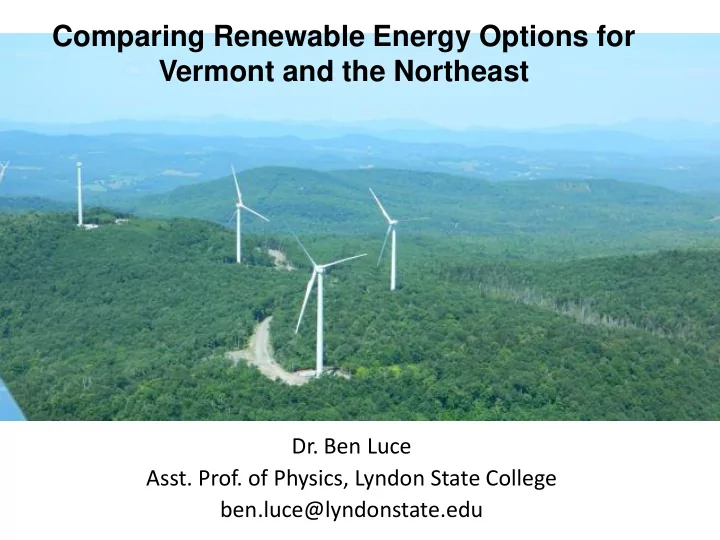
Comparing Renewable Energy Options for Vermont and the Northeast
SLIDE 3 2
New Mexico – The Heart of the Sunny Southwest
SLIDE 8 7
Carbon Dioxide Concentration
SLIDE 9
SLIDE 10 9
New Mexico Coalition For Clean Affordable Energy
SLIDE 11 10
New Mexico Coalition For Clean Affordable Energy
SLIDE 12 11
2004 - Governor Richardson signs the NM Renewable Energy Standard
SLIDE 13 12
2006 - Governor Richardson signs the NM Solar Tax Credit
SLIDE 14 New Mexico Clean Energy Legislation
- State Tax Incentives for Wind
- Renewable Energy Standard
- Solar Tax Credit
- Enhanced Solar Rights
- State Tax Incentives for Concentrating Solar
- Expanded Net-metering
- Feed-in Incentives for PV (RECS buyback
program)
13
SLIDE 16 Why Compare Renewable Energy Options?
- There are vast differences between resources and
technologies in terms of:
– Resource potentials – Costs – Impacts to people and the environment
- Money and political will for RE are in meager
supply in the US in general:
– Prioritizing the wrong renewable energy sources is potentially disastrous for efforts to mitigate climate change.
15
SLIDE 17 Comparing Wind Power and Solar Power Resources
- Use NREL data
- Look Nationally, Eastern US, and Regionally
16
SLIDE 18 Wind Energy Physics 101
- Wind power potential is proportional to the cube of the wind speed:
- Power/Area = Kinetic energy density (
1 2r v2) x wind speed (v)
- Therefore: 2x Speed means 8x Power
- Good Wind Sites Need Very High Average Wind Speeds
SLIDE 20 NREL Solar Resource Estimates: http://www.nrel.gov/docs/fy12osti/51946.pdf
19
SLIDE 21 Western US
26 1 2 3 4 5 6 7 8 9 10 . 15 25 29 27 30 31 33 34 35
20
Relative Ranking of State Wind Resources
Source: www.windpoweringamerica.gov (see previous slide)
Texas Kansas Montana Nebraska South Dakota North Dakota Iowa Wyoming Oklahoma New Mexico New York Maine Pennsylvania Vermont New Hampshire West Virginia Virginia Maryland Massachusetts Capacity Ranking State 1901 952 944 918 818 770 570 552 517 492 11 3 3 2 2 2 1 1
Eastern US
SLIDE 22 Iowa vs. New Hampshire
21
SLIDE 23 Onshore Eastern Wind Resources
- As estimated by DOE, the wind potential of the best
Eastern US states, in peak gigawatts (GW):
– New York: 26 GW – Maine : 11 GW – Pennsylvania: 3 GW – Vermont: 3 GW – New Hampshire: 2 GW – Virginia: 2 GW – West Virginia: 2 GW – Maryland: 1 GW – MA: 1 GW
SLIDE 24 Effective Onshore Wind Power Capacity
- f the Entire Eastern US
- Assume all 52 gigawatts are realized
- Effective Wind Capacity: .3*51 GW = 15.3 GW
- Current average US consumption ≈ 470 GW
- Potential average onshore Eastern wind
penetration into current US load: (15.3 GW/470 GW) x 100% ≈ 3%
- Percentage of Eastern Demand ≈ 7%
- Real Potential is likely closer to 1%
23
SLIDE 25
These NREL estimates must be considered as gross upper bounds on the real onshore wind potential in the East:
Myriad local siting and cost issues were not included: The real implications of achieving these levels of wind require extensive site-specific study. (NREL should have, but failed, to point this out clearly). Actual real potential in the Northeast: ~2 gigawatts? ~ 5 gigawatts? ~ 10 gigawatts?
SLIDE 26 Future NE Wind Targets
- Most discussions of future wind in the NE
have not exceeded about 5 GW:
– About 80 Lowell wind projects
25
SLIDE 27 “Capacity Factor” of a Generation Source
26
- “Good Wind Sites”: CF > .33
- Actual for Northeast Wind: CF < .25?
- Wind power in the Northeast likely has real capacity factors
well below those projected by developers to date.
- Photovoltaics: CF ~ .14
- Other Considerations:
- Correlation with Seasonal Demand Curve
- Correlation with Daily Demand Curve
- Solar has a lower capacity factor than wind, but is much better
correlated with both the daily and seasonal demand curves.
𝐃𝐛𝐪𝐛𝐝𝐣𝐮𝐳 𝐆𝐛𝐝𝐮𝐩𝐬 = 𝐁𝐝𝐮𝐯𝐛𝐦 𝐁𝐨𝐨𝐯𝐛𝐦 𝐅𝐨𝐟𝐬𝐡𝐳 𝐐𝐬𝐩𝐞𝐯𝐝𝐟𝐞 𝐅𝐨𝐟𝐬𝐡𝐳 𝐐𝐬𝐩𝐞𝐯𝐝𝐟𝐞 𝐯𝐨𝐞𝐟𝐬 𝟑𝟓 𝟖 𝐐𝐟𝐛𝐥 𝐏𝐪𝐟𝐬𝐛𝐮𝐣𝐩𝐨
SLIDE 28 Fraction of Demand Displaced With 5 Gigawatts of Wind?
27
Data Source: Energy Information Administration, “Today in Energy”, July 12, 2012: http://www.eia.gov/todayinenergy/detail.cfm?id=7070 28,000 MW (peak)
- NREL Data assumes CF ~ .3
- 5 gigawatts x .3= 1.5 gigawatts
- Less than 3% of current peak demand
- Less than 6% of average demand
40,000 MW (peak)
SLIDE 29 Conclusions for Ridgeline Wind Power Resources in the Northeast
- Ridgeline wind power cannot even approach
being a significant energy source in the Northeast unless the resource is developed to an extreme extent, that is, using most of the high ridges in the region.
- Even with extreme development, its
contribution will be modest at best.
28
SLIDE 30
The Solar Resource in the Northeast (NREL Solar Insolation for Central VT)
kWh/day
SLIDE 31 Scale and Flexibility of Solar Resources
- The usable solar resource is extremely large,
partially because the raw resource exists everywhere, and partially because the technology is completely scalable.
30
SLIDE 32 31
1-10 kw Rooftop Scale
SLIDE 33
1-10 kw Backyard Scale
SLIDE 34
10 kw – MW Scale
SLIDE 35
Multi-Megawatt Scale
SLIDE 36 Onshore Eastern Rooftop Solar Resources
– Alabama 13 GW – Connecticut 6 GW – Delaware 2 GW –
2 GW – Florida 49 GW – Georgia 25 GW – Kentucky 11 GW – Louisiana 12 GW – Maine 2 GW – Maryland 13 GW – Massachusetts 10 GW – Missouri 13 GW – New Hampshire: 2 GW – New Jersey 14 GW – New York 25 GW – North Carolina 23 GW – Ohio 27 GW – Pennsylvania 20 GW – Rhode Island 2 GW – South Carolina 12 GW – Tennessee 16 GW – Vermont 1 GW – Virginia 19 GW – West Virginia 4 GW
Even just rooftop solar potential greatly exceeds
- nshore wind potential in the
Eastern US. Onshore wind in the Southeast is also completely negligible.
SLIDE 37 Onshore Eastern Urban Utility-Scale Solar Resources
– Alabama 20 GW – Connecticut 5 GW – Delaware 9 GW –
0 GW – Florida 40 GW – Georgia 24 GW – Kentucky 16 GW – Louisiana 32 GW – Maine 2 GW – Maryland 18 GW – Massachusetts 11 GW – Missouri 18 GW – New Hampshire: 2 GW – New Jersey 25 GW – New York 33 GW – North Carolina 38 GW – Ohio 57 GW – Pennsylvania 36 GW – Rhode Island 1 GW – South Carolina 19 GW – Tennessee 29 GW – Vermont 1 GW – Virginia 16 GW – West Virginia 2 GW
SLIDE 38 Onshore Eastern Rural Utility-Scale Solar Resources
– Alabama 2115 GW – Connecticut 12 GW – Delaware 167 GW –
0 GW – Florida 2813 GW – Georgia 3088 GW – Kentucky 1119 GW – Louisiana 2394 GW – Maine 659 GW – Maryland 373 GW – Massachusetts 52 GW – Missouri 3157 GW – New Hampshire: 36 GW – New Jersey 251 GW – New York 926 GW – North Carolina 2347 GW – Ohio 2396 – Pennsylvania 357 GW – Rhode Island 9 GW – South Carolina 1555 GW – Tennessee 1267 GW – Vermont 35 GW – Virginia 19 GW – West Virginia 4 GW
Solar as a whole utterly dwarfs wind potential in the Eastern US.
SLIDE 39 Northeast Solar Resources: Rooftop + Urban + Rural
– Maine 2 + 2 + 659 GW – Massachusetts 10 + 11 + 52 GW – New Hampshire: 2 + 2 + 36 GW – New Jersey 14 + 25 + 251 GW – New York 25+ 33 + 926 GW – Pennsylvania 20+ 36 + 357 GW – Rhode Island 2+ 1 + 9 GW – Vermont 1+ 1 + 35 GW
- Total: 2512 GW
- Even at a 10% capacity factor, this is equivalent to
more than 250 GW of conventional capacity.
Solar utterly dwarfs wind potential in the NE as well. Even just rooftop solar potential in the NE (76 GW) significantly exceeds the likely onshore wind potential in the NE.
SLIDE 40
The Economics of Wind and Solar
SLIDE 41 Cost Trend of Wind Power (Nationally)
40
SLIDE 42 Solar Power Cost Trend
- Department of Energy’s Solar Technologies Market
Report
- http://www.nrel.gov/docs/fy12osti/51847.pdf
41
Decrease since report’s release
SLIDE 43 Data Source: EIA, Levelized Cost of New Generation Resources in the Annual Energy Outlook 2013 (as quoted on AWEA’s website)
42
Ridgeline wind? (my addition, based
- n the limited amount of publicly
available price info on actual NE projects, with REC prices included)
SLIDE 44 Additional Transmission Costs for Eastern Wind Power
- The Northeast Grid is already fairly congested
- According to Gordon van Welie, president and
chief executive officer of ISO New England Inc: “A conservative goal for 5,500 megawatts of wind power and 3,000 megawatts of hydro power through 2030 would carry transmission costs of between $7 billion and $12 billion.”
– From: “New England grid chief: Cooperate on wind power”, by David Sharp, Associated Press Writer, August 16, 2010.
- 4000+ miles of new transmission lines
43
SLIDE 45 Summary of Wind vs. Solar Cost
- Costs of solar and ridgeline wind are now
roughly in the same ballpark, assuming transmission costs for wind are minimal.
- If transmission costs for a large build-out of
wind are included, its difficult to see how wind could be competitive with solar.
- Solar technology is potentially much more
susceptible to price reduction through innovation and manufacturing scale up.
44
SLIDE 46 Impact Summary
- Topographical Impacts
- Hydrological Impacts
- Habitat Fragmentation & Loss
- Impacts to birds and bats
- Noise Impacts
- Aesthetic Impacts:
– Ecotourism, etc – Environmental valuing of the region
- Impacts to the Social Fabric of local communities
- Implications for the effectiveness of and public
support for renewable energy investments
45
SLIDE 47 Overall Conclusions
- There is no justification from either a resource
- r economic point of view to install ridgeline
wind projects for the sake of mitigating climate change.
- Continued large investment in ridgeline wind
in the Northeast will likely cripple the near- term investment in, and long-term success, of much more viable solutions.
46
SLIDE 48
Forest Biomass
Impact Resource Potential
PV Ridgeline Wind Power Microhydro Farm Cellulosic Biomass Anaerobic Digesters Sweet zone AD has special benefits Ground Source Heat Pumps Air Source Heat Pumps Solar Hot Water New Big Hydro Midwest Wind Power Concentrating Solar Power