
SLIDE 1
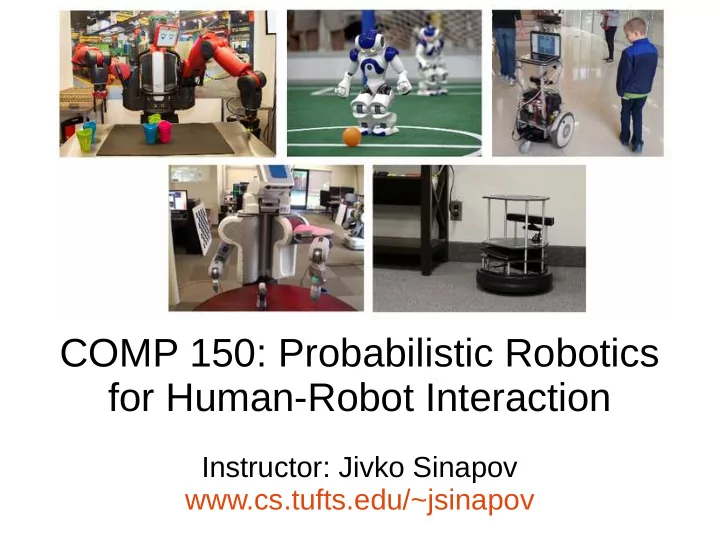
COMP 150: Probabilistic Robotics for Human-Robot Interaction - - PowerPoint PPT Presentation
COMP 150: Probabilistic Robotics for Human-Robot Interaction Instructor: Jivko Sinapov www.cs.tufts.edu/~jsinapov Today: Perception beyond Vision Announcements Project Deadlines Project Presentations: Tuesday May 5 th 3:30- 6:30 pm
– Presentation slides + videos – Final Report (PDF) – Source code (link to github repositories + README)
Sinapov, J., Schenck, C., Staley, K., Sukhoy, V., and Stoytchev, A. (2014) Grounding Semantic Categories in Behavioral Interactions: Experiments with 100 Objects Robotics and Autonomous Systems, Vol. 62, No. 5, pp. 632-645, May 2014.
grasp lift hold shake drop tap poke push press
… … … … … …
Action: poke Perception: optical flow
look grasp lift hold shake audio (DFT) haptics (joint torques) Color drop tap poke push press Optical flow SURF proprioception (finger pos.)
Category Recognition Model
Observation from poke-audio context
Recognition model for poke-audio context Distribution over category labels
Audio Proprioception Color Optical Flow SURF All look 58.8 58.9 67.7 grasp 45.7 38.7 12.2 57.1 65.2 lift 48.1 63.7 5.0 65.9 79.0 hold 30.2 43.9 5.0 58.1 67.0 shake 49.3 57.7 32.8 75.6 76.8 drop 47.9 34.9 17.2 57.9 71.0 tap 63.3 50.7 26.0 77.3 82.4 push 72.8 69.6 26.4 76.8 88.8 poke 65.9 63.9 17.8 74.7 85.4 press 62.7 69.7 32.4 69.7 77.4
Weighted Combination
Tatiya, G., and Sinapov, J. (2019) Deep Multi-Sensory Object Category Recognition Using Interactive Behavioral Exploration 2019 IEEE International Conference on Robotics and Automation (ICRA), Montreal, Canada, May 20-24, 2019.
Haptics
Sinapov, J., Schenck, C., and Stoytchev, A. (2014). Learning Relational Object Categories Using Behavioral Exploration and Multimodal Perception In the Proceedings of the 2014 IEEE International Conference on Robotics and Automation (ICRA)
Thomason, J., Sinapov, J., Stone, P., and Mooney, R. (2018) Guiding Exploratory Behaviors for Multi-Modal Grounding of Linguistic Descriptions In proceedings of the 32nd Conference of the Association for the Advancement of Artificial Intelligence (AAAI)
Robot, fetch me the green empty bottle
Thomason, J., Padmakumar, A., Sinapov, J., Walker, N., Jiang, Y., Yedidsion, H., Hart, J., Stone,
Jointly improving parsing and perception for natural language commands through human-robot dialog Journal of Artificial Intelligence Research 67 (2020)
[https://people.csail.mit.edu/bzhou/image/cover_places2.png]