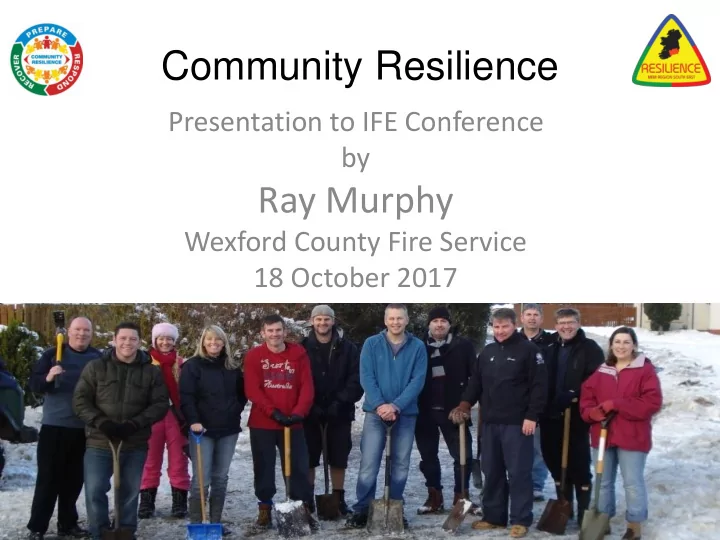
Community Resilience Presentation to IFE Conference by Ray Murphy - - PowerPoint PPT Presentation

community resilience
SMART_READER_LITE
LIVE PREVIEW

Community Resilience Presentation to IFE Conference by Ray Murphy - - PowerPoint PPT Presentation

Community Resilience Presentation to IFE Conference by Ray Murphy Wexford County Fire Service 18 October 2017 Aim & Objectives Aim That communities are as prepared as possible to deal with the consequences of any national or local


slide-1
SLIDE 1

Community Resilience

Presentation to IFE Conference by

Ray Murphy

Wexford County Fire Service 18 October 2017

slide-2
SLIDE 2

Aim & Objectives

Aim

“That communities are as prepared as possible to deal with the consequences of any national or local emergency…..”

Objectives

“That our communities are.....” Safer Stronger Greener Healthier Wealthier Smarter.

slide-3
SLIDE 3

What is community resilience?

  • Communities and individuals harnessing local resources

and expertise to help themselves prepare for, respond to and recover from emergencies, in a way that complements the work of the emergency responders.

  • Community resilience is about communities and individuals using

their collective resources and skills to help themselves prepare for, respond to and recover from emergencies. Readyscotland.org

  • Community Resilience is about communities using local resources and knowledge to help

themselves during an emergency in a way that complements the local emergency services (UK Cabinet Office). cabinetoffice.gov.uk/content/community-resilience.

slide-4
SLIDE 4

What’s a Community?

  • Geographical communities
  • Communities of:

– Circumstance – Interest – Practitioners

  • Faith, councillors, schools, Health professionals, engineering professionals
  • Geographic most relevant - but potential to work with

voluntary groups, business sector and wider “networks”.

  • Health Services, Food & Water, Transport, Utilities and

Financial Services

  • Local Regional & National.
slide-5
SLIDE 5
slide-6
SLIDE 6
slide-7
SLIDE 7

Circular Letter EM 1/11

  • Timely Public Communication
  • Winter Ready Week
  • Community Resilience
  • LA’s to identify a person within CVF
  • Grit drop points and farming community
  • Civil Defence and other VES.
slide-8
SLIDE 8

UK Community Engagement Framework

  • Informing
  • Consulting
  • Involving
  • Collaborating
  • Empowering

– Ensuring clarity of purpose – Working together – Being open and honest – Being flexible – Ensure that resources are well targeted – Treating participants with respect and feedback is provided – Ensuring that processes are reviewed

slide-9
SLIDE 9

US Resilience

slide-10
SLIDE 10

FEMA Shared Responsibility

  • Preparedness is a shared responsibility
  • It calls for the involvement of everyone - not just the government - in

preparedness efforts. By working together, safe from harm and resilient when struck by hazards, such as natural disasters, terrorism & pandemics.

  • Whole Community includes:
  • Individuals and families, including those with access and functional needs
  • Businesses
  • Faith-based and community organizations, Nonprofit groups
  • Schools, academia & Media outlets
  • All levels of government, including state, local, tribal, territorial, and federal
  • The phrase “whole community” is a guiding principle - means two things:

– Involving people in the development of the national preparedness documents. – Ensuring their roles and responsibilities are reflected in the content of the materials

slide-11
SLIDE 11

FEMA - Ready America

  • Prepare, Plan, Stay Informed
  • Citizen Corps is FEMA's grassroots strategy to bring together

government and community leaders to involve citizens in all-hazards emergency preparedness

  • Community Emergency Response Teams
slide-12
SLIDE 12

Emergency Management Australia

  • The National Emergency Volunteer Support Fund
  • Australian Safer Communities Awards
  • Courses, Workshops, Schools Programme
  • These programs are offered in each State and Territory

three times a year

  • EMA Schools website
  • Emergency Management Journals
slide-13
SLIDE 13

Community Engagement Framework

(Attorney-General’s Department, Australia)

slide-14
SLIDE 14

Good Practise Examples

  • Kerry
  • The goal – In an emergency, community communication channels in place
  • Created a Community Register, Set up a Steering Group & workshops to develop

contacts and structures and promote Community resilience.

  • Laois
  • Co-ordinated with local community leaders, shops, offices, councillors etc.
  • Partitioned the county for each section to approach.
  • Got local contact details & Follow up to ensure buy-in.
  • Westmeath - Last mile project

– Approached IFA - AGM – Presented the problem – Requested Farmers in all towns land Areas to give in phone numbers – Farmers to be available to bring an ambulance/ home help/ meals on wheels the last mile to someone's home

  • Any Community Activity

– local community groups, street party, litter cleanups, talks, shows, book clubs etc.

slide-15
SLIDE 15
slide-16
SLIDE 16
slide-17
SLIDE 17

Civil Defence

slide-18
SLIDE 18
slide-19
SLIDE 19
slide-20
SLIDE 20
slide-21
SLIDE 21
slide-22
SLIDE 22
slide-23
SLIDE 23

An Emergency Planning Approach

  • Develop the tools needed deliver resilience

– The household

  • website, guides

– The community

  • Engagement - PPN
  • Community Groups, Schools, GAA, The business Sector
  • Access to community leaders
  • Develop a communications network
  • Develop further options for delivery.
slide-24
SLIDE 24
slide-25
SLIDE 25
slide-26
SLIDE 26
slide-27
SLIDE 27
slide-28
SLIDE 28

Delivery

  • County Councils’ PPN

– A network of community and voluntary, environmental, and social inclusion organisations in each county. – Quarterly meetings centrally, Annual meetings locally

  • An Garda Siochána Community Policing Units

– Community Policing – Neighbourhood watch – Community Alert – Safer Communities Campaign

  • "defensive planting” plants as barriers to deter thieves.
  • HSE Community Care Nurses

– Access to vulnerable members of the community – Knowledge of vulnerability, age, location, condition.

slide-29
SLIDE 29

Delivery

  • Community Groups

– Talks – Community activities – Smoke Alarm Project

  • VES

– local knowledge – Local action – Local resources – Need to be coordinated

  • CE schemes, Enniscorthy community services council, Care for the elderly,

Age action, meals on wheels, etc.

slide-30
SLIDE 30

The Delivery Package

  • Map the community – contacts, resources

– Identify vulnerabilities, Hazards, Risks – Put plans in place to deal with the risks

  • Action cards and Guidance under the four Hazard

Categories, Natural, Transport, Technological, Civil

  • Existing Guidance Includes;

– Guidance on Preparing for emergencies – Community Guide to major emergencies – Keep Well and warm, fire safety in the home etc. – Be winter ready, Safety on the water, A guide to reoccupying Flooded Homes etc. etc.

slide-31
SLIDE 31

Community Groups & PRA’s

  • Key to improving resilience

– Set up community groups – Register with PPN – Register with Text Alert scheme – Get Insurance – Remain active

  • PRA’s

– Engage with Community groups on Resilience – Offer safety talks

  • Smoke Alarm Project, Text Alert Scheme, HSE Community Care
  • Ideal for leaflets, Be Winter Ready Campaign etc.
slide-32
SLIDE 32

Delivery

  • PPN Presentation – Link to community groups
  • Presentation to community group
  • Link up with AGS community alert scheme/presentations
  • Community group to highlight hazards
  • Map of area
  • Group to assemble names and numbers
  • PRA to assist in map development
  • Smoke alarm project
  • Lessons learnt from one group to the next
  • Follow up
slide-33
SLIDE 33

Delivery

  • Barntown Community Area
  • Piercestown Community Group
  • Enniscorthy VES
  • New Ross community housing scheme
  • White Mountain Community Group
  • Crossabeg Community Group
slide-34
SLIDE 34

Myth Busting

slide-35
SLIDE 35

Conclusion

  • Need a “0ne-stop-shop” for all community resilience

activity – joining the dots together

  • We’ve developed guidance and tools, helped develop

and highlighted some good practice and helped people share their experiences.

  • Work in progress - where next?

– Rolling out the use of tools and guidance across the county/region – Can the private sector contribute more? – Working with poorer urban communities – Communicating about risk in plain English

  • Funding and support of Voluntary Groups
slide-36
SLIDE 36

Conclusion

  • Winter Ready

– List of actions – involve the community`- to be further developed

  • Emphasized the need for strong links between the

community and the voluntary groups

  • This will require engagement and leadership from the

community

  • Development of a “Ready-Ireland” website with related

links and other media strands (twitter, facebook, an App etc.) is required. Broadly advertised.

slide-37
SLIDE 37

Moving Forward

  • Improve understanding of risk
  • Increase awareness of importance to act
  • Facilitate liaison & development
  • Support new ideas & approaches – pilots
  • Provide Guidance, advice & support “Myth

busting”

  • Provide funding and resource
  • Encourage behaviour change
slide-38
SLIDE 38

Thank You

Ray Murphy

Wexford County Fire Service 18 October 2017