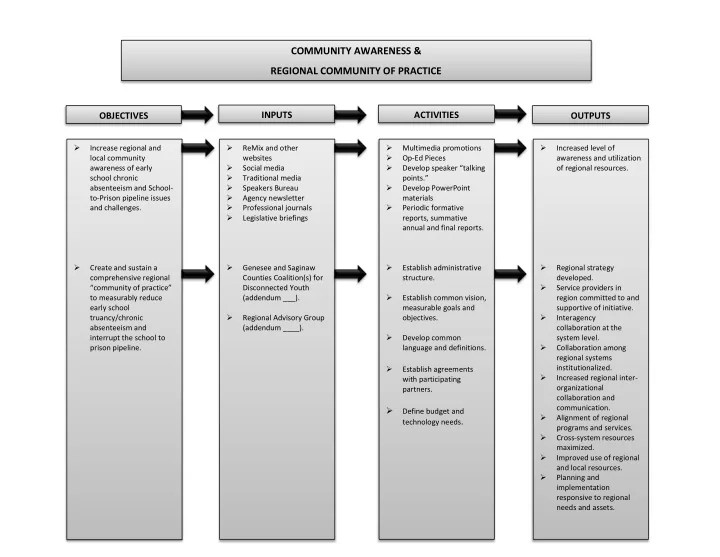

SLIDE 1
OBJECTIVES INPUTS
- Increase regional and
local community awareness of early school chronic absenteeism and School- to-Prison pipeline issues and challenges.
- Create and sustain a
comprehensive regional “community of practice” to measurably reduce early school truancy/chronic absenteeism and interrupt the school to prison pipeline.
OUTPUTS ACTIVITIES
- Increased level of
awareness and utilization
- f regional resources.
- Regional strategy
developed.
- Service providers in
region committed to and supportive of initiative.
- Interagency
collaboration at the system level.
- Collaboration among
regional systems institutionalized.
- Increased regional inter-
- rganizational
collaboration and communication.
- Alignment of regional
programs and services.
- Cross-system resources
maximized.
- Improved use of regional
and local resources.
- Planning and
implementation responsive to regional needs and assets.
- Multimedia promotions
- Op-Ed Pieces
- Develop speaker “talking
points.”
- Develop PowerPoint
materials
- Periodic formative
reports, summative annual and final reports.
- Establish administrative
structure.
- Establish common vision,
measurable goals and
- bjectives.
- Develop common
language and definitions.
- Establish agreements
with participating partners.
- Define budget and
technology needs.
- ReMix and other
websites
- Social media
- Traditional media
- Speakers Bureau
- Agency newsletter
- Professional journals
- Legislative briefings
- Genesee and Saginaw
Counties Coalition(s) for Disconnected Youth (addendum ___).
- Regional Advisory Group