Commonwealth North Presentation Thursday, March 21, 12:00 1:00 p.m. - - PowerPoint PPT Presentation

commonwealth north presentation
SMART_READER_LITE
LIVE PREVIEW

Commonwealth North Presentation Thursday, March 21, 12:00 1:00 p.m. - - PowerPoint PPT Presentation

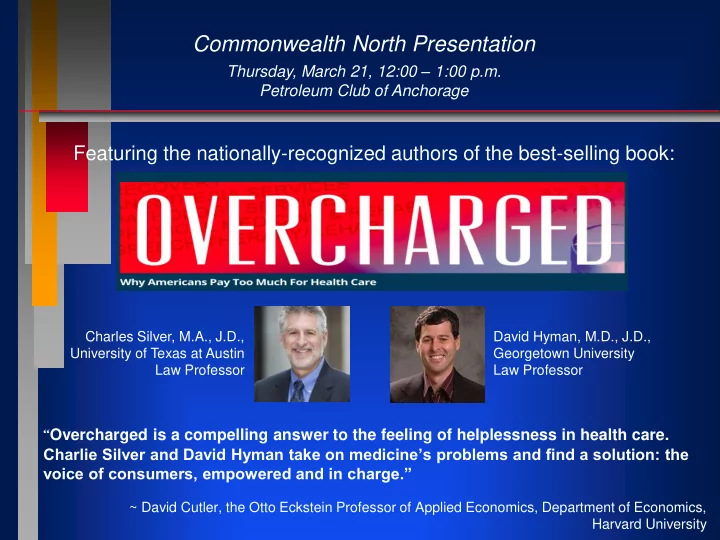
Commonwealth North Presentation Thursday, March 21, 12:00 1:00 p.m. Petroleum Club of Anchorage Featuring the nationally-recognized authors of the best-selling book: Charles Silver, M.A., J.D., David Hyman, M.D., J.D., University of Texas


slide-1
SLIDE 1

David Hyman, M.D., J.D., Georgetown University Law Professor

Featuring the nationally-recognized authors of the best-selling book:

Charles Silver, M.A., J.D., University of Texas at Austin Law Professor

Commonwealth North Presentation

Thursday, March 21, 12:00 – 1:00 p.m. Petroleum Club of Anchorage “Overcharged is a compelling answer to the feeling of helplessness in health care. Charlie Silver and David Hyman take on medicine’s problems and find a solution: the voice of consumers, empowered and in charge.”

~ David Cutler, the Otto Eckstein Professor of Applied Economics, Department of Economics, Harvard University

slide-2
SLIDE 2
slide-3
SLIDE 3

3

slide-4
SLIDE 4

4

slide-5
SLIDE 5

5

slide-6
SLIDE 6

6

slide-7
SLIDE 7

7

slide-8
SLIDE 8

Everyone Knows Martin Shkreli

  • Raised the price of Daraprim from $13.50 per pill to $750.
  • Became the face of pharma greed.
  • Convicted of securities fraud.

8

slide-9
SLIDE 9

Pharma Games: Shkreli Played An Established Game

Generics

  • Colchicine (9¢ to $4.85)
  • Tetracycline (5¢ to $11)
  • Clomipramine (22¢ to $8.17)
  • Captopril (price rose by > 2,700%)
  • Albuterol Sulfate (price rose by > 3,400%))
  • Doxycycline (price rose by 6,300%)

Branded

  • Harvoni
  • Oncology Drugs
  • Per OIG (2018): “Total reimbursement for all brand-

name drugs in Part D increased 77 percent from 2011 to 2015, despite a 17-percent decrease in the number

  • f prescriptions for these drugs.”

Biologics

  • Insulin

9

slide-10
SLIDE 10

10

slide-11
SLIDE 11

A Few of The Problems With Our Health Care System

“Open-ended reimbursement for patented pharmaceuticals, regardless of price. Excessive use of medical treatments. Providers’ conflicts of interest. The routine delivery of ineffective and unproven

  • treatments. Games that providers play to

maximize their revenues. Charges that bear no relation to costs. Surprise bills and other

  • ut-of-network rip-offs. Widespread quality

problems tied to dysfunctional business

  • models. Political corruption. And an ocean
  • f fraud.”

11

slide-12
SLIDE 12

Fraud, Waste & Abuse: How Much Is There?

Improper payments by HHS – 8.6% GAO (2017), https://www.gao.gov/assets/690/688748.p df. Standard estimate for fraud & abuse: 10%

  • Hyman (2002)

All F, W & A: 30% IOM (2012, using 2009 data) All F, W & A: 34% Berwick & Hackbarth, JAMA (2012, using 2011 data).

12

slide-13
SLIDE 13

Meet Dr. Jacques Roy

Primary Care - Tx $375M home health care fraud:

  • Certified 11,000 patients

for home health care over six years; 5,000 in a single year.

  • Suspended in 2011, but

continued certifying and billing.

  • Finally convicted in 2016.

https://www.dallasnews.com/news/crime/2017/ 08/09/doctor-maimed-patients-bilked- taxpayers-record-370-million-gets-35-years- prison 13

slide-14
SLIDE 14

Treating Wet Macular Degeneration: Avastin (Off Label) or Lucentis?

$60/dose $2,300/dose Copayment - 20% of drug cost. Reimbursement to dispensing physician: 6% of drug cost ($3.60 versus $138) -- now 4.3%)

14

slide-15
SLIDE 15
  • Dr. Salomon E. Melgen

Paid $135M by Medicare

  • Quadruple-billed for Lucentis
  • Unnecessary treatments

Made >$1M in political

  • contributions. Sen. Menendez

(N.J.) and his staff repeatedly went to bat for Dr. Melgen with CMS.

  • “Bad medicine is not illegal.

Medicare should pay these claims.”

https://www.nytimes.com/2017/0 9/27/nyregion/robert-menendez- trial-tom-harkin-testimony.html

15

slide-16
SLIDE 16

People are very worried about surprise medical bills!

16

slide-17
SLIDE 17
slide-18
SLIDE 18

Where do we see balance billing?

In health care?

  • Emergency Departments (whether the

hospital was in-network or not);

  • Anesthesiologists (whether the hospital

is in-network or not)

Outside of health care?

  • Nowhere

18

slide-19
SLIDE 19

Where do we not see balance billing?

In health care?

  • Independent physicians

who choose to be in- network.

  • Physicians are

employed by the in- network hospital.

Outside of health care?

  • Auto body shop as the

paradigm case.

19

slide-20
SLIDE 20

Why Is Our Health Care System So Dysfunctional?

Third party payment

  • We’re using insurance the wrong way.

Political control of health care spending

  • Tax subsidies, mandates, limits on market

entry (licensure and CON)

The political economy of health care

  • Medicine corrupts politics/regulatory policy.
  • Politics/regulatory policy corrupt medicine.

20

slide-21
SLIDE 21

Blind alleys and lost causes: What about single payer?

Which single payer:

  • Medicare?
  • Medicaid?
  • VA?
  • The people who ran the Alaska Psychiatric Hospital?

High on-budget costs.

  • Best case scenario: $33 trillion in new spending over 10

years – or 18-20% of GDP.

Advocates are willing to dramatically increase taxation and government spending – but what about the voters?

  • Vermont
  • California
  • Massachusetts

21

slide-22
SLIDE 22

Is Medicare Efficient?

Medicare costs about 1.5% to administer:

  • Divide administrative expenses ($9B) by total

Medicare spending ($679B) = 1.4%

This is a bad/misleading measure:

  • Suppose Medicare doubled what it paid for the

exact same services (i.e.,over-paid 2x).

  • Total spending is now $1.358T; administrative

expenses still $9B; ratio is now 0.66%

With this measure, overpaying makes Medicare seem to be more efficient.

That can’t be right.

22

slide-23
SLIDE 23

A Better Measure of Efficiency How much does Medicare spend to deliver $1 in appropriate care to a beneficiary? Berwick & Hackbarth’s estimate: Fraud, Waste & Abuse = 33% of health spending.

  • Total budget = $679B, less $226B in

FW&A, means appropriate spending=$453B

  • Ratio=$235B/$453B=52%

23

slide-24
SLIDE 24

So why does it work in [fill in the blank]? “Relative to governments in other developed countries, the U.S. government appears to be unusually subject to pressure from special interests and uniquely incapable of

  • rationing. It also often behaves as

though it is run by idiots.” (Silver & Hyman, 2018)

24

slide-25
SLIDE 25

What Should We Do?

Focus on making health care cheaper – not on expanding insurance coverage.

  • Encourage market entry and competition.
  • Rely more heavily on self-pay, with insurance

reserved for true catastrophes.

  • For (branded) pharmaceuticals, use prizes

rather than patents.

  • For (generic) pharmaceuticals, FDA reform.

Exploit federalism Fix the tax subsidies Subsidize those in need by giving them $$, not coverage.

25

slide-26
SLIDE 26

Where do we see low prices and transparent pricing?

Retail Clinics Lasik Cosmetic surgery Vasectomies Surgical Center of Oklahoma, http://surgerycenterok.com/pricing/ Medical tourism

26