Commitment vs. Discretion in Climate and Energy Policy Florian - - PowerPoint PPT Presentation

β–Ά
commitment vs discretion in climate and energy policy
SMART_READER_LITE
LIVE PREVIEW

Commitment vs. Discretion in Climate and Energy Policy Florian - - PowerPoint PPT Presentation

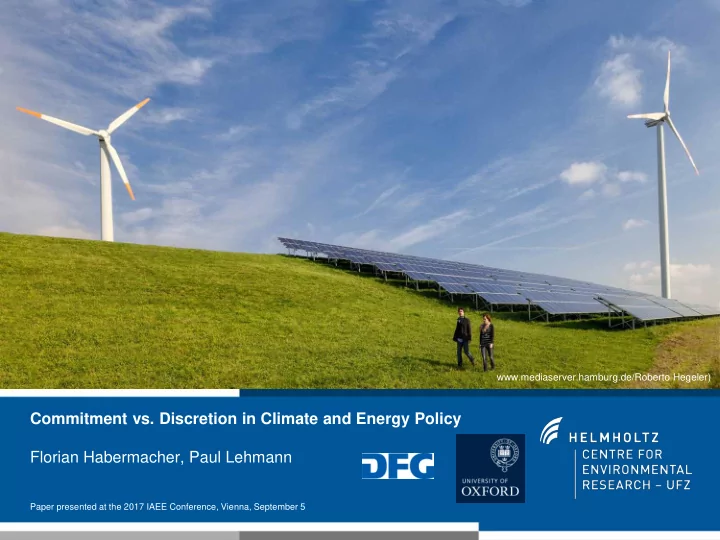
www.mediaserver.hamburg.de/Roberto Hegeler) Commitment vs. Discretion in Climate and Energy Policy Florian Habermacher, Paul Lehmann Paper presented at the 2017 IAEE Conference, Vienna, September 5 Outline Introduction Model


slide-1
SLIDE 1

Commitment vs. Discretion in Climate and Energy Policy Florian Habermacher, Paul Lehmann

Paper presented at the 2017 IAEE Conference, Vienna, September 5

www.mediaserver.hamburg.de/Roberto Hegeler)
slide-2
SLIDE 2

Outline

  • Introduction
  • Model
  • Results
  • Conclusion

SEITE 2

slide-3
SLIDE 3

RES policy commitment and discretion in Europe

SEITE 3

Evolution of feed-in tariffs for newly installed onshore wind power in selected European countries

Tariff level index (year of implementation = 100)

slide-4
SLIDE 4

Trade-off for climate and energy policy

SEITE 4

Costs of discretion

  • Time-inconsistent policy-

making if policy-makers simultaneously aim at promoting RES deployment and limiting costs of RES deployment

  • Result: under-investment in

RES deployment today Costs of commitment

  • Benefits and costs of RES

depoyment uncertain ex ante

  • Commitment foregoes
  • pportunity to incorporate new

knowledge in RES policy design

  • Result: over- or under-

investment in RES deployment in the future Research question:

  • How does this trade-off affect the optimal intertemporal design of policies

to support RES deployment?

slide-5
SLIDE 5

Linking two strands of literature

SEITE 5

  • Optimal choice of environmental policy in the presence of irreversible

investments and time-inconsistant policy-making (uncertainty in benefits or costs largely ignored)

(Biglaiser et al.,1995; Marsiliani and RenstrΓΆm, 2000; Abrego and Perroni, 2002; Helm et al., 2003, 2004; Levine et al., 2005; Baldursson and von der Fehr, 2008; Ulph and Ulph, 2013)

  • Optimal timing and choice of environmental policy with uncertain policy

benefits and/or costs (time inconsistency largely ignored)

(Weitzman, 1974; Roberts and Spence, 1976; Stavins, 1996; Pindyck, 2000, 2002; Pizer, 2002; Jacoby and Ellerman, 2004)

slide-6
SLIDE 6

Outline

  • Introduction
  • Model
  • Results
  • Conclusion

SEITE 6

slide-7
SLIDE 7

Dynamic partial equilibrium model

SEITE 7

  • A representative firm invests in RES deployment in period 1 and 2,

investments are irreversible and last for two periods

  • External benefits and technology costs of RES deployment may be

uncertain with two possible states

  • RES subsidy to internalize external benefit; produces deadweight

loss due to distortionary taxes levied to fund the subsidy (= trigger for time-inconsistent policy-making in the case of discretion)

  • Policy scenarios:

Unconditional commitment in period 1 to a fixed subsidy rate 𝑑2 for period-2 investments Discretion to set a subsidy rate 𝑑2𝑗 in period 2 after learning about the firm’s investment in period 1 and the actual state

  • f

the uncertain parameter in period 2

slide-8
SLIDE 8

Outline

  • Introduction
  • Model
  • Results
  • Conclusion

SEITE 8

slide-9
SLIDE 9

Ambiguous choice between unconditional commitment and discretion if benefits uncertain

SEITE 9

 Choice between unconditional commitment (UC) and discretion (UN) is analytically ambiguous:

𝑋

𝑉𝐷 βˆ’ 𝑋 𝑉𝑂 =

1 2𝑑1𝑑2 1 + 2π‘š πœ€π‘‘2

2π‘š2 𝑐1 + 𝐹 𝑐2 πœ€ + 1 + π‘š 𝑀 1 + πœ€ 2

1 + 4π‘š 1 + πœ€ 2 + π‘š2 4 + 9πœ€ + 4πœ€2 βˆ’ 𝑑1πœπ‘

2 1 + πœ€ 2

  • Pro commitment: Cost of discretion increases in consumer benefits (𝑀)

and (expected) external benefits (𝑐1, 𝐹[𝑐2])

  • Pro discretion: Cost of commitment increases in the variance of

external benefits (πœπ‘

2), cost of discretion decreases in the degree of

exogenous technological progress (𝑑1 βˆ’ 𝑑2)

  • Ambiguous effects of deadweight loss (π‘š) and discount factor (πœ€)
slide-10
SLIDE 10

Numerical illustration – Main scenario

SEITE 10

Parameter Value Unit Interpretation πœ€ 0.631 4.5% annual discount rate 𝑀 0.53 bn€/GW Wholesale electricity price 30€/MWh 𝑑1 0.0082 bn€/(GW)2 70€/MWh capex for 200th GW of wind power 𝑑2 0.0053 bn€/(GW)2 50€/MWh capex for 200th GW of wind power π‘š 0.3 30% deadweight loss per € raised by taxation 𝑐1, 𝑐2, 𝐹[𝑐2] 0.92 bn€/GW 70€/tCO2 𝑐2𝑀 0.66 bn€/GW +/- 20€/tCO2, 𝛽=0.5 𝑐2𝐼 1.18 bn€/GW 1 Period = 10 years

slide-11
SLIDE 11

First naΓ―ve finding: Discretion outperforms unconditional commitment in the main scenario

SEITE 11

 Discretion superior to unconditional commitment: Costs of commitment dominate costs of discretion  But: Welfare differences relatively small  Degree of commitment across time may be less important than choosing the adequate ambition for RES support today  Sensitivity of results? Relatively robust Welfare in bn€ Discretion, 𝑋

𝑉𝑂

521.7 Unconditional commitment, 𝑋

𝑉𝐷

516.2

slide-12
SLIDE 12

But: More realistic model assumptions put commitment at an advantage

SEITE 12

Welfare difference between commitment 𝑿𝑽𝑫 and discretion 𝑿𝑽𝑢: Sensitivity to deadweight loss π’Ž and standard deviation of the benefit resolving over time 𝝉𝒄 (yellow plain shows the zero level)

  • Commitment becomes (more) favorable if (1) uncertainty resolves only

slowly (see figure), (2) future policy-makers are not benevolent, and/or (3) investors are risk-averse.

slide-13
SLIDE 13

Comparison of social welfare if RES technology costs uncertain

SEITE 13

  • If subsidy is to internalize external benefits: commitment > discretion

(because optimal Pigouvian subsidy rate independent of costs)

  • If subsidy is to attain politically set RES target: discretion > commitment

(because target impedes discretion if policy-makers commit to it credibly)

slide-14
SLIDE 14

Outline

  • Introduction
  • Model
  • Results
  • Conclusion

SEITE 14

slide-15
SLIDE 15

Conclusions

SEITE 15

  • High degree of RES policy commitment may be economically

sensible, despite uncertain benefits and costs of RES deployment

  • Important exception: RES subsidy discretion may be economically

sensible in the presence of a credibly binding RES target

  • Similar conclusions may apply to climate policy in general once

the level of ambition of carbon pricing has risen

  • Small

welfare differential between commitment and discretion suggests choosing an adequate ambition for climate and energy policy today is more important than the way policy makers commit to it across time.

slide-16
SLIDE 16

SEITE 16

Thank you for your attention! Preliminary version published as: CESifo Working Paper 6355 Contact: paul.lehmann@ufz.de www.ufz.de/energyeconomics

www.mediaserver.hamburg.de/Roberto Hegeler)