Combined functionality and need for new tactics for optimized use of - - PowerPoint PPT Presentation

combined functionality and need for new tactics for
SMART_READER_LITE
LIVE PREVIEW

Combined functionality and need for new tactics for optimized use of - - PowerPoint PPT Presentation

Combined functionality and need for new tactics for optimized use of AUV-systems Presentation for UDT 2019 AUV 62 System 20 years of R&D 1996-1999 DAIM - Digital Acoustic Imaging . FOI and Saab together with LTH and CTH (Universities)


slide-1
SLIDE 1

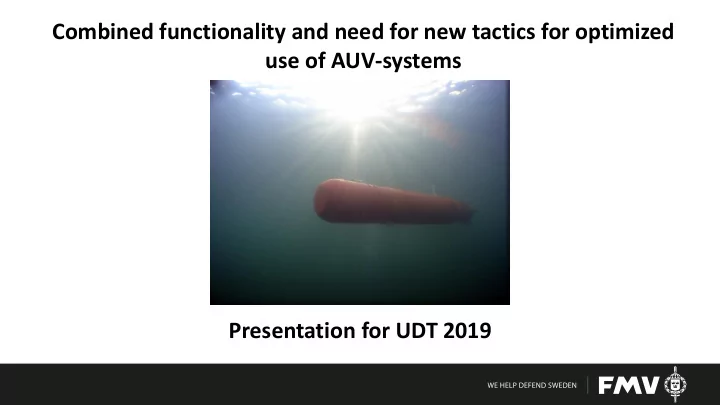
Combined functionality and need for new tactics for optimized use of AUV-systems Presentation for UDT 2019

slide-2
SLIDE 2

AUV 62 System –20 years of R&D

1996-1999 DAIM - Digital Acoustic Imaging.

  • FOI and Saab together with LTH and CTH

(Universities)

  • Results: wide band hi-frequency sonar and

algorithms for advanced hi-resolution signal processing methods for synthetic aperture sonar application.

slide-3
SLIDE 3

AUV 62 System –20 years of R&D

1999: AUV62F

  • Prototype parts of a

torpedo development project become an AUV

slide-4
SLIDE 4

AUV 62 System –SAPPHIRES

2003 – 2005 a demonstrator project takes form Synthetic APerture Processing HI-REsolution Sensor 2005 – 2007 the demonstrator platform is built. 2008 - SAPPHIRES is fully operational 2010 - FMV decided to take the SAPPHIRES Demonstrator one step further - the Acoustic Target (AT) module was designed and constructed

slide-5
SLIDE 5

AUV 62 System –SAPPHIRES

slide-6
SLIDE 6

Environmental conditions in the Baltic Sea

  • Shallow waters
  • Sea floor topography
  • Sea floor material
  • Brackish water
  • Thermoclines
  • Sea traffic intensity

Submarines are a limited and expensive ASW training resource AUV-systems can provide cost efficient ASW bulk training

Background for implementing AUV62-AT Acoustic Target

slide-7
SLIDE 7

Vision for implementing AUV62-AT

slide-8
SLIDE 8
  • Modular design
  • Multiple comlinks
  • Pumpjet propulsion
  • Different tail configurations (length/active/passive)
  • Rugged design

Development and use of the AUV62-AT

Nose Module Buoyancy Control Module Signature Generation Module Energy Module Navigation and Propulsion Module Tail

slide-9
SLIDE 9

Development and use of the AUV62-AT

Key funtions:

  • AUV62-AT can handle multiple units simultaneously
  • Entire chain locate/track/attack can be trained
  • Joint actions can be trained, such as ship/ship or ship/helicopter

cooperation.

  • AUV62-AT can also be used as torpedo target during exercises
slide-10
SLIDE 10

Development and use of the AUV62-AT

Mission planning and evaluation:

  • Flexible planning – adapt on the go
  • Preparation of routes and active/passive signals
  • Real time position prediction in mission planning system with overlay

functions such as charts and AIS data.

  • A single crew can operate more than one vehicle simultaneously
  • On board evaluation possible for rapid feedback during excersice
  • Advanced evaluation possible through combined data processing
slide-11
SLIDE 11

AUV62-AT – Business model for SwAF

GOCO business model for KUT (Advanced ASW-target Service):

  • Flexible and cost efficient introduction of new

system

  • Cost efficient solution for a system consisting of

a few items

  • Seamless transition of operation from

contractor to SwAF during expansion of system size

  • Flexible system operation - level of service

provided by contractor can alter.

slide-12
SLIDE 12

AUV62-AT – Business model for SwAF

Benefits:

  • Eliminates need for SwAF personell to operate and maintain the

systems

  • Skilled personell for efficient service, repairs and modifications
  • No need for storage and handling facilities or transportation for SwAF
  • Less administration
  • Integrated Project Team (IPT)
  • Saab can operate the AUV:s from own or SwAF platforms
slide-13
SLIDE 13

AUV62-system – Research and development

Use of collected data and combined experience

  • Continous improvment, development, research
  • Cooperation between SwAF, Swedish Defence Materiel Administration,

Swedish Defence Research Agency and SAAB.

  • The modular design allows for easy upgrades/maintenance and

implementation of new payload modules for new capabilities AUV-62 is also used as an important V&V asset for other projects by Swedish Defence Materiel Administration, Swedish Defence Research Agency and SAAB.

slide-14
SLIDE 14

AUV62-system – Research and development

Examples of future applications:

  • Decoy
  • Reconnaissance
  • Harbour protection
  • MCM (Sea floor mapping/classification and object identification)
  • Mobile communication node for sensor node network
slide-15
SLIDE 15

SMaRC – Swedish Maritime Research Center

  • Triple-Helix national industrial research center funded

by the Swedish Foundation for Strategic research

  • 7 years with a total project budget of >200MSEK
  • Focus on Maritime Robotics
  • Research areas:
  • Autonomy
  • Communication
  • Endurance
  • Perception
  • Working groups now at full speed with effective

collaboration between all participants

slide-16
SLIDE 16

SMaRC – Swedish Maritime Research Center

Benefit Areas:

  • Ocean production
  • Safeguarding Society
  • Environmental Monitoring
  • Main challenges
  • Reduced human interaction
  • Long-term presence
  • Operations in Unknown Waters
slide-17
SLIDE 17

Transition from manned- to unmanned systems

Capabilities Logistics Tactics Concpetual thinking

slide-18
SLIDE 18

Transition from manned- to unmanned systems

Capabilities

  • What is the purpose of using the system?
  • What advantages does it have compared to existing systems
  • Set up a system to maintain and evolve capabilities
  • Set up a system to develop new capabilities
slide-19
SLIDE 19

Transition from manned- to unmanned systems

Mission tactics

  • Adaptations and development based on the capabilities of the system and the

tasks it has to perform.

  • System perspective
  • Involve and prepare system users in the process of creating and integrating new
  • r modified tactics
  • Continous reevaluation of mission tactics to ensure continous improvements
slide-20
SLIDE 20

Transition from manned- to unmanned systems

Logistics

  • Adaptations and development to support platform capabilities and mission tactics.
  • Consider where and how the AUV-system is used.
  • Consider aspects such as:
  • Reliability and mean time between failure
  • Transportation
  • Demand for field repairs and infrastructure to support it
  • Security
slide-21
SLIDE 21

Transition from manned- to unmanned systems

Conceptual thinking

  • Optimize integration of unmanned systems and their chain of logistics on

existing platforms to maximize system performance

  • Consider existing and future use and handling of unmanned systems and their

chain of logistics during platform design.

  • Consider use and handling of unmanned systems and their chain of logistics

from a user perspective on different levels (operators/units/flottillas) and adapt accordingly

slide-22
SLIDE 22

Page: 22 2019-05-23

Transition from manned- to unmanned systems

Swedish conclusions – some examples for optimizing use of AUV:s

  • Delegate decision making of lower tasks to lower level (man/machine)
  • Consider transport to operating area and launch- and recovery sites – from land or

from platform at sea?

  • Consider mission duration and task (example: is ROV or AUV best choice?)
  • Minimize AUV idle time
  • Size versus capabilities and numbers
  • Use AUV:s for V&V activities and platform health checks
slide-23
SLIDE 23

Overall summary

  • Sweden has 20+ years of experience of development and use of AUV systems for

MR and ASW training.

  • The AUV62-system is a reliable and versatile modular platform enabling

evolutionary development and seamless incorporation of new capabilities.

  • The AUV62 is frequently used for V&V- and R&D activities by the Swedish Defence

Materiel Administration, Swedish Defence Research Agency and SwAF.

  • Continous R&D acitivities are ongoing both for existing and new capabilities.
  • SMaRC is an important piece of building strategic national competence in

autonomous underwater systems and their applications

  • Transition to unmanned systems require a new operative perspective and new

methods to be successful.

slide-24
SLIDE 24

Questions?