COLORANT CHEMISTRY From Prisms to Phthalocyanines Jeffery H. - - PowerPoint PPT Presentation

colorant chemistry from prisms to phthalocyanines
SMART_READER_LITE
LIVE PREVIEW

COLORANT CHEMISTRY From Prisms to Phthalocyanines Jeffery H. - - PowerPoint PPT Presentation

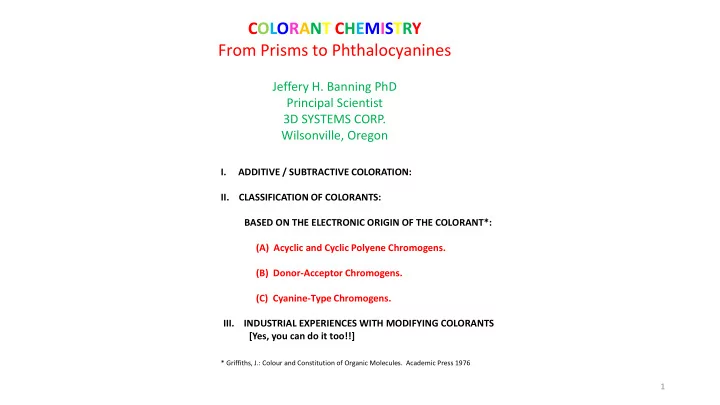
COLORANT CHEMISTRY From Prisms to Phthalocyanines Jeffery H. Banning PhD Principal Scientist 3D SYSTEMS CORP. Wilsonville, Oregon I. ADDITIVE / SUBTRACTIVE COLORATION: II. CLASSIFICATION OF COLORANTS: BASED ON THE ELECTRONIC ORIGIN OF


slide-1
SLIDE 1

COLORANT CHEMISTRY From Prisms to Phthalocyanines

Jeffery H. Banning PhD Principal Scientist 3D SYSTEMS CORP. Wilsonville, Oregon

  • I. ADDITIVE / SUBTRACTIVE COLORATION:
  • II. CLASSIFICATION OF COLORANTS:

BASED ON THE ELECTRONIC ORIGIN OF THE COLORANT*: (A) Acyclic and Cyclic Polyene Chromogens. (B) Donor-Acceptor Chromogens. (C) Cyanine-Type Chromogens.

  • III. INDUSTRIAL EXPERIENCES WITH MODIFYING COLORANTS

[Yes, you can do it too!!]

* Griffiths, J.: Colour and Constitution of Organic Molecules. Academic Press 1976

1

slide-2
SLIDE 2

Primary Colors for Subtractive Coloration

Superimposed dyes - subtractive coloration - e.g., artists paint palatte, color printer, etc Kirk-Othmer Encyclopedia of Chemical Technology - 3rd Ed., Vol 6, page 619

Primary Colors for Additive Coloration

Maxwell's arrangement - additive coloration - e.g., phosphors of a color TV Kirk-Othmer Encyclopedia of Chemical Technology - 3rd Ed., Vol 6, page 619

See: "The Fifteen Causes of Color (see table 3 and pp.860-875)" From the chapter on Color (pp. 841-876) Kirk-Othmer Encyclopedia of Chemical Technology Kurt Nasau, Consultant 4th Edition, Volume 6 John Wiley and Sons, Inc. 1993 ISBN 0-471-52674-6 Also: The Causes of Color by Kurt Nassau 1980 SCIENTIFIC AMERICAN, INC p.124

https://www.physics.utoronto.ca/~phy189h1/Causes%20of%20Color%20scientificamerican1080-124.pdf

2

slide-3
SLIDE 3

ADDITIVE COLORATION:

SUN "WHITE LIGHT" (Contains "all" wavelengths of visible light) 3

slide-4
SLIDE 4

4

slide-5
SLIDE 5

"WHITE LIGHT" (Contains all wavelengths of light) SUN

A prism can be used to "separate" all of the different wavelengths of "visible" light as shown above. Red: Longest wavelength, lower energy Yellow Green Green-Blue Blue Violet: Shortest wavelength, highest energy

ADDITIVE COLORATION:

5

slide-6
SLIDE 6

FILTER F I L T E R F I L T E R

6

slide-7
SLIDE 7

Examples seen with: phosphors of the “old” cathode ray tube based colored TV set, LEDs, OLEDs or any emissive based display today.

7

slide-8
SLIDE 8

ADDITIVE COLORATION:

Three monochromatic radiations are selected so that they are well separated sectors can be combined to make the color in the center (ex. Green, blue and red to make white) 8

slide-9
SLIDE 9

ADDITIVE COLORATION:

Two monochromatic radiations from any pair of flanking sectors can be combined to make the color in the between them (ex. Green and red to make yellow ) 9

slide-10
SLIDE 10

"WHITE LIGHT" (Contains all wavelengths of light) SUN Most colors that are prevalent throughout our environment arise from what is known as the subtractive color mixing process. In additive coloration we saw that the mixing of all the wavelengths (of colors) in the visible spectrum give "white light".

SUBTRACTIVE COLORATION:

Greenish-Blue

FILTER

Greenish-Blue light selectively filtered out

Example shown above: If sunlight is passed through a filter that removes a band of wavelengths in the region of 485 nm (i.e., Greenish-blue light) the eye will perceive the complementary color of greenish-blue -- i.e., orange (vice verse would be true: if only orange wavelength removed would appear greenish-blue). The eye perceives this complex mixture as ORANGE. However, if one of the components of "white light" (one wavlength, or even a narrow band of wavelengths) is removed, the color registered by the eye is the complementary color of the radiation removed (despite the fact that the light falling on the eye is still a complex mixture of wavelengths). 10

slide-11
SLIDE 11

The eye perceives this complex mixture as BLUE. 11

slide-12
SLIDE 12

"WHITE LIGHT" (Contains all wavelengths of light)

SUN

SUBTRACTIVE COLORATION:

lemon

Example shown above: When "white light" from a lightbulb or the sun hits the lemon, the pigments in the lemon absorb (filter) light (band of wavelengths) corresponding to the blue region. Hence, the remaining wavelengths of "white light" (less the blue) hit the retina of the eye. The eye will perceive the complementary color of blue - namely yellow The eye perceives this complex mixture as YELLOW.

Blue light selectively absorbed (filtered out)

12

slide-13
SLIDE 13

"WHITE LIGHT" (Contains all wavelengths of light)

SUN

SUBTRACTIVE COLORATION:

green pepper

The eye perceives this complex mixture as GREEN.

Red and violet light selectively absorbed (filtered out)

Example shown above: When "white light" from a lightbulb or the sun hits the "green" pepper, the pigments in the pepper absorb (filter) light corresponding to the purple region. But, no wavelength corresponding to purple exists. Instead wavelengths corresponding to red and violet (both flanking the purple region) are absorbed (i.e., effectively filtered) and the remaining wavelengths will hit the retina of the eye. The eye will perceive the complementary color of red and violet as green. 13

slide-14
SLIDE 14

"WHITE LIGHT" (Contains all wavelengths of light)

SUN

SUBTRACTIVE COLORATION:

8-ball

The eye perceives this 8-ball as BLACK.

A L L l i g h t i s s e l e c t i v e l y a b s

  • r

b e d ( f i l t e r e d

  • u

t )

Example shown above: When "white light" from a lightbulb or the sun hits the "black" 8-ball, the pigments in the ball absorb (filter) light corresponding to all wavelengths (i.e., all light is absorbed). Black is the absence of color (wavelengths) hitting the retina of the eye. The eye will perceive the absence of any color (light of any wavelength) hitting it as black. 14

slide-15
SLIDE 15

"WHITE LIGHT" (Contains all wavelengths of light)

SUN

SUBTRACTIVE COLORATION:

White Object (baseball)

The eye perceives this complex mixture as WHITE.

N

  • w

a v e l e n g t h s

  • f

l i g h t a r e a b s

  • r

b e d ( f i l t e r e d )

Example shown above: When "white light" from a lightbulb or the sun hits the white baseball, no light absorbs (or is filtered). Instead, all of the wavelengths are reflected and will hit the retina of the eye. The eye will perceive this as white. 15

slide-16
SLIDE 16

Example shown above: When "white light" from a lightbulb or the sun is filtered so that only the single wavelength of light corresponding to blue is able to hit the lemon, the pigments in the lemon absorb (filter) light in the blue region. Hence, no remaining wavelengths of visible light are left to hit the retina of the eye (i.e., all wavelengths of visible light are absorbed by the lemon) The eye will perceive this situation - with no reflected visible light as black The eye perceives this lemon as BLACK.

all light absorbed (filtered out)

16

slide-17
SLIDE 17

"WHITE LIGHT" (Contains all wavelengths of light)

SUN

SUBTRACTIVE COLORATION:

glass cuvette with yellow dye dissolved in colorless solvent

The eye perceives this complex mixture as YELLOW.

Example shown above: When "white light" from a lightbulb or the sun hits the cuvette containing a dye, the dye in solution absorb (filter) light (band of wavelengths) corresponding to the blue region. Hence, the remaining wavelengths of "white light" (less the blue) hit the retina of the eye. The eye will perceive the complementary color of blue - namely yellow

The wavelength corresponding to blue light is absorbed by the dye in solution and not "seen" by the eye (detector) The remaining wavelengths of visible light are transmitted through the dye in solution and "seen" by the eye (detector)

17

slide-18
SLIDE 18

"WHITE LIGHT" (Contains all wavelengths of light)

SUN

SUBTRACTIVE COLORATION: (With Cyanine Dye)

Xanthene (Rhodamine B)

N N CH2CH3 CH2CH3 H3CH2C H3CH2C NBMO

*

CO2 - O

The visible absorption band corresponds to the excitation of an electron from the HOMO (which is the NBMO in this case) into one of the LUMO (which is the vacant * orbital) of the chromogen. Example shown above: When "white light" hits the dye, the dye absorbs light corresponding to the green region. The eye will perceive the complementary color of green - namely Magenta The Green radiation matches “exactly” the energy necessary to excite and electron from the HOMO to the LUMO Hence, the remaining wavelengths of "white light" hit (are transmitted to) the retina of the eye. 18

slide-19
SLIDE 19

max

A = log (1/T)

19

slide-20
SLIDE 20

NBMO (HOMO)

* (LUMO)

heat Radiationless transition (occurs when an excited electron drops back to its ground state without the emission of light and usually involves transfer of heat to solvent) NBMO (HOMO)

* (LUMO)

Fluorescence (occurs when an excited electron drops back to its ground state - emmitting a photon of light. Usually this emmision of radiation is of a longer wavelength than the radiation that was absorbed) Note:

  • nly the lowest vibrational energy levels are shown - the

associated vibrational levels are not shown light "WHITE LIGHT" (Contains all wavelengths of light)

SUBTRACTIVE COLORATION: (With Cyanine Dye) - FLUORESCENCE

Xanthene (Rhodamine B)

N N CH2CH3 CH2CH3 H3CH2C H3CH2C NBMO

*

CO2 - O

SUN The eye perceives this complex mixture as MAGENTA

NBMO

*

N N CH2CH3 CH2CH3 H3CH2C H3CH2C CO2 - O

with an ORANGISH fluorescene 20

slide-21
SLIDE 21

* *

  • There are no donors or acceptors per se'.
  • Can be regarded as simply a

collection of sp2 or sp-hybridized atoms in which overlap (some to complete) of all the p-orbitals occurs giving a conjugated -electron system containing as many electrons as there are p-orbitals. (A) Acyclic (& Cyclic) Poly-ene Chromogens

  • Color is simply due to the

fact that conjugation is large.

  • Show convergence in absorption

wavelengths (at about 600 nm)

THREE SUB-CLASSES OF COMPOUNDS CAN FALL INTO THIS CATEGORY:

  • 1. Acyclic polyenes (poly-enes).
  • 2. Non-Benzenoid Alternant Cyclic Systems
  • 3. Polycyclic Benzenoid Compounds.

ALMOST IMPOSSIBLE TO BREAK INTO NIR REGION (unless cyclic aromatic structures are present)

  • Intensities are normally good

(extinction coefficients > 20,000) (B) Donor-Acceptor Chromogens (C) Cyanine-Typce Chromogens

*Griffiths, J.: Colour and Constitution of Organic Molecules, Academic Press 1976

  • II. CLASSIFICATIONS OF COLORANTS

BASED ON THE ELECTRONIC ORIGIN OF THE COLORANT*

* * * * *

21

slide-22
SLIDE 22

Ultra-Violet Spectrum

 Wavelength (in nanometers)

Absorption

200 250 300 350 400 450 500 550 600

max = 227 nm 2 double bonds max = 275 nm 3 double bonds max = 310 nm 4 double bonds max = 341 nm 5 double bonds max = 380 nm 6 double bonds max = 396 nm7 double bonds max = 413 nm 8 double bonds

At about 8 double bonds the system breaks into the visible spectrum (it would appear yellow).

max = 600 nm 20 double bonds

2 At about 20 double bonds the converges on 600 nms (and doesn't increase no matter the additional double bonds).

  • Visible Spectrum

*Griffiths, J.: Colour and Constitution of Organic Molecules, Academic Press 1976

227 nm 413 nm

(A) Linear Acyclic Poly-ene and light absorption

Note: these are not actual absorption bands, but ChemDraw generated peaks representing actual literature values

22

slide-23
SLIDE 23

max = 470 nm 11 conjugated double bonds

1 2 3 4 5 6 7 8 9 10 11

Lycopene - the "parent structure" for all of the caretenoids

  • Has 11 conjugated double bonds.
  • Responsible for red color in tomatos

(A) Linear Acyclic Poly-ene and light absorption

23

slide-24
SLIDE 24

Porphyrins are highly colored heterocyclic compounds that occur widely in nature.

N N N N H H

The parent structure is a macrocycle containing 4 pyrrole units linked by methine bridges called a porphin. Porphyrins are classified as polyene chromogens as they contain no donor

  • r acceptor groups (i.e., they resemble

annulenes).

N N N N H H

The maximum delocalization of electrons occurs about the [16]-annulene pathway shown to right: The system has 18 -electrons (when 2 of the N atoms provide 2 electrons each) and is therefore isoconjugate with the [16]-annulene dianion which is a (4n+2) system, therefore showing aromatic character (thus explaining in part the stability of the phorphyrins). Phthalocyanine (a commercially valuable pigment) can be described as a porphin.

N N N N H H

tetra-azo

N N N N

  • tetra-benz-

Metal Free Phthalocyanine Pigment Blue 16 CI 74100

Steamrollers, Sportscars and Security: Phthalocyanines Through the Ages J of Porphyrins and Phthalocyanines 3 (1999) 468-476

(A) Linear Acyclic and Cyclic Poly-ene Chromogens

2) NON-BENZENOID ALTERNANT CYCLIC SYSTEMS (PORPHYRINS)

24

slide-25
SLIDE 25

CN CN 4

CuCl2 / ~140oC Exotherm to 260-300oC 1 hour

Phthalonitrile

C N C N C N C N C N C N C N C N

Cu2+

C N C N C N C N C N C N C N C N

Cu2+

N N N N

= = = =

Cu

N N N N

The metal (Cu+2) acts as a template of sorts base (B:) induced cyclotetramerization B:

(C) ACYCLIC AND CYCLIC POLYENE CHROMOGENS - PREPARATION OF COMMERCIAL PHTHALOCYANINE DYES: PROPOSED MECHANISM

COPPER PHTHALOCYANINE Pigment Blue 15 C.I. 74160

(Greenish Blue)

(A) Linear Acyclic and Cyclic Poly-ene Chromogens

25

slide-26
SLIDE 26
  • There are no donors or acceptors per se'.
  • Can be regarded as simply a

collection of sp2 or sp-hybridized atoms in which overlap (some to complete) of all the p-orbitals occurs giving a conjugated -electron system containing as many electrons as there are p-orbitals. (A) Acyclic (& Cyclic) Poly-ene Chromogens

  • Color is simply due to the

fact that conjugation is large.

  • Show convergence in absorption

wavelengths (at about 600 nm)

THREE SUB-CLASSES OF COMPOUNDS CAN FALL INTO THIS CATEGORY:

  • 1. Acyclic polyenes (poly-enes).
  • 2. Non-Benzenoid Alternant Cyclic Systems
  • 3. Polycyclic Benzenoid Compounds.

ALMOST IMPOSSIBLE TO BREAK INTO NIR REGION (unless cyclic aromatic structures are present)

  • Intensities are normally good

(extinction coefficients > 20,000) (B) Donor-Acceptor Chromogens (C) Cyanine-Type Chromogens

  • There are donors or acceptors.
  • Can still basically be regarded as simply a

collection of sp2 or sp-hybridized atoms in which

  • verlap (some to complete) of all the p-orbitals
  • ccurs giving a conjugated - electron system

containing as many electrons as there are p-

  • rbitals - but donors and acceptors groups have

large effect on light absorption.

  • Color is simply due to the fact that conjugation

is large and donors and acceptors groups.

  • Show convergence in absorption

wavelengths (can be longer than 600 nm because

  • f donors and acceptors groups)

MOLECULES CONTAIN 3 PORTIONS:

  • 1. Donor Portion.
  • 2. Conjugated Bridge Portion
  • 3. Acceptor Portion.

DIFFICULT BUT POSSIBLE TO BREAK INTO NIR (with lots and strong EWG /EDGS /conjugation/ metallization )

  • Intensities are normally good

(extinction coefficients 15,000 –300,000)

  • II. CLASSIFICATIONS OF COLORANTS

BASED ON THE ELECTRONIC ORIGIN OF THE COLORANT*

*Griffiths, J.: Colour and Constitution of Organic Molecules, Academic Press 1976

* * * * * * *

26

slide-27
SLIDE 27

 Represents the largest group of Chromogens.  The majority of commercial dyes and pigments fall into this class.  Extinction coefficients range from 15,000 - 300,000.  Azo dyes, Methine dyes, Azomethine dyes, and Anthraquinone dyes are examples of colorants that fall into this category.

(B) Donor-Acceptor Chromogens

27

slide-28
SLIDE 28

N CH3 CH3 C H C NC NC

An electron donating group(s) - EDG (i.e., an atom possessing lone pair electrons directly linked to a conjugated -electron system). Example:

N CH3 CH3 C H C NC NC

The orbital containing the lone pair electrons (from the EDG) must be aligned with the adjacent p-orbitals of the conjugated (bridge) system, so that the lone pair electrons may be partly delocalized into the --system. Example: An electron withdrawing group(s) - EWG (functional groups that possess electronegative atoms conjugated with system - e.g., Nitrile, Nitro, Diazo groups). Example:

N CH3 CH3 C H C NC NC

N CH3 CH3 NC NC

(B) Donor-Acceptor Chromogens

28

slide-29
SLIDE 29

"WHITE LIGHT" (Contains all wavelengths of light)

SUN

SUBTRACTIVE COLORATION: (With Donor-Acceptor Dye)

N HC H3C CH3 C C N C N

YELLOW DYE * 

The wavelength corresponding to blue light is absorbed by the dye and not "seen" by the eye (detector)

% A B S O R B A N C E WAVELENGTH (nm)

N HC H3C CH3 C C N C N

*  The eye perceives this complex mixture as YELLOW.

The remaining wavelengths of visible light are transmitted through the dye and "seen" by the eye (detector)

% TRANSMISSION WAVELENGTH (nm)

page 21 29

slide-30
SLIDE 30
  • A. SOME EDGs IN ORDER OF EFFICIENCY:
  • OAc Least Effective
  • OH
  • NHAc
  • OCH3
  • SH
  • NH2
  • SCH3
  • NHCH3
  • N(CH3)2 Most Effective

Griffiths, J.: Colour and Constitution of organic molecules. Academic Press 1976

(B) Donor-Acceptor Chromogens (cont.) For predictive purposes, rough rules of thumb are as follows:

1) Adding more EDGs to the donor portion or replacing an EDG of a given chromogen with a more efficient donating group will lead to a BATHOCHROMIC shift (the reverse will lead to a HYPSOCHROMIC shift). The actual location (e.g., ortho, meta, or para) of these substituents can have a critical effect on the magnitude of the shift.

30

slide-31
SLIDE 31

N N H3C H3C N

STRONGER EDG (Julolidine) INTERMEDIATE EDG WEAKEST EDG (aziridine)

  • 2. RELATIVE EDG STRENGTHS OF N,N'-DIALKYL AMINO GROUPS:

N R H3C H3C CH3

STRONGER EDG (and better lightfastness) (trimethyl tetrahydroquinoline)

  • 3. IONIZED EDGs:

The electron donor strength of a particular group can be enhance greatly by imparting a negative charge to the heteroatom. This is normally achieved by deprotonation of the grouping by a base.

Examples: R-O- , R-S- , and R-NH-

(B) Donor-Acceptor Chromogens (cont.) For predictive purposes, rough rules of thumb are as follows:

31

slide-32
SLIDE 32

max = 423 (acetone)

N N S N H3C O O Cl OH Cl

max = 427 (acetone)

N N N S N CH3 CH3 H3C O O Cl

max = 446 (acetone)

N N S N CH2CH2-CN CH2CH2-OH H3C O O Cl

max = 455 (acetone)

N N S N CH2CH2-CN CH2CH2-OH H3C O O Cl H3C

max = 459 (acetone)

N N S N CH2CH2-OH CH2CH2-OH H3C O O Cl Cl

max = 460 (acetone)

N N S N CH2CH2-OH CH2CH2-OH H3C O O Cl

max = 467 (acetone)

N N S N CH2CH2-OH CH2CH3 H3C O O Cl

max = 474 (acetone)

N N S N CH2CH3 CH2CH3 H3C O O Cl

max = 475 (acetone)

N N S N CH2CH2-OH CH2CH3 H3C O O Cl H3C

max = 479 (acetone)

N N S N CH2CH2CH2CH3 CH2CH2CH2CH3 H3C O O Cl N N S N CH2CH2-OH CH2CH2-OH H3C O O Cl

max = 484 (acetone)

HN O

max = 485 (acetone)

N N S N CH2CH2-OH CH2CH2-OH H3C O O Cl HN CH3 O

max =485 (acetone)

N N S N CH2CH2OCH2CH2-OH H3C O O Cl CH3 CH3 H3C H3C

max = 527 (acetone)

N N S N CH2CH2-OH CH2CH2-OH H3C O O Cl HN CH3 O O-CH3

  • A. SOME EDGs IN ORDER OF EFFICIENCY:
  • OAc Least Effective
  • OH
  • NHAc
  • OCH3
  • SH
  • NH2
  • SCH3
  • NHCH3
  • N(CH3)2 Most Effective

Griffiths, J.: Colour and Constitution of organic molecules. Academic Press 1976

Examples of AZO dyes with different EDGs

(Electron Donating Groups) in order of efficiency

max = 511 (acetone)

N N S N H3C O O Cl

B A T H O C H R O M I C

32

slide-33
SLIDE 33

SOME EWGs IN ORDER OF EFFICIENCY:

  • CO2
  • M+ Least Effective
  • NO
  • CHO
  • CONH2
  • CO2CH3
  • CO2H
  • CF3
  • SO3
  • M+
  • SOCH3
  • COCH3
  • CN
  • SOCF3
  • SO2CH3
  • NO2
  • SO2CF3 Most Effective

Griffiths, J.: Colour and Constitution of Organic Molecules. Academic Press 1976

(B) Donor-Acceptor Chromogens (cont.)

2) Adding more Electron Withdrawing Groups - EWGs to the acceptor portion or replacing an EWG of a given chromogen with a more efficient withdrawing group will lead to a BATHOCHROMIC shift (the reverse will lead to a HYPSOCHROMIC shift). The actual location (e.g., ortho, meta, or para) of these substituents can have a critical effect on the magnitude of the shift.

33

slide-34
SLIDE 34

max = 413 (acetone)

N N

H

N CH2CH3 CH2CH3 N N

F

N CH2CH3 CH2CH3

max = 418 (acetone)

N N

S

N CH2CH3 CH2CH3

HO O O

max = 422 (acetone)

N N

Br

N CH2CH3 CH2CH3

max = 431 (acetone)

N N

Cl

N CH2CH3 CH2CH3

max = 435 (acetone) max = 440 (acetone)

N N

S

N CH2CH3 CH2CH3

H2N O O

max = 440 (acetone)

N N

C

N CH2CH3 CH2CH3

H2N O

N N

F3C

N CH2CH3 CH2CH3

max = 442 (acetone) max = 448 (acetone)

N N

C

N CH2CH3 CH2CH3

HO O

max = 449 (acetone)

N N

C

N CH2CH3 CH2CH3

H3CH2CO O

max = 454 (acetone)

N N

C

N CH2CH3 CH2CH3

H O

max = 456 (acetone)

N N

C

N CH2CH3 CH2CH3

H3C O

N N

NC

N CH2CH3 CH2CH3

max = 462 (acetone) max = 487 (acetone)

N N

S

N CH2CH3 CH2CH3

F3C O O

N N

O2N

N CH2CH3 CH2CH3

max = 490 (acetone) Examples of AZO dyes with different EWGs

(Electron Withdrawing Groups) in order of efficiency

  • CO2- M+ Least Effective
  • NO
  • CHO
  • CONH2
  • CO2CH3
  • CO2H
  • CF3
  • SO3-M+
  • SOCH3
  • COCH3
  • CN
  • SOCF3
  • SO2CH3
  • NO2
  • SO2CF3 Most Effective

Griffiths, J.: Colour and Constitution of Organic Molecules. Academic Press 1976

SOME EWGs IN ORDER OF EFFICIENCY:

B A T H O C H R O M I C

34

slide-35
SLIDE 35

N CH3 CH3 C H C NC NC

max = 430 nmacetone CV = 276 max = 452 nmacetone CV = 84.6

N CH3 CH3 C H C NC NC N CH3 CH3 C H CH C H C NC NC

max = 483 nmacetone CV = 199

(B) Donor-Acceptor Chromogens (cont.) 3) Extending the conjugated bridge of a given chromogen will normally lead to a BATHOCHROMIC shift (the reverse leading to a HYPSOCHROMIC shift) Donor (EDGs) Acceptor (EWGs) Longitudinal extension of the conjugated system, in general, is more effective than lateral extension in producing a BATHOCHROMIC shift. Conjugated Bridge 35

slide-36
SLIDE 36

* *

  • There are no donors or acceptors per se'.
  • Can be regarded as simply a

collection of sp2 or sp-hybridized atoms in which overlap (some to complete) of all the p-orbitals occurs giving a conjugated -electron system containing as many electrons as there are p-orbitals. (A) Acyclic (& Cyclic) Poly-ene Chromogens

  • Color is simply due to the

fact that conjugation is large.

  • Show convergence in absorption

wavelengths (at about 600 nm)

THREE SUB-CLASSES OF COMPOUNDS CAN FALL INTO THIS CATEGORY:

  • 1. Acyclic polyenes (poly-enes).
  • 2. Non-Benzenoid Alternant Cyclic Systems
  • 3. Polycyclic Benzenoid Compounds.

ALMOST IMPOSSIBLE TO BREAK INTO NIR REGION (unless cyclic aromatic structures are present)

  • Intensities are normally good

(extinction coefficients > 20,000) (B) Donor-Acceptor Chromogens (C) Cyanine-Type Chromogens

  • There are donors or acceptors.
  • Can still basically be regarded as simply a

collection of sp2 or sp-hybridized atoms in which

  • verlap (some to complete) of all the p-orbitals
  • ccurs giving a conjugated - electron system

containing as many electrons as there are p-

  • rbitals - but donors and acceptors groups have

large effect on light absorption.

  • Color is simply due to the fact that conjugation

is large and donors and acceptors groups.

  • Show convergence in absorption

wavelengths (can be longer than 600 nm because

  • f donors and acceptors groups)

MOLECULES CONTAIN 3 PORTIONS:

  • 1. Donor Portion.
  • 2. Conjugated Bridge Portion
  • 3. Acceptor Portion.

DIFFICULT BUT POSSIBLE TO BREAK INTO NIR (with lots and strong EWG /EDGS /conjugation/ metallization )

  • Intensities are normally good

(extinction coefficients 15,000 –300,000)

  • II. CLASSIFICATIONS OF COLORANTS

BASED ON THE ELECTRONIC ORIGIN OF THE COLORANT*

*Griffiths, J.: Colour and Constitution of Organic Molecules, Academic Press 1976

  • Sometimes depicted as having 2 donors (although

there are no donors or acceptors per se') but Odd Alternant hydrocarbon analog possessing NBMO equivalent.

  • The Cationic molecules with terminal heteroatoms

(usually N's) can still basically be regarded as simply a collection of sp2 or sp-hybridized atoms in which

  • verlap is complete. Possess NBMO and hence a low

energy 1st electronic transition (replacement of C’s at

  • ther positions follow Dewar's rules).
  • Color is due to the fact that molecules possess

NBMO are isoelectronic with odd alternant anion (and conjugation is present)

  • A convergent behavior of wavelengths is

not observed. Possess high degree of bond uniformity

CHROMOGENS POSSESS:

  • 1. Non-bonded Molecular Orbital NBMO.
  • 2. Bond Uniformity
  • 3. Non-Convergent Wavelength Behavior

FAIRLY "EASY" TO GET IN NIR (with lots Conjugation)

  • Intensities are normally good (extinction coefficients

15,000 - 300,000)

* * *

36

slide-37
SLIDE 37

DEWAR'S RULE SUMMARY: PUTTING IT ALL TOGETHER!

N(R)2 (R)2N max= 610 nm 1st: Trace a continuous path through the -portion of the molecule, starring alternate atoms N(R)2 (R)2N max= 610 nm

* * * * * * * *

2nd: Place the substituent (perturbant)

  • n/in the appropriate atom

and go to grid below for prediction: N(R)2 (R)2N

* * * * * * * *

N(R)2 (R)2N

* * * * * * * *

N CH3 max= 491 nm

STARRED ATOM UN-STARRED ATOM Increase Electronegativity (or add EWG) Decrease Electronegativity (or add EDG)

DEWAR'S RULE SUMMARY:

HYPSOCHROMIC SHIFT BATHOCHROMIC SHIFT BATHOCHROMIC SHIFT HYPSOCHROMIC SHIFT 37

slide-38
SLIDE 38

Linear Poly-ene

Linear Cyanine

max = 736 nm 6 double bonds R N NR2 R max = 625nm 5 double bonds

R N NR2 R max = 519 nm 4 double bonds R N NR2 R R N NR2 R

max = 414 nm 3 double bonds max = 313 nm 2 double bonds

R N NR2 R

max = 227 nm 2 double bonds max = 275 nm 3 double bonds max = 310 nm 4 double bonds max = 341 nm 5 double bonds max = 380 nm 6 double bonds

227 nm 313 nm 275 nm 414 nm 310 nm 519 nm 341 nm 625 nm 380 nm 736 nm

Wavelength (in nanometers)

A b s

  • r

p t i

  • n

200 300 400 500 600 700 800 900

Ultra-Violet Range (UV) Visible Range (Vis) Near Infra-Red Range (NIR)

*Griffiths, J.: Colour and Constitution of Organic Molecules, Academic Press 1976

Note: these are not actual absorption bands, but ChemDraw generated peaks representing actual literature values

38

slide-39
SLIDE 39

39

  • III. INDUSTRIAL EXPERIENCES WITH MODIFYING COLORANTS

[Yes, you can do it too!!]

slide-40
SLIDE 40

Bromamine Acid Sodium Salt

1-Amino-4-bromoanthraquinone-2-sulfonic Acid Sodium Salt 1-Amino-4-bromo-9,10-dihydro-9,10-dioxo-2-anthracenesulfonic acid sodium salt M.F. C14H7BrNNaO5S M.W. 404.17 CAS RN 6258-06-6 A0279 TCI America Bromaminic acid sodium salt Sigma Aldrich

O2N CN CN CN CN

40

2-​[4-​(Dibutylamino)​-​2-hydroxybenzoyl]​benzoic acid

CAS Number 54574-82-2 Linear Formula [CH3(CH2)3]2NC6H3(OH)COC6H4CO2H Molecular Weight 369.45 Mp = 190-193°C(lit.) Aldrich 402400 [THIS IS DHB [I HAVE MAX/GRIFF PREP FOR THIS]]

4-Nitrophthalonitrile

CAS Number Linear Formula XXXXXXXX Molecular Weight xxxxx N0524 TCI

Phthalonitrile

CAS Number Linear Formula XXXXXXXX Molecular Weight xxxxx P0404 TCI

QUINIZARIN

CAS Number 81-64-1 Linear Formula C14H8O4 Molecular Weight 240.21 D0243 TCI AMERICA

LEUCOQUINIZARIN

CAS Number 476-60-8 Linear Formula C14H10O4 Molecular Weight 242.23 T0116 TCI AMERICA

1,8-Naphthalenediamine

CAS Number 479-27-6 Linear Formula C10H10N2 Molecular Weight 158.20 D0102 TCI AMERICA

4-Phenylazo-1-naphthylamine

Naphthyl Red Solvent Yellow 4 CAS Number 131-22-6 Linear Formula C16H13N3 Molecular Weight 247.30 P0584 TCI AMERICA

Squaric Acid 1-Cyclobutene-3,4-dione-1,2-diol 3,4-Dihydroxy-3-cyclobutene-1,2-dione

CAS Number 2892-51-5 Linear Formula C4H2O4 Molecular Weight 114.06 D1399 TCI AMERICA

3-Diethylaminophenol

CAS Number: 91-68-9 Molecular Weight: 165.23 102091 Aldrich

N,N-Dibutyl-3-aminophenol

CAS 43141-69-1 Linear Formula C14H23NO Molecular Weight 221.34 D2138 TCI

N,N-Dimethylaniline

CAS 121-69-7 Linear Formula C8H11N Molecular Weight 121.18 D0665 TCI

4-Dimethylaminobenzaldehyde

CAS 100-10-7 Linear Formula C9H11NO Molecular Weight 149.19 D1495 TCI

PHTHALIC ANHYDRIDE

CAS Number 85-44-9 Linear Formula C8H4O3 Molecular Weight 148.12 P1614 TCI AMERICA

Select Aldrich/TCI Chemicals For Making Dyes
slide-41
SLIDE 41

N N N N N N N N SO3Na SO3Na SO3Na NaO3S COPPER PHTHALOCYANINE C.I. Acid Blue 249 C.I. 74220 (Greenish Blue) Cu ANTHRAQUINONE Acid Blue 27 CI 61530 (Greenish Blue) O O NH-CH3 HN CH3 SO3Na INDIGOID DYE Acid Blue 74 CI 73015 (Greenish Blue) N H H N O O SO3Na NaO3S N O N H3CH2C H3CH2C R INDOPHENOL Solvent Blue 22 CI 49705 (Blue) (R = H) TRIPHENYLMETHANE C.I. Acid Blue 9 C.I. 42090 (Bright Greenish Blue) N N SO3 - CH2CH3 CH2 H3CH2C CH2 NaO3S SO3Na N N N N N N N N Cl Cl Cl Cl Cl Cl Cl Cl COPPER PHTHALOCYANINE C.I. Pigment Green 37 C.I. 74255 (Bluish Green) Cu S C H METHINE Disperse Blue 354 CI 48480 (Blue) N NC CN O O CH2CH2CH2CH2CH2CH3 CH2CH2CH2CH2CH2CH3 H3C N N N CH2CH3 MONO AZO DYES Disperse Blue 338 CI 11405 (Greenish Blue) CH3 CH3 H3C H N CH3 NO2 CN O2N O ANTHRAQUINONE Disperse Blue 60 CI 61104 (Bright Greenish Blue) O O NH2 NH2 N-CH2CH2CH2-O-CH3 O O ANTHRAQUINONE Solvent Blue 35 CI 61554 (Greenish Blue) O O NH-CH2CH2CH2CH3 NH-CH2CH2CH2CH3 (NOTE: portions in red show potential sites for modification

  • III. SYNTHETIC STRATEGIES FOR TAILOR MAKING DYES:

VARIOUS CLASSES OF CYAN (& BLUE & GREEN) CHROMOPHORES THAT ARE COMMERCIALLY AVAILABLE and/or SYNTHETICALLY ACCESSIBLE

ANTHRAQUINONE

CI Acid Blue 62 CI 62045 (Bright Reddish Blue)

41

slide-42
SLIDE 42

ANTHRAQUINONE CI Acid Blue 62 CI 62045 (Bright Reddish Blue)

Bromamine Acid Sodium Salt

1-Amino-4-bromoanthraquinone-2-sulfonic Acid Sodium Salt 1-Amino-4-bromo-9,10-dihydro-9,10-dioxo-2- anthracenesulfonic acid sodium salt M.F. C14H7BrNNaO5S M.W. 404.17 CAS RN 6258-06-6 A0279 TCI America Bromaminic acid sodium salt Sigma Aldrich

NaOH/H2O CuSO4 42

ANTHRAQUINONE CI Acid Blue 62 CI 62045 (Bright Reddish Blue)

BROMAMINE ACID

slide-43
SLIDE 43

O O NH2 N H N N H H N N H N HN NH HN O O SO3Na NH2 SO3Na O O H2N NaO3S O O NH2 N N H H N N H N HN NH HN O O SO3Na NH2 SO3Na N H O O SO3Na NH2 O O NH2 N N H H N N H N HN NH HN O O SO3Na NH2 SO3Na

H2N N N H H N N H N NH2 HN NH2 NH2 n

Na2CO3 /CuSO4 Water/reflux

n = 3

Polyethylene Imine [PEI] Ratio of the 3 types of amines 1o amines 2o amines 3o amines

1 2 1

43

BROMAMINE ACID

slide-44
SLIDE 44

CH3 Si O CH3 Si CH3 CH3 O Si CH3 CH3 O Si CH3 CH3 O Si CH3 CH3 O Si CH3 CH2 O Si CH3 CH3 O Si CH3 CH3 O Si CH3 CH3 O Si CH3 CH3 O O CH2 CH2 NH2

n

Na2CO3 /CuSO4 THF/Water/reflux

Bromamine Acid

CH3 Si O CH3 Si CH3 CH3 O Si CH3 CH3 O Si CH3 CH3 O Si CH3 CH3 O Si CH3 CH2 O Si CH3 CH3 O Si CH3 CH3 O Si CH3 CH3 O Si CH3 CH3 O O CH2 CH2 HN n O O NH2 SO3Na

138 USP 8841472 9-23-2014 Xerox - Colored Polysiloxanes 44

BROMAMINE ACID

slide-45
SLIDE 45

45

LEUCO-QUINIZARIN (reduced [H] form) QUINIZARIN (oxidized [OX] form)

ANTHRAQUINONE Solvent Blue 35 CI 61554 (Greenish Blue)

QUINIZARIN/LEUCOQUINIZARIN

slide-46
SLIDE 46

LEUCO-QUINIZARIN (reduced [H] form) QUINIZARIN (oxidized [OX] form)

LEUCO-QUINIZARIN (reduced [H] form) QUINIZARIN (oxidized [OX] form)

2

ENOL FORM

USP 6437155 & USP 6447591 Anthraquinone Colorants for Inks

KETO FORM BIS-IMINE This condensation actually takes place in a stepwise fashion (i.e., first the MONO-imine forms primarily in the 1 position then in the 4 position) followed by oxidation

46

QUINIZARIN / LEUCOQUINIZARIN

slide-47
SLIDE 47

47

TRIPHENYLMETHANE C.I. Acid Blue 9 C.I. 42090 (Bright Greenish Blue)

  • 1. H2O/H2SO4

Reflux

  • 2. Neutralize
  • 3. Filter
  • 4. [OX]

Oleum (fuming sulfuric acid)

TRIPHENYL METHANES

slide-48
SLIDE 48

48

  • H2O

[Water is a great LG]

  • 1. H2O/H2SO4

Reflux

  • 2. Neutralize
  • 3. Filter
  • 1. Ethanol/heat
  • 2. oxidize

Adjust pH to ~10 With 40% NaOH Add “Acid”

A- A-

130 USP8303671 11-6-2012 basic dye and acid dye providing an internal salt composition 126 USP7997712 8-16-2011 Xerox TPM-Acid Dye Internal Salt

TRIPHENYL METHANES

Leuco [H] form Carbinol form

[-H2O]

slide-49
SLIDE 49

49

H2SO4 HA

HA

HSO4

  • 1

130 USP8303671 11-6-2012 basic dye and acid dye providing an internal salt composition 126 USP7997712 8-16-2011 Xerox TPM-Acid Dye Internal Salt

  • H2O
  • H2O
  • H2O
  • H2O

TRIPHENYL METHANES

slide-50
SLIDE 50

50

PHTHALOCYANINES

COPPER PHTHALOCYANINE C.I. Acid Blue 249 C.I. 74220 (Greenish Blue) CN CN CuCl2 / 14OoC Exotherm to 260- 300oC / 1 hour Phthalonitrile O O O OR CuCl2 / -xs- UREA (NH3)nMoO4/NH4Cl 200oC / 3 hour (UREA PROCESS) Phthalic Anhydride PURIFICATION:

  • Dissolve in conc H2SO4
  • ppt w/hot water
  • Wash with NH4OH

N N N N N N N N

Cu

90 - 100% Yield

N N N N N N N N

Cu

  • 1. Oleum

(fuming sulfuric acid)

  • 2. Neutralize
slide-51
SLIDE 51

CH3 Si O CH3 Si CH3 CH3 O Si CH3 CH3 O Si CH3 CH3 O Si CH3 CH3 O Si CH3 CH2 O Si CH3 CH3 O Si CH3 CH3 O Si CH3 CH3 O Si CH3 CH3 O O CH2 CH2 S

n

NC CN

138 USP 8841472 9-23-2014 Xerox - Colored Polysiloxanes

DMF/K2CO3/HEAT

51

PHTHALOCYANINES

Thiol functionalized PDMS

slide-52
SLIDE 52

CH3 Si O CH3 Si CH3 CH3 O Si CH3 CH3 O Si CH3 CH3 O Si CH3 CH3 O Si CH3 CH2 O Si CH3 CH3 O Si CH3 CH3 O Si CH3 CH3 O Si CH3 CH3 O O CH2 CH2 S

n

NC CN CN CN

8

[actually ~8+ moles are used instead of the 3 moles necessary to make the desired dye to ensure no crosslinking can take place. As a result some phthalocyanine pigment is produced which is not soluble and will either precipitate out or can be filtered out to yield the PDMS-dye]

+

138 USP 8841472 9-23-2014 Xerox - Colored Polysiloxanes

Copper phthalocyanine Pigment [Precipitate] Which is filtered out 52

PHTHALOCYANINES

PDMS/Copper Phthalocyanine dye

slide-53
SLIDE 53

N N N H O CN H3C CH2CH3 O NO2 Cl AZO PYRIDONE Disperse Yellow 211 CI 12755 N N N CH3 CH3 MONO AZO DYES Solvent Yellow 2 CI 11020 (Butter Yellow) (R , R' = H)

R R'

N N O O H NH CH3 Cl CH3 NO2 Cl HANSA-TYPE YELLOWS Pigment Yellow 98 CI 11727 O O N H3CH2C CH2CH3 COUMERIN DYES Disperse Yellow 232 CI 55165 N O Cl N CH CH NH H3C CH3 CH3 POLYMETHINE Basic Yellow 13 CI 48056 (R , R' = H) O-CH3

  • X

R R'

H N NO2 O2N NITRODIPHENYL AMINE DYES Disperse Yellow 14 CI 10340 (R = H)

R

N N O N H N CO2 Na SO3Na NaO3S AZO PYRAZOLONES Acid Yellow 23 CI 19140 N CH2CH2-O-C CH2CH3 CN NC METHINE Disperse Yellow 9O CI 48OO7 H3C O N Br H OH O O QUINOLINE DYES Disperse Yellow 64 CI 47023 (R , R' = H)

R' R

(NOTE: portions in red show potential sites for modification

  • III. SYNTHETIC STRATEGIES FOR TAILOR MAKING DYES:

VARIOUS CLASSES OF YELLOW CHROMOPHORES THAT ARE COMMERCIALLY AVAILABLE and/or SYNTHETICALLY ACCESSIBLE

53

slide-54
SLIDE 54

54

METHINE Disperse Yellow 9O CI 48OO7

Aldehyde Active Methylene Knoevenagel condensation

  • 1. Ethanol/reflux

NH4OAc [cat]

  • 2. Cool/ppt filter

METHINE & AZOMETHINES

slide-55
SLIDE 55

(B) Donor-Acceptor Chromogens: METHINEs & AZOMETHINES

max = 371 nm CV = 129.9 max = 430 nm CV = 276 max = 436 nm CV = 263 max = 446 nm CV = 244 max = 452 nm CV = 85 MeOH max = 456 nm CV = 226 max = 483 nm CV = 199 max = 495 nm CV = 220 max = 422 nm CV = 55 max = 448 nm CV = max = 456 nm CV = 219.6 max = 466 nm CV = 141 max = 493 nm CV = 237 max = 519 nm CV = 217.4

CV =  /MW

N C-H N C-H O N C-H CH3 O O H3C H3C H3CH2C H3CH2C H3CH2C H3CH2C HO C-H H3CO O N CH=CH-C-H O H3C H3C N C-H H3C H3C O N C-H O N N=O H3CH2C H3CH2C

max = 386 nm max = 392 nm CV = 98.4 max = 386 nm max = 424 nm CV = 51 max = 440 nm CV = 94.0 max = 429 nm CV = 85 max = 458 nm CV = 89.2 max = 462 nm CV = 217.3 max = 470nm CV = 140 max = 511 nm CV = 200 max = 525 nm CV = 143 max = 440 nm CV = 62 max = 476 nm max = 470 nm max = 490 nmMeOH CV = 141 MeOH max = 516 nm CV = 200 max = 544 nm CV = 165.7 max = 442 nm CV = 76 max = 483 nm CV = 103 max = 483 nm CV = 195 max = 552 nm CV = EthOH max = 486 nm max = 520 nm max=522 nmEthOH CV = 254 EthOH max = 548 CV = 222 max = 514 nm max = 484 nm max = 576 nm CV = 167 max =591 nm CV = 195 max = 513 nm CV = 99 max = 427nm max = 521 nm

NOTE: All spectral measurements performed in acetone unless otherwise stated

55

METHINE & AZOMETHINES

slide-56
SLIDE 56

56

METHINE & AZOMETHINES

slide-57
SLIDE 57

N N CO2 - CH2CH3 CH2CH3 H3CH2C

XANTHENE C.I. Solvent Red 49 C.I. 45170:1

(Bright Bluish Red) (Rhodamine B)

H3CH2C

O ANTHRAPYRIDONE Acid Red 80 CI 68215 (Bright Bluish Red)

O NH-CH3 HN

CH3

SO3Na

O ANTHRAQUINONE Disperse Red 60 (R=H) CI 60756 (Bluish Red)

O O NH2 OH

O

R

MONO AZO DYES Disperse Red 177 CI 11122 (Bright Bluish Pink)

N S N N N CH2CH2-CN CH2CH2-OCOCH3 O2N

N H H N O O H3C CH3

QUINACRIDONE C.I. Pigment Red 122 C.I. 73915

(Bright Bluish Red) N CH3 CH3 CN NC

R

METHINE Magenta

  • Org. Syn. Col. Vol. 4 p.953

(R = H) NC N CH CH H3C CH3 CH3 POLYMETHINE Basic Violet 16 CI 48013 (Bright Bluish Red) (R , R' = H) N

R R'

CH2CH3 CH2-CH3

  • Cl

O H N N SO3 - H3C CO2 -

LITHOL RUBINE C.I. Pigment Red 57:2 C.I. 15850:2 - Ba Salt

(Bluish Red)

Ba2+

ANTHRAQUINONE Solvent Red 172 CI 607280 Magenta

O O OH HN

CH3 Br Br

R

(NOTE: portions in red show potential sites for modification

NH HN O O

R R

DPP (Diketopyrrolopyrrole) C.I. Pigment Red 255 (R=H) C.I. 561050

(BrightYellowish Red)

  • III. SYNTHETIC STRATEGIES FOR TAILOR MAKING DYES:

VARIOUS CLASSES OF RED & MAGENTA CHROMOPHORES THAT ARE COMMERCIALLY AVAILABLE and/or SYNTHETICALLY ACCESSIBLE

57

slide-58
SLIDE 58

N N CO2 - CH2CH3 CH2CH3 H3CH2C

XANTHENE C.I. Solvent Red 49 C.I. 45170:1

(Bright Bluish Red) (Rhodamine B)

H3CH2C

O

RHODAMINES

slide-59
SLIDE 59

59

RHODAMINES

slide-60
SLIDE 60

60

DISAZO DYE (w/ Hydrazone) Direct Black 51 CI 27720 (R=H) N N O H N N HO NH2 HO3S NaO2C R R DIAZINE DYE Pigment Black 1 (Aniline Black) CI 50440 (R=H) N H N N N H N N N H N N N H R

X X X

MONO AZO DYES Solvent Black 35 (R=H) CI 12198 (is the chromium salt

  • f CI 121945 & 121965)

N N O O O2N N N O O NO2 R R

Cr+3 X

N N NH NH N N CH3 CH3 R DISAZO DYE Solvent Black 3 CI 26150 (R=H) DIAZINE/AZO DYE Basic Black 2 CI 11825 (R=H) N N N N N OH R

Cl

N N H O SO3Na NH2 NaO3S N N O2N DISAZO DYE (w/ Hydrazone) Acid Black 1 CI 20470 (R=H) R R O OH OH HO HO O Natural Black 1 CI 75290 (R=H) R CARBON BLACK Pigment Black 7 CI 77266

C

X

(NOTE: portions in red show potential sites for modification

  • III. SYNTHETIC STRATEGIES FOR TAILOR MAKING DYES:

VARIOUS CLASSES OF BLACK CHROMOPHORES THAT ARE COMMERCIALLY AVAILABLE and/or SYNTHETICALLY ACCESSIBLE

slide-61
SLIDE 61

61

N N NH NH N N CH3 CH3 R DISAZO DYE Solvent Black 3 CI 26150 (R=H)

DISAZO BLACK

Toluene Reflux Dean-Star Trap [-H2O] 1,8-diaminonaphthalene 2,3-dihydro-2,2- dimethylperimidine adduct acetone

HONO Solvent Black 3

slide-62
SLIDE 62

62

140 USP 8884012 11-11-2014 Xerox - Dye Compound and Method of Making the Compound [waxy pyrimidine intermediate for SK3 and Squarine based NIR dyes] 147 USP 9193869 11-24-15 Xerox Dye compounds, method of making the compounds and ink composition employing the compounds [DSSK, Squaric IR dye, etc.] 149 USP 9309410 4-12-16 Xerox COLORANT COMPOUNDS [IR absorb and SK3 dyes]

DIAZO DYES [PYRIMIDINE INTERMEDIATE]

Toluene Reflux Dean-Star Trap [-H2O] Toluene Reflux Dean-Star Trap [-H2O] Toluene Reflux Dean-Star Trap [-H2O] 1,8-diaminonaphthalene 2,3-dihydro-2,2- dimethylperimidine adduct 2,3-dihydro-2,2- distearylperimidine adduct acetone stearone 2-Hydroxyethyl Methyl Ketone 2,3-dihydro-2,2- methyl, hydroxyethyl perimidine adduct

slide-63
SLIDE 63

63

HONO HONO HONO

140 USP 8884012 11-11-2014 Xerox - Dye Compound and Method of Making the Compound [waxy pyrimidine intermediate for SK3 and Squarine based NIR dyes] 147 USP 9193869 11-24-15 Xerox Dye compounds, method of making the compounds and ink composition employing the compounds [DSSK, Squaric IR dye, etc.] 149 USP 9309410 4-12-16 Xerox COLORANT COMPOUNDS [IR absorb and SK3 dyes]

DIAZO DYES [Solvent Black 3 Analogs]

Solvent Black 3

slide-64
SLIDE 64

64

140 USP 8884012 11-11-2014 Xerox - Dye Compound and Method of Making the Compound [waxy pyrimidine intermediate for SK3 and Squarine based NIR dyes] 147 USP 9193869 11-24-15 Xerox Dye compounds, method of making the compounds and ink composition employing the compounds [DSSK, Squaric IR dye, etc.] 149 USP 9309410 4-12-16 Xerox COLORANT COMPOUNDS [IR absorb and SK3 dyes]

DIAZO DYES [Solvent Black 3 Analogs]

slide-65
SLIDE 65

2 2 2

140 USP 8884012 11-11-2014 Xerox - Dye Compound and Method of Making the Compound [waxy pyrimidine intermediate for SK3 and Squarine based NIR dyes] 147 USP 9193869 11-24-15 Xerox Dye compounds, method of making the compounds and ink composition employing the compounds [DSSK, Squaric IR dye, etc.] 149 USP 9309410 4-12-16 Xerox COLORANT COMPOUNDS [IR absorb and SK3 dyes] 155 USP 9738811 8-22-17 Xerox Phase Change Inks Containing Wax-Soluble Near IR Dyes [Squaric acid NIR Dye]

65

PYRIMIDINE/SQUARIC ACID BASED NIR DYE]

slide-66
SLIDE 66

66

140 USP 8884012 11-11-2014 Xerox - Dye Compound and Method of Making the Compound [waxy pyrimidine intermediate for SK3 and Squarine based NIR dyes] 147 USP 9193869 11-24-15 Xerox Dye compounds, method of making the compounds and ink composition employing the compounds [DSSK, Squaric IR dye, etc.] 149 USP 9309410 4-12-16 Xerox COLORANT COMPOUNDS [IR absorb and SK3 dyes] 155 USP 9738811 8-22-17 Xerox Phase Change Inks Containing Wax-Soluble Near IR Dyes [Squaric acid NIR Dye]

slide-67
SLIDE 67

MONO AZO DYES Solvent Black 35 (R=H) CI 12198 (is the chromium salt

  • f CI 121945 & 121965)

N N O O O2N N N O O NO2 R R

Cr+3 X

67 Can be a 1o 2o or 3o amine

METALLIZED AZO DYE

slide-68
SLIDE 68

M3+ M3+ Preparation of Derivatives of Metallized Dyes

68 Can be a 1o 2o or 3o amine Free acid form of metal complexed dye Free acid form of metal complexed dye

slide-69
SLIDE 69

Special Thanks to

  • Sarah Patty, Jian Yao, Alex Kugel, Tim Andrews, Virginia Espina,

Michael Harpole, Ruben Magni, Amanda Haymond, Marcus Peterson, James Hart, Jim O’Connell, Lori Lancaster, Max Weaver, John Griffiths, James Esplin, Keith Grosse and Arnold Ariss, Marty Jones, the entire Ink R&D group (XOG), former colleagues at XRCC, current colleagues at 3DSystems

69