Colonial Roots and Current Practices Park Board Committee Meeting - - PowerPoint PPT Presentation

colonial roots and
SMART_READER_LITE
LIVE PREVIEW

Colonial Roots and Current Practices Park Board Committee Meeting - - PowerPoint PPT Presentation

Exploring Park Boards Colonial Roots and Current Practices Park Board Committee Meeting Monday, July 23, 2018 Purpose of Presentation To report back on the Board April 2018 Board motion titled Truth and Reconciliation with the Park


slide-1
SLIDE 1

Park Board Committee Meeting

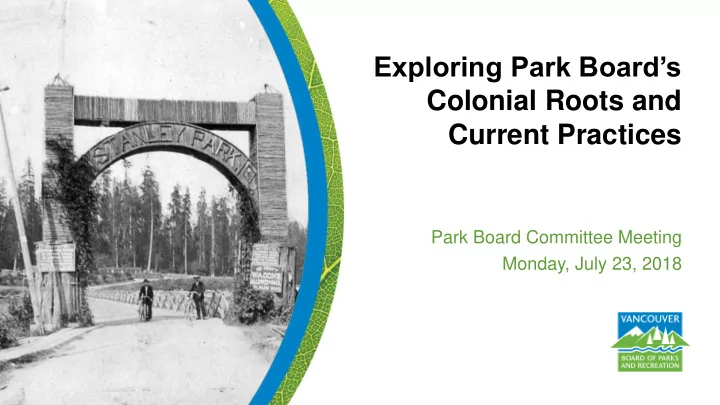
Exploring Park Board’s Colonial Roots and Current Practices

Monday, July 23, 2018

slide-2
SLIDE 2
  • To report back on the Board April 2018 Board motion titled

“Truth and Reconciliation with the Park Board’s Colonial Roots” with initial findings;

  • To provide recommended next steps for furthering the “truth-

telling” phase of Truth and Reconciliation.

22

Purpose of Presentation

slide-3
SLIDE 3

23

Context

Human Occupation in what is now known as Vancouver

slide-4
SLIDE 4

24

Background: Key Drivers for Colonial Analysis

  • Unceded Territory
  • Commissioners met with

Musqueam, Squamish, & Tsleil-Waututh at Musqueam Cultural Centre in Jan 2015;

  • Board approved 11

Reconciliation Strategies & UNDRIP Adopted as a framework in Jan 2016;

  • Aboriginal Consultation:

Truth-telling phase Report received by the Board April 2018

slide-5
SLIDE 5
  • Dispossession
  • Archaeology
  • Culture
  • Prioritization of non-Indigenous Ways of Knowing

*non-exhaustive list

25

Major Areas of Colonial Impact*

slide-6
SLIDE 6

Dispossession

26

Image from www.musqueam.bc.ca

slide-7
SLIDE 7

27

Dispossession

Second Beach, c. 191-?

  • 1888 – Park Board requests

Mayor to notify the “squatters” in Stanley Park to remove themselves

  • 1899 – Park Board attempts

to rid park of “Indian buildings at the Narrow”

  • 1909 – Campaign to get rid
  • f “squatters”
  • 1952 – Final residence

removed

slide-8
SLIDE 8

28

Dispossession Squamish people being sent away from their homes at Sen ̓ áḵw / sən ̓ aʔqʷ

  • c. 1913
slide-9
SLIDE 9

29

Beaches

English Bay, 1946 2016

  • 1904 – Acquisition of beach

property at English Bay

  • 1905 – Motion requiring the

“Jericho Reserve” [possibly Sen ̓ áḵw / sən ̓ aʔqʷ, or Locarno] for park purposes

slide-10
SLIDE 10

Archaeology

30

slide-11
SLIDE 11

31

Archaeology Digging through midden to build a road through Stanley Park

slide-12
SLIDE 12

Culture

32

slide-13
SLIDE 13

33

Culture - Events

By holding the authority over event permitting, Park Board acts as a gatekeeper of cultural expressions in parks and facilities

slide-14
SLIDE 14

34

Culture - Activities

  • Park Board is responsible

for building facilities and amenities geared for particular activities

  • Those activities serve

many members of the community

  • They do not necessarily

reflect the cultural practice and sports of marginalized communities

Kitsilano Pool, 1933

slide-15
SLIDE 15

35

Culture – Monuments and Memorials The collection of monuments and memorials accepted as donations in public park space speak to what the Park Board deems appropriate to venerate

  • r uphold.

Lord Stanley statue in Stanley Park

slide-16
SLIDE 16

Prioritizing non-Indigenous Ways of Knowing

36

slide-17
SLIDE 17

37

Prioritizing non-Indigenous Ways of Knowing

  • Use of non-Indigenous

internal & external expertise to guide stewardship

  • Aesthetic alterations to

landscape based on Western European ideals

slide-18
SLIDE 18

Conclusion

38

slide-19
SLIDE 19

Increased imperative to responsibly steward the land because of climate change, population increase, unabated development, increased economic disparity.

Global Temperature Change

39

Why a Colonial Audit

Source: climate.nasa.gov/vital-signs/global-temperature

slide-20
SLIDE 20

First Nations successfully stewarded the land for millennia, with an embedded worldview that prioritizes long-term planning & human/environment interdependency

40

Why a Colonial Audit

Lyra Soutar harvesting cedar bark June 2018

slide-21
SLIDE 21

41

Why a Colonial Audit

  • A paradigm shift in our

approach to stewardship is the most prudent course of action for a more resilient city

  • A study of how the Park

Board’s worldview has affected the land and Indigenous peoples will help build stronger relationships with local First Nations and provide

  • pportunities for new models
  • f stewardship and equity
slide-22
SLIDE 22
  • A. THAT the Vancouver Board of Parks and Recreation receive

and acknowledge the Initial Findings for a Park Board Colonial Audit, attached as Appendix A; and,

  • B. THAT the Board direct staff to undertake a comprehensive

“Colonial Audit” in order to identify both short term and long term opportunities and specific ways to improve Park Board policies and practices with regard to Reconciliation.

42

Recommendation

slide-23
SLIDE 23

A. THAT the Vancouver Board of Parks and Recreation receive and acknowledge the Initial Findings for a Park Board Colonial Audit, attached as Appendix A; B. THAT the Board direct staff to undertake a comprehensive “Colonial Audit” in order to identify both short term and long term opportunities and specific ways to improve Park Board policies and practices with regard to Reconciliation; and

  • C. FURTHER THAT the Board seek an opportunity to formally

acknowledge and apologize to representatives of the Musqueam, Squamish, and Tsleil-Waututh peoples for the colonial history and actions of the Vancouver Park Board.

43

Recommendation - Amended

slide-24
SLIDE 24

44

Photo credit – Lisa Walker

slide-25
SLIDE 25