Collaborators Opaque line Transparent line Vincent J Dercksen - - PDF document

collaborators
SMART_READER_LITE
LIVE PREVIEW

Collaborators Opaque line Transparent line Vincent J Dercksen - - PDF document

02.12.2011 Cortical neural networks: light-microscopy-based anatomical reconstruction, numerical simulation and analysis Hans-Christian Hege Berlin Workshop on Statistics and Neuroimaging 2011, Weierstrass Institute, Nov 25-27 Collaborators


slide-1
SLIDE 1

02.12.2011 1 Cortical neural networks: light-microscopy-based anatomical reconstruction, numerical simulation and analysis

Berlin Workshop on Statistics and Neuroimaging 2011, Weierstrass Institute, Nov 25-27

Hans-Christian Hege

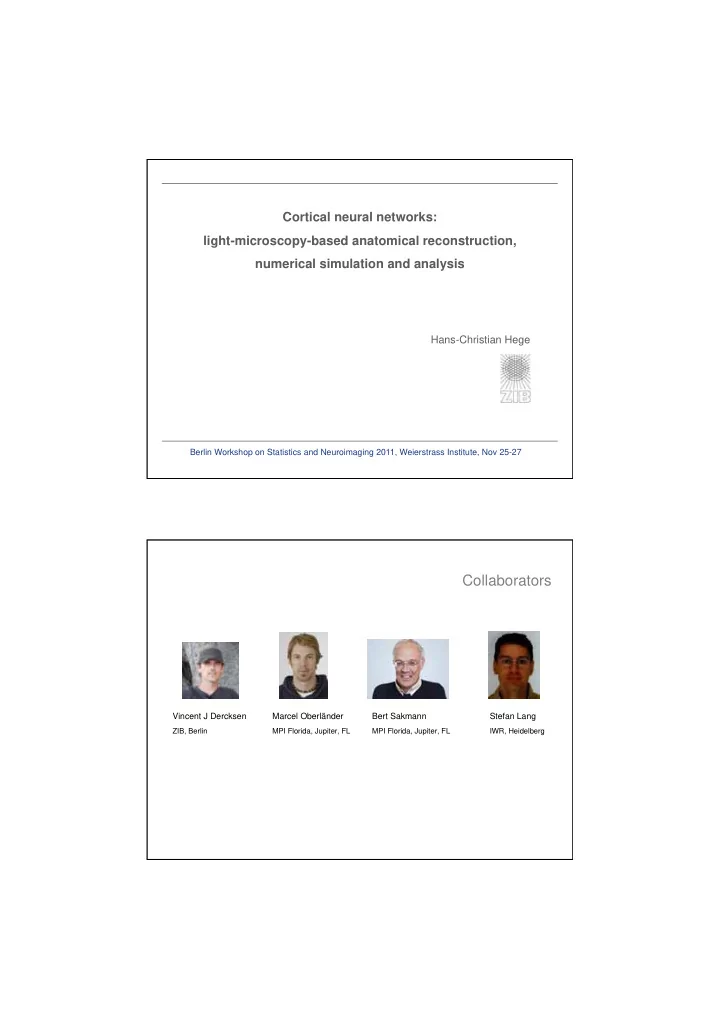
Collaborators

Opaque line Transparent line

Vincent J Dercksen

ZIB, Berlin

Marcel Oberländer

MPI Florida, Jupiter, FL

Bert Sakmann

MPI Florida, Jupiter, FL

Stefan Lang

IWR, Heidelberg

slide-2
SLIDE 2

02.12.2011 2

Motivation

Opaque line Transparent line

  • Fundamental question in neuroscience:

How does the brain translate sensory input into behavior? Describe and understand at cellular level, complete circuits that can drive behavior.

  • Widely used model system: somatosensory whisker system in rodents
  • Decision making; example: gap crossing

Reveal relation between structure and function (anatomy ↔ physiology)

Biological background: cortical column

Modified from Helmstaedter et al. (2007): Reconstruction of an average cortical column in silico. Brain Res. Rev. 55(2): 193-203 Modified from V.C. Wimmer et al (2010): Dimensions of a projection column and architecture of VPM and POm axons in rat vibrissal cortex. Cereb Cortex, 20(10), 2265–2276

  • Somatosensory cortex processes information from whisker
  • Information pathway:

whisker → brain stem → thalamus (VPM) → cortical column

  • Basic anatomical unit: cortical column
  • 1-to-1 whisker-column correspondence
  • Column divided into layers 1-6
slide-3
SLIDE 3

02.12.2011 3

Approach

Reconstruct cortical column Numerically simulate its behavior Analyze simulation results

Reconstruction

Ideal: Dense reconstruction of all neurons and their synaptic connections within a cortical column of 1 individual.

From: wikipedia axon synaptic cleft dendrite

slide-4
SLIDE 4

02.12.2011 4

SS TEM

From: K. Briggman and W. Denk. Towards neural circuit reconstruction with volume electron microscopy techniques.

  • Curr. Opin. Neurobiol. 16:562-70 (2006).

50 nm section of rat neocortex at 7 nm lateral resol. (xy plane) Registered (aligned) stack of 239 sections resectioned in silico (yz plane).

SBF SEM

350 mm3 from adult rat barrel cortex 13.2nm/pixel, 253 sections each 30 nm thick From: K. Briggman and W. Denk. Towards neural circuit reconstruction with volume electron microscopy techniques.

  • Curr. Opin. Neurobiol. 16:562-70 (2006).

Manually traced spiny dendrite

slide-5
SLIDE 5

02.12.2011 5

Synaptic connection

From: K. Braun, Univ. Magdeburg

Reconstruction of

  • dendrite segment with spine (yellow)
  • pre-synaptic bouton (red)

Reconstruction approach

Ideal: Using electron tomographic technique perform dense reconstruction of all neurons and their synaptic connections within a cortical column of 1 individual Instead “Reverse engineering”: Using light microscopy, collect somata and neurites from different sources and combine them in a single model and establish rule-based connection t e c h n i c a l l y n

  • t

y e t f e a s i b l e

slide-6
SLIDE 6

02.12.2011 6

What anatomical data do we need?

  • 3D neuron distributions
  • 3D VPM axon reconstructions
  • 3D dendrite reconstruction

for a representative sample of neurons of all occurring cell types

  • Spatial frequencies of all cell types
  • Spine- and bouton densities

(number of pre-/post-synaptic connection sites per μm axon/dendrite)

3D neuron distribution

  • Input: 3D confocal images

containing stained somata (cell bodies)

  • Problem: detect somata, resolve overlap
  • Method:

1) Binary segmentation 2) Morphology-based splitting of clusters 3) Volume model-based splitting of clusters

Oberlaender et al. (2009): Automated three-dimensional detection and counting of neuron somata. J Neurosci Methods, 180(1):147–160

slide-7
SLIDE 7

02.12.2011 7

3D neuron distribution (2)

  • Volume containing cortical

column

  • 2 x 2 x 40 confocal sections
  • ~18k neurons in cortical column
  • Density varies w.r.t. cortical depth

H.S. Meyer et al (2010): Number and laminar distribution of neurons in a thalamocortical projection column of rat vibrissal cortex. Cereb Cortex. 20:2277-2286

Morphology reconstruction

  • Input: stack of transmitted light

brightfield images (~35 sections)

  • Problem: trace axons and dendrites,

align stack, combine sections

  • Complications: thin foreground

structures, uneven dye penetration, stained background, large data (~20 GB/section)

  • Approach:

1) Automatic section tracing 2) Interactive intra-section post-processing 3) Automatic alignment 4) Interactive inter-section post-processing (final quality control) 5) Optional semantic labeling

slide-8
SLIDE 8

02.12.2011 8

Morphology reconstruction: “inverse tracing”

  • Staining problems and sectioning may

cause skipping of branches

  • Ensure completeness
  • Very conservative automatic tracing,

accepting over-segmentation

  • Manually remove false positives using

dedicated tool (Amira filament editor)

V.J. Dercksen et al (2012): Interactive visualization—a key prerequisite for reconstruction of anatomically realistic neural networks. In: Visualization in Medicine and Life Sciences II. Springer-Verlag. In press.

Morphology reconstruction: section alignment

  • Input: thin sections containing

traced fragments

  • Problem: alignment
  • Point matching of near-boundary

points

  • Detection of maximal clique in

distance compatibility graph

  • Scaling and rigid alignment

V.J. Dercksen et al (2009): Automatic alignment of stacks of filament data. Proc IEEE International Symposium on Biomedical Imaging: From Nano to Macro (ISBI), 971-974.

slide-9
SLIDE 9

02.12.2011 9

Morphology reconstruction: alignment

  • Time: ~10s / slice pair
  • Integrated in Filament Editor,

allowing interactive control

  • Interactive inter-slice connecting
  • f fragments
  • Removal of false positives

Morphology reconstruction: semantic labeling

  • Semantic labeling of sub-structures and landmarks for visualization and

analysis

slide-10
SLIDE 10

02.12.2011 10

Morphology reconstruction: dendritic cell types

  • ~100 dendritic reconstructions
  • Classification:

9 excitatory cell types

  • Relative frequency

w.r.t cortical depth (Cortical depth recorded during dye injection)

  • M. Oberlaender et al (2011): Cell type-specific three-

dimensional structure of thalamocortical circuits in a column of rat vibrissal cortex. Cereb Cortex, accepted.

Morphology reconstruction: axons

  • Axons: Long-ranging, thin, complex
  • VPM axons project into column
  • Convey input from whiskers
  • M. Oberlaender et al (2011): Cell type-specific three-dimensional structure of

thalamocortical circuits in a column of rat vibrissal cortex. Cereb Cortex, accepted.

slide-11
SLIDE 11

02.12.2011 11

Cortical column assembly

  • Place somata according to given neuron density
  • Place dendrites by duplicating morphologies, satisfying cell type frequency
  • M. Oberlaender et al (2011): Cell type-

specific three-dimensional structure of thalamocortical circuits in a column of rat vibrissal cortex. Cereb Cortex, accepted.

Synaptic connectivity

  • Number of synapses estimated from structural overlap (Peters' rule)
  • Synapse estimate in 503 μm3 grid cells
  • # boutons = axon length * bouton density
  • # spines = dendrite length * spine density
  • # synapses:

ci,j = # synapses of post-synaptic neuron i with pre-synaptic type j bj = # boutons of pre-synaptic type j si = # spines of cell i S = total # spines f = optional factor for inhibitory cell compensation

  • Synapse position input for simulation
  • Realization of pre-synaptic cell for each synapse is generated before

simulation (depending on convergence/divergence parameters)

slide-12
SLIDE 12

02.12.2011 12

Synaptic connectivity: VPM-L5B example

VPM Axon Bouton density Spine density L5B dendrites Bouton-spine overlap Synapse density

Visual analysis of anatomical network properties

  • Current work: Interactive exploration of neural network properties
  • Collect evidence to validate model, support hypotheses
  • Produce images for publication
  • Tool: query-based selection and evaluation for visual and quantitative analysis

Example:

selection VPMaxon = axon where CellTypeIs('VPMaxon') selection L5Bdendrites = dendrite where CellTypeIs('L5B') selection L4SSdendrites = dendrite where CellTypeIs('L4SS') profile VPMaxonLength = length(VPMaxon, Z, 25) profile L4SSdendriteLength = length(L4SSdendrites, Z, 25) profile L5BdendriteLength = length(L5Bdendrites, Z, 25) selection allDendrites = dendrite profile L5Bsynapses = synapses(VPMaxon, L5Bdendrites, allDendrites, XYZ, 50) profile L4SSsynapses = synapses(VPMaxon, L4SSdendrites, allDendrites, XYZ, 50)
slide-13
SLIDE 13

02.12.2011 13

Simulation of signal flow

(Stefan Lang)

  • Membrane potential (V)
  • Hodgkin-Huxley equations describe V in

response to input/output current through membrane channels and synapses

  • Cable equations describe V change through

compartments

  • Coupled PDEs of reaction-diffusion type
  • Finite Volume scheme
  • t-dependent eqs implicitly discretized by

Crank–Nicholson or Backward–Euler schemes

  • Simulation software NeuroDUNE

www.neurodune.org

Simulation parameters

  • Anatomical parameters
  • Number of neurons
  • Morphology
  • Spine, bouton densities
  • Number of synapses
  • Synapse positions on dendrites
  • ...
  • Physiological parameters
  • Electrical parameters

Ion channel conductances, reversal potentials, resting potential, etc.

  • Convergence/divergence
  • Pre-/post-synaptic neuron pairing
  • Input signal (#spikes)
  • Input synchrony
  • Synaptic efficacy
  • ...
slide-14
SLIDE 14

02.12.2011 14

Simulation parameters

  • Anatomical parameters
  • Number of neurons
  • Morphology
  • Spine, bouton densities
  • Number of synapses
  • Synapse positions on dendrites

...

  • Physiological parameters
  • Electrical parameters

Ion channel conductances, reversal potentials, resting potential, etc.

  • Convergence/divergence
  • Pre-/post-synaptic neuron pairing
  • Input signal (# spikes)
  • Input synchrony
  • Synaptic efficacy
  • ...
  • S. Lang et al (2011): Simulation of signal flow in 3D

reconstructions of an anatomically realistic neural network in rat vibrissal cortex. Neural Netw. 24:998-1011.

→ Anatomical data → Anatomical data → Values reported in literature → Anatomical data → Parameter study ... → Values reported in literature → Values reported in literature → Parameter study → Measured in vivo → Parameter study → Parameter study ...

Simulation: parameter sensitivity study

  • Model: VPM (285) → L4 spiny stellates (2770)
  • Monte Carlo: 507 runs per trial
  • Dependent parameter: number of L4SS spikes
  • 4 independent parameters were varied:
  • Anatomical connectivity (synapse positions)
  • Functional connectivity (pre- and post-synaptic neuron pairs)
  • VPM input spike timing (synchrony)
  • Synaptic efficacy (% spikes that elicit post-synaptic signal)
  • Functional connectivity and input synchrony explain most variance
slide-15
SLIDE 15

02.12.2011 15

Simulation: example result

  • Location-specific spiking response
  • Spiking response decreases
  • with distance to barrel column center (BCC)
  • towards layer boundaries (L3, L5)
  • This behavior has been reported for L2/3 cells in literature

Future challenges

  • Tools for explorative analysis of simulation results
  • Anatomic modeling of larger brain volumes

(currently: barrel field, ± 25 columns)

  • Utilization (also) of electon-tomographic images:

particularly automatic segmentation of TB sized data

Gradual, step-wise improvement of understanding:

anatomy – physiology – function

slide-16
SLIDE 16

02.12.2011 16

Acknowledgement to collaborators

Opaque line Transparent line

Vincent J Dercksen

ZIB, Berlin

Marcel Oberländer

MPI Florida, Jupiter, FL

Bert Sakmann

MPI Florida, Jupiter, FL

Stefan Lang

IWR, Heidelberg

Further acknowledgements

Opaque line Transparent line

Hanno-Sebastian Meyer

MPI Florida, Jupiter, FL

Christiaan de Kock

Free University, Amsterdam

Randy Bruno

Columbia University, NY

p q Tra Tran Tran Tran Tran ran n ran Tran Tran ran n an nspar spa spar spar spar spar spar spar spar spar spar spar spar spar spar spar spar ar spa spar spar ar spa spar r par spar spar spar spar spar spar spar r a spa e