
SLIDE 1
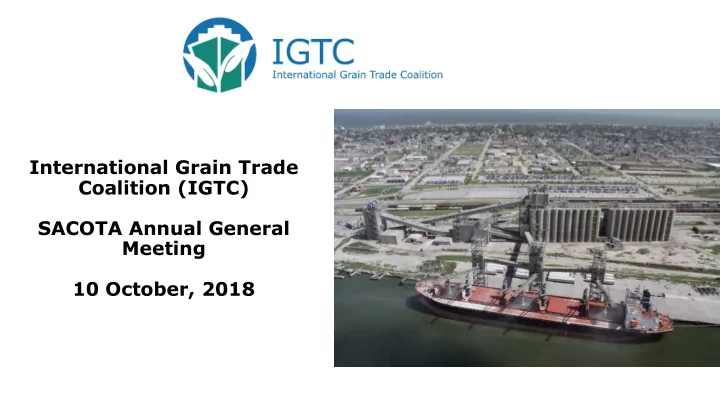
Coalition (IGTC) SACOTA Annual General Meeting 10 October, 2018 - - PowerPoint PPT Presentation
International Grain Trade Coalition (IGTC) SACOTA Annual General Meeting 10 October, 2018 Global context: Grain trade increasingly important 2 The IGTCs overarching objective is to achieve a market and regulatory environment supportive
2
CGC NAEGA, NCGA, NGFA, USGC, USW, CRA, USSEC
,
ANIAME, APPAMEX COCERAL GAFTA Eastern Africa Grain Council CIARA-CEC GTA CNFA, CNAGS, CGBA SOPA, SEA CAPECO
Geneva, Switzerland
ANEC RGU SACOTA
UGA
7 10 13 14 31 14 31 35 27 41 5 10 15 20 25 30 35 40 45
Cartagena Biosafety Protocol Plant Breeding Innovation Low Level Presence Maximum Residue Levels Phytosanitary control - ISPM Electronic Trading Documentation
NUMBER OF PEOPLE SIGNED UP
Jan-16 Jun-16 Jan-17 Jun-17 Jan-18 Jun-18 6
7
Jan 2017
APPAMEX CAPECO CGC COCERAL Gafta GTA NAEGA NGFA RGU US Grains Cl USSEC US Wheat
Jan 2018
APPAMEX CAPECO CGC CIARA-CEC COCERAL EAGC Gafta GTA NAEGA NCGA NGFA RGU SACOTA UGA US Grains Cl USSEC US Wheat
(194 governments)
(IPPC) (183 governments)
governments)
governments)
governments)
governments)
South Africa is present in all of the following venues!
9
2018 September 27-28 2018 GLI meeting Natal, Brazil September 26-27 WTO Agriculture Committee (closed) Geneva, Switzerland October 1-5 FAO Committee on Agriculture (COAG) FAO, Rome, Italy October 2-4 WTO Public Forum WTO, Geneva, Switzerland October 3-5 IPPC Focus Group on Commodity and Pathways Standards FAO, Rome, Italy October 15-20 UN Committee on World Food Security (CFS) FAO, Rome, Italy October 20 ISF-IGTC in-person meeting Berlin, Germany October 31-November 1 WTO SPS Committee (closed) Geneva, Switzerland November 17-29 COP 14 – CBD and COP-MOP 9 Sharm El-Sheikh, Egypt November 19-23 IPPC Standards Committee (closed) FAO, Rome, Italy November 21-22 WTO Agriculture Committee (closed) Geneva, Switzerland November 21-23 FAO International Symposium on Agricultural Innovation for Family Farmers: Unlocking the potential of agricultural innovation FAO, Rome, Italy November 27-29 IGTC General Assembly 2018 and related
Beijing, China December 2-4 NGFA Country Elevator Conference Union Station Hotel, St. Louis, MO, USA December 4 International Grains Council 48th Session Paris, France December 14 IGTC Management Council Virtual
Crop protection product approvals & residue measures
Harmonisation of phytosanitary control methods; UN International Plant Protection Convention (IPPC) Innovation in electronic trading documentation Plant Breeding Innovation Cartagena Biosafety Protocol Low Level Presence
Agreed by IPPC and industry partners in joint “Terms of Reference”
ePhyto em pleno funcionamento, com o envolvimento proativo de toda a cadeia de fornecimento e sem requisitos para a manutenção de certificados em papel.
crucial que
do setor privado continuem práticas de comércio eficientes e bem estabelecidas que atualmente sustentam a cadeia de fornecimento. Isso inclui partes comerciais que tenham um nível apropriado de controle sobre a liberação de um certificado phyto antes de ser apresentado a um importador.
definido no ePhyto Hub e incentiva os governos, particularmente aqueles de importância estratégica para a indústria de grãos, a apoiar a implementação o mais rápido possível.
apela ao apoio do governo para “estudos de caso da indústria”, o que acabará por contribuir para uma análise reforçada de custo-benefício e interoperabilidade com o setor.
do modelo de financiamento, a IGTC recomenda que a indústria contribua financeiramente apenas quando o sistema de trabalho estiver em funcionamento.
21
22
23
sovereign processes and import checks
Pacific
specified LMOs under the precautionary principle?
➢ Not in the CBP (yet?) ➢ No agreed definition (yet?) ➢ Intersessional AHTEG reports: Most organisms currently under development using synthetic biology fall under the definition of LMOs as per CBP ➢ Special interest groups ➢ Global Industry Coalition and certain governments say this is being pushed without broad support from Parties.
liability and redress issues
25
Applies to all LMOs, not only those “likely to have significant adverse effects on conservation and sustainable use of biodiversity” Potentially undermines the validity of national risk assessment processes Monitoring: Maintaining a paper trail of any (trans-boundary) movement of material that could be LMO or contain (traces of) LMOs Assumes that emergency measures are needed for LMOs that have already been through appropriate risk assessments, etc. Monitoring: Possible targets include the monitoring of (transboundary) movements
26
Picture: IGTC bilateral meeting with International Seed Federation (ISF), 26 April 2018
ISF agreed to share information on i) “general trends” about crops derived from gene editing methods for at least the next two-to-three years. This may include the specific type(s) of gene- editing methods being used; specific types of gene-edited crops that likely are being commercialized; and the approximate timing of market entry of such crops; ii) the evolution of regulatory systems around the world on crops derived from gene editing. ISF will hold internal member discussions on: i) “what” info can be shared, as well as potential mechanisms; ii) the feasibility to develop guidelines for its members on general principles in support of information sharing (early pipeline notification) along the value chain; iii) guidance or principles specifically on gene-edited crops with functionally different output characteristics, practices on closed-loop systems, etc. IGTC and ISF committed to mutual work on the specific information needs of the food industry regarding crops derived from gene editing. For the IGTC, this means providing specific examples of info demands from food companies/buyers, particularly those that cannot be addressed through an IP system. IGTC committed - after a request from ISF - to encourage its member associations and Corporate Stakeholders to speak to the plant breeding community at national and regional level. Next bilateral: Friday 19th October in Berlin, Germany – same crowd!
29
Decision makers Governments: The Global LLP Initiative (GLI) of 15 “like-minded” countries UN Food and Agriculture Organization (FAO), Codex Alimentarius Initiative The accommodation of safety-assessed GM events in the supply chain: encourage countries to introduce LLP policies Issues Raise awareness that detection of low levels in an importing country of an event authorized in one or more countries is not a food safety issue, but a legal compliance issue. Trade stops, thereby adversely impacting importing and exporting countries and threatening global food security. IGTC action
Policy Initiative
regulatory frameworks
31
32
32
Decision makers
UN International Plant Protection Convention (IPPC): IPPC recognized in WTO SPS agreement as the only international plant health standard setting organization
Initiative
Development of an International Standard on Phytosanitary Measures (ISPM) on the International Movement of Grain; 41 existing ISPMs, including on pest risk analysis, phytosanitary certification, and sampling methods
Issues (examples include)
Scope: phytosanitary measures only to be included in the standard – this is not a place for foreign material and associated tolerances; traceability, etc. Transparency: The current lack of access to information about the phytosanitary requirements of importing countries is a major hurdle to trade
IGTC action
1.Advocacy tools established, e.g., position paper, letters to national and regional authorities 2.IGTC leading grain trade input on the standard, convening significant expertise and representation 3.Coordination of one global voice to secure a trade facilitative ISPM 4.Global outreach effort coordinated, reaching government members of the IPPC’s Standards Committee; in total, more than half of the SC was reached
34
Assessed breadth & depth of phytosanitary concerns among IGTC Key “asks” coming out of the survey
❑ Transparent record of reasons & mitigating actions ❑ Document & demonstrate risk factors that justify ❑ Provide mechanism to resolve action in case of rejection / detainment
❑ Quick revelation if risk assessment has been carried out ❑ Produce data upon which assessment is based ❑ Interested parties to comment on risk analysis
35
ISPM on grain should…
…result in more harmonized approaches to managing pest risks
…result in more effective & proportionate risk management …increase predictability for trade …reduce transboundary shipment costs …reduce restrictions to trade …serve all in grain trade & not provide commercial or political advantage to one or small group …allow for bilateral agreements on pest risk & mitigation
36
ISPM on grain should NOT…
…be overly prescriptive
…result in arbitrary & inappropriate quarantine actions …include any direction
…include mgmt.
technologies …address all aspects of transboundary movements, from production through handling & transportation to further processing …introduce costly compliance issues
37
business impact on the grain trade
practices - reports of grain consignments being impacted either at both origin and destination market in the last 12 months
compliance
facilitate trade and contribute to global food security in the face of missing and misaligned MRLs.
sampling – more international work needed on this
38
Gary C. Martin, President North American Grain Export Association (NAEGA) Iliana Axiotiades, Acting Vice President COCERAL (EU) Randy Gordon, Treasurer National Grain and Feed Association (NGFA) Jaine Chisholm-Caunt, Grain and Feed Trade Association (Gafta) Tyler Bjornson, Canada Grains Council (CGC) Roz Leeck, US Soybean Export Council (USSEC) Tom Sleight, US Grains Council Pat O’Shannassy, Grain Trade Australia (GTA) Corporate stakeholder representation